
It’s no longer unusual to drive down a suburban street in December and see homes glowing with animated snowflakes, reindeer galloping across white siding, or cascading auroras dancing on garage doors—yet no tree in sight. The rise of Christmas light projectors isn’t just a seasonal trend; it’s part of a quiet but meaningful shift in how families define holiday aesthetics. Physical light strings still dominate retail shelves and nostalgic memories—but projectors now occupy 22% of the U.S. decorative lighting market (2023 National Retail Federation Holiday Survey), up from 7% in 2018. Meanwhile, 14% of households reported *not using any tree* in 2023—a figure that climbs to 28% among urban renters under 35. This isn’t about laziness or diminished tradition. It’s about recalibrating what “festive” means when space is tight, time is scarce, sustainability matters, and emotional resonance evolves.
Why Projectors Are Gaining Ground—Beyond Convenience
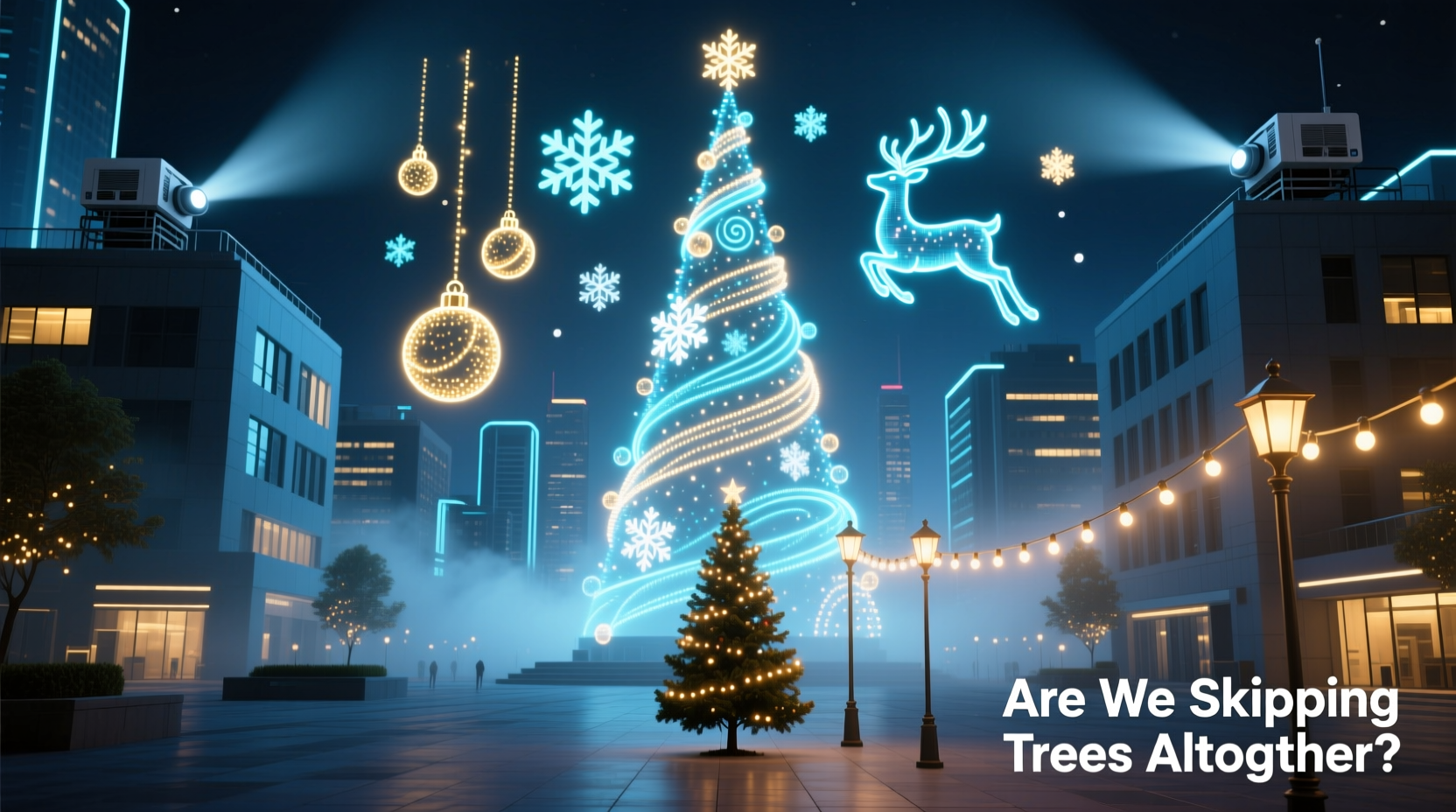
Projectors offer more than plug-and-play simplicity. Their appeal lies in layered functionality: dynamic motion, programmable themes, scalable coverage, and minimal physical footprint. A single unit mounted in an attic window can bathe an entire façade in synchronized color shifts—something 300 feet of traditional C9s would require hours to install, test, and secure against wind. Modern LED projectors consume 60–80% less energy than equivalent incandescent string sets, and many feature built-in timers, remote controls, and app integration for sunrise/sunset automation. Crucially, they eliminate ladder work, tangled wires, and the annual ritual of untangling lights that seem to knot themselves overnight.
But the deeper driver is spatial pragmatism. In studio apartments, historic brownstones with narrow stoops, or rental units with strict HOA rules, a 6-foot artificial tree may violate lease terms—or simply not fit through the door. A projector sidesteps those constraints without sacrificing visual impact. As interior designer Lena Torres notes in her 2023 report on urban holiday adaptation:
“We’re seeing clients prioritize *intentional ambiance* over inherited symbolism. A flickering candle projection on a mantel, paired with curated scent and sound, delivers warmth and ritual—without needing a pine centerpiece.”
Physical Strings: Enduring Strengths—and Unavoidable Realities
Despite the projector surge, physical strings remain irreplaceable for tactile authenticity and multisensory depth. The gentle hum of vintage mini-lights, the subtle warmth radiating from incandescent bulbs, the satisfying weight of draped garlands—all contribute to what psychologists call “embodied nostalgia”: memory encoded through touch, temperature, and spatial presence. A study published in the Journal of Environmental Psychology (2022) found participants who decorated with physical lights reported 34% higher levels of seasonal affective engagement than those using only projected effects—particularly when lights were integrated into shared activities like tree-trimming or porch-sitting.
Physical strings also offer unmatched versatility in texture and layering. Twinkling fairy lights woven through bookshelves, battery-operated copper wire lights wrapped around stair railings, or warm-white net lights draped over balcony railings create intimacy projectors struggle to replicate at close range. And unlike projectors—which rely on clean, light-colored surfaces for optimal clarity—strings work equally well on brick, stucco, dark wood, or textured walls.
Head-to-Head Comparison: Projectors vs. Strings
| Feature | LED Light Projectors | Traditional Light Strings |
|---|---|---|
| Installation Time | Under 5 minutes (mount + aim) | 30–120+ minutes (depending on scale & surface) |
| Safety Profile | No electrical contact with surfaces; low heat output | Risk of overheating if covered, damaged, or overloaded; ladder hazards |
| Lifespan (Typical) | 3–5 years (LED diodes); lens clarity degrades over time | 2–10 years (incandescent: 2–3 yrs; LED: 5–10 yrs with proper storage) |
| Customization | Preloaded animations only; limited theme variety per model | Full control: spacing, density, color mixing, layering, dimming |
| Surface Dependency | Requires light-colored, uncluttered surfaces; ineffective on busy textures | Works on any surface, including foliage, fabric, glass, and metal |
| Child/Pet Safety | No accessible wiring or small parts; unit typically mounted out of reach | Chew hazards (wires), tripping risks, bulb breakage (especially glass) |
| Eco-Impact (Annual Use) | Lower energy draw; no plastic housing waste per strand | Higher cumulative plastic use (bulbs, wires, controllers); recycling rates remain below 12% |
A Real Shift: The “Tree-Lite” Household Case Study
In Portland, Oregon, Maya R., a pediatric occupational therapist and mother of two, stopped using a physical tree in 2020. Her 700-square-foot apartment had no closet space for storage, and her toddler treated every ornament as a teething toy. She began experimenting: first with a compact projector casting soft golden light onto her living room wall, then adding battery-powered branch lights on a small faux-wood shelf, and finally integrating smart speakers playing curated winter soundscapes. By 2023, her setup included a rotating projector (snowfall + starfield), 12 feet of warm-white micro-LED string draped over floating shelves, and a tabletop “tree” made of stacked vintage books wrapped in linen and crowned with a single handmade paper star.
“It’s not about rejecting tradition—it’s about honoring what *works* for our family right now,” she explains. “My kids press the remote to change the projection, count falling ‘snowflakes,’ and help wrap the shelf lights. They’ve never known a tree with tinsel or a water reservoir. But they know the feeling of warmth, rhythm, and anticipation. That’s the heart of it—not the object.” Her approach reflects a broader movement: the “Tree-Lite” household, where symbolic elements are curated intentionally rather than inherited wholesale.
Practical Decision Framework: Which Path Fits Your Reality?
Choosing between projectors, strings, or tree-free setups isn’t binary—it’s contextual. Consider these factors before investing:
- Assess your primary display surface: Is it smooth, light-colored, and unobstructed? If yes, projectors shine. If it’s brick, dark siding, or cluttered with windows/doors, strings offer more reliable coverage.
- Evaluate physical access: Do you have safe ladder access to high points? Can you reach eaves or gutters without strain? If not, projectors reduce risk significantly.
- Define your emotional goal: Is it ambient background glow (projector strength), intimate tactile detail (strings excel), or layered storytelling (combine both)?
- Calculate long-term upkeep: Will you store, untangle, and inspect strings annually—or prefer set-it-and-forget-it reliability?
- Check local restrictions: Many rentals prohibit nails, staples, or permanent mounts. Projectors often comply; strings may require removable hooks or adhesive solutions.
FAQ: Addressing Common Concerns
Do projectors work well in daylight or on cloudy days?
Most consumer-grade projectors are designed for dusk-to-dawn use. While some high-lumen models (2,000+ lumens) cast visible patterns in overcast afternoon light, they lose contrast and definition in full sun. For daytime visibility, physical strings—especially warm-white LEDs—are far more effective and consistent.
Can I use light strings safely indoors without a tree?
Absolutely—and increasingly common. Wrap them around mirrors, headboards, curtain rods, or bookshelves. Use battery-operated options for cord-free flexibility. Just ensure bulbs are cool-to-touch (LED only), avoid covering wires with fabric or insulation, and never leave unattended overnight—especially near bedding or curtains.
Are projectors truly “eco-friendly” if they contain complex electronics?
They’re *more* eco-efficient per hour of operation than incandescent strings, but their environmental calculus differs. Projectors contain PCBs, rare-earth magnets, and non-recyclable lenses—making end-of-life disposal challenging. Opt for models with modular designs (replaceable bulbs/lenses) and brands offering take-back programs. When possible, extend projector life beyond 5 years through careful handling and dust management.
The Bigger Picture: Tradition Isn’t Static—It’s Adaptive
Skipping the tree doesn’t signal cultural erosion—it reveals resilience. Holiday traditions have always evolved: electric lights replaced candles in the 1890s; aluminum trees peaked in the 1960s; fiber-optic wreaths gained traction in the 1990s. Each shift responded to technological possibility, economic reality, and shifting domestic landscapes. Today’s projector adoption mirrors earlier transitions: it answers real constraints—urban density, climate awareness, caregiving demands—while preserving core human needs: beauty, rhythm, shared meaning, and sensory comfort.
What matters isn’t whether light comes from filament or diode, from branch or beam—but whether it invites pause, sparks connection, and holds space for what feels true. A child tracing projected snowflakes on a wall feels wonder just as deeply as one placing the star atop a spruce. A renter illuminating their fire escape with copper wire lights honors the same spirit as a grandparent hanging heirloom glass balls. The medium changes. The intention remains.
If you’ve leaned into projection this year—or gone fully tree-free—your choice isn’t lesser. It’s evidence of thoughtful curation in a world demanding increasing intentionality. And if you’re still wrestling with tangled strings in your garage, take heart: there’s no hierarchy in holiday light. Only presence. Only care. Only the quiet, persistent act of saying, “This matters. We are here. We celebrate.”




 浙公网安备
33010002000092号
浙公网安备
33010002000092号 浙B2-20120091-4
Comments
No comments yet. Why don't you start the discussion?