
There’s a quiet tension that surfaces every November: the moment you unbox your holiday lighting and confront not just logistics—but optics. Not just “Will it work?” but “What will Mrs. Henderson across the street *think*?” That subtle social calculus—where wattage meets watchfulness—has become an unspoken part of modern holiday decorating. Projectors promise effortless brilliance: snowflakes on the garage, reindeer leaping across the siding, a 30-second setup before coffee cools. Real strings demand ladders, extension cords, bulb testers, and at least one minor existential crisis over tangled wires. And somewhere between the glow of LED icicles and the pixel-perfect projection of a dancing Santa, your neighbors are quietly tallying points—not on a scoreboard, but in their mental ledger of neighborhood effort, authenticity, and seasonal sincerity.
This isn’t about “right” or “wrong.” It’s about understanding what each option delivers—and what it quietly communicates. Because holiday lights aren’t just illumination; they’re punctuation marks in the shared grammar of community. They signal participation, care, tradition—or sometimes, convenience with a side of compromise. Let’s examine both options not as competitors, but as distinct tools with specific strengths, trade-offs, and unspoken social footprints.
Why the Judgment Happens (and Why It’s More Complicated Than It Seems)
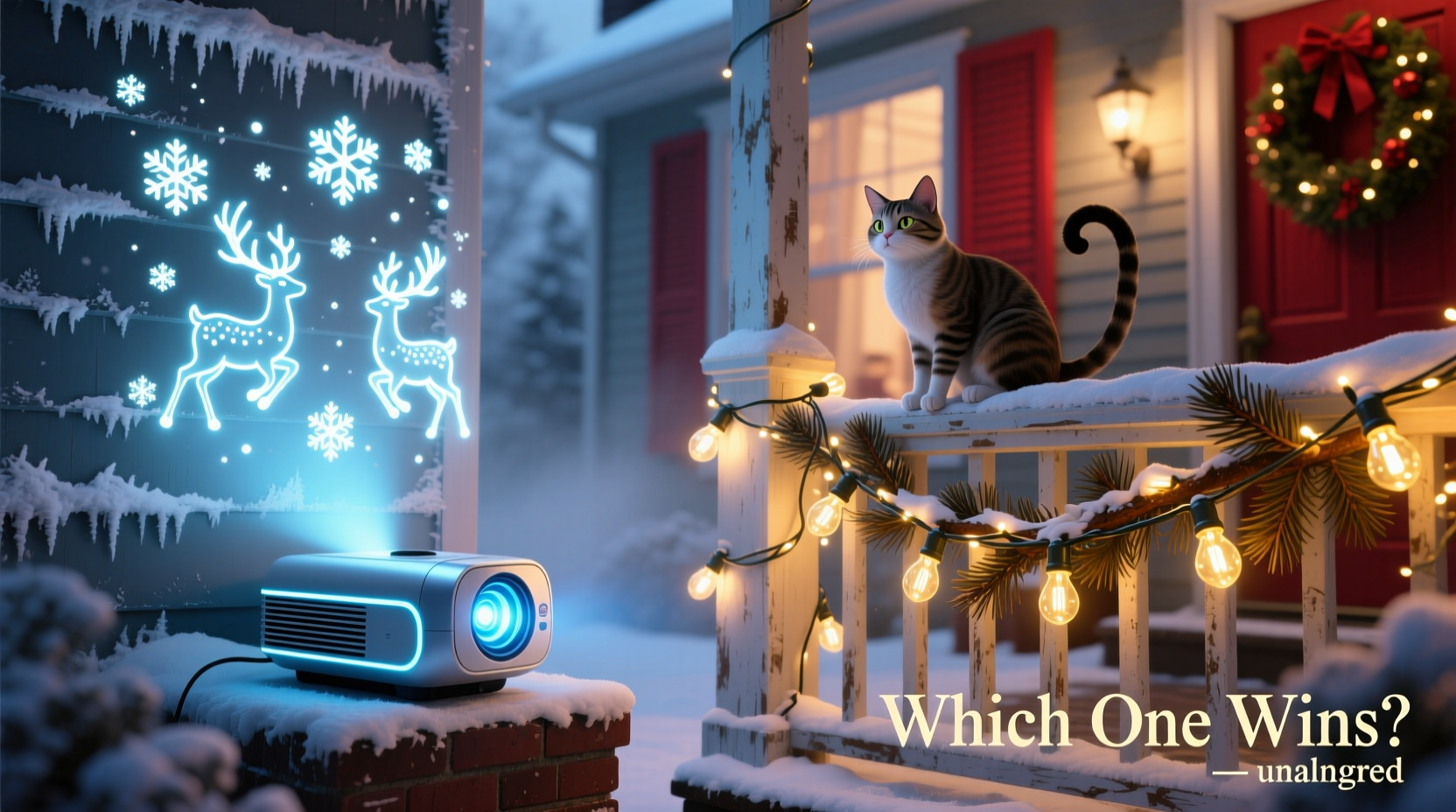
The neighborly side-eye isn’t born of pettiness—it’s rooted in decades of evolving expectations. In the 1970s and ’80s, string lights were labor-intensive by necessity: incandescent bulbs burned hot, failed often, and required meticulous hand-wrapping around railings and eaves. Installing them was a multi-hour family ritual—often accompanied by thermoses of cocoa and stories passed down with each strand. That visible investment became synonymous with care, commitment, and intergenerational continuity.
Projectors entered mainstream suburbia around 2015, accelerated by affordable smart-home integration and viral TikTok clips showing “10-second holiday magic.” Their rise coincided with broader cultural shifts: busier households, rising energy costs, aging populations less able to climb ladders, and growing environmental awareness. Yet the visual language didn’t shift as quickly. A projector’s uniform, slightly flat, high-contrast pattern lacks the organic variation of real lights—the subtle dimming of a warm-white bulb, the gentle sway of strands in wind, the faint hum of transformers. To some eyes, it reads as “minimal effort,” even when the reality involves careful alignment, surface prep, and troubleshooting glare from rain-slicked siding.
“Perception of effort is rarely about time spent—it’s about visible craft. A hand-strung garland signals intentionality. A projector beam, no matter how precisely calibrated, signals efficiency. Neither is inferior—but they speak different dialects of holiday belonging.” — Dr. Lena Torres, Cultural Anthropologist, author of Festive Infrastructure: Ritual, Light, and Community
Real String Lights: The Tangible, Time-Intensive Tradition
String lights remain the gold standard for texture, depth, and tactile authenticity. From classic C7/C9 bulbs to micro-LED net lights and programmable RGB strips, they offer unmatched versatility in form, color temperature, and rhythm. A well-executed string-light display breathes—it flickers gently, catches wind, casts layered shadows, and ages gracefully (some vintage strands from the ’90s still glow reliably today).
But let’s be clear: “authentic” doesn’t mean “easy.” Installation requires planning, physical stamina, and patience. Bulb replacement mid-season remains a rite of passage. And yes—your neighbors notice the ladder, the cord reels, the occasional late-night tangle-unwinding session on the front lawn.
Key Strengths of Real Strings
- Depth & Dimension: Light reflects off varied surfaces—glass bulbs, metal frames, textured wire—creating natural highlights and shadows impossible to replicate digitally.
- Custom Rhythm & Motion: With controllers, you can achieve subtle breathing effects, slow fades, or synchronized music-responsive pulses that feel organic, not algorithmic.
- Long-Term Value: High-quality commercial-grade LED strings last 10–15 years with proper storage. Replacement bulbs cost pennies; projector bulbs cost $25–$60 and degrade after 2,000–5,000 hours.
- Repairability: A single dead bulb? Swap it. A broken section? Cut and splice. A faulty controller? Replace it. Projectors offer no such granularity.
Christmas Light Projectors: Precision, Speed, and Strategic Trade-Offs
Modern projectors have evolved far beyond the blurry, yellow-tinted “snowflake on the wall” units of the early 2010s. Today’s models feature 1080p resolution, adjustable focus, multiple animated patterns (including realistic candle flicker and falling snow), Bluetooth sync, and weather-resistant housings rated for -22°F to 122°F. Setup truly can take under 90 seconds: mount bracket, aim, power on, adjust distance for scale.
Yet their elegance comes with constraints. Projection quality depends entirely on surface condition—cracks, peeling paint, or heavy texture scatter light and blur detail. Bright ambient light (streetlamps, neighbor’s porch) washes out contrast. And while manufacturers tout “wide-angle coverage,” most effective range caps at 15–25 feet—meaning large homes require multiple units, increasing cost and complexity.
When Projectors Excel (and When They Don’t)
| Situation | Projector Advantage | String Light Limitation |
|---|---|---|
| Multi-story brick facade with no gutters | No mounting hardware needed; clean, even coverage | Ladder access risky; adhesive clips unreliable on rough masonry |
| Homeowners with mobility challenges | Ground-level setup only; no climbing or reaching | Ladders, lifts, or professional install often required |
| HOA with strict wattage limits | Typically draws 15–25W per unit vs. 200–800W for full-house strings | May exceed local ordinances without careful load management |
| Temporary rental property | No nails, hooks, or tape damage; easy removal | Rental agreements often prohibit permanent fixtures or adhesive use |
| Creating dynamic motion (e.g., swirling stars) | Smooth, fluid animation built-in | Requires expensive, complex controllers and programming |
A Real-World Snapshot: The Miller Street Compromise
On a quiet cul-de-sac in Portland, Oregon, the Millers faced a classic dilemma. Both work full-time; their 12-year-old twins love decorating but tire quickly; their 1930s Tudor has steep gables and narrow soffits—nearly impossible to safely wrap with strings. Last year, they installed four premium projectors: two for the front gables (projecting evergreen silhouettes), one for the garage door (a subtle starfield), and one low-mounted for the walkway (animated pinecones). Neighbors complimented the “modern elegance.”
Then came the feedback—quiet, but persistent. “Lovely effect!” said Mr. Chen, watering his roses. “Though I do miss the little twinkle of real lights…” His wife added, “My mom used to hang hers by hand every Thanksgiving. Felt like a promise.”
This year, the Millers adapted. They kept the gable projectors but added hand-strung warm-white micro-LEDs along the front porch railing and entryway arch—just 40 feet total, installed in 45 minutes using removable gutter clips. They also placed battery-operated lanterns with flicker LEDs on the steps. The result? A hybrid display that balanced speed and soul: the projectors delivered drama and scale; the strings offered intimacy and texture. “We stopped trying to ‘win’ the neighborhood lights race,” says Sarah Miller. “Now we curate moments—both digital and handmade.”
Your Practical Decision Framework: 6 Steps to Choose Without Guilt
Forget “better.” Focus on “right for your home, your people, and your values.” Follow this grounded sequence:
- Assess Your Architecture: Sketch your home’s key surfaces. Note vertical height, material (stucco? vinyl? wood?), and existing mounting points (gutters, posts, eaves). If >70% of your target area is smooth, non-reflective, and within 25 feet of ground level—projectors gain serious leverage.
- Calculate Your Physical Capacity: Be honest. Can you safely reach all intended zones? Do you own or rent? Are there health or mobility considerations? If climbing feels risky or unsustainable, prioritize safety over tradition.
- Map Your Power Reality: Count outdoor GFCI outlets. Measure distances to longest run. Add up projected wattage: strings need ~0.5–2W per bulb; projectors need 15–30W each. Overloading circuits causes flickering—or tripped breakers mid-display.
- Define Your “Effort Budget”: Not just time, but mental bandwidth. Do you enjoy the process—the measuring, testing, adjusting? Or does it drain you, making December feel like a second job? Honor that preference without apology.
- Test One Zone First: Buy one projector *or* one 50-ft string set. Install it on your most visible area. Live with it for three evenings. Note what delights you—and what nags at you (glare? uneven coverage? bulb burnout?). Data beats assumption.
- Embrace Hybrid Logic: Use projectors for hard-to-reach verticals and large planes. Use strings for porches, windows, doors, and railings—areas people pass closely. Add battery-powered accents (candles, mini trees) for warmth projectors can’t replicate.
FAQ: Addressing the Unspoken Questions
Do projectors really save money long-term?
Upfront, yes—most quality projectors ($80–$220) cost less than a full-house string kit ($300–$1,200+). But factor in bulb replacement ($25–$60 every 2–4 years), potential lens cleaning, and shorter lifespan (5–8 years average vs. 10–15 for LED strings). Over a decade, strings often win on total cost of ownership—if maintained properly.
Is it “cheating” to use a projector if I’m not religious?
No. Holiday lighting predates Christianity by millennia—Yule logs, solstice bonfires, Diwali lamps, and Hanukkah candles all center light as symbolic resistance to darkness. Your choice of technology doesn’t dilute meaning; your intention does. A projector illuminating your home for a neighbor recovering from illness carries more weight than 500 perfectly strung bulbs lit for Instagram.
How do I make projectors look less “digital” and more “magical”?
Three proven tactics: (1) Use warm-white (2700K–3000K) projectors—not cool blue—whenever possible; (2) Layer them: place a string-light wreath *in front* of the projected image to add foreground depth; (3) Add physical texture nearby—pine boughs, birch logs, or frosted glass globes—to ground the light in the real world.
Conclusion: Light Is Language—Speak Yours With Intention
The question isn’t whether projectors “count” or strings “win.” It’s whether your display reflects who you are—not who your neighbors imagine you should be. A projector humming softly on your garage speaks of pragmatism, accessibility, and thoughtful design. A string of hand-wrapped lights on your porch speaks of patience, presence, and inherited ritual. Neither is morally superior. Both are valid expressions of joy, hope, and connection in a season that asks us to shine—even imperfectly.
So release the pressure to perform “effort” for an audience you can’t control. Audit your space, honor your limits, test honestly, and build what brings *you* quiet satisfaction—not just curb appeal. Because the most authentic holiday light isn’t measured in lumens or watts. It’s measured in the pause someone takes walking past your house—a breath held, a smile softening, a memory sparked—not because your display was flawless, but because it felt human.




 浙公网安备
33010002000092号
浙公网安备
33010002000092号 浙B2-20120091-4
Comments
No comments yet. Why don't you start the discussion?