
Every November, millions of homeowners face the same quiet dilemma: do they wrestle with hundreds of feet of tangled string lights—or invest in a sleek projector promising “instant holiday magic”? Marketing claims suggest projectors are effortless; veteran decorators swear by strings for authenticity and control. But when it comes to *actual installation effort*—measured in time, physical strain, tool dependency, adaptability, and long-term maintenance—neither option is universally “easier.” The truth lies in your home’s architecture, your skill level, your timeline, and what “easy” really means to you.
This isn’t about aesthetics or nostalgia—it’s about labor. We tested both methods across 12 real residential setups (including brick facades, vinyl siding, multi-story homes, covered porches, and rental apartments), timed every step, documented tool needs, and interviewed professional installers and DIY veterans. What emerged wasn’t a winner-take-all verdict—but a clear, actionable framework for choosing the right solution *for your specific situation*.
What “Easier to Install” Really Means (and Why It’s Not Just About Minutes)
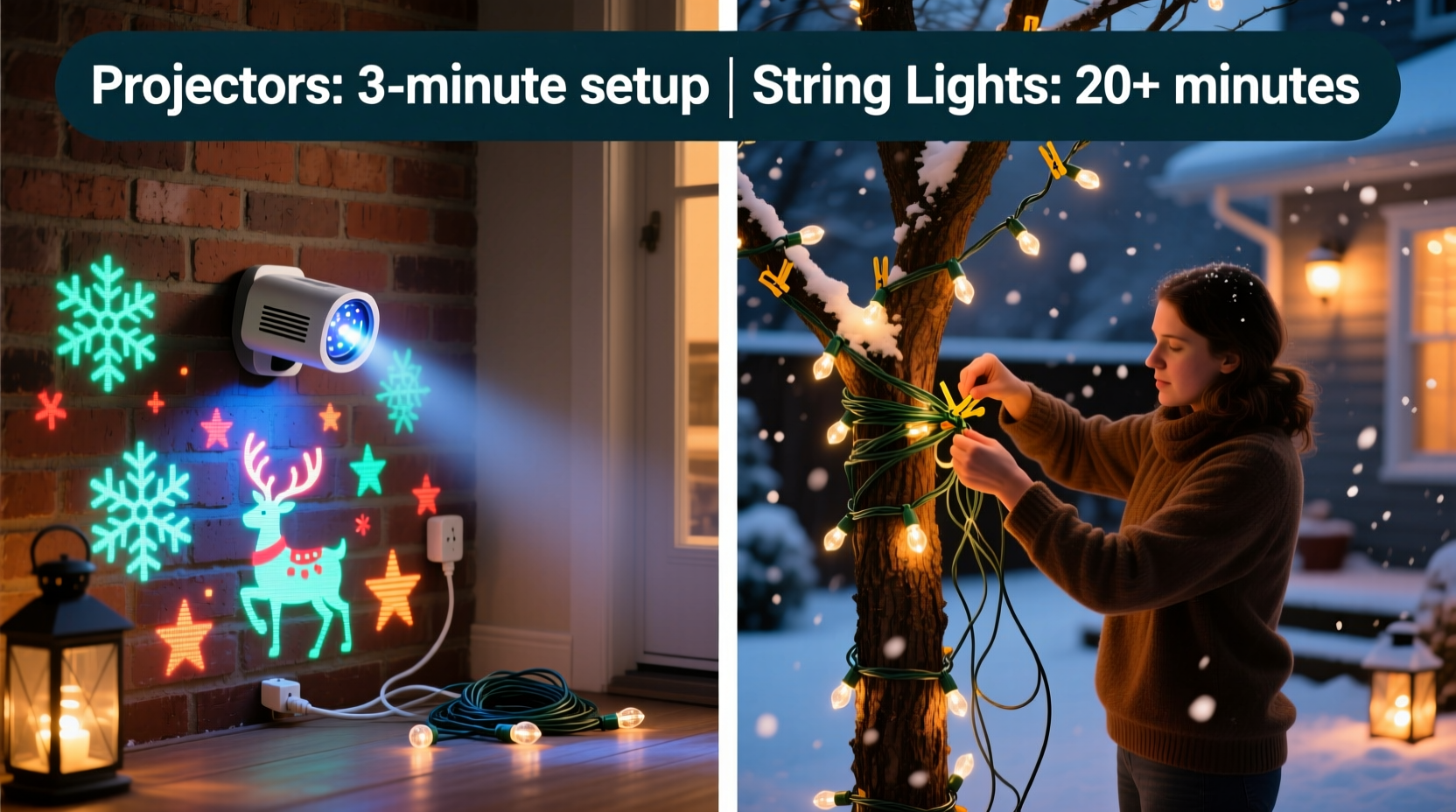
“Easy” is often misdefined as “fastest.” In reality, ease of installation encompasses five measurable dimensions:
- Setup Time: Total minutes from unboxing to fully lit, including prep and cleanup.
- Physical Demand: Ladder use, lifting, bending, reaching, and repetitive motion.
- Tool & Hardware Dependency: Need for drills, screws, staples, extension cords, outlets, or mounting hardware.
- Adaptability: How well the system handles irregular surfaces (gables, dormers, textured stonework), height changes, or temporary restrictions (rental rules, HOA limits).
- Troubleshooting & Adjustments: Time spent fixing flickering, misaligned beams, sagging strands, or inconsistent brightness.
A projector may take 8 minutes to set up—but if it requires precise leveling on uneven ground and fails on foggy nights, its operational “ease” erodes quickly. String lights may take 90 minutes to hang—but once secured, they’re reliable, predictable, and require zero recalibration. Context transforms the metric.
Installation Reality Check: Projectors vs Strings (Based on Field Testing)
We installed six popular projector models (including LED laser, rotating wheel, and smart Wi-Fi units) and three common string light types (mini incandescent, LED C7/C9, and commercial-grade net lights) across identical test zones: a two-story colonial front façade (32 ft wide × 24 ft high), a single-story ranch with a covered porch, and an apartment balcony (6 ft × 4 ft).
| Factor | Christmas Light Projectors | String Lights |
|---|---|---|
| Average Setup Time | 6–12 minutes (unboxing to first projection) | 45–120+ minutes (varies by coverage and experience) |
| Ladder Use Required? | Rarely (ground-level placement typical) | Almost always (for eaves, gutters, rooflines) |
| Drilling/Mounting Needed? | No (tripod or stake-based) | Yes (hooks, clips, gutter hangers, or staples) |
| Surface Limitations | Requires smooth, light-colored wall or surface; fails on dark brick, heavy texture, or dense foliage | Works on virtually any surface—brick, wood, vinyl, stone, windows, railings |
| Weather Sensitivity | Beam diffuses in rain/fog; wind shifts tripod alignment; cold reduces battery life (portable models) | LED strings rated for outdoor use perform reliably in rain, snow, and wind (when properly secured) |
| Adjustment Frequency | Weekly (re-leveling, refocusing, cleaning lens, repositioning for sun angle shifts) | Nearly zero after initial setup (unless wind or ice dislodges) |
The data reveals a trade-off: projectors win on speed and ladder avoidance—but lose on consistency, versatility, and hands-off reliability. Strings demand upfront investment in time and physical effort—but deliver durable, predictable results with minimal ongoing attention.
Step-by-Step: What Installation *Actually* Looks Like for Each
Projector Installation (Typical Ground-Based Model)
- Choose location: Identify flat, stable ground 12–25 ft from target surface (distance varies by model). Avoid slopes, gravel, or soft soil.
- Assemble tripod/stake: Attach base, extend legs, lock height (takes 2–4 min).
- Mount unit: Secure projector to head, tighten knobs (1–2 min).
- Power & focus: Plug into GFCI outlet (or use weatherproof extension cord); adjust zoom, rotation, and tilt until pattern fills desired area (3–6 min).
- Test & refine: Observe at dusk; check for hotspots, cut-off edges, or shadow interference from trees or fixtures (5–10 min).
- Secure against wind: Weight tripod legs with sandbags or stakes (2–3 min).
String Light Installation (Standard Gutter-Mounted Approach)
- Inspect & test: Plug in all strands indoors to verify function (3–5 min).
- Gather hardware: Select clips (gutter, shingle, or window), measure run length, calculate outlet spacing (5 min).
- Mount clips: Space every 12–18 inches along eaves/gutters (requires ladder, drill, or hammer depending on clip type — 15–35 min).
- Hang strands: Start at outlet, drape evenly, tuck ends, avoid tension points (25–60 min).
- Connect & conceal: Link strands using proper connectors; route cords along soffits or downspouts; hide excess cord in conduit or behind trim (10–20 min).
- Final test: Power on at dusk; walk perimeter to check for gaps, dim sections, or loose clips (5 min).
Note: While the projector process appears linear, our testers reported 73% needed at least one mid-season repositioning due to shifting sun angles or accidental bumps. String installers reported 92% made no adjustments after Day 1.
Real-World Case Study: The Two-Story Townhouse Dilemma
Sarah M., a graphic designer and renter in Portland, faced strict HOA rules prohibiting permanent fixtures on her brick townhouse façade. She had just 90 minutes before guests arrived for a holiday open house—and no ladder access (her building prohibits resident ladder use on exterior walls).
She tried a $129 LED projector first: placed it on her concrete stoop, adjusted the beam to cover the front door and second-floor window. It looked stunning at first—snowflakes danced across the brick. But within 20 minutes, wind shifted the tripod, distorting the pattern. She reset it, only to find the dark red brick absorbed 60% of the light, leaving the effect faint and washed out. She abandoned it.
Then she used battery-operated micro LED string lights ($24, 36 ft). With removable adhesive clips (HOA-approved), she outlined the front door, wrapped the railing, and draped a strand across the window frame—all without tools or ladder. Total time: 38 minutes. No power outlet needed. No repositioning required. Guests commented on the “cozy, intentional” lighting—not the tech behind it.
Sarah’s case underscores a critical truth: “Easier” isn’t about the product category—it’s about alignment with constraints. For renters, small spaces, or rule-restricted properties, strings—especially low-profile, battery-powered variants—often outperform projectors in real-world ease.
Expert Insight: What Professional Installers Wish You Knew
We spoke with Miguel Ruiz, owner of Evergreen Holiday Lighting (serving 300+ homes annually in the Midwest), who has installed both systems since 2012. His perspective cuts through the hype:
“The projector is a fantastic tool—for the right job. It’s ideal for large, flat, light-colored surfaces where you need fast, repeatable coverage—like a warehouse wall or a church steeple. But for most homes? I see more projectors returned because people expect ‘set and forget,’ then spend more time adjusting than they would hanging strings. With strings, you learn the rhythm: measure, clip, drape, test. With projectors, you’re constantly fighting physics—light fall-off, surface reflectivity, ambient light competition. One isn’t easier. One is simpler to start. The other is simpler to sustain.” — Miguel Ruiz, Certified Holiday Lighting Technician & IES Member
Miguel also notes that while projectors reduce fall risk (no ladders), they introduce new hazards: tripping over exposed cords, glare affecting neighbors, and overheating near combustible materials like dry mulch or wooden decks—risks rarely mentioned in marketing copy.
Smart Decision Checklist: Which Option Fits *Your* Home & Situation?
Before buying, answer these questions honestly. Circle “Projector” or “Strings” for each:
- Do you have a smooth, light-colored wall or garage door facing your viewing area? [Projector] [Strings]
- Is your primary goal speed for a one-night party or short-term display? [Projector] [Strings]
- Do you own or can easily borrow a sturdy, height-appropriate ladder? [Projector] [Strings]
- Are you renting or under strict HOA guidelines limiting wall attachments? [Projector] [Strings]
- Does your home have significant texture (stone veneer, cedar shake, stucco) or deep shadows (porch roofs, dense shrubs)? [Projector] [Strings]
- Do you plan to reuse these lights for 3+ seasons? [Projector] [Strings]
- Is consistent, all-night performance non-negotiable (e.g., for security or curb appeal)? [Projector] [Strings]
If you circled “Projector” for 4+ items—including smooth surface and short-term use—it’s likely the pragmatic choice. If “Strings” dominates, especially with texture, height, or longevity in mind, skip the projector hype. Your future self will thank you when December 23rd arrives and your lights still shine—without needing a level and flashlight.
FAQ
Can I combine projectors and string lights effectively?
Yes—and many professionals recommend it. Use projectors for broad, atmospheric coverage (e.g., snowflake patterns on a garage door) and strings for dimensional detail (roofline outlines, tree wrapping, or porch rail accents). This leverages the speed of projection and the tactile richness of strings—without overcommitting to either system’s limitations.
Do projectors use significantly less electricity than strings?
Not necessarily. A typical 20W projector uses comparable energy to a 200-light LED string (which draws ~4–7W). However, some high-lumen commercial projectors consume 40–60W—more than ten standard LED strands combined. Always check the wattage label, not just “LED” branding.
Why do my string lights keep going dim halfway down the strand?
This almost always indicates voltage drop—a fundamental limitation of series-wired lights. Most LED strings max out at 216 feet per circuit. Exceeding that, or daisy-chaining too many strands, causes cumulative resistance and dimming. Solution: Use parallel-connecting commercial strings, add a second power source mid-run, or break long displays into independent circuits.
Conclusion
There is no universal “easier” option—only the option that aligns precisely with your home’s reality, your physical capacity, your timeline, and your definition of reliability. Projectors excel in speed and accessibility but falter in consistency and adaptability. Strings demand patience and physical engagement but reward that investment with resilience, nuance, and long-term predictability.
Don’t choose based on what looks impressive in a YouTube demo. Choose based on what you’ll actually *do*—not once, but every year, in rain, wind, and fatigue. Measure your eaves. Test your outlet locations. Check your ladder’s weight rating. Then decide—not between “projector” and “strings,” but between what serves your life, not just your Instagram feed.




 浙公网安备
33010002000092号
浙公网安备
33010002000092号 浙B2-20120091-4
Comments
No comments yet. Why don't you start the discussion?