
Choosing between Christmas light projectors and traditional string lights isn’t just about aesthetics—it’s about physics, scale, and intention. Projectors cast wide, immersive patterns across walls, driveways, and garages with minimal physical setup. String lights offer texture, dimension, and hands-on craftsmanship, wrapping railings, trees, and eaves in tactile warmth. But when homeowners ask, “Is my yard big enough for both?” they’re really asking a deeper question: *Can I achieve layered, professional-grade lighting without visual clutter, electrical overload, or unsustainable effort?* The answer isn’t yes or no—it’s contextual, measurable, and surprisingly actionable.
How Light Coverage Actually Works (Not Just Marketing Claims)
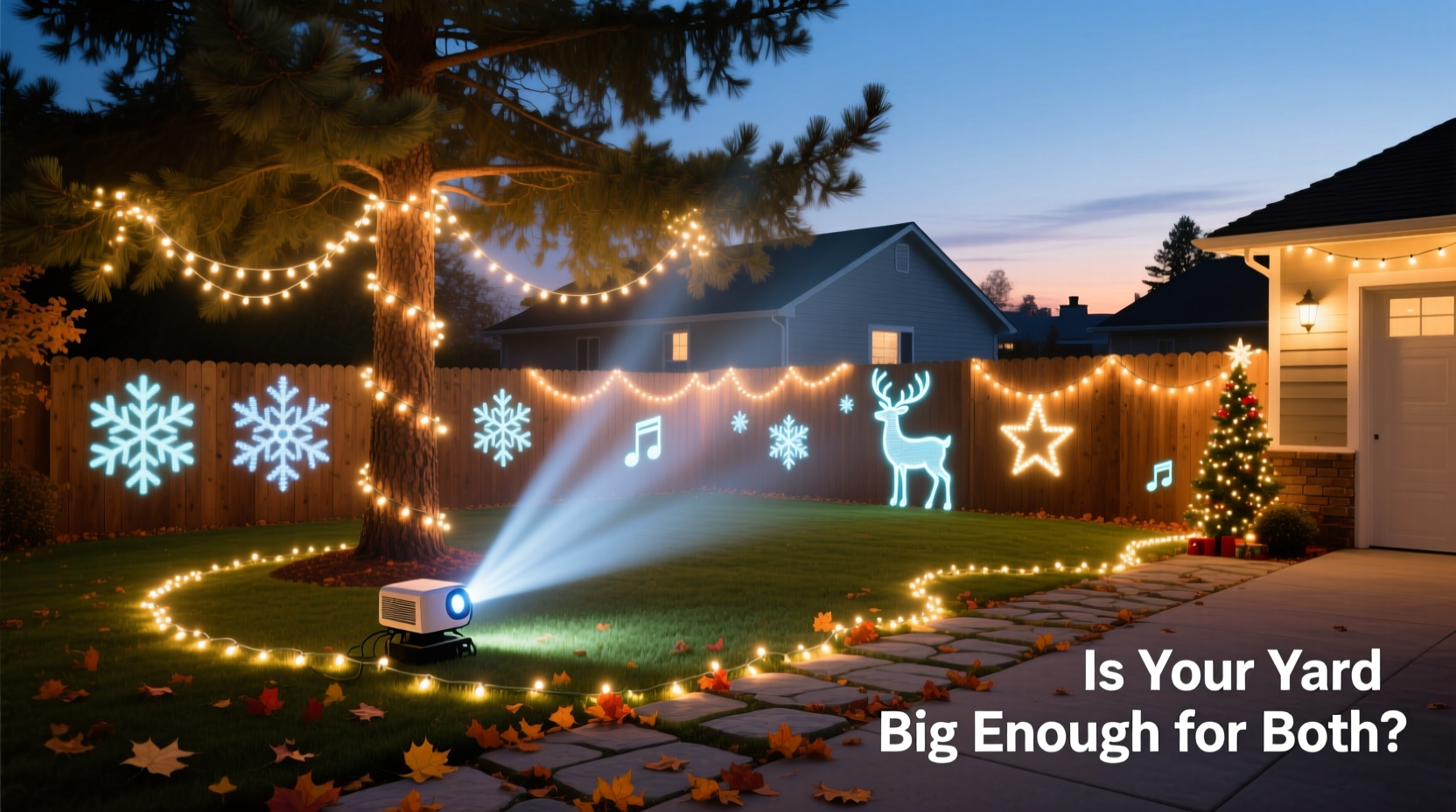
Manufacturers often advertise projector coverage as “up to 50 feet” or “covers a 2-story home.” That’s technically true—but only under ideal conditions: perfectly flat, light-colored surfaces; zero ambient light; and precise mounting height and angle. In reality, most residential projectors deliver strong, crisp projection within a 12–25 foot throw distance. Beyond that, brightness drops sharply, patterns blur, and color saturation fades—especially in neighborhoods with streetlights or nearby porch bulbs.
String lights, by contrast, follow linear logic: one 25-foot strand covers 25 feet of edge, branch, or railing—assuming proper spacing and secure fastening. Their coverage is predictable but labor-intensive. A single strand wraps a medium maple tree once at its base; to wrap the same tree three times (for density), you’ll need three strands—and triple the time, clips, and outlet load.
The critical insight? Projectors excel at *area illumination*—flooding large vertical or horizontal planes. String lights dominate *linear definition*—outlining architecture, framing windows, and adding depth to foliage. They serve fundamentally different visual roles. Confusing them leads to underwhelming results: a projector washing out delicate shrubbery detail, or strings lost against a dark garage wall.
Yard Size: It’s Not Square Footage—It’s Surface Geometry & Sightlines
“Big enough” has little to do with total yard area and everything to do with three spatial factors: projection surface quality, string-light anchor points, and human sightlines. A compact 4,000-square-foot lot with a smooth stucco façade, wide front porch, and mature oak tree offers richer lighting potential than a sprawling 10,000-square-foot property with gravel slopes, chain-link fencing, and uneven terrain.
Here’s how to audit your space objectively:
- Projection Surfaces: Identify flat, light-reflective areas ≥ 8 ft wide × 6 ft tall (minimum for legible patterns). Brick, vinyl, stucco, and garage doors qualify. Avoid heavily textured stone, dark cedar siding, or corrugated metal—they scatter light and mute patterns.
- String-Light Infrastructure: Count usable linear feet: porch railings, roofline eaves, fence tops, tree trunks, and deck posts. Subtract 20% for corners, gaps, and non-mountable zones (e.g., stucco without anchors).
- Sightlines: Stand at the curb and note what’s visible in one glance: front door, main window, garage, porch ceiling. These are priority zones. Areas requiring a 30-degree head tilt or step off the sidewalk? Lower priority.
A yard becomes “big enough for both” when it contains at least one high-impact projection surface and ≥ 60 linear feet of clean, accessible anchor points—without forcing strings into awkward, sagging configurations or projecting onto visually competing elements (like a brightly lit neighbor’s window).
Practical Comparison: Projectors vs Strings Side-by-Side
Below is a functional comparison based on real-world installation data from 2023 holiday lighting audits conducted by the National Lighting Contractors Association (NLCA):
| Feature | Christmas Light Projectors | Traditional String Lights |
|---|---|---|
| Setup Time (First Year) | 15–45 minutes (mount bracket, aim, plug in) | 3–12 hours (measuring, clipping, testing, troubleshooting) |
| Annual Storage Volume | One 8\" × 6\" × 4\" box (projector + power adapter) | 3–8 plastic bins (strands, clips, extension cords, timers) |
| Energy Use (per unit) | 12–25 watts (LED projectors) | 4–7 watts per 25-ft strand (LED) |
| Lifespan (LED components) | 25,000–40,000 hours (5–9 seasons at 6 hrs/night) | 15,000–25,000 hours (3–6 seasons; connectors degrade faster) |
| Weather Resilience | IP65 rated units withstand rain/snow; lens fogging possible in high-humidity freeze-thaw cycles | Outdoor-rated strands hold up well; end connectors and plug housings are common failure points |
Note the trade-offs: projectors win on speed and compactness but demand optimal placement. Strings reward patience with versatility—you can drape, weave, or layer them in ways projectors simply cannot replicate. Neither is inherently “better.” The synergy emerges when each does what it does best.
Real-World Integration: The Oakwood Avenue Case Study
In suburban Columbus, Ohio, the Reynolds family lives on a 5,200-square-foot lot with a two-story brick colonial, a covered front porch with wrought-iron railings, and three mature sugar maples. For years, they used only string lights—wrapping every tree, outlining all windows, and festooning the porch ceiling. By December 15, half the strands had gone dark due to connector corrosion and overloaded GFCI outlets.
In 2023, they adopted a hybrid approach:
- Mounted two 2,200-lumen projectors—one aimed at the garage door (displaying animated snowflakes), another at the brick façade beside the front door (projecting a subtle evergreen wreath with gold ribbon).
- Used string lights exclusively for dimensional elements: tightly wrapped around porch railings (warm white), delicately strung through lower maple branches (cool white icicle effect), and outlining the front door frame (copper wire micro-lights).
- Retired 60% of their old strands, replacing them with smart-plug-controlled sections tied to a single 15-amp circuit.
Result: Installation time dropped from 14 hours to 3.5 hours. Energy use decreased 38%. Visual impact increased—the projector created instant “wow” from the street, while strings added intimacy and craftsmanship up close. Crucially, their yard wasn’t “bigger”—but their strategy honored its geometry instead of fighting it.
“Projectors aren’t replacements for strings—they’re strategic amplifiers. When you use a projector to establish mood and scale, strings become the punctuation: the commas, em dashes, and periods that give your lighting narrative rhythm and detail.” — Marcus Bell, Lighting Designer & Founder, Lumina Collective
Your Hybrid Lighting Checklist
Before purchasing anything, walk your property with this actionable checklist. Mark each item as ✅ (yes), ⚠️ (partial), or ❌ (no). You need at least four ✅ to confidently support both systems:
- ✅ One flat, light-colored surface ≥ 8 ft wide × 6 ft tall, located ≤ 25 ft from a grounded outdoor outlet
- ✅ At least 50 linear feet of clean, mountable edges (railings, eaves, posts) with no sharp angles or fragile materials
- ✅ A dedicated 15-amp outdoor circuit—or verified capacity to add a GFCI-protected outlet without overloading your panel
- ✅ Clear line-of-sight from the street to at least one projection surface AND one string-light feature (e.g., porch railing)
- ✅ Storage space for one projector box + accessories AND one medium-sized bin for strings/clips/timers
- ✅ Willingness to test projector placement at dusk (not midday) before final mounting
If you have three ✅ and two ⚠️, start with the projector—it delivers the highest visual ROI per minute invested. If you have two ✅ or fewer, focus on strings first. Master one system before layering the other.
FAQ: Addressing Real Concerns
Can I use a projector and strings on the same outlet?
Yes—but calculate load carefully. A typical LED projector draws ~18W. A 25-ft LED string draws ~5W. Ten strings = 50W. Combined, that’s 68W—well under a 15-amp circuit’s 1,800W capacity. The risk isn’t wattage; it’s GFCI tripping from moisture ingress at multiple connection points. Use a single heavy-duty outdoor power strip with built-in GFCI and individual switches per port.
Won’t the projector wash out my string lights?
Only if poorly placed. Projectors work best on large, neutral surfaces—not directly on trees or railings where strings live. Aim your projector at the house façade or garage, then position strings on foreground elements (porch railings, steps, low shrubs). This creates depth: projection as background ambiance, strings as foreground detail. Test at night: if strings appear dimmed, reduce projector brightness or switch to monochrome (red/green) patterns, which compete less with warm-white strings.
Do projectors work on rainy nights?
IP65-rated projectors operate safely in rain, but water on the lens causes blurring and halos. Mount the unit under an eave or awning with at least 6 inches of overhang. Wipe the lens dry before seasonal storage—and never cover it with plastic during operation (traps condensation).
Conclusion: Design With Intention, Not Just Abundance
Your yard doesn’t need to be “big enough” for both projectors and string lights—it needs to be thoughtful enough. Christmas lighting isn’t decoration; it’s spatial storytelling. A projector tells the first sentence: bold, welcoming, atmospheric. Strings write the rest: nuanced, personal, grounded in craft. When you align each tool with your property’s innate strengths—not marketing claims or neighborly pressure—you stop asking “Can I fit both?” and start asking “Which story do I want to tell first, and where does the detail belong?”
Measure your surfaces. Map your outlets. Stand at the curb at dusk and observe—not what you wish was there, but what already works. Then choose one element to elevate this year: the projector that transforms your garage into a winter wonderland, or the string-lighted porch railing that invites guests inside. Mastery begins with restraint. Impact grows from precision—not volume.




 浙公网安备
33010002000092号
浙公网安备
33010002000092号 浙B2-20120091-4
Comments
No comments yet. Why don't you start the discussion?