
As holiday season approaches, homeowners face a familiar decision: how to decorate their outdoor space with maximum visual impact and minimal hassle. For those with small yards—typically under 500 square feet—the challenge is even more nuanced. Limited space means every inch counts, and over-decorating can overwhelm, while under-lighting may go unnoticed. Two popular options dominate modern holiday lighting: traditional string lights and newer Christmas light projectors. Each has strengths and limitations, but when it comes to coverage, visibility, and ease of use in compact areas, one may clearly outperform the other.
This article examines both solutions through the lens of practicality, aesthetics, and efficiency. Whether you're aiming for cozy curb appeal or a dazzling display visible from the street, understanding how these technologies perform in tight spaces will help you make an informed decision.
Understanding the Basics: How Each Option Works
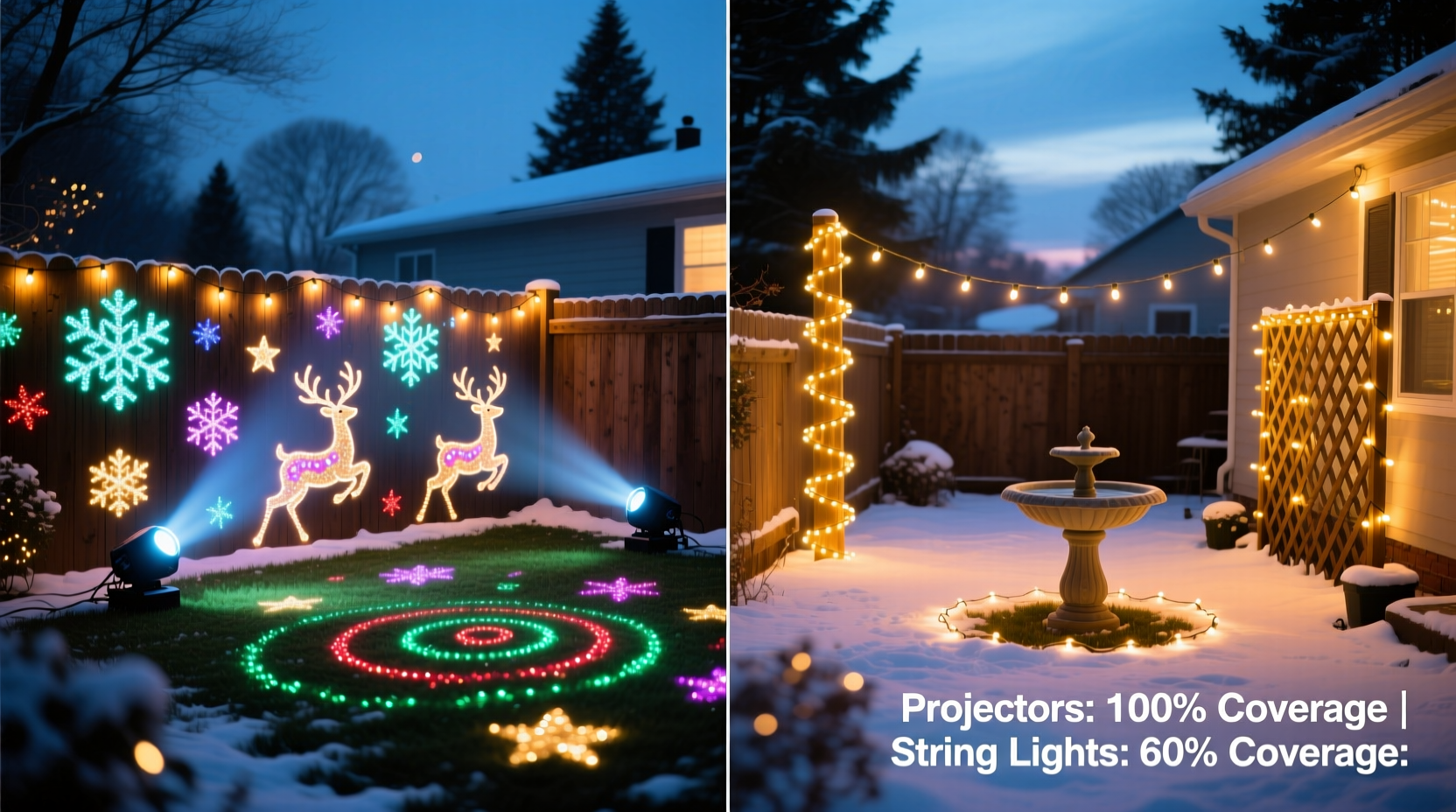
Before comparing performance, it's essential to understand how each type of lighting functions.
String lights are strands of LED or incandescent bulbs connected by a wire, typically draped along fences, railings, rooflines, trees, or bushes. They provide direct illumination and allow precise control over where light appears. Available in various lengths, colors, and bulb styles (such as C9, mini, or icicle), they remain a staple of seasonal décor.
Christmas light projectors, on the other hand, are compact devices that project patterns of light onto surfaces like driveways, walls, or lawns. Using rotating lenses and high-lumen LEDs, they simulate thousands of twinkling points without physical strings. Most models cover between 500 and 1,000 square feet per unit and often include multiple seasonal designs like snowflakes, reindeer, or falling stars.
The key difference lies in delivery: string lights add light *to* objects, while projectors cast light *onto* them. This distinction affects not only appearance but also suitability for small-scale environments.
Coverage Comparison: What \"Better\" Really Means
\"Better coverage\" depends on several factors: area illuminated, uniformity of light distribution, depth of field, and perceived brightness. In small yards, efficient coverage means maximizing visual interest without cluttering limited space.
String lights offer localized brightness. A 50-foot strand might wrap a porch railing or outline a tree, but its effect is confined to the path it follows. To achieve broader coverage, multiple strands and anchor points are needed—increasing complexity and power requirements.
Projectors, by contrast, can illuminate large swaths instantly. A single unit placed near a front step can project shimmering lights across a driveway and adjacent wall, creating the illusion of expansive decoration. Some models even support dual projections, doubling effective reach. However, this coverage is surface-dependent; flat, light-colored walls reflect best, while dark or textured surfaces absorb or distort the image.
In terms of raw square footage, projectors win. But in terms of dimensional presence—how the lighting interacts with the landscape—string lights often feel more immersive. Their three-dimensional placement adds depth, casting shadows and highlighting textures that projectors cannot replicate.
Practical Performance Across Key Metrics
To determine which option delivers superior results in constrained spaces, consider five critical metrics: installation effort, energy efficiency, weather resilience, customization, and visual impact.
| Metric | String Lights | Light Projectors |
|---|---|---|
| Installation Time | High (requires measuring, hanging, securing) | Low (place, plug in, adjust angle) |
| Energy Use | Moderate to high (depends on length and bulb type) | Low (single device, ~7–15W) |
| Weather Resistance | Good (if rated for outdoor use) | Excellent (sealed units with IP ratings) |
| Customization | High (color, pattern, layout control) | Limited (preset patterns, fixed effects) |
| Visual Depth | Strong (3D effect, shadow play) | Flat (2D projection on surfaces) |
While projectors excel in speed and simplicity, string lights offer greater creative freedom. For instance, wrapping a small evergreen shrub with warm white LEDs creates a glowing centerpiece. Projectors lack this tactile integration—they enhance rather than inhabit the space.
“Projectors are brilliant for renters or those with zero outdoor infrastructure, but they don’t replace the warmth of actual lights woven into the landscape.” — Daniel Reeves, Landscape Lighting Designer
Real-World Example: The Corner Townhouse Yard
Consider a typical urban scenario: a 12' x 25' backyard bordered by a wooden fence, with a concrete patio and two potted plants. The homeowner wants festive lighting visible from the sidewalk but lacks gutters or tall trees for hanging.
With string lights, options are limited. One could drape strands between fence posts or create a canopy over the patio, but this requires hooks, zip ties, and extension cords. Wind may cause sagging, and uneven spacing becomes noticeable up close. Total coverage might reach 150 sq ft if carefully arranged.
A Christmas light projector changes the equation. Placed on a patio table facing the house, it projects animated snowflakes across the entire back wall and part of the ground. The effect covers nearly 400 sq ft instantly. Passersby see motion and scale, while the yard itself remains uncluttered. Setup takes under five minutes, and takedown is just as fast.
In this case, the projector provides dramatically better coverage with far less effort. However, the trade-off is authenticity. Neighbors describe the display as “fun” but “artificial,” while a friend’s nearby home with modest string lights around a planter feels cozier and more inviting.
The lesson? Coverage isn’t just about area—it’s about perception. Projectors amplify reach; string lights deepen connection.
Actionable Tips for Maximizing Coverage in Small Spaces
Regardless of your choice, smart strategies can enhance effectiveness. Here are proven methods tailored to compact yards:
- Elevate your vantage point: Place projectors on risers or tables to widen the projection cone and avoid distortion on nearby surfaces.
- Layer lighting types: Combine a projector on the house wall with a short string of icicle lights along a window ledge for depth and variety.
- Focus on focal points: Direct projector beams toward architectural features like columns or doorways to draw attention and imply larger scale.
- Use timers: Automate operation to ensure consistent display times, especially important for projectors meant to impress evening foot traffic.
- Test angles at dusk: Adjust projector direction when ambient light is low to accurately judge coverage and clarity.
Step-by-Step Guide: Choosing & Installing for Optimal Results
Follow this timeline to select and deploy the best lighting solution for your small yard:
- Week 1: Assess Your Space
Measure yard dimensions, note available outlets, and identify flat surfaces suitable for projection. Walk around at night to observe sight lines from the street. - Week 2: Define Goals
Determine whether you want subtle ambiance or bold visibility. High-impact displays favor projectors; intimate charm leans toward string lights. - Week 3: Research & Purchase
For projectors, look for at least 500-lumen output and multiple patterns. For string lights, choose pre-lit nets or short runs (25–50 ft) with warm white or multicolor LEDs. - Week 4: Test Setup
Before permanent installation, do a trial run. Position the projector and check for hotspots or cutoffs. Drape string lights loosely to evaluate spacing and cord management. - Installation Day: Secure & Connect
Mount projector on stable base, aim carefully, and secure cord. For string lights, use adhesive clips or gutter hooks to avoid drilling. Plug both into GFCI-protected outlets. - Ongoing: Monitor & Maintain
Check weekly for debris, moisture, or shifting. Clean projector lens monthly for optimal clarity. Store all components properly after the season.
Frequently Asked Questions
Can I use both projectors and string lights together?
Yes, combining both can deliver excellent results. Use the projector for broad background coverage and string lights to highlight specific features like planters or steps. Just ensure they complement rather than compete—match color temperatures (e.g., warm white with warm white) and avoid overlapping bright zones.
Do projectors work on grass or uneven ground?
Poorly. Grass absorbs light and disrupts pattern clarity. Projectors perform best on smooth, light-colored surfaces. If your yard is mostly lawn, focus projection on vertical elements like fences or house walls instead.
Are string lights safer than projectors?
Both are safe when used correctly. Modern LED string lights generate little heat and consume low power. Projectors are fully enclosed and often rated IP44 or higher for weather resistance. Always check for UL certification and avoid overloading circuits regardless of type.
Final Verdict: Which Delivers Better Coverage?
For sheer coverage area and ease of deployment, Christmas light projectors are unmatched in small yards. A single device can transform a modest facade into a dynamic display visible from afar, requiring no tools, ladders, or complex wiring. They’re ideal for renters, time-constrained decorators, or anyone seeking instant impact.
However, string lights provide richer, more authentic illumination. Their three-dimensional presence integrates with the environment, offering warmth and texture that projectors cannot mimic. While they cover less area physically, their perceptual depth often makes them feel more substantial.
If coverage is defined strictly by square footage and visibility, projectors win. But if coverage includes emotional resonance and environmental harmony, string lights hold their ground.
For most small-yard owners, the optimal approach is hybrid: use a projector to extend visual reach and pair it with targeted string lighting to anchor the scene. This combination leverages the strengths of both—maximizing coverage while preserving charm.
“The future of holiday lighting isn’t choosing one over the other—it’s knowing how to blend them for maximum effect.” — Lena Choi, Urban Holiday Stylist
Take Action This Season
Your small yard doesn’t have to mean a small impression. With strategic lighting, even the tiniest outdoor space can radiate holiday spirit. Evaluate your surfaces, consider your goals, and don’t hesitate to experiment. Try a projector this year if you’ve never used one—or revisit string lights with a fresh layout. Share what works in your neighborhood, and inspire others to light up their corners of the world.




 浙公网安备
33010002000092号
浙公网安备
33010002000092号 浙B2-20120091-4
Comments
No comments yet. Why don't you start the discussion?