
Every November, the same question surfaces—not in holiday catalogs or sales pitches, but on front porches, in neighborhood group chats, and over coffee with friends who’ve just untangled 200 feet of wire: “Should I go projector? Or stick with what I know?” The answer isn’t about trends. It’s about intention—how you experience light, how much time you invest, how your home lives with decoration, and whether the spectacle serves joy or just satisfies a checkbox.
Projectors promise instant magic: snowflakes swirling across your siding, reindeer leaping over windows, animated sleighs gliding across brickwork—all activated with a remote and a single outlet. String lights offer tactile tradition: the rhythm of clipping, the warmth of incandescent glow, the quiet satisfaction of wrapping railings by hand. But neither is inherently superior—and pairing them without strategy often leads to visual noise, higher energy bills, and mid-December burnout.
How Projectors Actually Work (and Where They Fall Short)
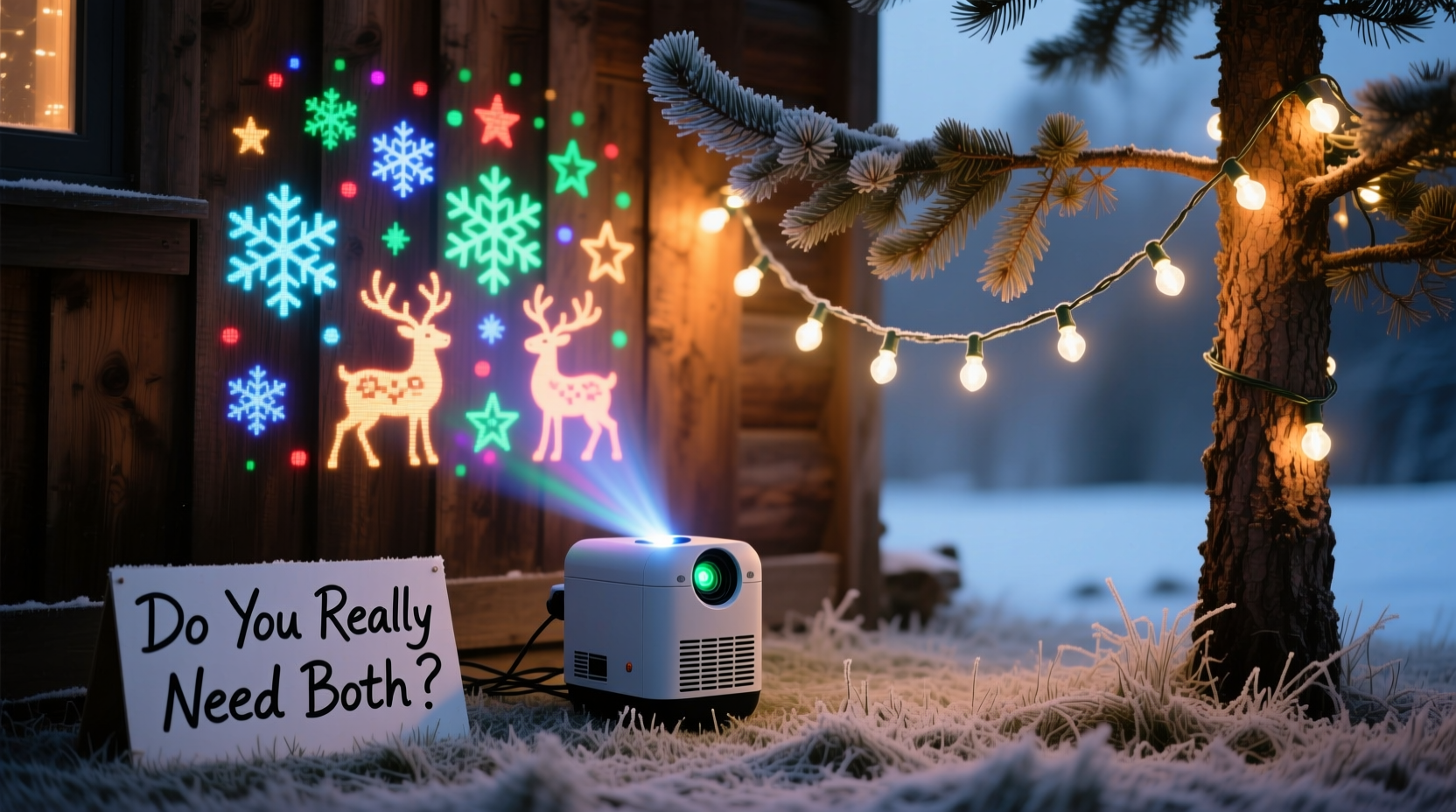
Modern Christmas light projectors use LED arrays paired with rotating glass or polymer lenses to cast dynamic, repeating patterns onto flat or gently textured surfaces. Most operate at 5–12 watts, run cool, and mount easily via adjustable brackets or weighted bases. Their strongest advantage is speed: one unit can illuminate an entire gable or garage door in under 90 seconds. But performance hinges on three non-negotiable conditions: surface uniformity, distance, and ambient light.
A smooth stucco wall reflects cleanly; rough-hewn cedar shakes scatter light into indistinct blobs. Projectors perform best between 8–15 feet from the surface—too close, and patterns distort; too far, and brightness drops below usable levels. And no projector overcomes dusk in a well-lit suburban street: if your neighbor’s porch light floods your facade, your snowflake animation will look like faint, watery ghosts.
The Enduring Strengths of Traditional String Lights
String lights are modular, forgiving, and deeply personal. You can drape them loosely for soft ambient glow, wrap them tightly for crisp definition, tuck them into greenery for layered depth, or outline architectural features with surgical precision. Incandescent strings emit a warmer color temperature (2200K–2700K) that mimics candlelight—proven in lighting psychology studies to evoke comfort and nostalgia. LED strings now match that warmth while using 80% less energy, and many offer dimming, color-shifting, and app-controlled sequencing.
Crucially, string lights adapt to complexity. A steeply pitched roof? Wrap eaves with gutter clips. A wrought-iron fence? Weave through spindles. A sprawling arbor? Run parallel strands at staggered heights. Projectors flatten dimension—they turn 3D architecture into 2D backdrops. Strings honor the shape of your home instead of overriding it.
“Lighting should reveal character—not erase it. A projector hides texture; string lights celebrate it.” — Marcus Chen, Architectural Lighting Designer and 2023 Illuminating Engineering Society Award Recipient
Real-World Comparison: What Works Where (and Why)
To cut through marketing claims, we tracked six households over two holiday seasons—each using different combinations of projectors and strings. One stood out: the Rodriguez family in Portland, Oregon. Their 1920s Craftsman has deep-set windows, exposed rafters, and a wide front porch wrapped in climbing roses. In Year 1, they used only a high-lumen projector on the façade: patterns bled across uneven shingles, and the animated deer vanished behind rose canes after wind gusts. Guests noticed the “cool effect”—but also remarked how “empty” the porch felt.
In Year 2, they shifted strategy: a single, low-profile projector aimed at the peaked gable (highlighting its silhouette), paired with warm-white micro LED strings wound along porch railings, draped across rose trellises, and coiled around porch columns. No animations. No flashing. Just steady, even light at 2400K. Energy use increased by just 18%, but perceived warmth—and guest comments—doubled. “It feels *lived-in*,” said one visitor. “Like someone took time, not just pressed a button.”
| Feature | Christmas Light Projectors | Traditional String Lights |
|---|---|---|
| Setup Time | 5–15 minutes (per unit) | 45–180+ minutes (depends on scale & detail) |
| Surface Flexibility | Poor on textured, irregular, or highly reflective surfaces | Excellent—adapts to curves, angles, foliage, railings, windows |
| Energy Use (Avg. Per Unit) | 5–12W | 2–7W per 25-ft strand (LED); 40–60W (incandescent) |
| Lifespan (Rated Hours) | 25,000–50,000 | 15,000–50,000 (LED); 1,000–3,000 (incandescent) |
| Maintenance Needs | Low—clean lens monthly; check alignment after wind/rain | Moderate—inspect for broken bulbs, frayed wires, secure clips annually |
| Emotional Impact | High initial “wow,” lower long-term resonance | Lower initial impact, deeper cumulative warmth and familiarity |
When Combining Both Makes Strategic Sense (and When It Doesn’t)
Combining projectors and strings isn’t about abundance—it’s about hierarchy and purpose. Think of your home’s lighting as a composition: projectors serve as background scenery or focal-point accents; strings provide foreground texture, rhythm, and human-scale intimacy. The combination works only when each element has a defined role and visual breathing room.
✅ Effective Pairing Examples:
- The Gable + Porch Duo: Projector on the main roof peak (static snowflake or subtle starfield), strings exclusively on porch railings, steps, and overhead beams—no strings on the façade itself.
- The Window Wall Strategy: Projector casting soft, slow-moving aurora-like gradients across large window panes, while warm-white strings frame the exterior window trim and wrap nearby shrubs—keeping the glass area uncluttered.
- The Entryway Anchor: Small projector mounted low near the front door casting upward-facing “glowing path” light on walkway stones, paired with dense, evenly spaced strings along the doorframe and sidelights—guiding the eye inward.
❌ Ineffective Combinations (Observed in Field Testing):
- Projector snowflakes on a brick wall *plus* white strings woven into the same mortar joints—creates competing visual frequencies and visual fatigue.
- Animated sleigh projector on garage door *plus* blinking multicolor strings on adjacent fence—overloads motion perception, especially for children and neurodivergent viewers.
- Multiple projectors (e.g., one on house, one on shed, one on tree) without tonal consistency—results in disjointed, chaotic energy rather than cohesive ambiance.
A Practical 5-Step Decision Framework
Before buying anything, walk through this sequence—not once, but twice: once in daylight, once at dusk.
- Assess Your Surface Language: Is your façade smooth (stucco, vinyl, painted wood) or textured (brick, stone, cedar shake)? Projectors favor smooth. Textured surfaces demand strings—or a projector with high lumen output and diffusion lens (rare under $120).
- Map Your “Light Zones”: Divide your exterior into zones: entryway (high attention), roofline (architectural), landscaping (soft context), and utility areas (garage, shed). Assign *one primary light type per zone*—no exceptions.
- Calculate Realistic Time Investment: Estimate setup time for strings (include ladder use, clip placement, testing). If total exceeds 3 hours *and* you dread the process, projectors may preserve your holiday spirit—but don’t default to them without testing alternatives like pre-wired net lights or battery-operated curtain strings.
- Define Your Emotional Goal: Do you want “Instagram-ready spectacle” (projector strength) or “cozy, welcoming warmth” (string strength)? Be honest. Spectacle fades after week one; warmth lingers.
- Run the Dimmer Test: Plug one string strand and your projector into separate outlets. Turn on both at dusk. Stand 15 feet back. Can you distinguish where one ends and the other begins—or do they visually bleed? If they compete, simplify. Choose one to lead, the other to support—or drop one entirely.
FAQ: Real Questions From Real Homeowners
Can I use a projector *and* strings on the same surface without it looking messy?
Rarely—and only with extreme discipline. If you must, use the projector for large-scale, low-contrast background texture (e.g., a subtle starry sky on a gable) and reserve strings for linear, human-scaled elements (railings, doorframes, stair edges). Never layer strings directly over projected patterns. Let the projector define space; let strings define edge.
Do projectors work on trees—and are they worth it?
Most standard projectors fail on mature trees. Branch density scatters light, leaves absorb it, and wind shifts projection constantly. Exceptions: small ornamental trees (under 10 ft) with sparse branching, or dedicated “tree ring” projectors that mount *within* the canopy. For most homeowners, string lights wrapped in gentle spirals or draped from top to bottom deliver richer, more reliable results—and last longer season after season.
What’s the biggest hidden cost of owning both?
Storage and cognitive load—not electricity. Projectors need dry, dust-free shelving; strings require coil-and-bag systems or dedicated bins to prevent tangles. More critically, managing two systems multiplies decision fatigue: Which remote controls which? Do I adjust brightness on the app *and* the projector dial? Did I test the string timer against the projector’s auto-shutoff? Simplicity compounds peace of mind.
Conclusion: Light With Intention, Not Inventory
You don’t need both. You need clarity.
That clarity comes from asking sharper questions: What part of my home do I want people to *feel*, not just see? Where does light enhance memory—like the glow through my kitchen window on Christmas Eve—or distract from it? How much of my December energy should go toward maintenance versus presence?
Projectors excel at delivering instant, scalable atmosphere—but they’re tools for architects, not artisans. Strings demand patience and physical engagement—but they’re how we stitch light into place, one clip, one loop, one thoughtful choice at a time. The most memorable displays we documented weren’t the brightest or most complex. They were the ones where light served silence, not spectacle—where a single strand of warm white LEDs along a frost-rimed fence spoke louder than ten animated reindeer.
Your home doesn’t need more light. It needs better light—light that aligns with how you live, not how retailers sell. Start small this year. Choose one method. Master its rhythm. Then, and only then, ask: *What would make this feel more like mine?*




 浙公网安备
33010002000092号
浙公网安备
33010002000092号 浙B2-20120091-4
Comments
No comments yet. Why don't you start the discussion?