
For decades, hanging Christmas lights meant ladders, tangled cords, sore shoulders, and the quiet dread of untangling 200 bulbs after Thanksgiving dinner. Then came the projector: a sleek box that beams snowflakes, reindeer, or shimmering trees onto your home in under 90 seconds. Instant curb appeal. Zero climbing. But as neighborhoods fill with synchronized projections—and fewer hand-strung garlands—a question lingers, often whispered by neighbors, debated in holiday forums, and even asked by designers: Are light projectors really just a lazy shortcut? Not quite. The truth is more nuanced—and far more practical. This isn’t about laziness versus virtue; it’s about intentionality, resource allocation, accessibility, and evolving definitions of craft in seasonal decoration.
What Light Projectors Actually Do (and What They Don’t)
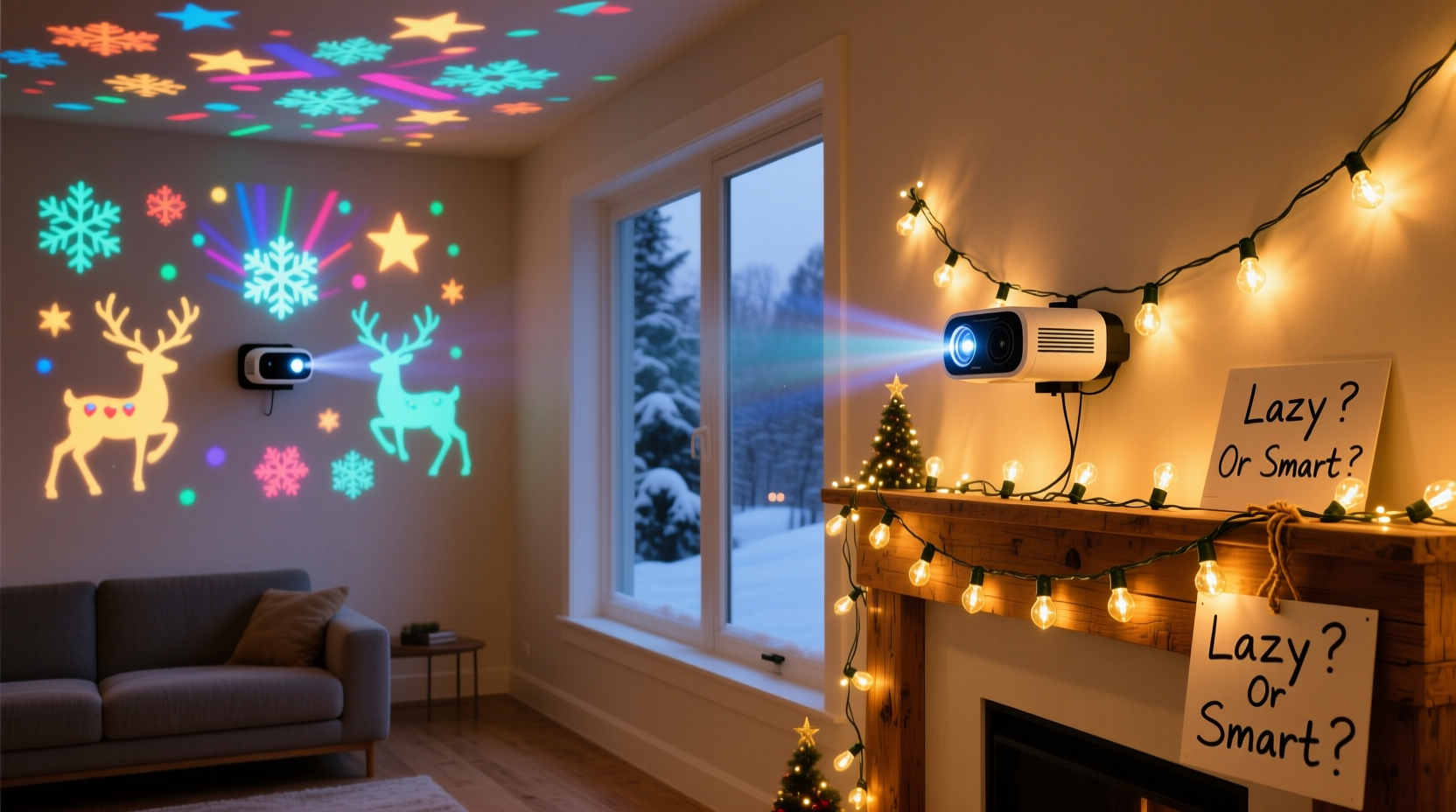
Modern LED light projectors use high-lumen, narrow-beam optics to cast crisp, animated or static patterns up to 30 feet away. Most operate at 15–30 watts, run cool, and connect via simple plug-in power—no extension cords snaking across lawns or outlets overloaded with string sets. Unlike strings, which illuminate *along* surfaces (eaves, railings, bushes), projectors illuminate *onto* them. That distinction changes everything: coverage, maintenance, adaptability, and visual impact.
Projectors excel where strings struggle: steep roofs, multi-story facades, uneven stonework, or homes with limited access points. A single unit can cover an entire front elevation—something that might require 12+ 50-light strands, 400+ clips, and two hours of installation. But projectors also have real limits. They perform poorly in direct wind (causing pattern flutter), lose clarity on textured or dark surfaces (brick, cedar shingles), and offer little depth or dimensionality compared to layered string arrangements wrapped around columns or draped through hedges.
The Real Labor Behind Traditional Strings: More Than Just Hanging
Calling string-light installation “traditional” undersells its physical and aesthetic complexity. It’s not merely draping wires. It’s calculating linear footage, matching voltage drops across circuits, selecting bulb types (C7, C9, mini-LED, warm white vs. cool white), choosing between incandescent charm and LED efficiency—and then executing it all while balancing on a ladder at 38°F.
A professional-grade residential string-light setup involves: • Measuring every eave, window frame, and porch column • Installing weatherproof clips (not staples—those damage gutters) • Daisychaining no more than three 16.4-ft LED strands per circuit to prevent dimming • Concealing transformers and junction boxes • Testing each segment before final mounting • Adding timers, smart hubs, or DMX controllers for sequencing
This level of detail creates texture, rhythm, and presence. A well-executed string job wraps light *around* architecture—highlighting contours, casting soft shadows, and inviting viewers to walk closer. Projectors flatten space; strings inhabit it. As lighting designer Marcus Bell told Architectural Lighting magazine:
“Light strings are sculptural tools. You’re not just adding illumination—you’re drawing with photons in three dimensions. A projector gives you a postcard. Strings give you a portrait.”
Cost, Longevity, and Environmental Trade-offs
Upfront cost favors projectors—but long-term value tells another story. A mid-tier projector ($89–$149) lasts 3–5 seasons before LED degradation dulls brightness or motors wear out. High-end models ($249+) include weather sealing and 50,000-hour diodes, but replacement parts (lenses, gobo wheels) are rarely available, and firmware updates cease after two years.
String lights, by contrast, have near-infinite modularity. A $35 100-bulb set can be repaired (replace one bulb, not the whole unit), extended (add compatible strands), or repurposed (wrap a patio railing one year, outline a tree the next). Quality commercial-grade strings last 10–15 years with basic storage in climate-controlled bins—not plastic bags left in attics.
| Factor | Light Projectors | Traditional String Lights |
|---|---|---|
| Avg. Upfront Cost (per 2,000 sq ft facade) | $99–$229 | $140–$320 (for 12–20 strands + clips + timer) |
| Lifespan (with care) | 3–5 years | 10–15+ years |
| Repairability | Low (entire unit often replaced) | High (bulbs, fuses, connectors replaceable) |
| Energy Use (seasonal avg.) | 18–25 kWh | 32–68 kWh (depending on strand count & type) |
| Storage Footprint | One 8\"x6\"x4\" box | Two 24\"L rolling bins or custom spools |
Who Benefits Most From Each Approach?
It’s not about right or wrong—it’s about fit. Projectors serve real needs beyond convenience: • Seniors and people with mobility limitations who’ve decorated for 40 years but can no longer climb ladders • Renters prohibited from drilling or clipping into leased property • Homeowners with historic woodwork or fragile stonework where clips risk damage • Families with young children who need quick, safe, low-chore holiday setup
Strings remain essential for those who value: • Custom layering (white micro-strings behind red C9s on a porch roof) • Indoor applications (mantels, stair rails, ceiling drapes) • Interactive displays (motion-triggered sections, sound-reactive sequences) • Community or neighborhood traditions built around shared string-light nights
Mini Case Study: In Portland, Oregon, the “Maple Street Light Walk” began in 2003 as a block-wide string-light initiative. Residents spent weekends helping each other hang vintage-style C7s on porches and fences. By 2018, five households switched to projectors—citing arthritis and time constraints. Attendance dipped slightly, but neighbors adapted: projector users added handmade wooden signs (“Hot Cocoa Station,” “Carolers Welcome”) and coordinated timing so animations synced with carolers’ arrival. The tradition didn’t vanish—it evolved. As resident and retired teacher Lena Ruiz observed: “The lights changed, but the warmth didn’t. We just found new ways to hold space for each other.”
A Practical Decision Framework: 5-Step Installation Audit
Before buying anything, ask these questions—not once, but aloud, with your partner or household:
- Surface Audit: Is your primary display surface smooth, light-colored, and unobstructed? If it’s brick, stucco, or shaded by mature trees, projectors will underperform.
- Access Reality Check: Can you safely reach all intended areas without equipment rental or professional help? If not, strings may introduce greater risk than projectors eliminate.
- Time Budget: How many hours are you willing to spend installing, adjusting, and troubleshooting *before* December 1st? Projectors average 20 minutes; quality string setups take 3–6 hours over multiple days.
- Aesthetic Priority: Do you want “wow from the street” (projector strength) or “delight up close” (strings’ tactile detail)?
- Long-Term Intent: Will this be a one-season experiment—or part of a 5-year holiday vision? If the latter, invest in modular, repairable strings first, then add a projector as a supplemental accent.
FAQ: Addressing Common Misconceptions
Do projectors look cheap compared to strings?
Not inherently—but execution matters. Low-resolution projectors with washed-out color and visible pixelation do look dated. Mid-to-high-tier units (look for 1080p native resolution, ≥2,500 lumens, and glass lenses) deliver rich, sharp imagery that holds up at night. Still, they lack the warmth and variation of incandescent strings or the subtle twinkle of premium LED strings with built-in fade effects.
Can I mix projectors and strings effectively?
Absolutely—and this is where thoughtful design shines. Use a projector for your main house facade (snowfall animation), then wrap strings around porch columns, railings, and entryway wreaths. The projector provides scale and motion; the strings add intimacy and dimension. Pro tip: Sync both to the same timer or smart hub so they power on/off together.
Are projectors harder to store than strings?
No—they’re dramatically easier. One compact box replaces dozens of coiled strands, bags of clips, spare fuses, and tangled extension cords. However, avoid storing projectors in damp garages or attics: condensation inside lenses causes permanent fogging. Keep them in their original box with silica gel packs in a closet or dry basement.
Conclusion: Redefining Craft in the Age of Light Technology
Calling projectors “lazy” confuses effort with outcome—and overlooks what people truly value during the holidays: presence, safety, joy, and shared meaning. There’s nothing lazy about a grandmother using a projector to keep her home glowing for visiting grandchildren when her knees won’t allow ladder work. There’s nothing virtuous about straining your back to hang lights you’ll resent by December 10th—especially when that energy could go toward baking cookies, writing cards, or sitting quietly with someone you love.
Craft isn’t defined by how hard something is to do. It’s defined by intention, attention to detail, and respect for the experience you’re creating—for yourself and others. Whether you choose a projector’s effortless sweep or a string’s deliberate rhythm, what matters is that your lights reflect who you are *this year*, not who you were in 2007. So hang what serves your life. Adjust what no longer fits. And if you find yourself smiling more, stressing less, and actually enjoying December evenings—then you haven’t taken a shortcut. You’ve chosen wisely.




 浙公网安备
33010002000092号
浙公网安备
33010002000092号 浙B2-20120091-4
Comments
No comments yet. Why don't you start the discussion?