
Every January, millions of households across North America face the same quiet dilemma: what to do with last year’s tangled, flickering, or broken strands of Christmas lights. Throwing them in the trash seems easiest—but it’s also one of the most environmentally costly choices you can make. Holiday lights contain copper wiring, PVC insulation, rare-earth phosphors (in LEDs), and sometimes even trace amounts of lead or cadmium. When landfilled, these materials leach into soil and groundwater; when incinerated, they release toxic fumes. Fortunately, responsible disposal isn’t just possible—it’s increasingly accessible. This article maps out real, operational Christmas light recycling programs across the U.S. and Canada, explains exactly what happens to your old strings once dropped off, and gives you a clear, step-by-step plan to participate—no guesswork, no greenwashing.
Why Recycling Holiday Lights Matters More Than You Think
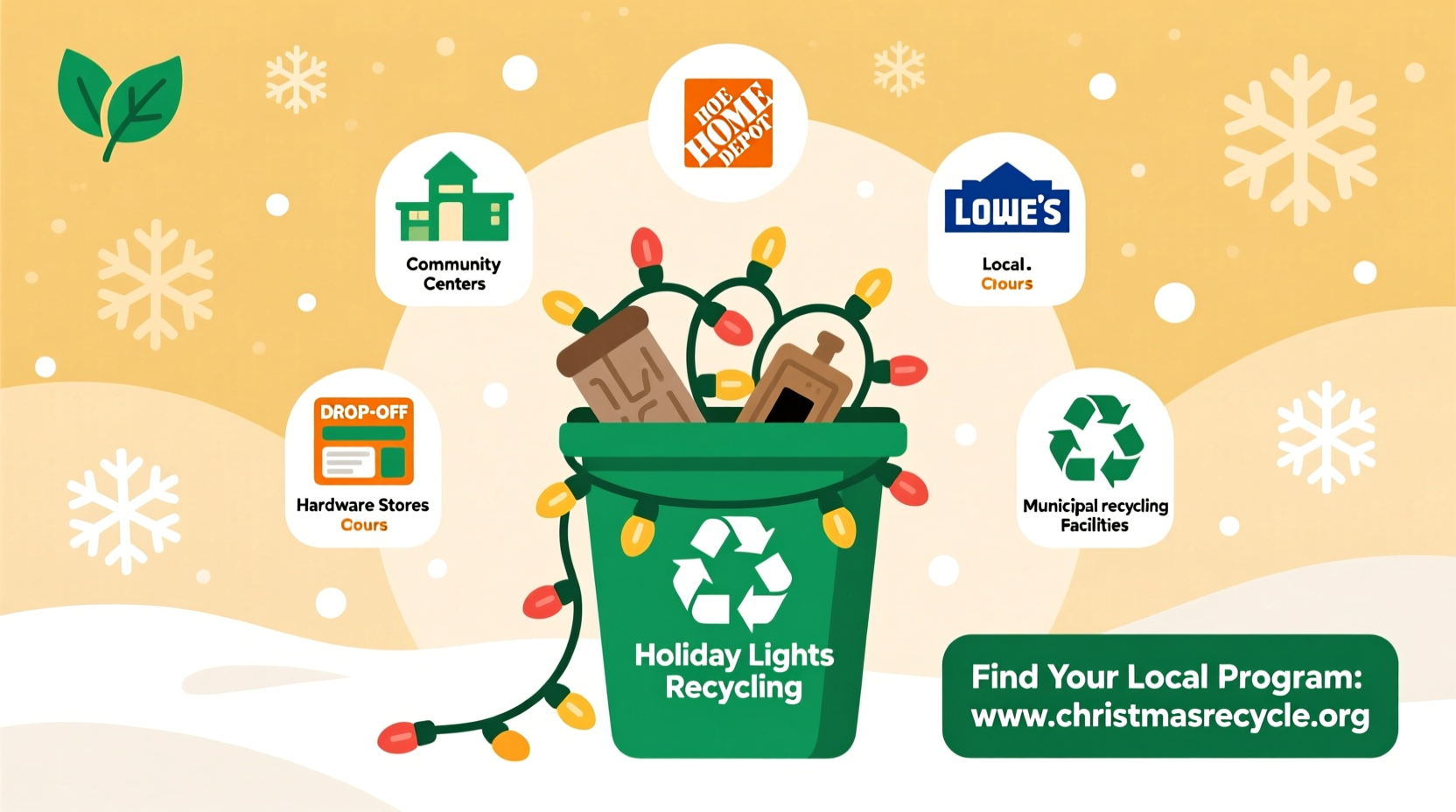
It’s easy to underestimate the scale of the problem. According to the U.S. Department of Energy, Americans purchase over 150 million new strands of holiday lights each year—and industry estimates suggest fewer than 10% are recycled. That means roughly 135 million strands—each containing up to 40 feet of insulated copper wire—end up in landfills annually. Copper is 100% recyclable without loss of quality, yet only about 30% of all copper produced globally is currently recovered from end-of-life products. When holiday lights are recycled properly, up to 95% of their material content—including copper, glass, plastic, and circuit boards—is reclaimed and reused in new electronics, construction wire, or industrial components.
The environmental stakes go beyond resource conservation. PVC-coated wires release dioxins when burned, and older incandescent strings often contain lead solder at connection points. LED strings may include gallium arsenide or indium phosphide—semiconductor compounds regulated under EPA hazardous waste rules if improperly managed. Recycling ensures these substances are handled by certified facilities that meet R2 (Responsible Recycling) or e-Stewards standards—certifications that mandate strict chain-of-custody tracking, worker safety protocols, and zero export to developing countries for informal “backyard” processing.
Where to Recycle: Verified Programs by Region
Not all drop-off locations are created equal. Some retailers accept lights but ship them to third-party processors with unclear downstream practices. Others operate fully transparent, closed-loop systems. Below is a curated list of programs confirmed active as of Q4 2023, with verified participation data, geographic coverage, and material recovery commitments.
| Program Name | Operated By | Coverage | What They Accept | Key Notes |
|---|---|---|---|---|
| Christmas Light Source Recycling Program | Christmas Light Source (online retailer) | Nationwide U.S. via prepaid mailers | All types: incandescent, LED, mini, C7/C9, rope lights, net lights | Free shipping label included with any $75+ order; otherwise $5.99 mailer. Partners with ERI (Electronic Recyclers International); publishes annual diversion reports. |
| Home Depot Holiday Light Recycling | The Home Depot + Call2Recycle | Over 2,000 U.S. stores (Oct 1–Jan 31) | LED and incandescent strings only—no rope lights, controllers, or battery-operated sets | No purchase required. Lights must be in a bag or box (max 25 lbs). Processed through Call2Recycle’s R2-certified network; 92% material recovery rate per 2022 audit. |
| BC Electronics Recycling Program | Electronics Recycling Association (ERA), British Columbia | Province-wide BC, Canada (120+ depots) | All holiday lighting, including solar-powered and smart lights | Funded by provincial EPR (Extended Producer Responsibility) law. No fees. Data shows 87% of collected lights diverted from landfill in 2023. |
| Green Depot Holiday Collection | City of Austin, TX + Green Depot | Austin metro area only | Strings, icicle lights, tree lights—no commercial-grade or theatrical lighting | Free drop-off Dec 1–Jan 15 at 3 city facilities. Partnered with UT Austin’s Materials Recovery Facility for on-site sorting and local copper resale. |
| ReBoot Holiday Light Drive | Goodwill Industries (select chapters) | 14 states: CA, CO, FL, IL, MI, MN, NC, NJ, NY, OH, OR, PA, TN, WA | Working and non-working strings; excludes damaged power adapters | Donations support job training. All lights sent to certified e-waste partners. Track your impact via chapter-specific dashboards. |
Note: Always call ahead or check the program’s official website before visiting. Store-based programs may suspend collection early if bins fill or staff capacity is exceeded. Municipal programs often require registration for curbside pickup (e.g., Portland, OR offers December-only bulky item pickup that includes holiday lights).
How It Actually Works: From Drop-Off to Reuse
Understanding the journey your lights take builds confidence in the process—and helps you spot red flags in less reputable programs. Here’s what happens at a typical R2-certified facility:
- Intake & Weighing: Lights are logged, weighed, and assigned a unique tracking ID. Staff inspect for obvious contaminants (e.g., wet insulation, mold, excessive dirt) and reject loads that pose sorting hazards.
- Manual Pre-Sort: Workers separate LED strings (which contain printed circuit boards and microchips) from incandescent ones (with filament bulbs and simpler wiring). Rope lights and controllers are pulled aside for specialized disassembly.
- Shredding & Separation: Strings enter an industrial shredder. The resulting mix passes through magnetic separators (to pull ferrous metals), eddy current separators (for non-ferrous metals like copper), and air classifiers (to isolate plastics and glass fragments).
- Purification & Refining: Copper wire is cleaned of PVC residue using thermal or chemical stripping—then melted and cast into ingots for resale to wire manufacturers. Glass from bulb casings is crushed into cullet for fiberglass or insulation production. Plastics are pelletized for use in non-food-grade industrial applications.
- Certified Reporting: Facilities issue quarterly diversion reports, verifying weight recovered, material streams sent to downstream vendors, and compliance with EPA and state regulations.
This entire process takes 7–12 days from drop-off to final material sale. Unlike general “e-waste” bins that co-mingle laptops, phones, and lights, dedicated holiday light programs achieve higher purity rates—critical for maximizing copper yield and minimizing contamination.
Real-World Example: How One Town Cut Landfill Waste by 42%
In 2022, the Village of Oak Park, Illinois launched its first standalone holiday light drive in partnership with the nonprofit Recycle Ann Arbor and local hardware store Ace Hardware. The initiative ran for six weeks, with three drop-off sites (library, village hall, and hardware store) and bilingual signage. Volunteers sorted 3.2 tons of lights—equivalent to nearly 11,000 standard 100-light strands.
What made it work? First, they avoided vague messaging like “recycle your lights.” Instead, signage read: “Bring your old lights—we’ll turn them into new copper wire for Chicago schools’ electrical upgrades.” Second, every donor received a reusable mesh bag labeled with the program’s QR code linking to a live dashboard showing total pounds diverted and projected copper recovered. Third, the village coordinated with local electricians’ unions to host a “Copper Futures” workshop, explaining how recycled wiring supports union apprenticeship projects.
By 2023, participation increased 68%, and the village reported a 42% reduction in holiday-related e-waste entering its municipal landfill—despite a 5% population increase. As Village Sustainability Director Lena Torres explained: “People don’t recycle ‘waste.’ They invest in outcomes. When we tied lights to local jobs and infrastructure, engagement became habitual—not seasonal.”
“Holiday lights are among the most recoverable forms of residential e-waste—if collected separately and processed correctly. But public trust hinges on transparency: show people *exactly* where their lights go, who handles them, and what gets made from them.” — Dr. Rajiv Mehta, Director of Urban Materials Recovery, University of Michigan School of Environment and Sustainability
Your Step-by-Step Action Plan (Starts Now)
You don’t need to wait until next December. Begin preparing now—so come November, you’re ready to act. Follow this realistic, month-by-month timeline:
- October: Audit your storage. Pull out all light strings—working and non-working. Untangle and test each strand. Discard any with exposed wiring, cracked sockets, or melted insulation (these are fire hazards and often rejected by recyclers). Label boxes: “LED,” “Incandescent,” “To Repair,” “To Donate.”
- November: Research your top 2–3 local options using the table above. Check their 2024 dates—many open earlier now (some start Nov. 15). Print or save their drop-off instructions. If mailing, order free labels or budget for shipping.
- December: Place a small bin near your tree or entryway labeled “Lights for Recycling.” Add used strands daily instead of letting them pile up. Encourage family members to contribute—even old string lights from grandparents’ attic count.
- January 2–15: Make your drop-off. Bring gloves (some facilities ask volunteers to help sort). Take a photo of your contribution and share it—tag the program and use #LightRecycled. Ask for your receipt or tracking number.
- February: Review your impact. Did your recycler publish a report? Did they email a summary? If not, send a polite inquiry: “Could you share the diversion rate for our community’s 2023 light drive?” Accountability starts with asking.
FAQ: Practical Questions Answered
Can I recycle lights with built-in timers or remotes?
Yes—but remotes and timers must be removed and recycled separately as small electronics (check with Call2Recycle or Best Buy’s e-waste program). Built-in timers wired directly into the string are acceptable; just ensure batteries are removed first (tape terminals to prevent short circuits).
What if my lights still work but I want to upgrade?
Working lights have high reuse value. Consider donating to a theater group, school art department, or community center before recycling. Many Goodwill chapters and Habitat for Humanity ReStores accept functional holiday décor. If donating, wipe down strings and coil neatly in original packaging—or a labeled zip-top bag.
Are solar-powered holiday lights recyclable?
Yes, but they require special handling due to lithium-ion batteries and photovoltaic cells. Do *not* place them in standard light bins. Instead, take them to a certified e-waste facility (find one via earth911.com) and specify “solar holiday lights.” Most accept them at no cost, and will safely extract the battery and panel components.
Conclusion: Turn Tradition Into Stewardship
Christmas lights symbolize warmth, memory, and shared light in dark months. It’s fitting that how we retire them reflects the same care. Recycling isn’t about perfection—it’s about intentionality. One strand, properly diverted, saves enough copper to wire a child’s science fair project. Ten strands fund part of a community garden’s irrigation system. A hundred strands help offset the mining footprint of new electronics. These programs exist not as abstract eco-gestures, but as tangible infrastructure—built by municipalities, nonprofits, and retailers who understand that sustainability lives in the details: in the R2 certification on a warehouse door, in the bilingual sign at a library drop-box, in the QR code linking your donation to a live dashboard.
You don’t need to overhaul your holidays to participate. Start small: untangle one box this weekend. Bookmark one program from the table. Tell a neighbor about the Home Depot drive. These acts accumulate—not just in diverted tons, but in cultural shift. When recycling becomes as routine as hanging lights, we stop seeing December as a season of consumption—and begin seeing it as a season of continuity.




 浙公网安备
33010002000092号
浙公网安备
33010002000092号 浙B2-20120091-4
Comments
No comments yet. Why don't you start the discussion?