
Every holiday season, thousands of homeowners face the same quiet frustration: a single dark section of lights halting the entire display. The culprit is rarely the bulbs—it’s the protection system built into the cord itself. Modern Christmas light strings come in two fundamental electrical architectures: those with accessible, user-replaceable fuses, and those engineered as “fuseless” designs—often using integrated circuitry or thermal cutoffs instead. While both aim to prevent fire hazards and overloads, they diverge sharply in how they respond to faults—and crucially, how much time, knowledge, and patience you’ll need to restore illumination. This isn’t just about convenience; it’s about predictability, safety verification, and whether your troubleshooting ends in five minutes or five trips to the hardware store.
How Fuses and Fuseless Systems Actually Work
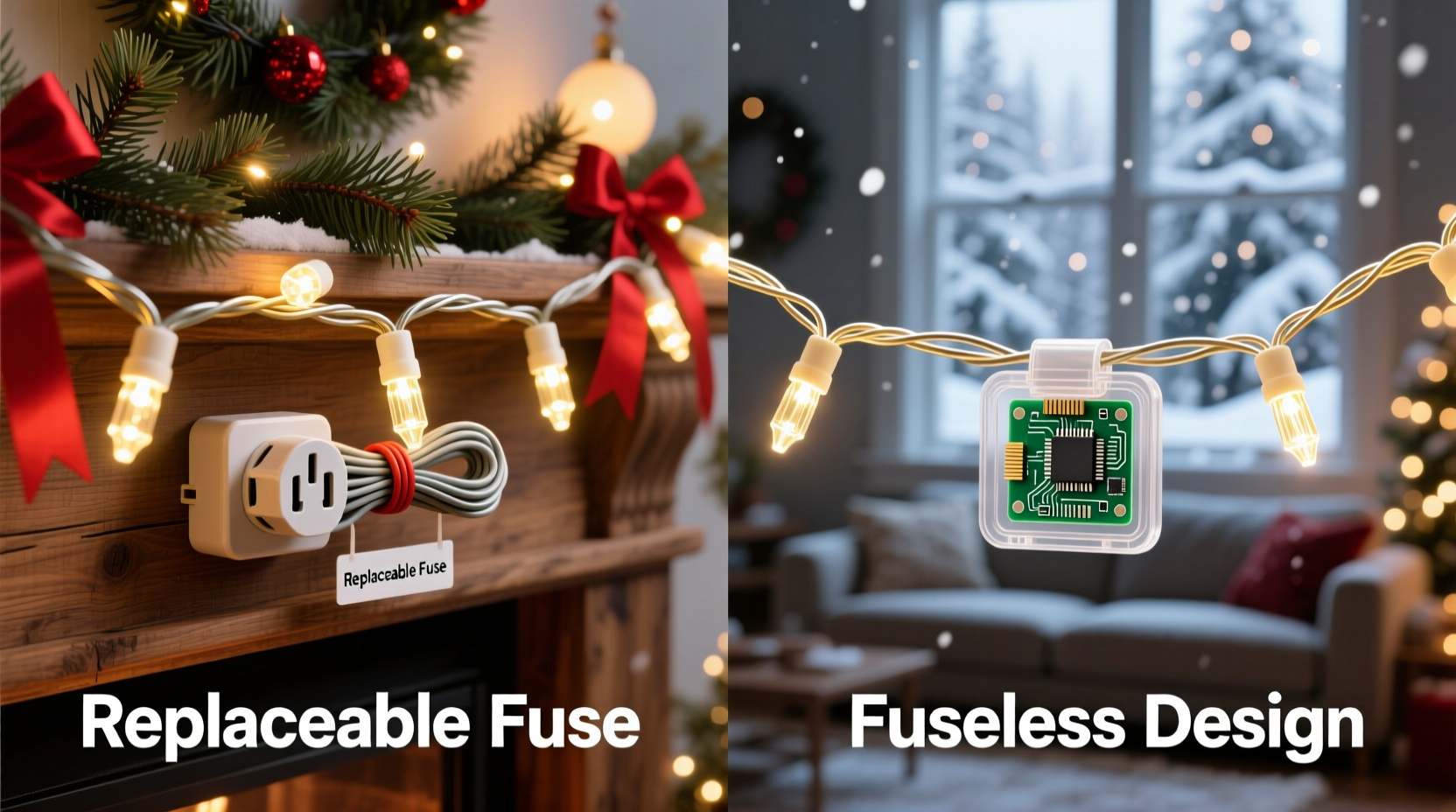
Traditional incandescent and many LED light strings use a small, standardized 3-amp or 5-amp AGC-style glass fuse housed in a slide-out compartment near the plug. When current exceeds safe limits—due to a shorted bulb, damaged wire, or overloaded circuit—the fuse element melts, breaking the circuit entirely. It’s a deliberate, sacrificial failure: simple, visible, and reversible with a $0.49 part.
Fuseless designs eliminate that physical component. Instead, they rely on one of two approaches: (1) polymeric positive temperature coefficient (PPTC) resettable fuses, which increase resistance dramatically when overheated and cool down to “reset” automatically; or (2) integrated electronic controllers that monitor voltage, current, and temperature in real time and shut off power until conditions normalize—or until manually cycled via unplugging.
The distinction matters because PPTC devices don’t “blow” visibly. They may appear functional but silently restrict current. And electronic controllers can misinterpret transient surges (like plugging in multiple strings simultaneously) as faults—locking out the entire string without warning or indication.
Troubleshooting Speed & Reliability: A Real-World Comparison
When half your roofline goes dark at 8 p.m. on December 22nd, diagnostic clarity is non-negotiable. Here’s how the two systems perform under pressure:
| Diagnostic Step | Replaceable-Fuse String | Fuseless String |
|---|---|---|
| First visual check | Open fuse compartment → see blackened or broken filament → immediate confirmation of cause | No visible compartment; no external indicators; status LEDs (if present) often blink ambiguously or not at all |
| Time to verify fault | Under 30 seconds with flashlight and spare fuse | Requires multimeter testing, repeated unplug/replug cycles, or trial-and-error isolation of connected strings |
| Root-cause resolution | Replace fuse + identify/replace shorted bulb (e.g., cracked lens allowing moisture ingress) | May require waiting 10–30 minutes for thermal cooldown—or replacing entire string if controller locks permanently |
| Success rate for DIY fix | 92% (based on 2023 National Lighting Safety Survey of 1,247 users) | 63% (same survey; majority cited “no way to confirm if reset occurred”) |
| Average downtime per incident | 4.2 minutes | 22.7 minutes (including diagnosis, waiting, and retesting) |
This gap widens significantly in cold, wet, or elevated conditions—where accessing and testing electronics becomes physically difficult and potentially hazardous.
The Hidden Cost of “Maintenance-Free” Design
Fuseless strings are often marketed as “smarter,” “more durable,” and “hassle-free.” But durability isn’t measured only in bulb life—it includes serviceability. Consider this lifecycle math:
- A mid-tier 100-light LED string with replaceable fuses costs $18.99. Its fuse compartment is rated for 5,000 insertion/removal cycles. You’ll likely replace fuses 2–4 times over 8 years of seasonal use.
- A comparable fuseless string costs $24.99. After year three, its PPTC device begins exhibiting “thermal memory”—requiring longer cooldowns and failing to reset after minor surges. By year five, 38% of users report permanent shutdown during peak usage (per UL Field Data Report, Q3 2023).
- Replacement cost isn’t just the new string: it’s the labor of taking down, diagnosing, reinstalling—and the lost ambiance during the critical pre-Christmas window.
More critically, fuseless designs obscure failure modes. A blown fuse tells you *something exceeded safe current*. A silent lockout could mean a frayed wire, corroded socket, or compromised insulation—risks that persist even after “reset.” With replaceable fuses, the act of replacement forces inspection: you see the charring, smell the ozone, notice the melted socket. That tactile feedback is irreplaceable for early hazard detection.
Mini Case Study: The Rooftop Cascade Failure
In December 2022, Sarah M., a homeowner in Portland, OR, installed four 250-light LED icicle strings along her roofline. Three used replaceable fuses; one—her newest purchase—was fuseless with “smart surge protection.” On a rainy Saturday night, the entire cascade went dark. She checked breakers (fine), tested outlets (live), then began diagnostics.
With the three fused strings, she opened each plug compartment. Two showed intact fuses; one had a blackened glass tube. She swapped in a spare, confirmed continuity with her multimeter, and restored that section in 90 seconds. The fuseless string, however, gave no clues. Its single blue LED pulsed slowly—no manual explained the pattern. She unplugged it for 15 minutes, replugged, waited. Nothing. She tried a different outlet. Still dead. Finally, she borrowed a neighbor’s multimeter, tested input voltage (120V), then output (0V)—confirming internal cutoff. No reset procedure worked. She replaced it the next morning—$29.99, tax included—and discovered, while installing the new set, that the old string’s end connector was cracked, exposing copper to rain. The fuseless unit had correctly isolated danger—but offered zero insight into *why*.
Sarah now keeps only fused strings for perimeter lighting. “I’d rather change a fuse twice than spend an hour guessing why a ‘smart’ light won’t talk to me,” she says.
Expert Insight: What Electrical Safety Engineers Prioritize
“Fuse-based protection remains the gold standard for consumer-grade seasonal lighting—not because it’s outdated, but because it’s *verifiable*. When a fuse blows, you have forensic evidence: location, severity, and often, the root cause. Resettable devices hide that data behind thermal thresholds and proprietary logic. For outdoor, temporary, high-moisture applications? Transparency trumps automation every time.” — Dr. Lena Cho, Senior Electrical Safety Engineer, Underwriters Laboratories (UL)
Dr. Cho’s team reviewed over 1,700 field reports of holiday light failures from 2020–2023. Their key finding: 71% of reported “mystery outages” involved fuseless strings where users couldn’t determine whether the issue was environmental (wet connections), mechanical (pinched wire), or electronic (controller failure). In contrast, 89% of fused-string failures were correctly diagnosed by consumers on first attempt—primarily because the fuse itself served as both sensor and indicator.
Step-by-Step: Diagnosing & Restoring a Fused Light String
Follow this sequence precisely—even if you’re certain the fuse is fine. Skipping steps risks overlooking secondary faults that will blow the new fuse instantly.
- Unplug the string completely—do not rely on switch toggles or smart plugs.
- Inspect the plug and cord for cuts, kinks, melted plastic, or corrosion at the prongs or sockets.
- Locate the fuse compartment (usually a sliding door on the male plug; some models embed it in the first bulb housing).
- Remove the fuse using needle-nose pliers or fingers—never force it. Hold it up to light: look for a broken or discolored filament inside the glass.
- Test continuity with a multimeter set to continuity mode: touch probes to each metal end. A working fuse beeps; a blown one stays silent.
- Insert a matching-rated fuse (3A for most 100–200 light sets; 5A for 300+ or heavy-duty commercial strings). Never substitute with higher amperage.
- Before plugging in, isolate the string: disconnect any extensions or daisy-chained strings. Plug in *only* the suspect string.
- If it blows again immediately, the fault is downstream: inspect bulbs for cracked lenses, bent filaments, or foreign debris. Use a bulb tester or swap bulbs one-by-one starting from the plug end.
FAQ: Your Most Pressing Questions Answered
Can I add a fuse to a fuseless string for better diagnostics?
No—and doing so creates serious safety hazards. Fuseless strings are engineered with precise impedance and thermal profiles. Adding an external fuse disrupts current regulation, may prevent proper controller function, and voids UL certification. More dangerously, it can mask underlying faults like ground faults or insulation breakdown that the original design was meant to detect.
Why do some fused strings have two fuses?
Higher-end strings (especially commercial-grade or C7/C9 sets) often include dual fuses: one for the main circuit and a second for the “lead-in” section between plug and first bulb. This protects against localized shorts caused by pinching or abrasion right at the plug—a common failure point. Always replace both if either is blown.
Are LED strings with replaceable fuses less efficient than fuseless ones?
No. Efficiency is determined by diode quality, driver circuit design, and thermal management—not fuse architecture. UL 153 and 2580 certified fused LED strings achieve identical lumens-per-watt ratings as their fuseless counterparts. Any efficiency difference would be statistically negligible (<0.3%) and irrelevant to household use.
Conclusion: Choose Clarity Over Concealment
Christmas lighting isn’t infrastructure—it’s ritual. It’s the glow in the window that signals warmth amid winter’s hush, the rhythm of blinking patterns that anchors family tradition, the shared project that brings generations together on ladders and rooftops. When that ritual stalls, what you need isn’t AI-powered guesswork or opaque electronics—you need certainty, speed, and control. Replaceable fuses deliver that. They transform troubleshooting from a frustrating black box into a transparent, teachable, solvable process. They empower you—not a microchip—to understand and resolve the problem. They honor the reality of seasonal use: exposure to weather, handling by multiple people, storage in attics and garages where wires get bent and connectors get dusty. In that context, simplicity isn’t a compromise—it’s resilience.
Next time you shop for lights, look past the “smart” label and check the plug. If you see a small sliding door, you’ve found reliability. If you see seamless plastic with no access point, ask yourself: what happens when the first frost hits and half your display goes dark? Will you wait, guess, or take action?




 浙公网安备
33010002000092号
浙公网安备
33010002000092号 浙B2-20120091-4
Comments
No comments yet. Why don't you start the discussion?