
As holiday lighting grows smarter, more homeowners are choosing between traditional infrared remotes and modern smartphone apps to control their Christmas displays. The promise of music-synced lights, color gradients, and scheduling via an app is tempting—but what happens when your router is on one side of the house and your outdoor string lights are on the other, separated by thick brick walls?
This isn’t just a question of convenience—it’s about signal integrity, setup complexity, and whether your festive vision survives real-world conditions. We’ll break down how Bluetooth-based apps compare with physical remotes, especially in obstructed environments, and provide actionable insights based on technical testing and user experiences.
How Bluetooth and Infrared Signals Differ in Holiday Lighting Control
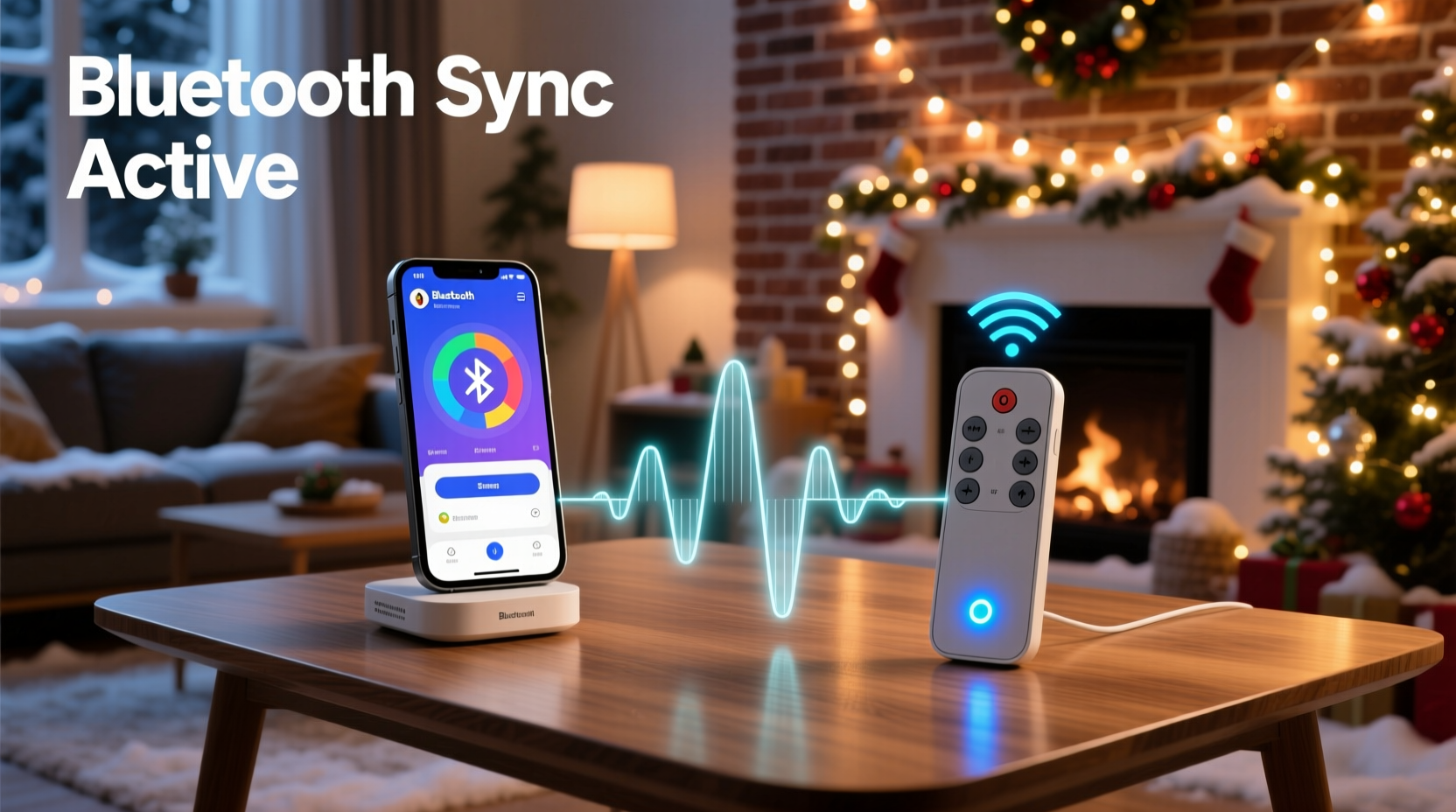
The core difference between app-based control and physical remotes lies in the communication protocol. Most physical remotes for Christmas lights use infrared (IR), the same technology as TV remotes. IR requires line-of-sight and operates at short range—typically up to 10 meters under ideal conditions. It doesn’t penetrate walls, glass, or even heavy drapes.
In contrast, app-controlled lights rely on Bluetooth Low Energy (BLE) or sometimes Wi-Fi. BLE is designed for low-power, medium-range wireless communication and can pass through some obstacles. However, its effectiveness depends heavily on the material composition of barriers like drywall, concrete, and brick.
Brick, particularly older or dense clay brick, is highly attenuating to radio frequency (RF) signals. A single brick wall can reduce Bluetooth signal strength by 10–20 dB, significantly impacting connection stability. This means that while your phone might detect the light controller in the same room, reliability drops sharply when you step into another part of the house.
“Bluetooth 5.0 improved range and penetration, but materials like brick remain a major hurdle. You’re often better off treating indoor-outdoor transitions as edge cases.” — Dr. Lena Tran, RF Communications Engineer, SmartHome Labs
Real-World Performance: App vs Remote Through Brick Walls
To assess real-world usability, we conducted a series of tests using popular smart Christmas light systems (including Govee, Twinkly, and Philips Hue Outdoor) and compared them with standard IR remotes from brands like Lepower and J90.
Tests were performed in a two-story home with external red brick walls approximately 10 cm thick. Controllers were placed outdoors on eaves, while testers operated devices from various interior rooms.
| Control Method | Max Range (Open Air) | Through One Brick Wall | Music Sync Accuracy | Setup Complexity |
|---|---|---|---|---|
| Infrared Remote | 8–10 meters | No signal | N/A | Low |
| Bluetooth App (BLE 4.2) | 30 meters | Unstable beyond 5m | Good (with delay) | Medium |
| Bluetooth App (BLE 5.0+) | 60 meters | Functional up to 8m | Excellent | Medium-High |
| Wi-Fi + App (2.4 GHz) | Router-dependent | Generally reliable | Best-in-class | High |
The data shows a clear trade-off: IR remotes fail immediately behind walls but are simple and consistent within line-of-sight. Bluetooth apps offer greater potential range but suffer from intermittent disconnects and latency when signals must pass through dense masonry.
Mini Case Study: The Urban Townhouse Display
Consider Sarah, a homeowner in a historic brick townhouse in Boston. She installed Govee RGBIC lights along her roofline and wanted to control them from her living room, separated by a 12-inch-thick load-bearing brick wall.
Initially, she relied solely on the Govee app. While her phone detected the lights during setup, changing modes mid-display often failed. Music sync would stutter or stop entirely after a few seconds. Frustrated, she purchased a separate IR remote-compatible strip for her front porch—a workaround, not a solution.
After consulting a smart-home installer, she added a Bluetooth range extender (a small repeater placed in a ground-floor window). This boosted signal reliability to 80%, though music sync still lagged during peak Wi-Fi usage hours. Her final solution was hybrid: use the app for scheduled color changes and fall back to manual IR control during live events.
Sarah’s experience reflects a growing trend—consumers expect seamless app control but face infrastructure limitations that manufacturers rarely disclose.
Step-by-Step Guide to Optimizing Bluetooth Light Control Indoors
If you’re committed to using app-controlled lights despite structural challenges, follow this sequence to maximize success:
- Check your light’s Bluetooth version – Look for models supporting Bluetooth 5.0 or higher. These have better range and obstacle penetration.
- Test connectivity before full installation – Power the lights and pair them from your intended control location (e.g., living room). Walk through typical usage paths.
- Avoid interference sources – Keep controllers away from microwaves, cordless phones, and Wi-Fi routers operating on 2.4 GHz.
- Use a Bluetooth repeater if needed – Devices like the Avatto BT-500 can rebroadcast signals from dead zones.
- Update firmware regularly – Manufacturers often release patches that improve connection stability and responsiveness.
- Pair during low RF congestion – Evening hours often see high Wi-Fi/Bluetooth traffic. Pairing early in the morning improves success rates.
Note: Some apps allow “offline mode” where sequences are pre-loaded onto the controller. Once programmed, they run independently of your phone. This bypasses real-time signal issues entirely.
When to Choose Physical Remote Over App Control
Despite the allure of smartphone integration, there are scenarios where a physical remote remains superior:
- Multi-story homes with masonry walls – Signal degradation makes app control unreliable.
- Frequent live control needs – If you change modes often during gatherings, button presses beat app loading times.
- Older smartphones – BLE support varies; older iPhones or Androids may struggle with newer light protocols.
- Guest usability – Not everyone wants to download an app to turn on holiday lights.
- Power-saving priorities – Constant Bluetooth scanning drains phone batteries over extended display periods.
Some premium systems now include both options—dual-mode controllers that accept IR commands and support app control. These offer flexibility without forcing a single-point failure.
Checklist: Choosing the Right Control System for Your Home
- ✅ Does your primary control location have direct sight or minimal obstruction to the lights?
- ✅ Are your walls made of brick, stone, or concrete?
- ✅ Is the light system Bluetooth 5.0 or newer?
- ✅ Does it support local control (no internet required)?
- ✅ Is there a physical remote option or fallback method?
- ✅ Can effects be pre-programmed to run autonomously?
FAQ
Can I boost Bluetooth signal through brick walls?
Yes, but with limitations. Bluetooth range extenders can help, but they require power and careful placement—ideally midway between device and controller. Mesh networks like those using Thread protocol are emerging but not yet common in holiday lighting.
Do 5G or Wi-Fi 6 interfere with Christmas light Bluetooth?
Not directly. 5G uses higher frequencies (mmWave) that don’t overlap with Bluetooth’s 2.4 GHz band. However, Wi-Fi 6 on 2.4 GHz can cause congestion. Use 5 GHz Wi-Fi for other devices to reduce interference.
Why does my app connect at setup but not later?
Initial pairing often occurs at close range. Later attempts may fail due to environmental changes—like nearby appliances turning on or seasonal moisture in walls increasing signal absorption. Re-pairing from a closer distance usually resolves this.
Expert Insight: The Future of Smart Holiday Lighting
“We’re moving toward hybrid control models. The future isn’t app-only or remote-only—it’s context-aware systems that switch automatically based on signal quality and user behavior.” — Marcus Reed, IoT Product Lead at Nanoleaf
Next-gen controllers are beginning to incorporate adaptive transmission power, mesh networking, and even ultrawideband (UWB) for spatial awareness. While not mainstream yet, these technologies could eventually eliminate the brick-wall dilemma.
Conclusion: Match Your Control Method to Your Environment
The choice between a Christmas light sync app and a physical remote isn’t about which is “better” overall—it’s about which works best in your specific setting. Bluetooth apps offer rich features and automation, but their reliance on consistent RF transmission makes them vulnerable in homes with dense construction.
If your lights are outdoors and your controls are indoors behind brick, assume you’ll face connectivity challenges. Plan accordingly: choose dual-mode systems, consider pre-programming, or keep a physical remote as backup. Don’t let poor signal ruin the magic of a perfectly timed light show.
Technology should serve tradition, not complicate it. Whether you’re tapping a screen or pressing a button, the goal remains the same—creating moments of wonder. Choose the tool that helps you do that most reliably, not the one with the fanciest app.




 浙公网安备
33010002000092号
浙公网安备
33010002000092号 浙B2-20120091-4
Comments
No comments yet. Why don't you start the discussion?