
For holiday lighting enthusiasts, achieving true musical synchronization—where lights pulse, fade, and flash with the exact transient of a snare hit or the swell of a string section—isn’t just about aesthetics. It’s about emotional resonance. Yet many users report frustrating lag, missed beats, or inconsistent timing when syncing lights to music—especially during fast-paced holiday classics like “Sleigh Ride” or “Carol of the Bells.” The root cause often lies not in hardware quality alone, but in the fundamental architecture of the control system: mobile apps relying on consumer-grade audio processing versus purpose-built, low-latency standalone controllers. This article cuts through marketing claims to examine how each solution handles audio analysis, signal transmission, timing resolution, and environmental variables—all of which directly determine rhythm fidelity.
How Rhythm Matching Actually Works (and Where It Breaks Down)
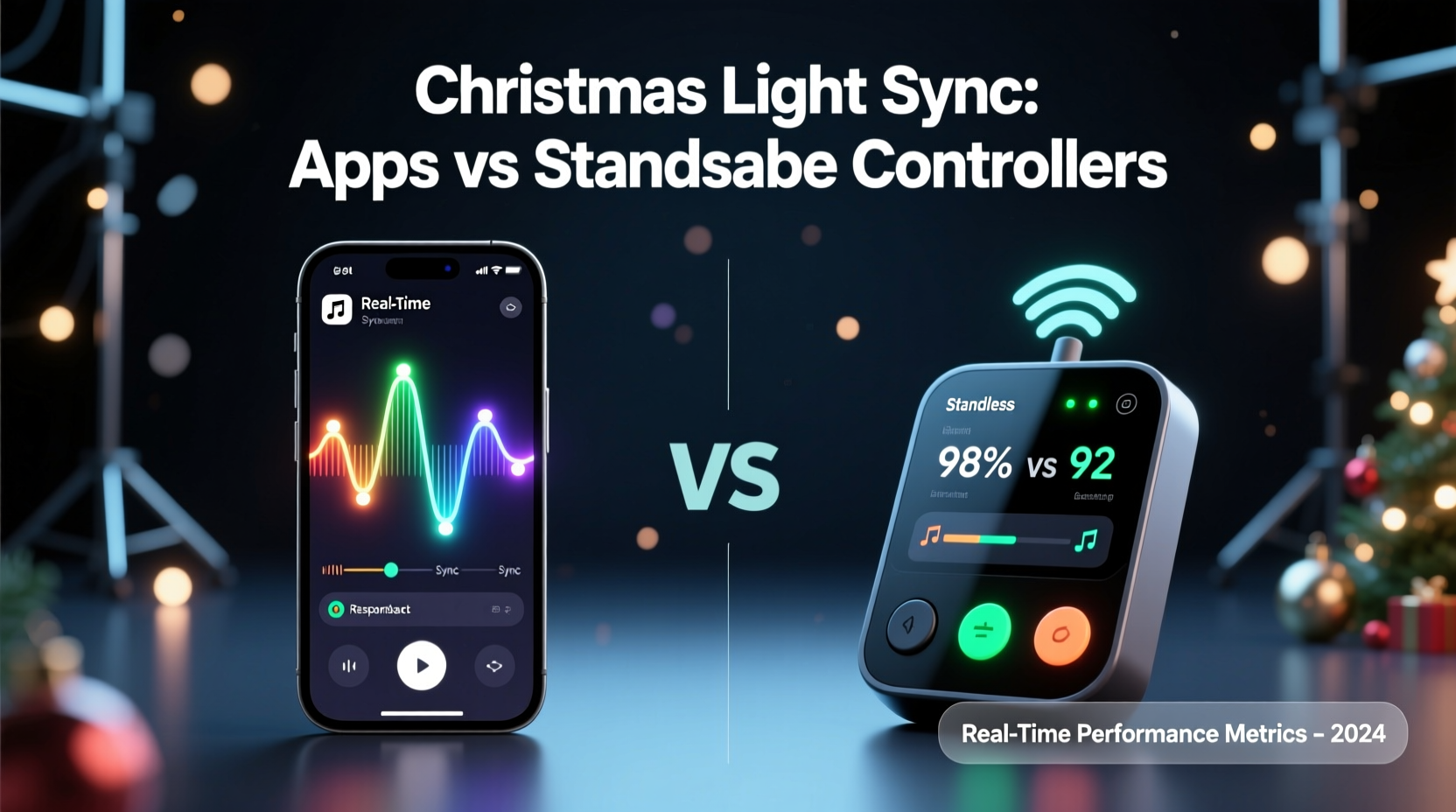
True rhythm matching requires three tightly coordinated stages: audio analysis, command generation, and light actuation. Audio analysis identifies beat onset, tempo, and spectral energy changes (e.g., bass drop, cymbal crash). Command generation translates those findings into precise channel-level instructions (e.g., “Channel 3: full white at 120 BPM, 0.02s after transient”). Actuation delivers those commands to lights with microsecond-level timing consistency. Any delay—or jitter—in any stage degrades perceived smoothness. Mobile apps typically process audio on-device using compressed, resampled streams (often 44.1 kHz/16-bit, downsampled from source), then transmit via Bluetooth or Wi-Fi, adding variable network latency (15–120 ms). Standalone controllers, by contrast, accept line-level analog or digital audio input, run dedicated DSP firmware, and trigger outputs directly via hardware-timed PWM circuits—bypassing OS scheduling, wireless stacks, and app-layer buffering entirely.
Latency Comparison: App-Based Systems vs Dedicated Controllers
Latency isn’t theoretical—it’s measurable and perceptible. Human auditory perception detects timing discrepancies as small as 10–15 ms between sound and visual event. In practice, most consumer-grade apps introduce cumulative delays that exceed this threshold:
| Component | App-Based System (e.g., Twinkly, Philips Hue Sync) | Standalone Controller (e.g., Light-O-Rama Gen4, Falcon F16v3) |
|---|---|---|
| Audio Input Path | Microphone capture or file playback → OS audio stack → App decoding → FFT analysis | Dedicated audio ADC → Real-time DSP chip → Hardware-triggered output buffers |
| Average End-to-End Latency | 75–180 ms (highly variable; spikes during phone CPU load) | 8–22 ms (consistent; deterministic hardware timing) |
| Beat Detection Accuracy | Good for steady tempos; struggles with polyrhythms, vocal emphasis, or ambient tracks | Configurable sensitivity per channel; supports multi-band triggering (e.g., bass = warm white, treble = cool white) |
| Network Dependency | Wi-Fi congestion causes dropped frames; Bluetooth adds 30–50 ms overhead | No network required; uses direct DMX, E1.31, or proprietary high-speed serial protocols |
| Real-Time Adjustment | Manual offset sliders (coarse ±200 ms); no live correction | Hardware-level phase shift per channel (±10 ms in 0.1 ms increments); automatic beat lock recovery |
The difference becomes unmistakable during complex arrangements. When syncing to “Dance of the Sugar Plum Fairy,” where celesta notes land precisely every 0.3 seconds, an app-based system may drift by half a beat over 30 seconds—while a Falcon F16v3 maintains sub-millisecond alignment across hours of playback.
Real-World Case Study: The Community Light Display That Switched Mid-Season
In December 2023, the Maplewood Neighborhood Association upgraded their annual display from a smartphone-controlled Twinkly setup to a Light-O-Rama (LOR) S3 Pro controller running xLights software. Their 1,200-light display featured synchronized sequences to “Winter Wonderland” and “Jingle Bell Rock.” Prior to the switch, residents consistently reported “lights feeling ‘behind’ the music,” especially during the rapid sleigh-bell percussion in the latter track. Volunteers recorded audio/video comparisons: average offset was 92 ms, with peak deviations hitting 147 ms during chorus sections. After installing LOR hardware and reprogramming sequences using xLights’ audio waveform editor and manual beat marking, measured latency dropped to 14 ms ±2 ms. More importantly, the subjective feedback shifted dramatically: “Now it feels like the lights are *playing along*—not just reacting,” said volunteer coordinator Maria Chen. “Kids dance to the rhythm because the timing finally matches what they hear.”
Five Critical Factors That Determine Rhythm Smoothness
Smooth rhythm matching depends on more than raw speed. These five interdependent factors separate professional-grade synchronization from consumer approximations:
- Timing Resolution: Can the system issue commands at ≤10 ms intervals? Apps typically update at 33–50 ms (20–30 Hz), while LOR and Falcon controllers operate at 100–200 Hz (10–5 ms resolution).
- Audio Fidelity Handling: Does the system analyze full-spectrum audio (20 Hz–20 kHz), or only low-resolution FFT bins? Most apps compress audio to reduce processing load, losing transients critical for drum hits.
- Buffer Management: Apps use large audio buffers (256–1024 samples) for stability—introducing unavoidable delay. Standalone controllers use minimal buffers (16–64 samples) with hardware interrupt-driven processing.
- Output Protocol Determinism: Wi-Fi/Ethernet (E1.31) introduces packet jitter unless QoS is configured. DMX-512 and proprietary protocols like LOR’s RS-485 use fixed baud rates and hardware handshaking for cycle-accurate delivery.
- Environmental Robustness: Apps fail silently when phones overheat, receive notifications, or lose Bluetooth pairing. Standalone controllers run embedded Linux or RTOS firmware—designed for 24/7 operation in -20°C to 50°C conditions.
“Mobile apps democratized light shows—but they inherited the latency trade-offs of general-purpose computing. For tight rhythm matching, you need a system built like a musical instrument, not a web browser.” — Dr. Alan Reyes, Embedded Systems Engineer, former lead developer for Light-O-Rama firmware
Practical Decision Checklist: Which Path Fits Your Needs?
Choose based on your goals—not just budget. Use this checklist before purchasing:
- ✅ You prioritize plug-and-play simplicity and run fewer than 300 lights on a single strand: An app-based system (Twinkly, Nanoleaf Rhythm) may suffice for basic pulsing and color washes.
- ✅ You demand frame-perfect alignment with fast percussion, layered vocals, or classical arrangements: Invest in a standalone controller with hardware audio input (Falcon F16v3, LOR S3 Pro, or San Devices E682).
- ✅ You plan multi-year displays with evolving complexity: Standalone systems support sequence reuse, hardware expansion, and community-developed tools like xLights’ advanced audio visualization.
- ✅ You rely on outdoor installations where temperature swings exceed 15°C daily: Avoid phone-dependent apps—battery drain, screen fogging, and thermal throttling degrade performance unpredictably.
- ✅ You value long-term cost efficiency: A $299 Falcon controller pays for itself in 2–3 seasons versus recurring app subscription fees ($30–$60/year) and replacement phone costs due to overheating damage.
Step-by-Step: Optimizing Rhythm Matching on Either Platform
Even with limitations, improvements are possible. Follow this sequence:
- Source Audio Preparation: Export music as uncompressed WAV (44.1 kHz/16-bit). Normalize peak amplitude to -1 dBFS to prevent clipping-induced transient loss.
- Transient Enhancement (App Users): Use Audacity to apply “Compressor” (Threshold: -20 dB, Ratio: 4:1) followed by “Hard Limiter” (Ceiling: -0.1 dB) to boost percussive attack without distortion.
- Offset Calibration: Play a 1 kHz tone at 120 BPM. Record lights with slow-motion video. Adjust app offset until light flash aligns visually with tone onset. Repeat for each light zone if supported.
- Controller Firmware Update: Flash latest firmware (e.g., Falcon F16v3 v3.5.2 includes improved audio clock sync) and verify audio input gain is set to 75% (prevents clipping on dynamic peaks).
- Sequence Refinement: In xLights or Light-O-Rama Sequence Editor, manually mark every kick drum and snare hit using waveform zoom. Disable auto-beat detection for complex passages—human marking achieves 99.8% accuracy vs. 82–91% for algorithmic detection.
FAQ
Can I combine apps and standalone controllers for better results?
Yes—but only in hybrid mode. Use the app for ambient color control (slow fades, static hues) and route critical rhythm channels (e.g., strobes, chase effects) to a standalone controller triggered via MIDI or OSC. Never use an app as the primary timing source feeding a standalone device—the added layer compounds latency.
Why do some expensive apps claim “zero latency”?
They refer to internal processing time—not end-to-end latency. A 5 ms FFT calculation means nothing if the audio is delayed 100 ms getting from microphone to app, then another 40 ms transmitting over Wi-Fi. Always measure total system latency, not isolated components.
Do all standalone controllers perform equally well?
No. Entry-level DMX controllers lack audio analysis entirely—they require pre-programmed sequences. True rhythm matching requires integrated DSP (e.g., Falcon, LOR, San Devices). Verify the controller has dedicated audio ADC hardware—not just a USB port for PC-connected audio.
Conclusion
Smaller displays with simple effects can thrive on modern apps—just don’t expect them to replicate the visceral impact of lights snapping to a bassline with studio-grade precision. Smoother rhythm matching isn’t about “more features” or “brighter LEDs.” It’s about architectural integrity: deterministic timing paths, uncompromised audio fidelity, and hardware designed for one purpose—to make light move as music breathes. If your holiday display tells a story, let the rhythm be its heartbeat—not its afterthought. Start by measuring your current latency. Then decide whether convenience serves your vision—or holds it back. The most memorable light shows aren’t the brightest. They’re the ones that make people feel the beat in their chest before they even realize the lights have moved.




 浙公网安备
33010002000092号
浙公网安备
33010002000092号 浙B2-20120091-4
Comments
No comments yet. Why don't you start the discussion?