
Every holiday season brings the familiar frustration: you pull out your favorite string of Christmas lights, plug them in, and—nothing. Or worse, only half the strand lights up. With time ticking and decorations still incomplete, speed and accuracy in diagnosing the issue become critical. Two tools commonly used to troubleshoot these failures are the dedicated Christmas light tester and the digital multimeter. But which one actually gets you back to a fully lit display faster?
This isn’t just about convenience—it’s about efficiency, safety, and understanding the strengths and limitations of each device when dealing with modern and vintage light strings alike. Whether you're a homeowner hanging a single strand or managing a large outdoor display, knowing which tool delivers quicker results can save hours during setup.
How Faulty Christmas Lights Fail: The Basics
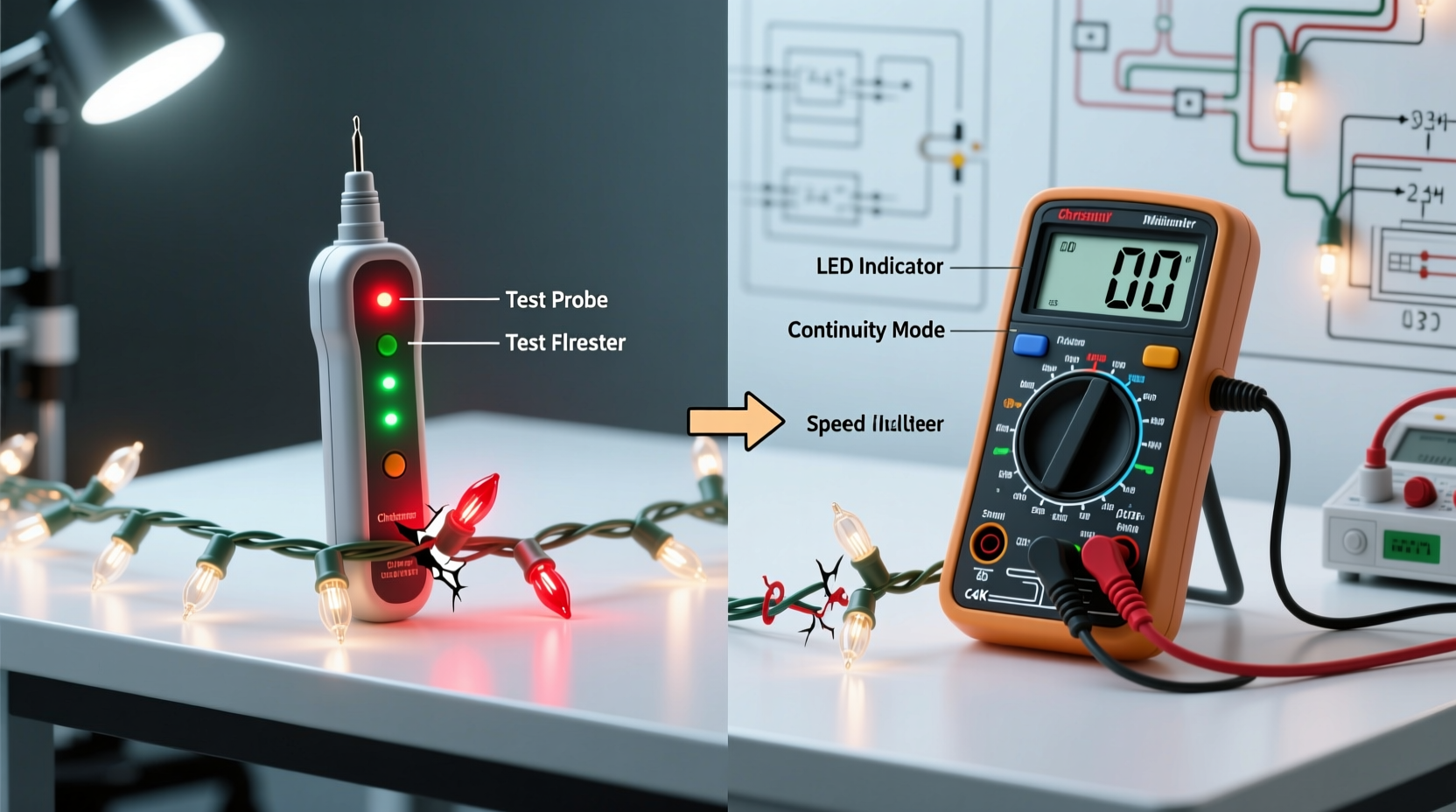
Before comparing tools, it's essential to understand how Christmas lights fail—and why that matters for diagnosis. Most incandescent mini-light strands use series wiring, meaning electricity flows through each bulb in sequence. If one bulb burns out, becomes loose, or develops a broken shunt (a small wire designed to bypass the filament when it fails), the entire circuit breaks, and the rest of the strand goes dark.
LED strands operate differently. While many are wired in parallel or hybrid configurations, allowing partial operation even if some bulbs fail, they can still suffer from open circuits due to damaged wires, faulty connectors, or driver malfunctions. Diagnosing these issues requires detecting continuity, voltage drops, or complete circuit interruptions.
The key challenge lies in isolating the problem quickly. Is it a single dead bulb? A bad socket? A cut wire? Or is the entire string beyond repair? Both the Christmas light tester and the multimeter aim to answer this—but they do so in fundamentally different ways.
Understanding the Tools: Purpose and Design
A Christmas light tester is a specialized, non-contact device designed specifically for troubleshooting light strings. Held near the strand while powered, it detects electromagnetic fields generated by current flow. As you move it along the wire, the indicator (usually an LED or sound) changes when it passes over a break in the circuit, pinpointing the location of the fault without direct contact.
In contrast, a digital multimeter is a general-purpose electrical testing instrument capable of measuring voltage, resistance, continuity, and more. When applied to Christmas lights, it’s typically used in continuity mode (with power off) or voltage mode (with power on). This allows precise measurement at individual points—such as across a bulb or between sockets—but requires physical contact and methodical probing.
“Holiday lighting diagnostics benefit most from tools that minimize disassembly and guesswork. Speed often beats precision when you’re working under deadline.” — Carlos Mendez, Electrical Technician & Seasonal Display Consultant
Speed Comparison: Real-World Diagnosis Scenarios
To evaluate which tool diagnoses faulty strings faster, consider two common situations:
Scenario 1: Half-Lit Incandescent Strand (Series-Wired)
- With a Christmas light tester: Plug in the strand. Hold the tester near the first live section. Move it slowly along the wire until the signal stops—this indicates where current ceases. The fault is likely within a few inches before that point. Visually inspect bulbs in that zone. Total time: 60–90 seconds.
- With a multimeter: Unplug the strand. Set to continuity mode. Begin at the first unlit bulb. Test each bulb individually by placing probes on its base contacts. Continue down the line until one shows no continuity. Alternatively, test voltage at each socket with power applied—a slower, riskier process. Total time: 5–15 minutes depending on strand length.
Scenario 2: Entire String Dead (Possible Open Circuit)
- Christmas light tester: Apply power. Run tester from plug end. If no signal appears anywhere, the issue may be at the plug, fuse, or first bulb. Check fuses first (common failure point), then retest. If signal starts but dies early, isolate that segment. Time: 2–3 minutes.
- Multimeter: Check fuses using continuity function. Then test resistance from plug blades to first socket. Trace forward incrementally. May require removing bulbs or accessing internal connections. Time: 10+ minutes, especially for longer strands.
Side-by-Side Tool Comparison
| Feature | Christmas Light Tester | Multimeter |
|---|---|---|
| Time to First Diagnosis | Under 1 minute | 3–10+ minutes |
| Contact Required? | No (non-contact) | Yes (probes needed) |
| Power On During Test? | Yes | Sometimes (depends on test type) |
| Precision Level | Segment-level (pinpoints zone) | Component-level (exact bulb/wire) |
| Skill Required | Low (beginner-friendly) | Moderate to high |
| Cost (Average) | $10–$20 | $25–$100+ |
| Multipurpose Use? | No (lights only) | Yes (electronics, home wiring, etc.) |
| Safety Risk | Low (no contact) | Moderate (exposed probes, live circuits) |
The data clearly shows that the Christmas light tester wins in terms of speed and ease of use for holiday-specific tasks. Its non-contact design allows rapid scanning without disassembling the strand or handling small components. For users focused solely on seasonal lighting, it’s purpose-built for performance.
However, the multimeter offers unmatched versatility and diagnostic depth. It can confirm whether a replacement bulb is functional, measure output voltage from a transformer, or test extension cords—making it invaluable for complex displays involving timers, controllers, or custom wiring.
When Each Tool Excels: Practical Recommendations
Choose the right tool based on your needs, experience level, and scale of operation.
Use a Christmas Light Tester When:
- You maintain fewer than 10 light strings annually.
- Speed is essential (e.g., last-minute setup).
- Users include children or non-technical helpers.
- You work primarily with traditional incandescent mini-lights.
Use a Multimeter When:
- Troubleshooting LED arrays, smart lights, or custom installations.
- Diagnosing intermittent issues requiring voltage monitoring.
- You already own one for other household or hobby projects.
- You need to verify power delivery from outlets or adapters.
“The light tester cuts diagnosis time by 70% compared to manual methods. For homeowners, that’s the difference between finishing decorations before dinner or after midnight.” — Holiday Lighting Efficiency Report, Consumer Tech Review (2023)
Step-by-Step: Fastest Way to Diagnose a Dead Strand
- Unbox and visually inspect the strand for obvious damage—crushed plugs, chewed wires, missing bulbs.
- Plug into a known-working outlet and test operation. If nothing happens, proceed.
- Check fuses in the plug cap. Replace if blown (spares often stored inside plug). <4> If fuses are good, use a Christmas light tester: Power on the strand, hold tester near the wire starting at the plug, and slide along slowly.
- Identify signal drop-off point—where the tester stops indicating current flow.
- Inspect bulbs within 2–3 inches before that point. Look for darkened filaments, loose seating, or corroded bases.
- Replace suspect bulb with a known-good one. Re-test strand.
- If still not working, repeat with adjacent bulbs or check for socket damage.
This process typically resolves most issues in under five minutes. In contrast, a multimeter-based approach would involve multiple disconnections, probe placements, and incremental checks—increasing both time and potential for error.
Mini Case Study: Resolving a Persistent Outdoor Display Issue
Mark T., a homeowner in Ohio, manages a 12-strand outdoor Christmas display. One year, two identical 100-light incandescent strands failed mid-season. Using his digital multimeter, he spent over 40 minutes total diagnosing both—testing individual bulbs, checking sockets, and confirming voltage. Frustrated, he purchased a $15 Christmas light tester the following year.
During setup, another strand showed partial lighting. He diagnosed the fault in 70 seconds using the tester, found a loose bulb in the predicted zone, secured it, and restored full illumination. “It paid for itself in saved time,” he said. “I used to dread light night. Now it’s almost fun.”
For seasonal users like Mark, the reduction in troubleshooting friction makes a meaningful difference—not just in efficiency, but in enjoyment of the holiday tradition itself.
Frequently Asked Questions
Can a Christmas light tester work on LED strings?
Most non-contact testers are designed for AC-powered incandescent lights that generate detectable electromagnetic fields. Many LED strings run on low-voltage DC and produce weaker or no fields, making detection unreliable. Some newer testers claim LED compatibility, but results vary. For LEDs, a multimeter is often more effective.
Do I need both tools?
For casual decorators, a Christmas light tester alone is sufficient. Enthusiasts, electricians, or those integrating lights with control systems may benefit from owning both—one for quick holiday diagnostics, the other for deeper electrical analysis.
Are light testers safe to use outdoors?
Yes, provided the strand is plugged into a GFCI-protected outlet and the tester itself is dry. Avoid use during rain or snow. Always follow manufacturer instructions regarding operating conditions.
Final Recommendation: Choose Based on Your Workflow
If your goal is to diagnose faulty Christmas light strings faster, the dedicated Christmas light tester is objectively superior in speed, simplicity, and user-friendliness. It eliminates guesswork, reduces physical handling, and delivers actionable results in seconds. For typical household use, it’s the smarter investment.
The multimeter remains indispensable for broader electrical tasks and advanced diagnostics. But when it comes to restoring holiday cheer quickly, it simply can't match the targeted efficiency of a purpose-built light tester.




 浙公网安备
33010002000092号
浙公网安备
33010002000092号 浙B2-20120091-4
Comments
No comments yet. Why don't you start the discussion?