
Every holiday season, millions of households across the world wrestle with the same frustrating ritual: untangling strings of Christmas lights, only to find that half of them don’t work. The traditional method—plugging each strand into an outlet to see if it lights up—is time-consuming, inefficient, and often leaves homeowners standing on ladders in the cold, testing one string at a time. Enter the Christmas light tester: a small handheld device promising to diagnose dead bulbs and faulty circuits without ever needing to plug into a wall. But do these tools actually save time? Are they truly faster than the old-school method of plugging in each strand? The answer, backed by practical experience and expert insight, is a resounding yes.
How Traditional Testing Slows You Down
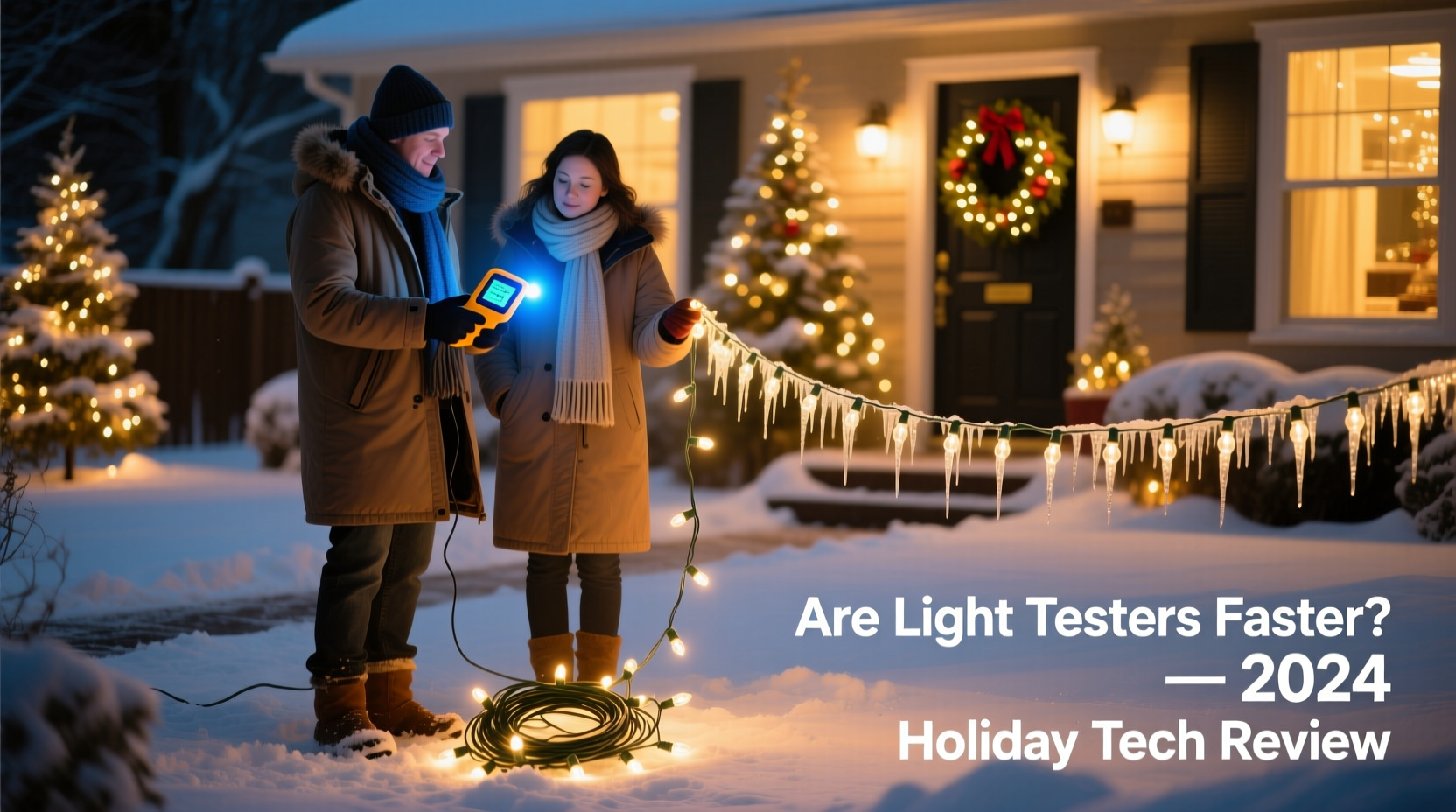
The conventional way of checking Christmas lights involves plugging each strand into a power source and visually inspecting whether the bulbs illuminate. While this seems straightforward, it introduces several inefficiencies:
- Access to outlets: Outdoor setups may require extension cords just to test strands before installation.
- Ladder dependency: Many people test lights after hanging them, meaning repeated climbs to plug and unplug.
- Partial failures: A single dead bulb can kill an entire section, but you won’t know which one without further inspection.
- Weather exposure: Testing outdoors in cold or damp conditions increases discomfort and risk.
- No diagnostic detail: You only learn if the strand works—not why it doesn’t.
This trial-and-error approach can turn a two-hour decorating job into an all-day ordeal. For professional installers or those with large displays, the cumulative time loss becomes significant. Consider someone with 20 light strands: even at three minutes per test (uncoiling, plugging, observing, unplugging, coiling), that’s a full hour spent just verifying functionality—before installation begins.
How Christmas Light Testers Work
A Christmas light tester is a compact electronic tool designed to detect electrical current flow through a string of miniature incandescent or LED holiday lights. Most models operate using electromagnetic field detection. When you run the tester along the wire, it senses the alternating current passing through the circuit. If the current stops at a certain point, the tester alerts you—usually with a beep or LED indicator—pinpointing the location of the break.
These devices do not require the strand to be plugged into a wall outlet. Instead, they work while the lights are still unplugged, making them ideal for pre-installation checks. Some advanced models can even identify open shunts, detect voltage presence, and differentiate between series and parallel wiring issues.
For example, the popular \"Light Keeper Pro\" uses a combination of signal injection and pulse technology to clear common shunt failures—the tiny mechanisms inside bulbs that are supposed to bypass a dead filament. In many cases, simply running the device over a non-working section restores functionality without replacing a single bulb.
“Time is the most valuable resource during holiday setup. A good light tester can cut troubleshooting time by 70% compared to manual plug-in testing.” — Mark Reynolds, Professional Holiday Lighting Installer with 15+ years of experience
Time Comparison: Tester vs. Plug-In Method
To understand the real-world efficiency difference, consider a side-by-side comparison of both methods when evaluating five typical light strands (each 100 bulbs, mini-incandescent type).
| Method | Steps Involved | Average Time per Strand | Total Time (5 Strands) |
|---|---|---|---|
| Plug-In Testing | Uncoil, locate outlet, plug in, observe, unplug, coil, repeat | 3–4 minutes | 15–20 minutes |
| Light Tester | Uncoil slightly, run tester along wire, check for signal, fix or set aside | 1–1.5 minutes | 5–7.5 minutes |
Even under optimistic conditions, the plug-in method takes more than twice as long. But the disparity grows when dealing with malfunctioning strands. A plug-in test only confirms “works” or “doesn’t work.” A light tester identifies *where* the problem lies, allowing for targeted repairs instead of discarding or replacing entire strings.
Step-by-Step: Using a Light Tester Efficiently
To maximize speed and effectiveness, follow this proven process when preparing holiday lights for display:
- Gather all light strands in one central location (garage, basement, living room).
- Uncoil the first strand just enough to access the plug end and first few inches of wire.
- Turn on the light tester and place it near the plug. Confirm it detects signal at the input.
- Slowly move the tester along the wire, watching for changes in tone or light indicators.
- If the signal drops: Isolate the section. Check for loose bulbs, corroded sockets, or damaged wires.
- Use the tester’s repair function (if available) to attempt clearing shunt failures.
- Mark or set aside problematic sections for repair; keep working ones ready for installation.
- Repeat for each strand, grouping functional and non-functional sets.
This systematic approach allows you to evaluate and sort all your lights in under an hour—even for extensive collections. Compare that to the hours often lost with repeated trips to outlets, ladder use, and guesswork.
Real Example: A Homeowner’s Holiday Breakthrough
Sarah Thompson, a homeowner in Vermont, used to spend every first weekend of December wrestling with her family’s collection of 18 light strands. “I’d hang them up, plug them in, see half weren’t working, take them down, try another set—it was exhausting,” she said. After buying a $15 light tester on a recommendation, her process changed completely.
“Last year, I laid all the strands out on my living room floor. In about 40 minutes, I tested every single one. The tester found three with broken shunts and one with a chewed wire from squirrels. I fixed two with the tool’s pulse function, replaced one bulb, and retired the damaged one. I hung the rest knowing they’d all work. It took me less time to test than it used to take to hang just four strands.”
Sarah now recommends light testers to every friend setting up holiday decorations. “It’s like having a mechanic for your lights,” she said. “You wouldn’t drive a car without checking the engine first. Why decorate without checking the lights?”
Advantages Beyond Speed
While speed is the most obvious benefit, Christmas light testers offer additional advantages that enhance convenience and cost-efficiency:
- Increased safety: No need to handle live outlets or daisy-chain multiple strands during testing.
- Longer lifespan for lights: Early detection of issues prevents overstressing working bulbs in a failing circuit.
- Reduced waste: Repairing rather than replacing strands cuts down on plastic and electronic waste.
- Better storage insights: Identifying recurring failure points helps improve off-season storage practices.
- Cost savings: Replacing a $10 strand adds up quickly over time. Testers typically pay for themselves after fixing just 2–3 sets.
Checklist: Pre-Season Light Readiness
Before the holidays arrive, ensure your lights are ready with this quick checklist:
- ✅ Gather all light strands in one place
- ✅ Charge or replace batteries in your light tester
- ✅ Inspect cords for visible damage (cuts, frays, rodent bites)
- ✅ Use the tester to verify continuity and detect dead sections
- ✅ Replace or repair faulty bulbs and shunts
- ✅ Label working strands for easy identification
- ✅ Discard or recycle non-repairable sets responsibly
- ✅ Store tested, working strands separately from untested ones
Frequently Asked Questions
Can a Christmas light tester work on LED strands?
Yes, most modern testers are compatible with both incandescent and LED light strings. However, because LEDs draw less power, some older or low-sensitivity models may struggle. Look for testers labeled “LED-compatible” for best results.
Do light testers really fix broken bulbs?
They don’t replace bulbs, but many testers—including the Light Keeper Pro—emit a high-frequency pulse that can re-establish connection in a failed shunt. This effectively “resets” the bypass mechanism inside a dead bulb, restoring the circuit without replacement.
Are light testers worth it for small displays?
Even if you only have 3–5 strands, a tester saves time and frustration. At under $20, it pays for itself in convenience alone. Plus, early diagnosis helps prevent future issues and extends the life of your lights.
Conclusion: Save Time, Reduce Stress, Enjoy the Holidays More
The question isn’t whether Christmas light testers are faster than plugging in each strand—it’s why anyone would choose the slower, more frustrating method. With the ability to diagnose problems in seconds, pinpoint failures, and even restore function without replacements, these small tools deliver outsized value. They transform a tedious, error-prone task into a smooth, efficient process that respects your time and energy.
Holiday decorating should be joyful, not a battle with tangled wires and dead circuits. By adopting smarter tools like light testers, you reclaim hours, reduce waste, and start the season with confidence. Whether you’re a casual decorator or a neighborhood display champion, integrating a light tester into your routine is one of the simplest upgrades you can make.




 浙公网安备
33010002000092号
浙公网安备
33010002000092号 浙B2-20120091-4
Comments
No comments yet. Why don't you start the discussion?