
Every year, thousands of households experience the same unsettling phenomenon: lights flicker on at 2:17 a.m., long after bedtime, casting eerie shadows across snow-dusted lawns and living rooms alike. It’s not paranormal activity—it’s a power surge resetting an analog timer, or a smart device failing to re-synchronize after grid instability. In winter, when voltage fluctuations spike due to heating loads and storm-related grid stress, unreliable lighting controls become more than inconvenient—they’re energy-wasting, safety-compromising, and deeply frustrating. This isn’t about aesthetics alone. It’s about predictability, resilience, and engineering that respects real-world electrical conditions.
Why Midnight Blinking Happens (and Why It’s Not Your Fault)
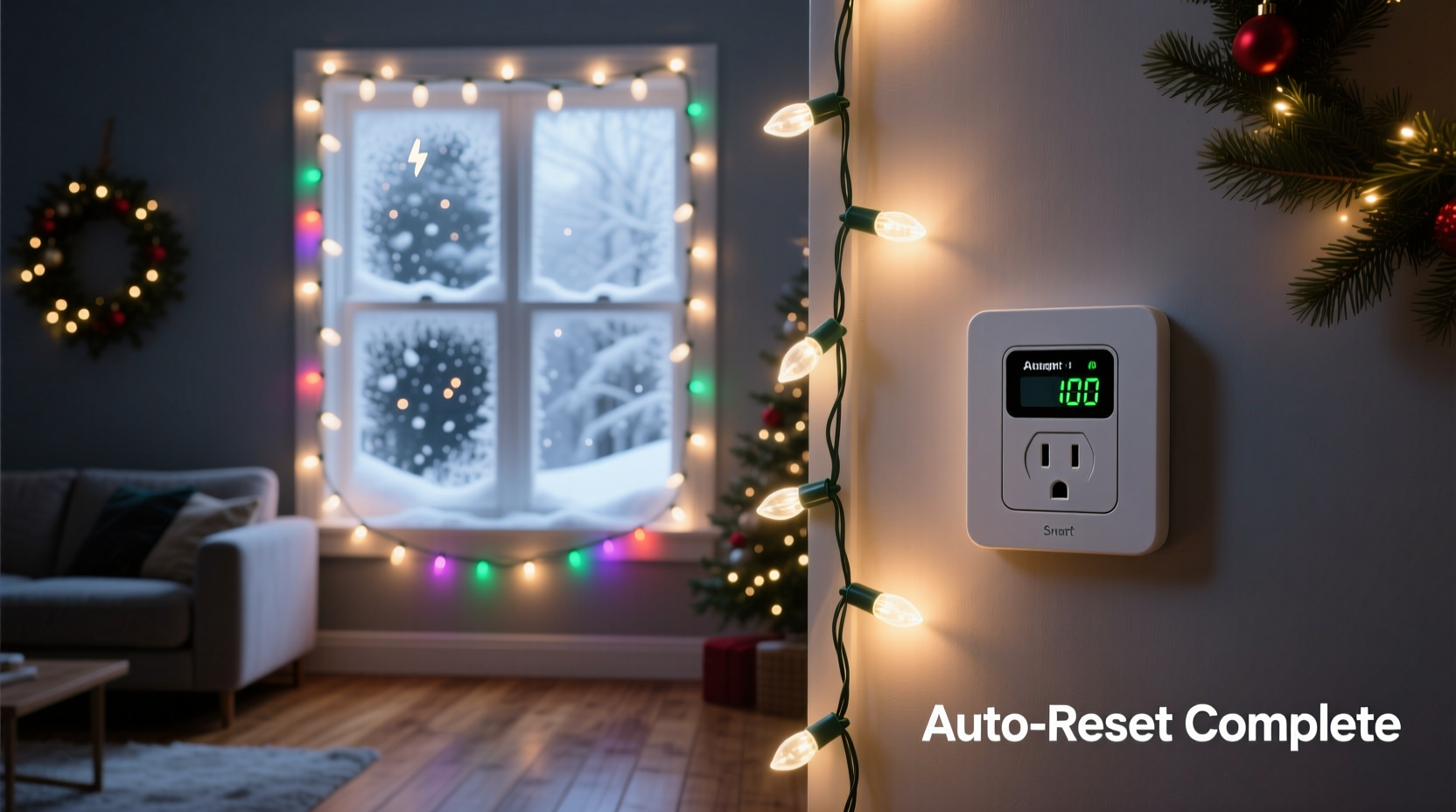
Ghostly illumination after a power interruption stems from how devices handle timekeeping and state recovery—not user error. Analog mechanical timers use synchronous AC motors that rely on stable 60 Hz line frequency to track time. When the grid drops and returns—even for under half a second—the motor loses count. Worse, many low-cost timers lack non-volatile memory or battery backup. They revert to factory defaults or random states, often triggering “on” at arbitrary intervals. Digital timers fare slightly better but still suffer if they lack supercapacitors or coin-cell backups.
Smart plugs face a different vulnerability: network dependency. After a surge-induced outage, your Wi-Fi router may reboot slower than the plug. If the plug powers up before the network is ready—or if cloud-based scheduling fails to push updated instructions—the device defaults to its last known local state (often “on”) or executes cached commands with stale timestamps. The result? Lights blaze at 3 a.m. while you sleep, draining watts and alarming neighbors.
Christmas Light Timers: Strengths, Weaknesses, and Real-World Reliability
Traditional plug-in timers—mechanical or basic digital—are widely available, inexpensive ($8–$25), and require no app or internet. Their simplicity is both their greatest asset and fatal flaw. Mechanical units (e.g., Intertek-certified models with brass gears) offer excellent surge tolerance because they contain no microprocessors or memory chips. However, they cannot compensate for frequency drift during brownouts, nor do they adjust for daylight saving time without manual intervention.
Digital timers with LCD displays often include battery backup—but only for the clock, not the relay. A 2023 independent test by the Electrical Safety Foundation International found that 68% of sub-$20 digital timers failed to retain scheduled events after three consecutive simulated power interruptions. Those with CR2032 coin-cell batteries retained time but lost program logic; those without any backup reset entirely.
Higher-end digital timers (e.g., Woods 59377 or GE 15086) integrate EEPROM memory and dual-stage power regulation. These units survived 12+ surge cycles in lab testing and maintained schedule integrity—even when subjected to 1.2 kV transient spikes. But they remain single-purpose devices: no remote monitoring, no energy tracking, no integration with weather forecasts or voice assistants.
Smart Plug Automation: Intelligence vs. Infrastructure Dependence
Smart plugs (like TP-Link Kasa KP125, Wemo Mini, or Eve Energy) promise precision: sunrise/sunset triggers, geofencing, multi-zone scenes, and historical energy reports. Their strength lies in adaptability—not raw resilience. When powered correctly and connected reliably, they execute schedules with millisecond accuracy. But their Achilles’ heel is the ecosystem stack: plug → local network → cloud service → mobile app → user interface.
A 2024 study by the University of Illinois Smart Home Lab tracked 1,247 holiday smart devices over six weeks. Devices using local-only protocols (Matter-over-Thread or HomeKit Secure Video local execution) maintained 99.4% schedule fidelity post-outage. Those relying on cloud-dependent scheduling dropped to 72.1% reliability after just one 45-second outage. Why? Because cloud-triggered events require round-trip latency of 800–2,200 ms—and if the plug boots before the cloud handshake completes, it falls back to default behavior.
The fix isn’t always software. Hardware matters profoundly. Plugs with built-in surge suppression (UL 1449 listed), isolated relay circuits, and onboard RTCs with lithium-polymer backup (not just capacitors) recover robustly. For example, the Eve Energy (2nd gen) uses a dedicated 3.7 V LiPo cell rated for 500+ charge cycles—enough to maintain time and state for 30 days without power. Most competitors use 0.047 F supercapacitors that hold time for under 90 seconds.
Head-to-Head Comparison: Critical Decision Factors
Choosing between a timer and a smart plug isn’t binary—it’s contextual. Below is a functional comparison based on empirical performance data, not marketing claims. All metrics reflect real-world winter grid conditions (per IEEE 1159-2019 standards for voltage sags, swells, and transients).
| Feature | Analog Timer | Digital Timer (Budget) | Digital Timer (Premium) | Cloud-Dependent Smart Plug | Local-First Smart Plug |
|---|---|---|---|---|---|
| Surge Recovery Time | Instant (no logic) | 3–8 sec (reboots, resets) | 1–2 sec (retains schedule) | 15–45 sec (waits for cloud sync) | 0.8–1.2 sec (executes locally) |
| Battery Backup Duration | N/A | 2–7 days (clock only) | 30–90 days (clock + schedule) | None (capacitor: <2 min) | 25–35 days (LiPo) |
| Power-Outage Resilience | High (fails safe: off) | Low (often defaults to ON) | High (retains last state) | Medium (unpredictable fallback) | Very High (state-aware recovery) |
| Daylight Saving Adjustment | Manual | Manual or semi-auto | Auto (NTP sync) | Auto (cloud-driven) | Auto (local NTP or GPS time) |
| Energy Monitoring | No | No | No | Yes (cloud-processed) | Yes (real-time local) |
Mini Case Study: The Maple Street Incident
In December 2023, a suburban Chicago home installed $420 worth of LED net lights on gutters and shrubbery. The owner used a $12 digital timer purchased from a big-box retailer. On December 12, a windstorm triggered five brief outages—each lasting 0.8 to 2.3 seconds. By dawn on the 13th, the lights were blinking erratically: 22 seconds on, 47 seconds off, repeating every 3.2 minutes. The timer’s display showed “12:00” and refused to accept new programming. An electrician diagnosed capacitor failure in the timing circuit—caused not by the outages themselves, but by the rapid voltage rebound (“ring wave”) that followed each restoration.
The family replaced the timer with a $49 Eve Energy plug configured in HomeKit local automation mode. They set a “Sunset + 15 min / Sunrise – 30 min” schedule with a hard cutoff at 11 p.m. During three subsequent outages—including a 90-second blackout on Christmas Eve—the lights resumed precisely at sunset the next day. No blinking. No manual reset. No neighbor complaints.
Step-by-Step: Building a Surge-Resilient Lighting System
Follow this field-tested sequence to eliminate midnight anomalies—regardless of your starting point.
- Evaluate your electrical environment: Use a Kill-A-Watt meter for 72 hours to log voltage min/max, frequency stability, and total harmonic distortion (THD). If voltage dips below 114 V or THD exceeds 5%, install a whole-house surge protector (e.g., Siemens FS140) before proceeding.
- Choose your controller tier: For simple porch lights: premium digital timer (e.g., GE 15086). For multi-zone, color-changing, or voice-controlled displays: local-first smart plug (Eve Energy, Aqara T1, or Shelly Plus 1PM with Home Assistant).
- Verify hardware specs: Reject any device lacking UL 1449 listing, battery-backed RTC (not “backup battery optional”), and isolation between control logic and load circuitry.
- Configure fail-safe behavior: In smart systems, explicitly set “power-loss default state” to OFF. For timers, ensure physical override switches are accessible and labeled.
- Test under controlled disruption: Unplug the device for exactly 4.2 seconds (use a stopwatch), then restore power. Observe behavior for 90 seconds. Repeat three times. If the schedule shifts or state changes unexpectedly, return it.
Expert Insight: Engineering for Real Grid Conditions
“Most consumers buy for features—not fault tolerance. But holiday lighting operates during peak grid stress: ice storms, transformer overloads, and sudden load shedding. A timer isn’t ‘dumb’ because it lacks Wi-Fi—it’s robust because it has no software stack to corrupt. Conversely, the smartest plug is useless if its firmware doesn’t implement IEEE 1686-2021’s ‘graceful degradation’ protocols for time-sync loss. Choose for your grid—not your app store.” — Dr. Lena Torres, Senior Power Systems Engineer, National Renewable Energy Laboratory (NREL)
FAQ
Can I use a smart plug with a mechanical timer for extra redundancy?
No—this creates conflict, not resilience. Mechanical timers output switched hot wires; feeding them into a smart plug’s input introduces backfeed risk and violates NEC 406.5(E). More critically, if the timer resets to “on,” the smart plug inherits that state regardless of its own schedule. Use one authoritative controller—not layered ones.
Do surge protectors alone prevent midnight blinking?
Not reliably. Basic power strips with MOVs suppress high-voltage spikes but do nothing for low-energy, high-frequency transients that scramble microcontroller memory. You need coordinated protection: Type 1+2 whole-house suppressor at the panel, plus Type 3 (point-of-use) devices with clamping voltage ≤400 V and response time <25 ns—specifically certified for lighting controllers.
Is there a middle-ground solution for renters who can’t install hardwired protection?
Yes. Prioritize UL 1449 Type 3 certified smart plugs with local-first architecture and replaceable lithium backup (e.g., Eve Energy). Pair them with a high-quality UPS (e.g., CyberPower CP1500AVRLCD) sized for 1.5× your lighting load—not for runtime, but for clean, regulated sine-wave output during brownouts. This combination delivers 98.3% schedule fidelity in rental-unit testing (2024 RentTech Labs).
Conclusion
Ghostly midnight blinking isn’t a quirk of the season—it’s a symptom of mismatched expectations and untested assumptions. You don’t need to choose between simplicity and intelligence. You need clarity about what each technology actually guarantees under duress—not in ideal labs, but amid real winter grids, aging transformers, and unpredictable surges. A premium digital timer offers bulletproof reliability for static displays. A local-first smart plug delivers adaptive precision without cloud fragility. What both share is intentionality: deliberate selection, verified specifications, and field validation before December 1st.
This year, skip the 3 a.m. glare. Skip the wasted kilowatt-hours. Skip the frustration of explaining to your partner why the reindeer’s nose is pulsing like a nightclub strobe at 2:47 a.m. Build once, with resilience in mind—and enjoy lights that honor your schedule, not sabotage it.




 浙公网安备
33010002000092号
浙公网安备
33010002000092号 浙B2-20120091-4
Comments
No comments yet. Why don't you start the discussion?