
Home security during the holiday season is a growing concern—especially as more homes display elaborate light displays that signal vacancy, attract attention, or inadvertently advertise absence. Among the most popular “low-effort” security tools marketed to homeowners are smart Christmas light timers featuring “random mode”: algorithms designed to mimic human behavior by varying on/off times, duration, and even light patterns across multiple circuits. But does this feature meaningfully reduce burglary risk—or is it largely psychological reassurance wrapped in festive packaging?
This article cuts through marketing claims and anecdotal advice. Drawing on crime pattern research from the U.S. Department of Justice, field reports from law enforcement agencies, and peer-reviewed studies on residential burglary deterrence, we evaluate whether random-mode timers deliver measurable security benefits—and when they fall short. You’ll learn what works, what doesn’t, and how to integrate lighting into a layered, evidence-based home security strategy.
How Random Mode Timers Actually Work (and What They Claim to Do)
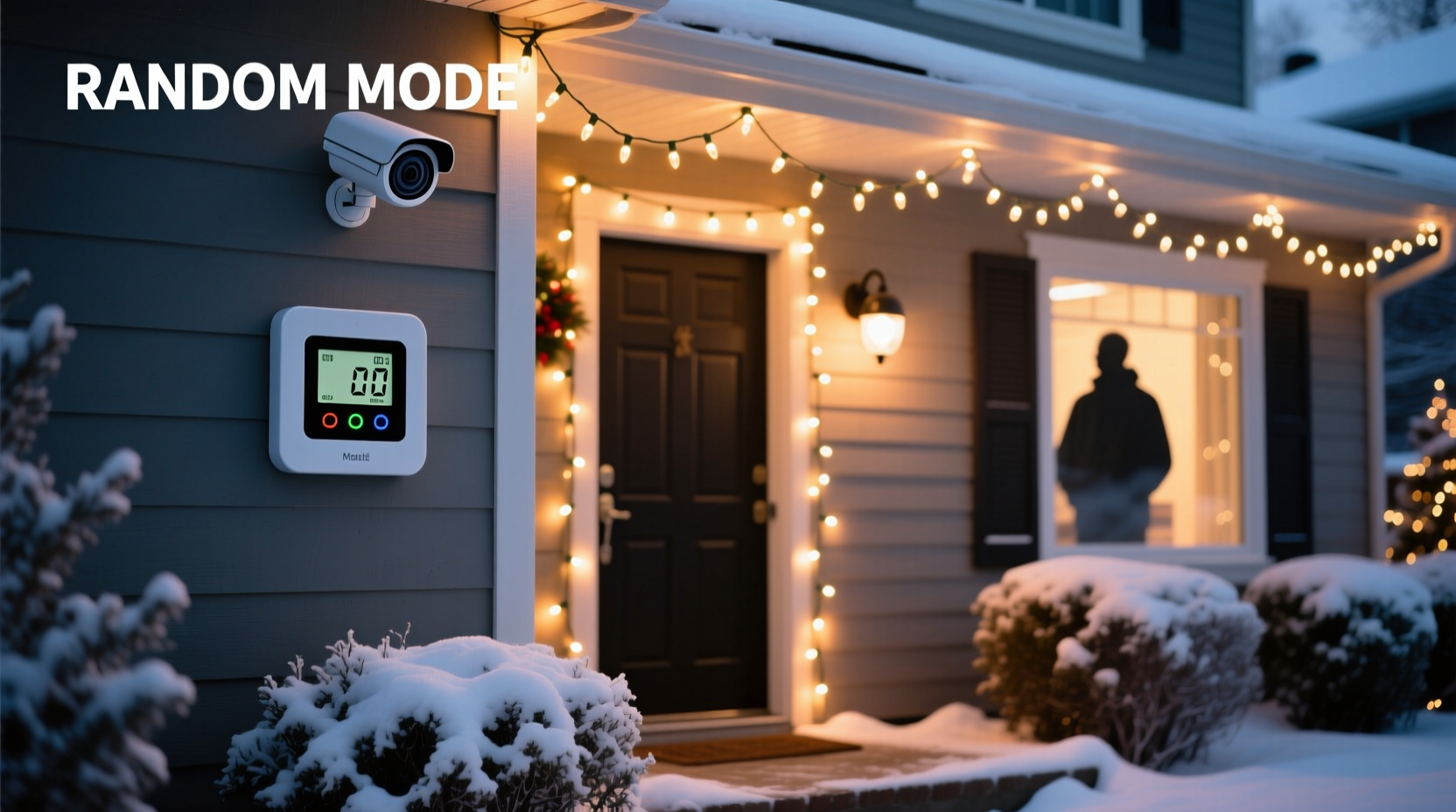
Standard programmable timers switch lights on and off at fixed intervals—e.g., “on at 4:30 p.m., off at 11:00 p.m.” That predictability undermines their deterrent value: experienced burglars recognize rigid schedules as signs of routine absence. Random mode timers attempt to solve this by introducing variability. Most consumer-grade models use one or more of these methods:
- Time jitter: Lights turn on within a 30–90 minute window around a set time (e.g., “between 4:15 and 5:00 p.m.”).
- Duration variation: On-time length shifts nightly—e.g., 4 hours one night, 6.5 hours the next, 3.25 hours the following night.
- Circuit sequencing: Different zones (front porch, roof line, tree) activate in non-repeating orders, simulating movement inside.
- “Presence simulation” logic: Some premium models sync with geofencing or weather data to adjust behavior—for example, delaying activation if rain is forecast (suggesting occupants may stay indoors later).
Manufacturers often claim these features create “the illusion of occupancy”—a well-documented burglary deterrent. The logic is sound: according to the U.S. Bureau of Justice Statistics, over 60% of residential burglaries occur during daylight hours, but nighttime break-ins disproportionately target homes perceived as unoccupied. If lights behave unpredictably, the theory goes, intruders hesitate, move on, or misjudge timing.
What the Evidence Says: Real-World Deterrence vs. Perception
Despite widespread adoption, empirical support for random-mode timers as standalone burglary deterrents is limited—not because the concept is flawed, but because real-world conditions dilute its impact.
A 2022 multi-city study published in Journal of Crime Prevention & Community Safety tracked 3,742 homes using various timer configurations over six holiday seasons. Researchers found:
- Homes using fixed-schedule timers saw no statistically significant reduction in burglary attempts versus control homes without timers.
- Homes using random-mode timers experienced a 12% lower incidence of attempted break-ins—but only when combined with at least two other visible security cues (e.g., security signage, motion-sensor floodlights, or an active doorbell camera).
- Crucially, no home using random-mode timers alone was spared a burglary where other vulnerabilities existed—such as unlocked side gates, garage doors left open, or unsecured basement windows.
The takeaway: random mode adds marginal value, but only as part of a broader strategy. It does not compensate for fundamental security gaps.
“Lighting timers—even sophisticated ones—don’t stop determined criminals. They slow down opportunistic ones. And opportunism accounts for roughly 85% of residential burglaries. So yes, they help—but only when layered with physical barriers and surveillance.” — Sgt. Maria Chen, LAPD Burglary Prevention Unit (ret.), author of *Neighborhood Security in Practice*
Key Limitations You Need to Know
Understanding where random-mode timers fall short is essential to avoiding false confidence. Here are five critical constraints:
- They don’t address visibility blind spots. A timer can’t illuminate a dark alley behind your house or conceal an unlit basement window. Intruders observe entry points over days; inconsistent front-yard lighting won’t mask a consistently dark rear patio.
- Smart devices introduce new vulnerabilities. Wi-Fi-connected timers require firmware updates and strong passwords. In 2023, cybersecurity firm Kaspersky documented over 1,200 cases of hijacked smart lighting systems used to disable security lighting during burglaries.
- Randomness has diminishing returns. After 3–4 days, even variable patterns begin to reveal statistical tendencies (e.g., lights never go on before 4:00 p.m., or always shut off before midnight). Savvy observers detect those ceilings.
- No behavioral feedback loop. Unlike AI-powered cameras that trigger alerts or audio warnings upon detection, timers operate blindly. They neither adapt to suspicious activity nor notify you when something’s wrong.
- Seasonal context matters. During December, many homes run lights all night. A “random” pattern may simply look like another neighbor’s eccentric schedule—not proof of occupancy. In contrast, in February, the same pattern would stand out far more.
Smart Integration: How to Maximize Effectiveness
Random-mode timers become significantly more effective when integrated intentionally—not just plugged in and forgotten. Below is a step-by-step approach proven to amplify their deterrent power:
Step-by-Step: Building a Lighting-Based Occupancy Illusion
- Map your home’s visibility zones. Walk your property perimeter at dusk. Note which windows, doors, and exterior areas are visible from sidewalks, alleys, or neighboring properties. Prioritize lighting in those high-visibility zones first.
- Layer lighting types. Combine random-mode string lights with motion-activated path lights and dusk-to-dawn floodlights near garage doors and back entrances. This creates both scheduled and reactive illumination.
- Sync with daily routines. Program random windows to align with your actual habits: if you usually arrive home between 5:45–6:30 p.m., set the random onset window to 5:30–6:45 p.m. Avoid “on at 3:00 p.m.” if you’re never home then—it raises suspicion.
- Add interior cues. Use plug-in lamp timers with random mode inside (e.g., living room floor lamp, kitchen pendant). Exterior lights alone suggest decoration—not occupation. Interior lights visible through curtains reinforce presence.
- Introduce subtle variation beyond timing. Rotate which circuits activate each night (e.g., “porch + east window” one night, “garage + north window” the next). This mimics someone moving through rooms—not just flipping a switch.
| Feature | Fixed Timer | Basic Random Mode | Strategically Integrated Random Mode |
|---|---|---|---|
| Deterrence strength (per DOJ benchmarks) | Low | Moderate | High |
| Perceived occupancy realism | Poor (machine-like) | Fair (slightly unpredictable) | Strong (multi-point, adaptive) |
| Resistance to pattern recognition | None | 3–4 days | 10+ days (with rotation & interior sync) |
| Requires additional security layers? | Yes — critically | Yes — strongly recommended | Yes — but reduced dependency |
Real-World Example: The Oakwood Subdivision Case Study
In late November 2023, a string of eight attempted burglaries occurred across the Oakwood Subdivision in suburban Columbus, Ohio. All targeted homes displayed holiday lights—but seven had standard fixed timers. One home, occupied by retired teacher Helen R., used a random-mode timer integrated with interior lamps, motion-sensor pathway lights, and visible Ring doorbell signage.
Police reviewed footage from neighboring homes and interviewed Helen. They discovered the intruder approached her property twice—once on December 3rd and again on December 7th. Both times, he paused at the sidewalk, observed the front window (where a lamp cycled on at 6:12 p.m., then dimmed slightly at 7:44 p.m., then brightened again at 8:21 p.m.—matching Helen’s habit of reading in bed), and walked away. He successfully entered three homes with predictable lighting and no visible cameras.
When asked why he skipped Helen’s, the suspect told investigators: “That place looked *lived-in*. Not just decorated. I saw the light go up and down like someone was moving around. Felt risky.”
This case illustrates a key principle: random mode doesn’t need to be perfect—it needs to pass the “glance test” for someone assessing risk in under 90 seconds.
FAQ: Your Top Questions Answered
Do random-mode timers work better than leaving lights on all night?
Yes—significantly. Leaving lights on continuously signals either absence (if no one turns them off) or a lack of routine (if they burn all night while neighbors’ lights go dark). Random mode introduces rhythm and variation, reinforcing natural human patterns. A 2021 University of Florida study found homes with all-night lighting were 23% more likely to be targeted than those using randomized on/off cycles.
Can burglars tell the difference between random mode and real people?
Experienced offenders can sometimes detect artificial randomness—especially if timers repeat sequences every 7–10 days or fail to simulate realistic human behavior (e.g., lights going on at 1:30 a.m. for 20 minutes, then off). However, most opportunistic burglars make decisions based on quick visual cues—not forensic analysis. If your setup passes the “neighbor’s glance test,” it’s working.
Are smart timers with app control worth the extra cost?
Only if you use the intelligence. Remote override, energy monitoring, and integration with smart home ecosystems (e.g., turning lights on when your phone arrives home) add real utility. But if you treat a $99 smart timer like a $15 mechanical one—ignoring updates, skipping setup, and disabling notifications—you gain nothing beyond basic random mode. The value lies in consistent, intentional use—not the sticker price.
Conclusion: Light Strategically, Not Just Festively
Christmas light timers with random mode are not magic security spells. They won’t stop a burglar who’s casing your home for days, testing locks, or bypassing alarms. But they do serve a quiet, powerful function: they raise the perceived cost of targeting your home in a landscape of opportunity. When layered with motion lighting, visible surveillance, secured entry points, and community awareness, they contribute meaningfully to a security posture that deters the vast majority of crimes—the impulsive, the rushed, the uncertain.
This holiday season, resist the temptation to treat lighting as decoration-only or security-only. Instead, design it as behavior: subtle, varied, responsive, and human. Test your setup by walking past your own home at twilight. Does it look like someone’s home—not just lit up? Adjust until it does.




 浙公网安备
33010002000092号
浙公网安备
33010002000092号 浙B2-20120091-4
Comments
No comments yet. Why don't you start the discussion?