
As the holiday season approaches, homes across neighborhoods begin to glow with festive cheer. Strings of Christmas lights twinkle on rooftops, porches, and trees—symbols of celebration and warmth. But beyond aesthetics, these lights can play a crucial role in home security. When used strategically with timers, they create the illusion of occupancy, a proven deterrent against potential intruders. The real question isn’t whether to use a timer—but which type works best: fixed schedule or random mode? Understanding the differences between these two approaches can mean the difference between an inviting target and a well-protected home.
Why Light Timers Matter for Burglary Prevention
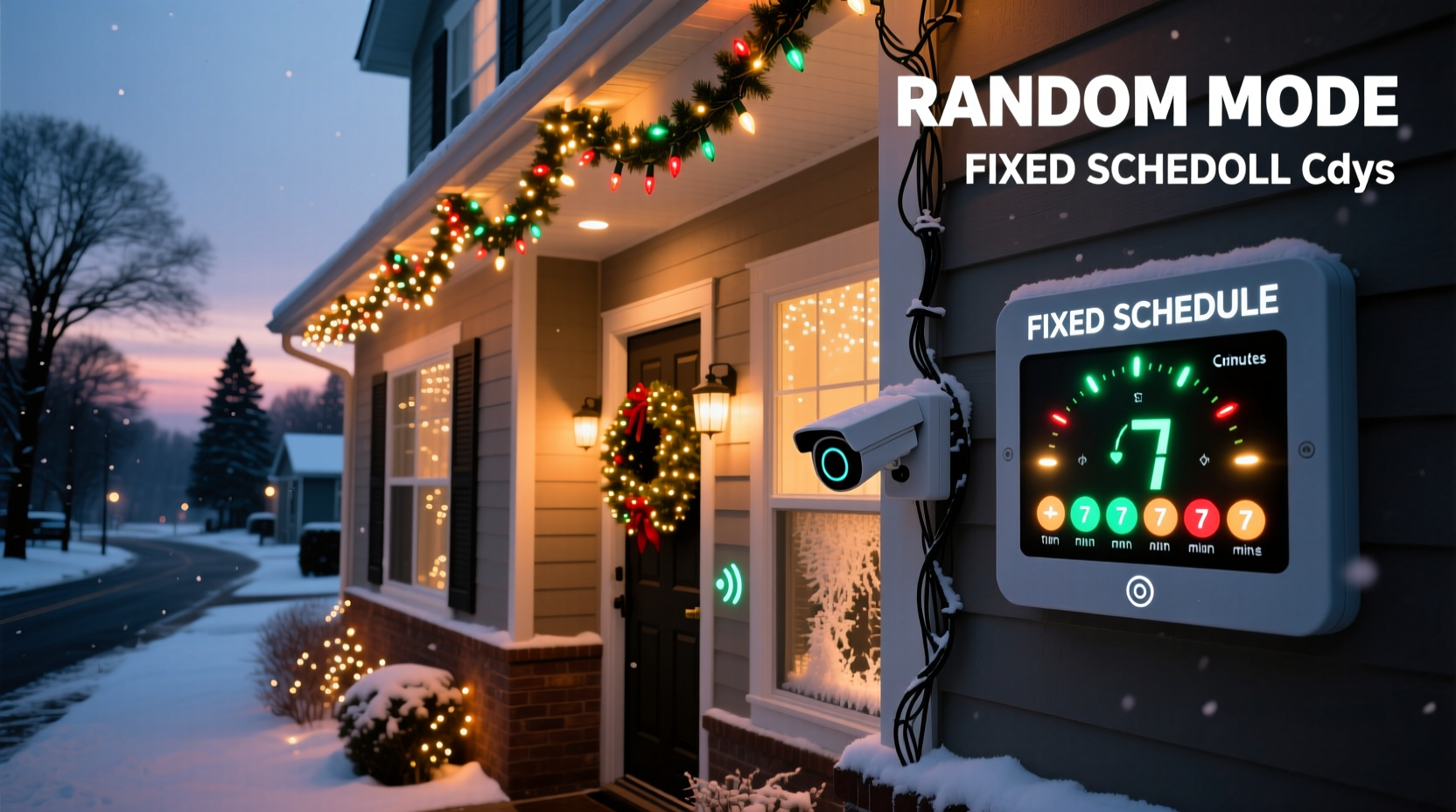
Burglars don’t just look for valuables—they look for opportunity. A dark, unoccupied house signals vulnerability. According to a 2023 FBI report on property crime trends, nearly 60% of residential break-ins occur during daylight hours when homeowners are likely at work. However, evening hours remain high-risk periods, especially during winter months when darkness falls early and blinds are drawn.
Light timers simulate human presence by turning indoor and outdoor lights on and off at regular intervals. This simple act disrupts a burglar’s risk assessment. As Detective Mark Renner of the Seattle Police Department explains:
“Criminals avoid homes that appear occupied. Even small signs—like a lamp turning on at 7 p.m.—can be enough to make them move on.” — Detective Mark Renner, Seattle Police Department
The key is consistency without predictability. While any form of timed lighting is better than none, not all timers are created equal. Fixed schedules offer reliability, while random modes introduce variability. Each has strengths and weaknesses when it comes to mimicking real human behavior.
Fixed Schedule Timers: Predictable but Reliable
Fixed schedule timers operate on a set time each day. For example, you might program your porch lights to turn on at 5:30 p.m. and shut off at 11:00 p.m., every single night. These devices are straightforward, often built into basic plug-in outlets or smart home systems.
Their strength lies in dependability. Homeowners know exactly when lights will activate, making it easy to coordinate with routines or family schedules. They’re also widely available, affordable, and compatible with most lighting setups.
However, this consistency can become a liability. Over time, a fixed pattern becomes predictable. A persistent observer—a neighbor, delivery driver, or would-be intruder—can quickly learn the rhythm. Once they recognize that lights come on precisely at 5:30 and go off at 11:00—even when no one enters or leaves—the illusion of occupancy weakens.
Random Mode Timers: Mimicking Human Behavior
Random mode timers take a more sophisticated approach. Instead of following a rigid clock, they switch lights on and off at irregular intervals within a user-defined window—say, between 6:00 p.m. and midnight. Some models even simulate movement by toggling different circuits randomly, giving the impression someone is walking through rooms or adjusting lamps.
This randomness closely mirrors actual human behavior. People don’t flip switches at the same second every night. One evening, you might turn on the living room light at 6:45; the next, it’s 7:10 after dinner. Random timers replicate this unpredictability, making surveillance far more difficult for criminals.
Advanced versions integrate with smart home ecosystems (like Alexa or Google Home), allowing remote adjustments, geofencing triggers, or integration with other security systems. Some even use AI to learn typical household patterns and generate realistic lighting sequences.
How Randomization Enhances Security
A study conducted by the University of North Carolina’s Department of Criminology found that homes with variable lighting patterns were 38% less likely to be targeted than those with consistent illumination. Researchers concluded that “unpredictable interior lighting was one of the strongest environmental cues indicating active occupancy.”
Unlike fixed timers, random-mode devices reduce the chance of behavioral profiling. Even if someone watches your house over several nights, they won’t detect a repeatable sequence. This uncertainty increases perceived risk for burglars, who prefer quick, low-effort targets.
Comparing Both Approaches: A Practical Breakdown
| Feature | Fixed Schedule Timer | Random Mode Timer |
|---|---|---|
| Predictability | High – same times daily | Low – varies within set range |
| Setup Complexity | Simple – easy programming | Moderate to high – may require app setup |
| Cost | $5–$15 (basic models) | $20–$50+ (smart/random models) |
| Lifespan & Reliability | Long – mechanical simplicity | Varies – depends on electronics |
| Burglary Deterrence Effectiveness | Moderate – effective short-term | High – long-term advantage |
| Best For | Renters, budget users, temporary use | Homeowners, frequent travelers, security-conscious |
The data suggests that while both types offer protection, random mode timers provide superior long-term deterrence due to their ability to mimic natural human inconsistency.
Real-World Example: The Portland Holiday Break-In Trend
In December 2022, Portland, Oregon experienced a spike in residential burglaries during the holiday week between Christmas and New Year’s. Police noted a disturbing pattern: many victims had decorative lights on timers, but nearly all used fixed schedules. Surveillance footage from nearby cameras revealed suspects casing homes for multiple evenings, noting when lights turned on and off.
One homeowner, Sarah Lin, returned from vacation to find her back door jimmied open. Her front yard displayed a perfect row of synchronized red-and-green lights—on at 5:15 p.m., off at 10:45 p.m., every night. Neighbors reported seeing a man taking photos of her house mid-day. After reviewing the evidence, detectives confirmed he had mapped her lighting routine and struck on a night when the lights went off early—assuming she’d gone to bed.
In contrast, a few blocks away, another home remained untouched despite being vacant. That house used a smart timer with randomized indoor lighting—different rooms activated each night, sometimes earlier, sometimes later. No consistent pattern emerged. The same suspect was seen loitering but left without attempting entry.
This case illustrates how subtle differences in timer strategy can have real-world consequences.
Step-by-Step Guide: Choosing and Setting Up the Right Timer
Selecting the right Christmas light timer involves more than price or convenience—it’s about aligning with your security goals. Follow this timeline to implement an effective system before the holidays begin.
- Assess Your Risk Profile (Week 1): Are you traveling? Do you live in a high-density neighborhood or isolated area? Frequent travelers benefit more from randomization.
- Inventory Your Lighting Setup (Week 2): List all indoor and outdoor outlets where lights or lamps will be connected. Note wattage requirements and accessibility.
- Choose Between Fixed and Random (Week 3): Opt for random mode if security is a priority. Consider smart plugs like Kasa Smart Wi-Fi Timer or GE Cync for advanced features.
- Install and Test (Week 4): Plug in devices, connect to Wi-Fi if applicable, and run test cycles. Ensure lights turn on/off as expected. Walk outside at night to verify visibility.
- Introduce Variability (Ongoing): Even with fixed timers, change the schedule weekly. With random timers, review logs monthly to confirm activity variation.
Checklist: Optimizing Your Holiday Lighting for Security
- ✅ Use timers on both indoor and outdoor lights
- ✅ Choose random mode for higher security needs
- ✅ Avoid syncing all lights to turn on/off simultaneously
- ✅ Position lights so interiors are partially visible from street level
- ✅ Pair with motion-sensor floodlights for layered defense
- ✅ Change settings weekly if using fixed timers
- ✅ Inform trusted neighbors of your schedule for added monitoring
Frequently Asked Questions
Can burglars tell the difference between real occupancy and a timer?
Yes—especially with fixed schedules. Experienced offenders watch for patterns over multiple days. Consistent on/off times, lack of interior movement, or absence of vehicle activity can signal automation. Randomized lighting combined with occasional radio or TV sounds increases believability.
Are smart timers worth the extra cost?
For most homeowners, yes. Beyond randomization, smart timers offer remote control, scheduling updates via smartphone, and integration with security cameras or alarms. The added layer of control pays off during unexpected travel changes or emergencies.
Should I use timers only on Christmas lights?
No. While decorative lights contribute, indoor lighting has greater psychological impact. A lit living room window suggests someone is watching TV; a kitchen light implies late-night snacking. Use timers on lamps in frequently used rooms, not just holiday displays.
Expert Insight: What Law Enforcement Recommends
Captain Lisa Tran of the Austin Police Department’s Community Safety Division emphasizes proactive measures:
“We always recommend residents make their homes look lived-in, especially during holidays. We’ve seen cases where a simple random-light timer made the difference. It’s not about complexity—it’s about creating doubt in the criminal’s mind.” — Captain Lisa Tran, Austin PD
She advises combining lighting strategies with other low-cost tactics: pausing mail delivery, asking neighbors to park in your driveway occasionally, and installing visible security signage—even without a full system.
Conclusion: Make Your Home Unappealing to Intruders
When it comes to deterring burglars, perception is everything. A house that looks occupied—even subtly—is far less tempting than one shrouded in silence and darkness. While both fixed and random timers serve a purpose, the latter offers a distinct edge in mimicking authentic human behavior. In the battle against break-ins, unpredictability wins.
This holiday season, go beyond decoration. Treat your lighting plan as part of your home’s security infrastructure. Invest in a quality random-mode timer, layer it with indoor automation, and maintain variability throughout the month. Small efforts compound into strong protection.




 浙公网安备
33010002000092号
浙公网安备
33010002000092号 浙B2-20120091-4
Comments
No comments yet. Why don't you start the discussion?