
As the holiday season approaches, homes across neighborhoods light up with dazzling Christmas displays. While stringing lights brings joy, it also introduces real electrical risks—especially when circuits are overloaded. One of the most overlooked yet critical tools in holiday lighting safety is understanding how to calculate your transformer’s load capacity. Without this knowledge, you risk tripped breakers, damaged equipment, or even fire hazards.
Modern outdoor lighting setups often rely on low-voltage transformers that convert standard 120V household current into safer 12V or 24V outputs. These transformers power landscape lighting, pathway markers, and decorative features. But they have limits. Exceeding those limits doesn’t just dim your display—it compromises safety. A proper Christmas light transformer load calculator isn't a physical device; it's a methodical approach to measuring wattage, voltage, and amperage so you can stay within safe operating ranges.
Why Transformer Load Matters for Holiday Lighting
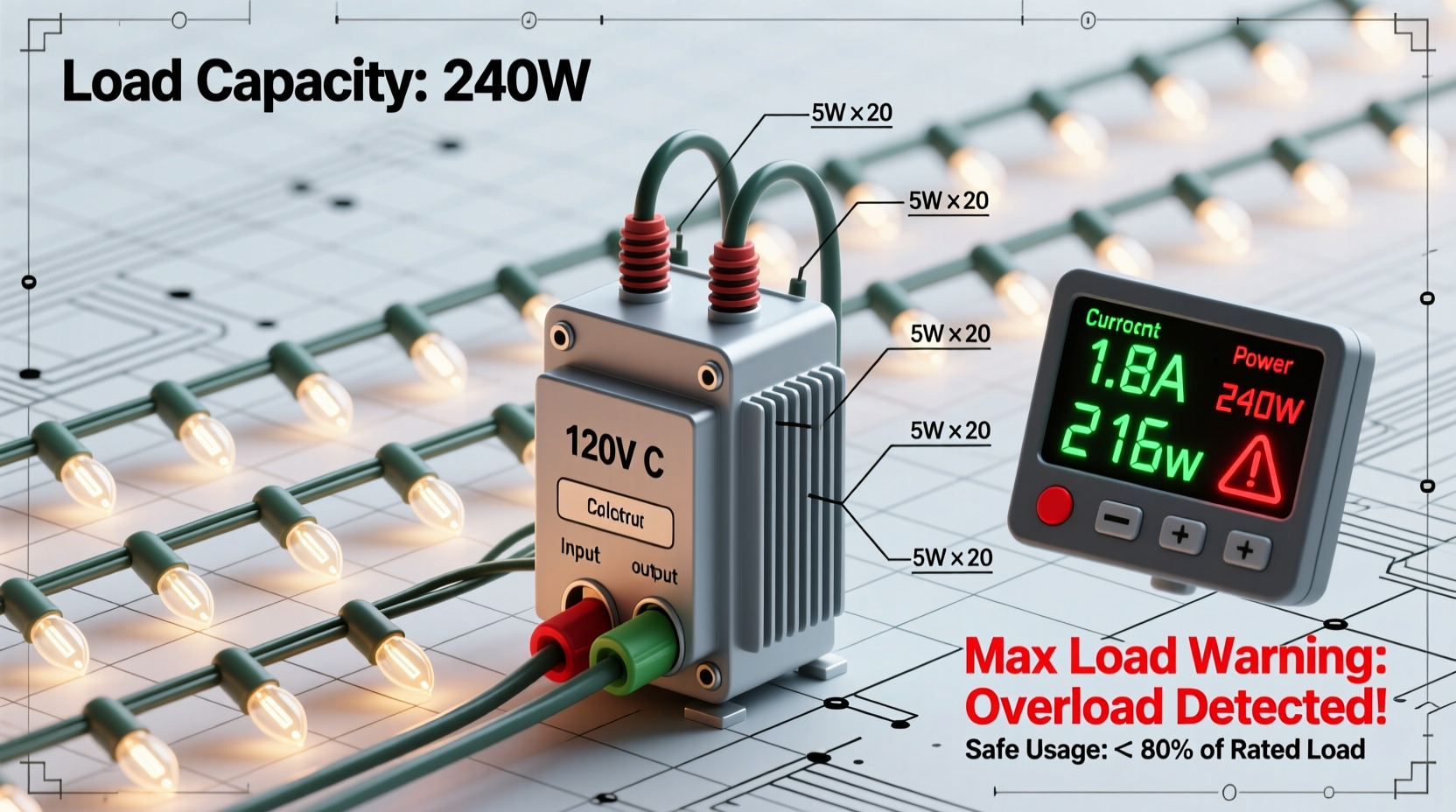
A transformer acts as a gatekeeper between your home’s electrical system and your low-voltage lighting network. When too many lights draw more power than the transformer can supply, several issues arise:
- Voltage drop: Lights at the end of long runs appear dimmer because insufficient voltage reaches them.
- Overheating: Transformers strain under excess load, potentially shortening their lifespan or causing failure.
- Circuit trips: Overloaded circuits trigger GFCI outlets or main breakers, cutting off power unexpectedly.
- Safety risks: In extreme cases, overheated wiring can lead to insulation damage or fire.
The National Electrical Code (NEC) recommends operating transformers at no more than 80% of their rated capacity for continuous loads—those running three hours or longer, which includes most holiday displays. This safety margin ensures reliability and reduces stress on components.
“Many homeowners don’t realize that overloading a transformer is like forcing an engine beyond its redline—it may work briefly, but long-term damage is inevitable.” — Mark Reynolds, Licensed Electrician & Outdoor Lighting Consultant
How to Calculate Transformer Load: Step-by-Step Guide
To avoid overloading your transformer, follow this systematic process using basic electrical principles. You’ll need only a few details: the total wattage of your lights, the transformer’s output rating, and the length of your cable runs.
Step 1: Gather Your Light Specifications
Check each light set or fixture for its wattage. Most LED landscape lights use 1–5 watts per bulb. Multiply the number of bulbs by individual wattage to get total system wattage.
Step 2: Determine Total System Wattage
Add up all connected devices. For example:
- 12 path lights × 3W = 36W
- 8 spotlights × 4W = 32W
- 1 string of 50 mini-lights = 20W
Total = 88 watts
Step 3: Check Transformer Capacity
Transformers are rated in volt-amperes (VA), which for resistive loads like lighting equals watts. A 150VA transformer can handle up to 150 watts. However, applying the 80% rule: 150 × 0.8 = 120 watts maximum recommended load.
In our example, 88W is well under 120W—so the transformer is adequately sized.
Step 4: Verify Voltage Compatibility
Ensure all lights operate at the same voltage (e.g., 12V or 24V). Mixing voltages causes malfunction or damage. Most residential systems use 12V for flexibility and brightness control.
Step 5: Account for Cable Length and Gauge
Long wire runs increase resistance, leading to voltage drop. Use thicker gauge wire (lower AWG number) for distances over 30 feet. For example:
| Distance from Transformer | Recommended Wire Gauge | Max Recommended Load (12V) |
|---|---|---|
| Up to 25 ft | 16 AWG | 75W |
| 25–50 ft | 14 AWG | 150W |
| 50–100 ft | 12 AWG | 200W |
Ignoring wire gauge can result in poor performance—even with a properly sized transformer.
Real Example: The Overloaded Front Yard Display
Consider a homeowner in Denver who installed a new holiday lighting setup. They purchased a single 120VA transformer and connected:
- 15 LED path lights (3W each) = 45W
- 10 tree uplights (5W each) = 50W
- Two strings of net lights (each 25W) = 50W
Total load: 145W — already exceeding the transformer’s 120W safe limit.
Within two nights, the display began flickering. By day five, the transformer shut down completely. After calling an electrician, they learned the unit had overheated due to sustained overload. The fix? Replace with a 200VA transformer and split high-draw zones onto separate circuits.
This scenario underscores why estimation isn’t enough. Precise calculation prevents costly mistakes and downtime during peak viewing times.
Do’s and Don’ts of Transformer Management
Follow these guidelines to maintain efficiency and safety throughout the season.
| Do | Don’t |
|---|---|
| Calculate total wattage before installation | Plug in lights without checking ratings |
| Use timers or smart controllers to reduce runtime | Run lights 24/7 unless necessary |
| Inspect connections annually for corrosion | Ignore signs of overheating (buzzing, discoloration) |
| Label circuits clearly for troubleshooting | Mix different voltage systems on one transformer |
| Upgrade to energy-efficient LEDs | Use indoor-rated transformers outdoors |
Build Your Own Load Calculator: Simple Formula
You don’t need software to assess your setup. Use this formula:
Total Load (Watts) = Σ(Number of Fixtures × Wattage per Fixture)
Then compare to transformer capacity:
Safe Maximum Load = Transformer Rating × 0.8
If Total Load ≤ Safe Maximum Load → OK
If Total Load > Safe Maximum Load → Upgrade transformer or reduce load
For amperage-based checks (useful if specs list amps):
Current (Amps) = Total Watts ÷ Output Voltage
Example: 96W ÷ 12V = 8A. If transformer max output is 10A, you’re within range (but still apply 80% rule: 10A × 0.8 = 8A usable).
Checklist: Pre-Installation Safety Review
Before powering up your display, complete this checklist:
- ☑ List every light and its wattage
- ☑ Sum total system wattage
- ☑ Confirm transformer VA rating and voltage output
- ☑ Apply 80% rule to determine safe load limit
- ☑ Compare total load vs. safe limit
- ☑ Select appropriate wire gauge based on run length
- ☑ Ensure all lights match transformer voltage
- ☑ Install GFCI protection on primary circuit
- ☑ Test system incrementally—add sections gradually
- ☑ Monitor transformer temperature after first full night
Frequently Asked Questions
Can I connect multiple transformers to one outlet?
Yes, but only if the outlet’s circuit can handle the combined input load. Each transformer draws AC power from the wall. For example, two 150VA transformers draw about 1.25A each (150W ÷ 120V), totaling 2.5A. A standard 15A circuit can support multiple units—but avoid daisy-chaining extension cords. Use a power strip with surge protection instead.
What happens if I exceed the transformer’s load?
Short-term effects include dimming lights, overheating, and shutdowns. Long-term consequences involve shortened transformer life, melted connectors, or fire risk. Some models have thermal cutoffs that reset when cooled, but repeated cycling damages internal components.
Are LED lights really better for transformer load?
Absolutely. LEDs typically use 70–90% less power than incandescent bulbs. A traditional 20-light strand might draw 40W; an equivalent LED version uses just 4–6W. This dramatic reduction allows more lights per transformer and reduces overall electrical demand.
Advanced Tips for Large Displays
For expansive holiday setups—such as multi-zone yard lighting or synchronized displays—consider these strategies:
- Zoning: Divide your layout into zones powered by separate transformers. This isolates faults and improves voltage stability.
- Dedicated Circuits: Run transformers from dedicated indoor outlets backed by individual breakers to prevent interference with other appliances.
- Smart Monitoring: Use Wi-Fi-enabled transformers or smart plugs to monitor energy usage and schedule operation times.
- Future-Proofing: Choose transformers with 25–50% extra capacity to accommodate future expansions.
- Weather Protection: House transformers in weatherproof enclosures mounted above ground level to prevent water ingress.
Professional installers often use dual-tap transformers that offer both 12V and 14V outputs. The higher tap compensates for voltage drop over long distances, ensuring consistent brightness at far ends of the circuit.
Conclusion: Light Up Safely and Smartly
Holiday lighting should inspire wonder—not worry. By applying simple electrical math and respecting equipment limits, you protect your home, family, and investment. The concept of a “Christmas light transformer load calculator” may sound technical, but it boils down to one principle: know what your system consumes and what your equipment can safely deliver.
Taking time to calculate load isn’t an obstacle—it’s empowerment. It lets you design bolder displays with confidence, knowing every bulb has the power it needs without pushing boundaries. Whether you're illuminating a single tree or transforming your entire property, thoughtful planning leads to brighter, safer results.




 浙公网安备
33010002000092号
浙公网安备
33010002000092号 浙B2-20120091-4
Comments
No comments yet. Why don't you start the discussion?