
There’s nothing more frustrating than stringing up your holiday lights, plugging them in, and seeing only every third bulb glowing. The rest remain dark, breaking the rhythm of your display and raising questions about safety and function. This pattern—where one bulb lights and two don’t—is not random. It’s a symptom of a specific electrical configuration common in series-wired mini Christmas lights. Understanding why this happens and how to systematically troubleshoot it can save you time, money, and the hassle of replacing entire strands unnecessarily.
Most traditional incandescent mini lights are wired in series, meaning electricity flows through each bulb in sequence before returning to the power source. In many modern sets, especially those with 35 or 50 bulbs per strand, manufacturers use a three-wire design or shunted sockets to allow partial functionality even when a bulb fails. When only every third bulb lights up, it typically means that a critical break has occurred in the circuit—often due to a single faulty bulb, loose connection, or damaged socket—that disrupts power to the subsequent two bulbs in the group.
How Series Wiring Causes Every Third Bulb to Light
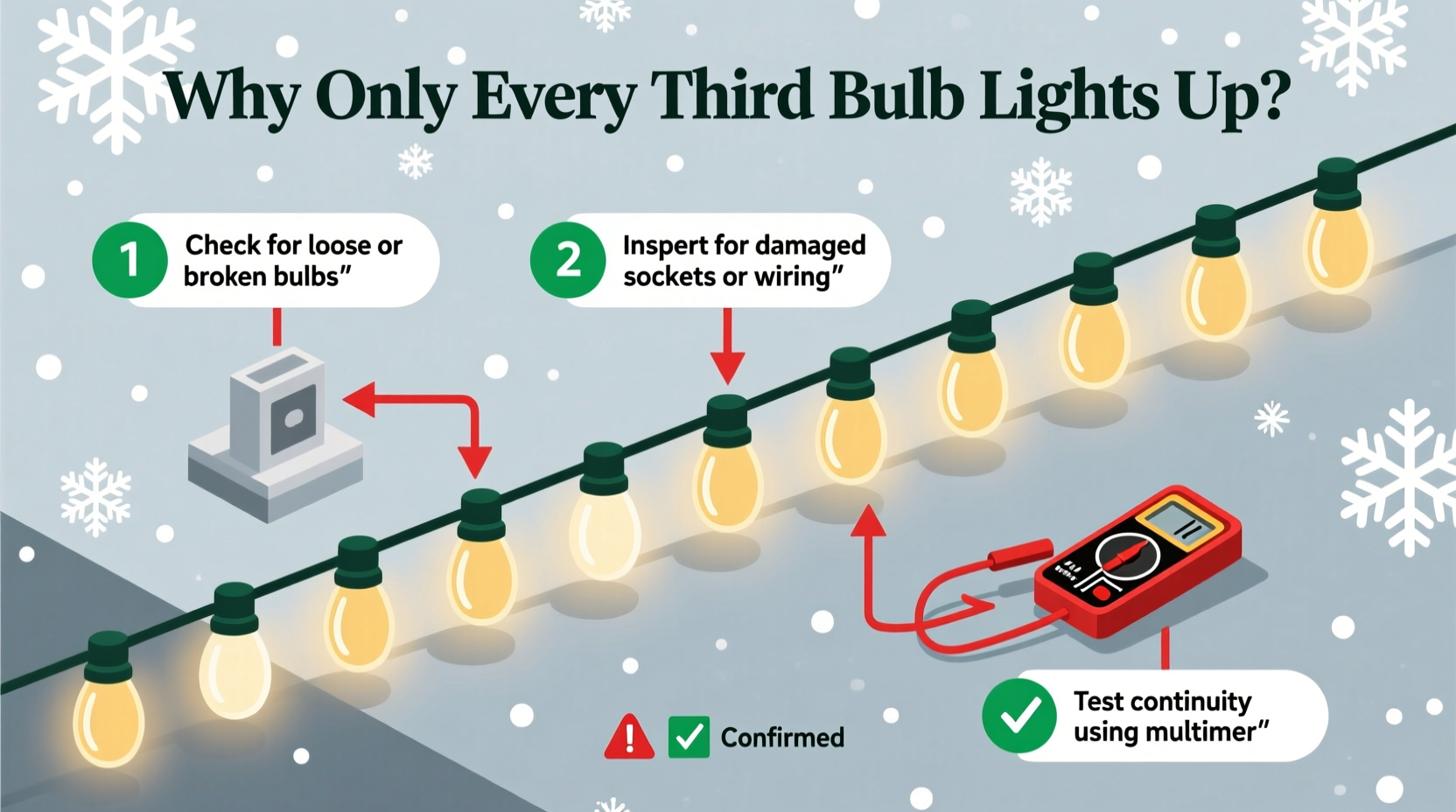
In a standard series circuit, if one bulb burns out, the entire strand goes dark because the circuit is broken. However, many newer Christmas light sets incorporate shunted sockets—small conductive pathways inside the bulb base that allow current to bypass a dead filament. This innovation lets the rest of the strand stay lit even if one bulb fails. But there's a catch: these shunts only work under certain conditions.
When a bulb is removed or its shunt fails to activate, the circuit breaks for the next segment. In configurations where three bulbs share a voltage drop (common in 3.5-volt bulbs on a 120-volt line), the failure of one bulb can prevent the next two from receiving adequate power—even if the shunt is present. As a result, you see a repeating pattern: one working bulb, followed by two dark ones.
“Modern mini lights are designed for redundancy, but they’re only as reliable as their weakest connection. A single corroded contact or misaligned bulb can throw off an entire section.” — Alan Reeves, Electrical Technician & Holiday Lighting Specialist
Troubleshooting Flowchart: Step-by-Step Diagnosis
Follow this logical diagnostic process to identify and resolve the issue efficiently. This step-by-step guide walks you through inspection, testing, and repair without requiring advanced tools.
- Unplug the strand immediately. Safety first. Never handle electrical components while powered.
- Inspect visually for obvious damage. Look for cracked bulbs, bent filaments, melted sockets, or frayed wires. Pay close attention to the area around non-lighting bulbs.
- Check for loose bulbs. Gently press each bulb into its socket, starting near the first dark bulb after a lit one. Poor contact is a common cause of partial lighting.
- Test with a known-good replacement bulb. Swap out the first unlit bulb in the dark pair using a fresh bulb from a spare pack. Reconnect and test.
- Use a Christmas light tester (optional). These handheld devices detect current flow without removing bulbs. Pass the tester along the strand to locate the exact point where voltage drops.
- Examine the shunt connections. Remove suspect bulbs and inspect the metal tabs inside the socket. Corrosion or debris can block conductivity even if the bulb appears seated.
- Check for wire continuity. If no bulb fixes the issue, use a multimeter to test for continuity between sections. A break in the wire will require splicing or replacement.
- Verify plug and fuse integrity. Open the plug compartment and inspect the fuses. Replace with identical-rated fuses only. Test with a new fuse even if the old one looks intact.
Common Failure Points and How to Address Them
The root cause of the “every third bulb lit” issue usually lies in one of five areas. Identifying which one saves hours of guesswork.
| Failure Point | Symptoms | Solution |
|---|---|---|
| Faulty bulb with failed shunt | One dark bulb prevents next two from lighting; filament may be broken | Replace bulb with correct voltage/type (usually 2.5V or 3.5V) |
| Loose or oxidized socket contact | Bulb appears seated but doesn’t conduct; intermittent lighting | Clean socket with compressed air or cotton swab; reseat bulb firmly |
| Partial wire break (internal) | No power beyond a certain point; strand gets progressively darker | Use multimeter to trace break; splice wire or cut off damaged section |
| Blown fuse in plug | Entire strand dim or erratic; sometimes affects half the set | Replace with same-rated fuse (typically 3A or 5A slow-blow) |
| Damaged male/female connector | Strand works alone but fails when daisy-chained | Replace end connector or avoid linking beyond manufacturer limits |
It’s important to match replacement bulbs exactly. Using a 2.5-volt bulb in a 3.5-volt circuit can overload and burn out quickly, while a higher-voltage bulb may not light at all. Most packaging lists the voltage, wattage, and base type (e.g., E12 candelabra). Keep a spare bulb kit labeled with your strand specifications.
Real-World Example: Diagnosing a Problematic Strand
Consider Sarah, who hangs her favorite 50-light red mini strand each year on her front porch. This season, she notices that only the first, fourth, seventh, and subsequent bulbs (multiples of three plus one) are lit. The others are dark. She begins troubleshooting:
- She unplugs the strand and checks each dark bulb. One near the middle feels loose.
- After reseating it, she plugs the strand back in—no change.
- She replaces that bulb with a new one from her spare kit. Still no improvement.
- Using a Christmas light tester, she finds that voltage stops at the ninth socket.
- She removes the bulb at position nine and inspects the socket. The internal shunt tab is slightly bent and not making contact.
- With a small screwdriver, she gently bends the tab upward to improve contact.
- She reinserts the bulb, plugs in the strand—and all bulbs light evenly.
The culprit was a mechanical failure in the socket, not the bulb itself. Without the right tools and understanding of shunted circuits, Sarah might have replaced multiple bulbs or discarded the entire strand.
Essential Tools and Supplies for Effective Repair
You don’t need a full electronics lab, but having a few key items makes diagnosis faster and more accurate:
- Replacement bulbs – Matched to your strand’s voltage and base type.
- Miniature bulb remover tool – Prevents damage to sockets during extraction.
- Christmas light tester – Non-contact devices like the LightKeeper Pro can clear shunt failures and detect breaks.
- Multimeter – For advanced users to test continuity, voltage, and resistance.
- Spare fuses – Always keep extras rated for your lights (usually 3A or 5A).
- Needle-nose pliers and wire strippers – Useful if splicing wires becomes necessary.
The LightKeeper Pro, in particular, includes a feature called “shunt reviver,” which sends a high-voltage pulse through the socket to clear minor corrosion or activate a stuck shunt. While not always effective, it’s saved countless strands from premature retirement.
Preventative Maintenance Checklist
Extend the life of your Christmas lights with regular care. Follow this checklist annually:
- Unplug lights carefully—never yank by the cord.
- Remove bulbs before storage if in a dusty or humid environment.
- Coil strands loosely around a cardboard template or reel to avoid kinks.
- Store in airtight plastic bins with desiccant packs to reduce moisture.
- Keep away from rodents—use peppermint-soaked cotton balls in storage areas.
- Test all strands before decorating season begins.
- Replace cracked or discolored sockets before reuse.
- Limit daisy-chaining to three strands unless labeled for more.
Proper storage prevents up to 70% of common electrical failures. Heat, cold, and humidity degrade insulation and corrode contacts over time. Avoid attic storage in hot climates and uninsulated garages in freezing zones.
Frequently Asked Questions
Why do only every third bulb light up on my Christmas lights?
This pattern occurs in series-wired mini lights when a single bulb fails to pass current—either due to a dead filament, poor socket contact, or inactive shunt. Since the circuit is divided into groups of three, the failure affects the next two bulbs in the sequence, creating the 1-on, 2-off pattern.
Can I fix this without special tools?
Yes. Start by checking for loose bulbs and replacing the first dark bulb in each unlit pair. Reseating and swapping bulbs often resolves the issue. For persistent problems, a $10 light tester can pinpoint the fault without disassembly.
Are LED strands affected the same way?
No. Most LED Christmas lights use parallel wiring or constant-current drivers, so one bulb failure rarely affects others. If you see a similar pattern on LED strings, it’s likely a driver or controller issue, not a bulb problem.
Final Thoughts: Keep Your Lights Bright for Years
The sight of only every third bulb lighting up isn’t a death sentence for your Christmas lights—it’s a diagnostic signal. With a clear understanding of series circuits, shunted sockets, and common failure points, you can restore full brightness in minutes. The key is methodical troubleshooting: observe, isolate, test, and repair.
Don’t rush to replace entire strands. Thousands of perfectly good lights are thrown away each year due to a single faulty bulb or bent contact. By mastering this simple flowchart, you’ll save money, reduce waste, and keep your holiday displays radiant year after year.




 浙公网安备
33010002000092号
浙公网安备
33010002000092号 浙B2-20120091-4
Comments
No comments yet. Why don't you start the discussion?