
When holiday lights fail, pinpointing the exact cause can turn a festive setup into a frustrating puzzle. Many homeowners reach for basic tools like voltage testers or continuity checkers, assuming either will quickly reveal what’s wrong. But in practice, these tools serve different diagnostic purposes—and only one offers the precision needed to efficiently troubleshoot modern light strands. Understanding their differences isn’t just about technical know-how; it’s about saving time, reducing waste, and keeping traditions glowing year after year.
How Modern Christmas Light Strands Work
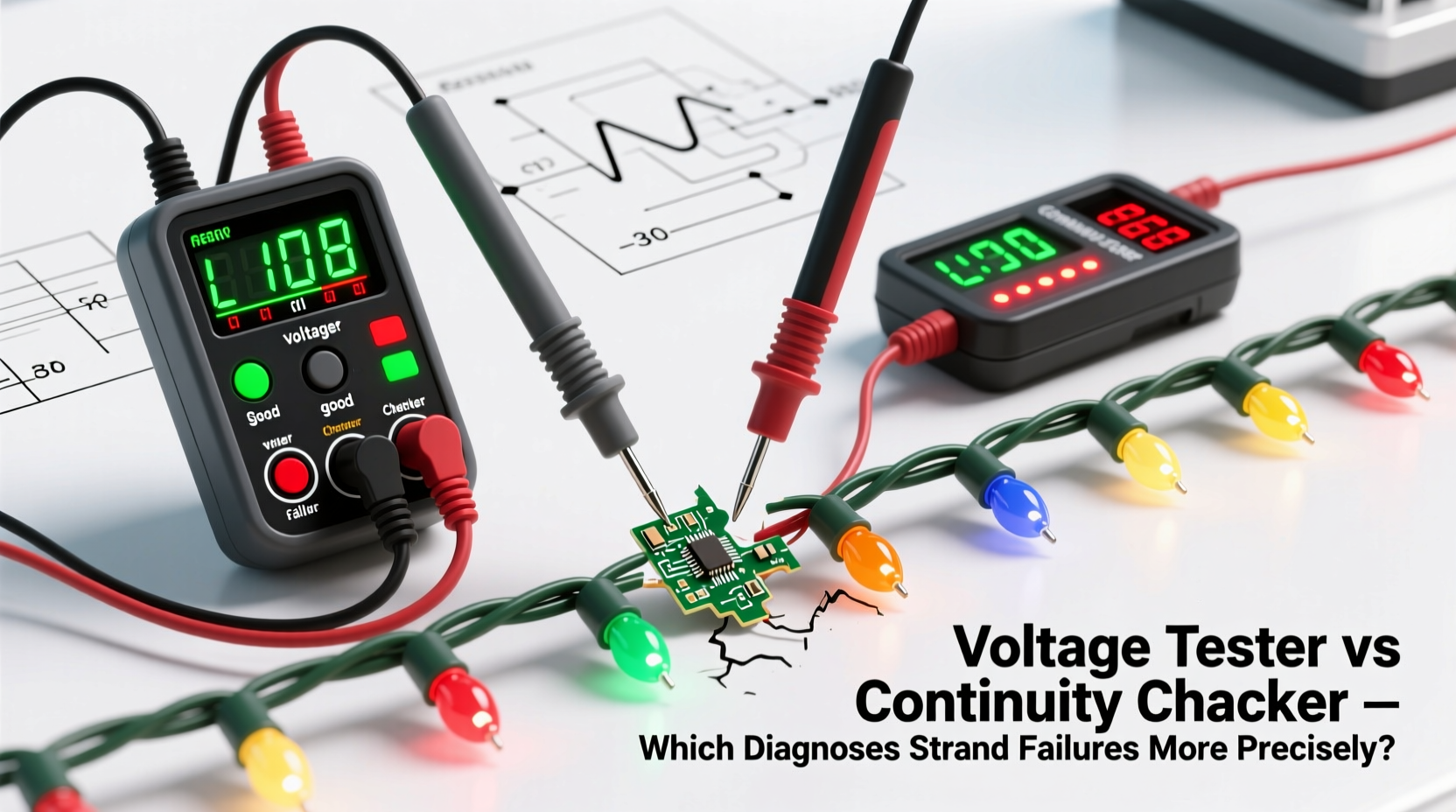
Most traditional incandescent mini-light strands are wired in series, meaning electricity flows through each bulb in sequence. If one bulb burns out or becomes loose, the entire circuit breaks, and the whole section—or string—goes dark. Newer LED strands often use parallel-wired circuits or include shunt resistors that bypass failed bulbs, allowing the rest of the strand to stay lit. However, even with these improvements, open circuits, broken wires, or faulty sockets still occur.
The key to fast repairs lies not in guessing but in measuring. That’s where test equipment comes in. Two common tools—voltage testers and continuity checkers—offer distinct approaches to diagnosing electrical faults. While both deal with electricity, they answer different questions: Is there power present? Or is there a complete path for current?
Voltage Testers: Detecting Live Power at a Point
A voltage tester (often a non-contact type) detects the presence of AC voltage without making direct contact with conductive parts. It senses electromagnetic fields around live wires and alerts users via light or sound. These are popular among homeowners because they’re simple, safe, and require no circuit interruption.
In the context of Christmas lights, a voltage tester can confirm whether an outlet is live and if power reaches the plug end of the strand. Some advanced models even detect voltage along the wire, helping identify where power stops flowing.
However, voltage testers have limitations. They don’t measure resistance, current flow, or continuity. A wire may be energized but still broken internally, creating a false positive. Also, induced voltages (phantom voltage) from nearby lines can trigger the sensor even when no usable current exists. This makes voltage testers useful for initial screening—but insufficient for precise fault location.
Continuity Checkers: Mapping the Full Circuit Path
A continuity checker, typically part of a digital multimeter (DMM), tests whether a complete electrical path exists between two points. When set to ohms or continuity mode, it sends a small DC current through the circuit and measures resistance. If the resistance is very low (near zero), the circuit is continuous. If it reads “OL” (over limit), the path is broken.
This capability makes continuity checkers far more precise for diagnosing strand failures. For example, you can disconnect the light string from power, remove all bulbs, and test socket-to-socket along the line. A break in continuity identifies the exact segment where the wire is severed or a socket has failed.
Continuity testing also allows you to isolate individual components. You can test each bulb’s filament, check for shorts between wires, or verify internal shunts in LED sets. Unlike voltage testers, which only show “power here” or “no power,” continuity gives definitive yes/no answers about physical integrity.
“Continuity testing is the gold standard for troubleshooting series-wired lighting. It removes guesswork and targets the actual point of failure.” — Mark Rinaldi, Electrical Systems Technician with 22 years in residential diagnostics
Direct Comparison: Voltage Tester vs Continuity Checker
| Feature | Voltage Tester | Continuity Checker |
|---|---|---|
| Measures | Presence of AC voltage | Electrical continuity (resistance) |
| Power Required? | Yes – circuit must be live | No – powered off safely |
| Precision in Locating Faults | Moderate – shows where power drops | High – pinpoints open circuits |
| Safety Risk | Higher – works on live circuits | Lower – used on de-energized systems |
| Useful for Bulb Testing? | No | Yes – test filaments directly |
| Cost (Average) | $8–$15 | $20–$60 (as part of multimeter) |
| User Skill Level | Beginner | Intermediate |
While voltage testers are faster for confirming power delivery, continuity checkers provide deeper insight into why a strand fails. For instance, a strand might show voltage at the plug and halfway down the line due to capacitive coupling, yet remain completely non-functional because the neutral wire is cut. Only a continuity test will expose this invisible break.
Step-by-Step Diagnosis Using a Continuity Checker
To accurately diagnose a failed light strand using continuity testing, follow this methodical process:
- Unplug the strand immediately. Safety first—never perform continuity tests on live circuits.
- Remove all bulbs from the string. This prevents false readings caused by disconnected shunts or broken filaments.
- Set your multimeter to continuity mode (symbolized by a diode or sound wave).
- Touch probes to both pins of the plug. A working strand should beep, indicating continuity. No beep means a major break—likely near the plug or fuse.
- If continuity passes, begin testing individual sections. Insert one probe into the female end’s contact and the other into the male end’s corresponding terminal.
- Move down the strand, checking each segment between bulbs. Silence indicates a break in that span.
- Inspect wires and sockets visually in the affected area. Look for cuts, corrosion, or bent contacts.
- Test each bulb individually by placing probes on its metal base. Replace any with no continuity.
- Reassemble and test under power once repairs are made.
Real-World Example: The Case of the Half-Lit Strand
Consider a homeowner installing a 50-light mini-bulb strand. The first 25 bulbs glow; the rest stay dark. A quick pass with a non-contact voltage tester shows faint activity beyond the cutoff point, suggesting partial power delivery. Assuming a bad bulb, the user replaces several—one by one—with no improvement.
Frustrated, they borrow a multimeter and switch to continuity mode. After unplugging and removing all bulbs, they test from the last working socket to the first dead one. No continuity is detected. Upon closer inspection, they find a tiny rodent bite in the insulation just behind the 25th socket, severing the internal wire. The voltage tester had picked up stray electromagnetic fields, misleading them into thinking power was reaching further than it actually did.
With the damaged section isolated, the user cuts and splices in a new wire segment. After retesting for full continuity, the entire strand lights up perfectly. Total repair time: 35 minutes. Without continuity testing, the issue might have been misdiagnosed as multiple failed bulbs or a defective controller.
Essential Tools Checklist for Diagnosing Light Failures
Equip yourself properly before diving into seasonal repairs. Here’s what every serious holiday troubleshooter should have:
- Digital multimeter with continuity and resistance settings
- Non-contact voltage tester (for initial safety checks)
- Needle-nose pliers and wire strippers
- Replacement bulbs matched to your strand’s voltage and base type
- Insulated electrical tape or heat-shrink tubing
- Small zip ties or labels for marking tested sections
- Spare fuses (commonly found inside the plug of incandescent strands)
Having both tools—a voltage tester and a continuity checker—offers complementary advantages. Use the former for rapid triage and the latter for surgical diagnosis.
FAQ: Common Questions About Testing Holiday Lights
Can I use a battery-powered continuity tester instead of a multimeter?
Yes, dedicated continuity testers (with built-in batteries and LEDs) work well for basic checks. However, they lack the precision and additional functions (like resistance measurement) of a digital multimeter, limiting their versatility.
Why does my voltage tester light up along a dead strand?
This is likely due to “ghost voltage” or capacitive coupling—where inactive wires run parallel to live ones and pick up electromagnetic fields. These signals aren't strong enough to power lights but can trigger sensitive detectors. Always verify with a load test or continuity check.
Do LED Christmas lights need different testing methods?
LED strands often behave differently due to lower current draw and integrated rectifiers. While continuity testing still applies, note that some LED strings won’t show continuity in both directions due to diode design. Always consult manufacturer specs, and consider using a diode test function if available.
Expert Recommendation: Prioritize Precision Over Convenience
While voltage testers offer speed and simplicity, they fall short when precision matters. As lighting technology evolves—with denser circuits, mixed-voltage controllers, and smart features—the demand for accurate diagnostics grows. Continuity checkers deliver that accuracy.
Professional electricians and seasoned decorators alike emphasize starting with a systematic approach. “I see people wasting hours replacing bulbs when the real issue is a nicked wire behind the third socket,” says Rinaldi. “One five-second continuity test would’ve saved them the hassle.”
For those who decorate annually, investing in a $30 multimeter pays for itself in saved replacement costs and reduced stress. Even casual users benefit from learning basic continuity principles—it transforms troubleshooting from guesswork into a repeatable science.
Final Thoughts: Choose the Right Tool for the Job
Diagnosing Christmas light failures isn’t just about fixing a broken string—it’s about preserving memories, minimizing waste, and maintaining joy during the holidays. While a voltage tester helps rule out power supply issues quickly, only a continuity checker reveals the true nature of electrical breaks within the strand.
For precise, reliable, and safe diagnostics, continuity testing is superior. It isolates faults down to the inch, verifies component health, and enables targeted repairs. Combine it with careful observation and proper tools, and you’ll spend less time chasing ghosts and more time enjoying the glow.




 浙公网安备
33010002000092号
浙公网安备
33010002000092号 浙B2-20120091-4
Comments
No comments yet. Why don't you start the discussion?