
Every holiday season, millions of strings of Christmas lights are plugged in—only to discover that one section won’t light up or the controller has mysteriously failed. For DIY-savvy homeowners and seasonal decorators alike, troubleshooting these issues is part of the ritual. But when it comes to diagnosing electrical problems in low-voltage LED light strings, a critical question arises: Should you use a dedicated Christmas light voltage tester or invest in a multimeter?
The answer isn’t just about convenience—it’s about safety, accuracy, and preventing costly mistakes like frying an expensive controller. Many beginners assume either tool will do the job, but using the wrong one can lead to incorrect readings, damaged components, or even short circuits. This guide breaks down both tools from a practical, real-world perspective, helping you choose the right instrument to keep your display bright—and your equipment intact.
Understanding the Problem: Why Controllers Fail
Fried controllers are among the most common and frustrating failures in modern Christmas light setups. These small electronic boxes regulate power, sequence patterns, and often connect to Wi-Fi or music sync features. When they fail, entire sections of lights go dark, sometimes taking down dozens of strands with them.
One major cause of failure isn’t faulty manufacturing—it’s user error during troubleshooting. Plugging in mismatched voltages, back-feeding power through incorrect test methods, or misdiagnosing open circuits can send damaging surges into sensitive circuitry. The root issue? Using tools without understanding what they measure—or how they interact with low-voltage DC systems.
“Over 60% of controller failures we see at repair clinics come from improper testing techniques, not component defects.” — Mark Reynolds, Holiday Electronics Technician, North Pole Diagnostics
How a Christmas Light Voltage Tester Works
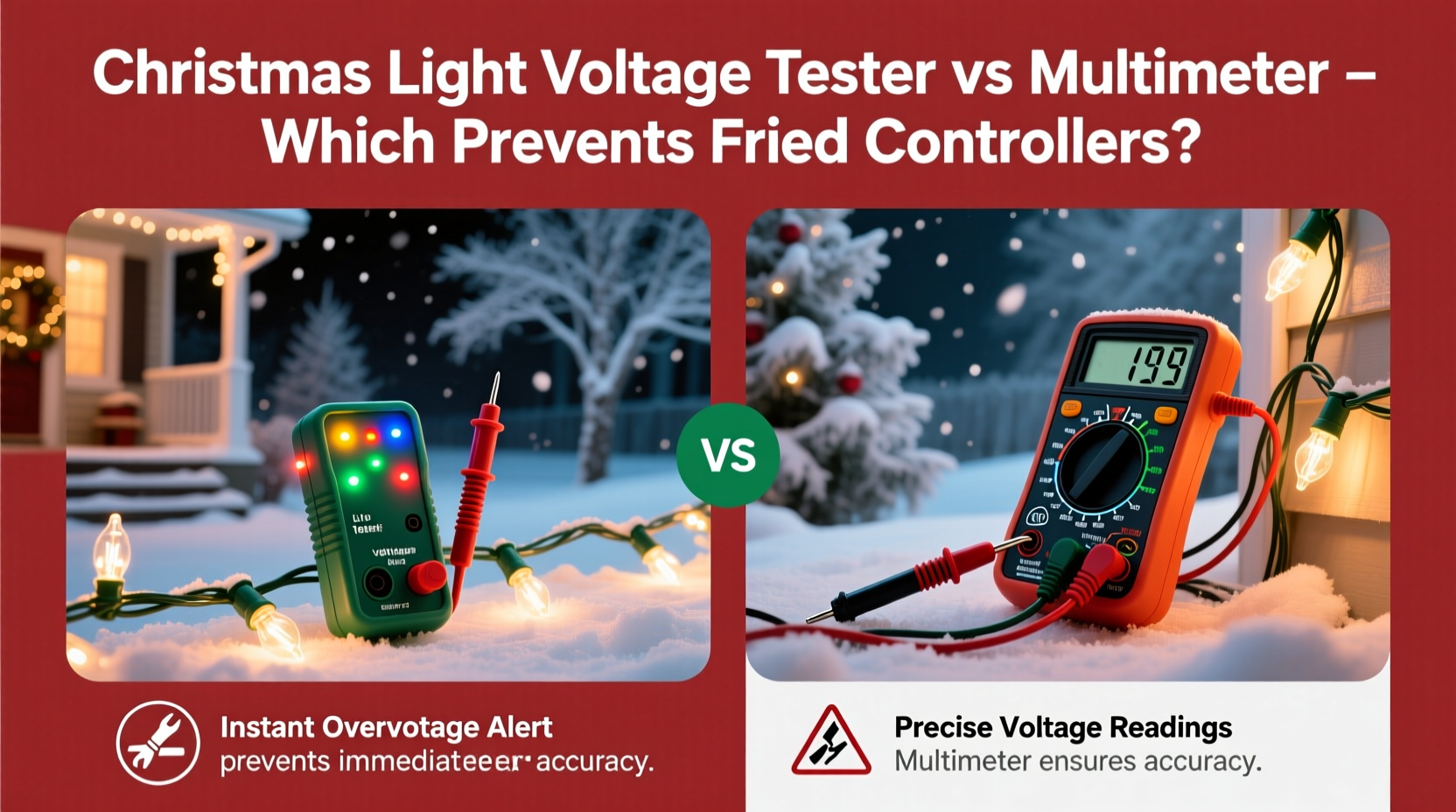
A Christmas light voltage tester (often called a “light keeper” or “circuit tester”) is a purpose-built device designed specifically for holiday lighting. It clips onto individual wires along a strand and uses LEDs to indicate whether voltage is present at that point. Most models work on both AC and DC systems and are calibrated for typical Christmas light voltages—usually between 3V and 24V.
These testers detect live conductors without direct contact, making them safer for users who aren’t comfortable handling exposed wires. They’re simple: plug in the string, slide the tester along the wire, and watch for where the indicator stops lighting up. That’s typically where the break or bad bulb is located.
Because they’re non-invasive and require no setup beyond plugging in the lights, these tools are ideal for quick diagnostics. However, they have limitations. They don’t provide exact voltage readings, can’t measure resistance or continuity, and may give false positives if there’s capacitive coupling in long runs of wire.
What a Multimeter Can Do (and Where It Falls Short)
A digital multimeter (DMM) is a versatile electrical measuring device capable of reading voltage, current, resistance, continuity, and more. For someone serious about electronics repair—even at a hobbyist level—a multimeter offers precision and diagnostic depth far beyond a basic voltage tester.
When used correctly, a multimeter can:
- Measure exact output voltage from a power supply
- Check continuity across fuses and wires
- Detect short circuits or ground faults
- Verify proper polarity before connecting a controller
However, this versatility comes with risk—especially for beginners. Misplacing the probes, selecting the wrong setting (like measuring current instead of voltage), or touching live terminals incorrectly can create accidental shorts. In low-voltage LED systems, even a brief short can overload the controller’s internal regulator, causing permanent damage.
Moreover, many budget multimeters lack fine resolution for sub-5V measurements. A reading of “0.00V” might actually be 1.2V due to poor sensitivity—leading to incorrect conclusions about dead circuits.
Side-by-Side Comparison: Tool Capabilities
| Feature | Voltage Tester | Multimeter |
|---|---|---|
| Ease of Use | Very easy – clip and go | Moderate – requires settings knowledge |
| Accuracy | Low – indicates presence only | High – precise numerical readout |
| Safety Risk | Low – non-contact design | Medium – exposed probes, user error possible |
| Cost | $10–$20 | $20–$100+ |
| Best For | Quick fault location in series strings | Diagnosing power supplies, controllers, complex setups |
Real Example: How a Beginner Fried a $70 Controller
Dan, a homeowner in Colorado, bought a new set of addressable RGB LED lights controlled by a Wi-Fi module. One evening, half the strip stopped responding. He grabbed his $15 multimeter, set it to DC voltage, and touched the red probe to the data line while the black was on ground—just like he’d seen in a YouTube video.
But he didn’t realize the data line carried a 3.3V signal referenced to the same ground. His meter, set incorrectly, created a partial short. Within seconds, the controller emitted a faint pop and smoke curled from the case. The unit was dead.
Later, at a local repair workshop, the technician explained: “You don’t need to probe data lines unless you’re debugging communication. For power issues, check V+ and GND first. And never assume all pins are safe to touch.”
Dan could have avoided this with a simple voltage tester. By checking along the power rail, he would’ve seen if voltage dropped off mid-strip—indicating a broken connection—not a controller issue at all.
Step-by-Step Guide: Safe Troubleshooting Without Damaging Equipment
- Unplug everything. Start with all lights and controllers disconnected from power.
- Inspect visually. Look for cracked housings, corroded connectors, or bent pins.
- Use a Christmas light voltage tester first. Plug in the main power supply and run the tester along the positive wire. Note where the signal stops.
- If voltage disappears early, isolate that segment. There’s likely a broken wire or loose connector.
- Only then consider a multimeter. Set it to DC voltage (20V range), place red probe on V+, black on GND. Confirm expected voltage (e.g., 5V, 12V).
- Test continuity on suspect wires—but only after disconnecting power and removing the wire from the circuit.
- Reconnect and retest. If the controller still fails, the issue may be upstream—check the power supply output directly.
Expert Recommendation: Use Both Tools Strategically
Seasoned technicians don’t rely on just one tool—they use each for its strengths. As electrician and holiday lighting installer Luis Mendez explains:
“I carry both. I start with the voltage tester to quickly locate dead zones. If the problem isn’t obvious, I switch to the multimeter to verify power delivery, check ground integrity, or test a replacement fuse. But I never touch the controller with probes until I’m certain the circuit is stable.”
The key insight: a voltage tester minimizes interaction with live components, reducing risk. A multimeter provides answers when the tester can’t—such as determining whether a power supply is under-voltage due to a failing transformer.
Checklist: Preventing Fried Controllers This Season
- ✅ Unplug all devices before inspecting or connecting wires
- ✅ Use a Christmas light voltage tester as your first diagnostic step
- ✅ Verify power supply output with a multimeter—before attaching any controller
- ✅ Never back-feed power into a controller from an external source
- ✅ Double-check polarity (positive/negative) on DC connections
- ✅ Replace blown fuses only with identical ratings (voltage and amperage)
- ✅ Keep spare controllers and power supplies labeled and stored together
Frequently Asked Questions
Can I use a multimeter to test individual LED bulbs?
Yes, but not reliably in-circuit. To test a single LED, remove it from the strand and use the diode setting. In a series circuit, other components will affect the reading. For quick checks, a voltage tester showing no drop across a bulb usually indicates it’s blown.
Is a Christmas light voltage tester worth buying if I already own a multimeter?
Absolutely—if you work with holiday lights regularly. It’s faster, safer, and less prone to user error. Think of it as specialized gear for a specific job, like snow tires versus all-seasons. You wouldn’t use a sports car to plow a driveway.
Why did my controller fail even though I didn’t touch anything?
Environmental factors play a big role. Moisture ingress, temperature swings, and power surges from shared outlets can degrade electronics over time. Using a surge-protected extension cord and sealing connectors with dielectric grease helps extend lifespan.
Conclusion: Choose the Right Tool for the Job
When it comes to protecting your Christmas light controllers, prevention beats repair every time. For beginners, starting with a dedicated voltage tester drastically reduces the risk of accidental shorts and misdiagnosis. It’s the safest way to pinpoint issues without poking around live circuits.
A multimeter remains essential for deeper diagnostics—but only once you understand the basics of voltage, polarity, and circuit isolation. Used recklessly, it can do more harm than good. The smart approach isn’t choosing one tool over the other; it’s knowing when to use each.
This holiday season, protect your investment, your time, and your sanity. Begin with the simpler, safer option. Master the fundamentals. Then, if needed, graduate to advanced tools with confidence.




 浙公网安备
33010002000092号
浙公网安备
33010002000092号 浙B2-20120091-4
Comments
No comments yet. Why don't you start the discussion?