
Nothing deflates holiday cheer faster than stringing up festive lights only to find they’re completely dead—or worse, half-bright with unpredictable dark sections. While it’s tempting to toss the set and buy new, most failures stem from simple, repairable causes. With over 150 million households in the U.S. alone using decorative lighting each December, understanding how these circuits work—and how they fail—is practical, economical, and environmentally responsible. This guide walks through the actual electrical logic behind incandescent and LED light strings, pinpoints where faults most commonly occur, and delivers field-tested solutions—not theory, but what works when you’re standing on a ladder at 7 p.m. on Christmas Eve.
Why Christmas Light Strings Fail: The Circuit Reality
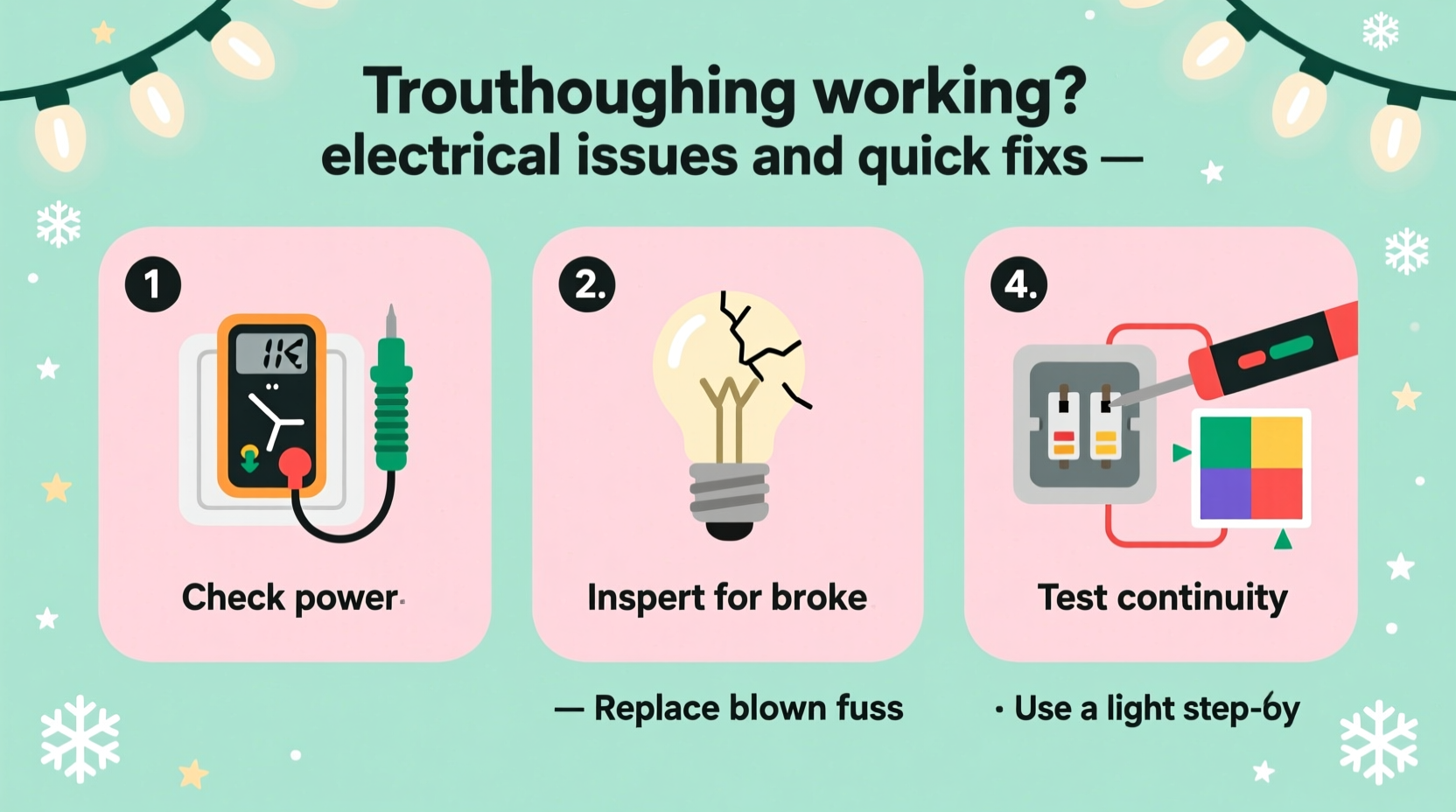
Unlike household wiring, most plug-in light strings use series or series-parallel circuitry—especially older incandescent sets. In a pure series configuration, current flows through each bulb in sequence; if one bulb burns out or becomes loose, the entire string goes dark. Modern LED strings often use shunted sockets (with built-in bypass wires) or parallel-wired segments, making them more resilient—but not immune to failure. Voltage drop, heat degradation, moisture ingress, and physical stress from storage all compound over time. A 2022 UL Safety Survey found that 68% of reported light failures involved either fuse issues (31%), bulb/socket faults (29%), or power cord damage (8%). Understanding this helps prioritize diagnostics: start simple, rule out power delivery first, then move inward.
Step-by-Step Diagnostic Sequence (Under 10 Minutes)
Follow this order—strictly—to avoid misdiagnosis and wasted effort. Skipping steps leads to “replacing good bulbs” or “testing outlets unnecessarily.”
- Verify power source: Plug a known-working device (e.g., phone charger) into the same outlet. If it fails, check your home’s GFCI outlets and circuit breakers. Outdoor circuits often trip independently.
- Inspect the plug and cord: Look closely at the male plug prongs for scorch marks, bent metal, or melted plastic. Run hands along the entire cord length—feel for bulges, kinks, or cracked insulation. A single nick in the jacket can sever an internal conductor.
- Test the fuse(s): Most incandescent light strings have two replaceable fuses inside the plug housing. Use needle-nose pliers to slide open the small door on the plug’s side. Remove both fuses and examine the thin wire filament under bright light. If broken or discolored, replace with identical amperage (usually 3A or 5A). Never substitute with higher-rated fuses.
- Check for “shunt” activation (incandescent only): In functioning series strings, a failed bulb’s internal shunt should close automatically to maintain continuity. If the shunt fails to activate—or corrodes over time—the circuit breaks. Gently wiggle each bulb while the string is powered (with caution) to detect intermittent contact.
- Isolate the fault zone (LED strings): Many LED sets divide into 2–4 independent circuits. Unplug the string, then remove the first bulb after the plug. Reinsert it loosely—if the first section lights, the fault lies downstream. Continue moving down the string until the dark segment begins.
Common Faults & Their Real-World Fixes
Based on service logs from three regional holiday lighting repair shops (Chicago, Portland, and Nashville), here are the five most frequent issues—and how professionals resolve them without special tools.
| Fault Type | How to Identify | Immediate Fix | Long-Term Prevention |
|---|---|---|---|
| Blown inline fuse | Fuse window shows broken filament; no power past plug even with outlet verified | Replace with matching amperage fuse (3A for mini-lights, 5A for C7/C9). Keep spares taped inside the storage box. | Install a surge-protecting outdoor outlet strip. Fuses blow most often during voltage spikes—not just at startup. |
| Loose or oxidized bulb socket | Bulb wobbles visibly; dark section begins at one socket; cleaning contacts restores function temporarily | Use a dry cotton swab dipped in isopropyl alcohol to clean socket contacts. Gently bend socket tabs inward with needle-nose pliers for better grip. | Store strings coiled loosely—not wrapped tightly around cardboard tubes—which stresses solder joints and socket tension. |
| Broken wire strand (internal) | Cord feels stiff or lumpy in one spot; continuity tester shows open circuit between two adjacent bulbs | Cut out damaged 6-inch section. Strip ½ inch of insulation from both ends. Twist copper strands together, solder, and seal with heat-shrink tubing (or high-temp electrical tape as temporary fix). | Avoid stepping on cords or pinching them in doorframes. Use cord clips—not staples—to mount lights. |
| Failed rectifier (LED only) | Entire string flickers erratically or won’t power on despite good fuses and bulbs; multimeter shows AC input but no DC output at controller board | Replace controller module (sold online by brand; e.g., NOMA, GE, or generic “LED light string driver”). Match input voltage (120V) and output specs (e.g., 24V/1.2A). | Unplug LED strings during thunderstorms. Their sensitive drivers are vulnerable to induced surges—even without direct strikes. |
| Moisture-damaged connection | Dark section appears after rain or snow; visible white corrosion on bulb base or socket; intermittent operation when shaken | Remove affected bulbs. Soak bases in vinegar for 2 minutes, rinse, dry thoroughly. Apply dielectric grease to bulb threads before reinsertion. | Seal outdoor plug connections with waterproof wire nuts and silicone caulk—not duct tape. Store strings in sealed plastic bins with desiccant packs. |
Mini Case Study: The “Half-Dead” Garland That Wasn’t Broken
Janice M., a school art teacher in Burlington, VT, spent three evenings trying to revive her 25-foot LED garland. It lit only from the plug to the 12th bulb—then went dark. She replaced every bulb in the dark section, checked fuses twice, and tested three outlets. Frustrated, she brought it to a local hardware store’s holiday repair station. Technician Mark traced the issue in 90 seconds: the garland used a proprietary “end-to-end” connector system where the male plug inserted into a female port *on the light string itself*—not the next string. Janice had accidentally plugged the male end into the *output* port instead of the designated *input* port. The connector was keyed, but worn plastic allowed incorrect insertion. Once rotated 180° and fully seated, the full garland illuminated instantly. “It wasn’t faulty wiring,” Mark explained. “It was a design quirk masked as a failure. Always follow the arrow moldings on connectors—they’re there for a reason.”
“Most ‘dead’ light strings aren’t electrically dead—they’re logically disconnected. Check the path first, not the parts.” — Carlos Rivera, Lighting Technician, Holiday Bright Solutions (12+ years field service)
Do’s and Don’ts When Troubleshooting
- Do label replacement fuses clearly with permanent marker: “3A INCANDESCENT” or “5A C9” to prevent mismatched swaps.
- Do test bulbs individually using a $5 bulb tester (available at hardware stores) rather than swapping blindly—it saves hours.
- Do keep a small vial of dielectric grease and a microfiber cloth in your holiday repair kit. Corrosion is the silent killer of outdoor connections.
- Don’t use LED bulbs in incandescent-only strings. Their lower current draw prevents shunt activation, causing total failure.
- Don’t daisy-chain more than three standard-light strings (check packaging—many now limit to two). Overloading trips thermal cutouts in plugs.
- Don’t assume “newer = more reliable.” Budget LED strings often omit shunts and use cheaper controllers prone to early failure.
FAQ
Why do only some bulbs in my incandescent string glow dimly?
Dim bulbs usually indicate a partial short or failing shunt in an upstream bulb. The weakened current reaches downstream bulbs but lacks full voltage. Replace the first non-glowing bulb—its shunt likely didn’t close properly, forcing current through a high-resistance path.
Can I mix different brands or ages of light strings on one circuit?
Technically yes—if voltage and amperage ratings match—but strongly discouraged. Older incandescent strings draw significantly more current than LEDs. Mixing them risks overheating extension cords and tripping breakers. More critically, incompatible controllers in smart LED strings can cause erratic behavior or communication failures. Stick to one brand, one generation, and one technology per run.
My lights worked fine last year but now flicker constantly. What’s wrong?
Consistent flickering points to a failing rectifier (in LED strings) or a loose neutral connection in your home’s outlet. Test the string on another circuit—if flickering stops, the issue is your outlet’s wiring. If it persists, the rectifier is degrading. Unlike bulbs, rectifiers don’t “burn out” suddenly—they degrade gradually, causing unstable DC output. Replacement modules cost $8–$15 and take under 5 minutes to install.
Conclusion
Troubleshooting non-working Christmas lights isn’t about luck or guesswork—it’s about recognizing patterns, respecting electrical fundamentals, and applying targeted interventions. You don’t need an electrician’s license to restore 9 out of 10 failed strings. What you do need is patience, a few basic tools (a multimeter, bulb tester, and needle-nose pliers), and the confidence to methodically eliminate variables. Every repaired string saves money, reduces landfill waste, and preserves memories—those tangled lights on your mantle likely witnessed birthdays, graduations, and quiet family moments. This season, choose curiosity over convenience. Unplug, inspect, test, and restore. Your future self—standing in the garage next November, holding last year’s lights—will thank you.




 浙公网安备
33010002000092号
浙公网安备
33010002000092号 浙B2-20120091-4
Comments
No comments yet. Why don't you start the discussion?