
When photographing holiday decor—especially Christmas ornaments—achieving a clean, magical aesthetic often means making hardware disappear. The goal is to suspend ornaments as if floating mid-air, free from visible supports. Two popular methods dominate this niche: traditional plastic or metal ornament hangers and clear fishing line. But under the scrutiny of professional studio lighting, one can betray its presence with unwanted reflections, glare, or shadows. So which option truly remains invisible? This guide dives deep into material science, light behavior, and practical photography techniques to answer that question definitively.
The Challenge of Invisibility in Studio Photography
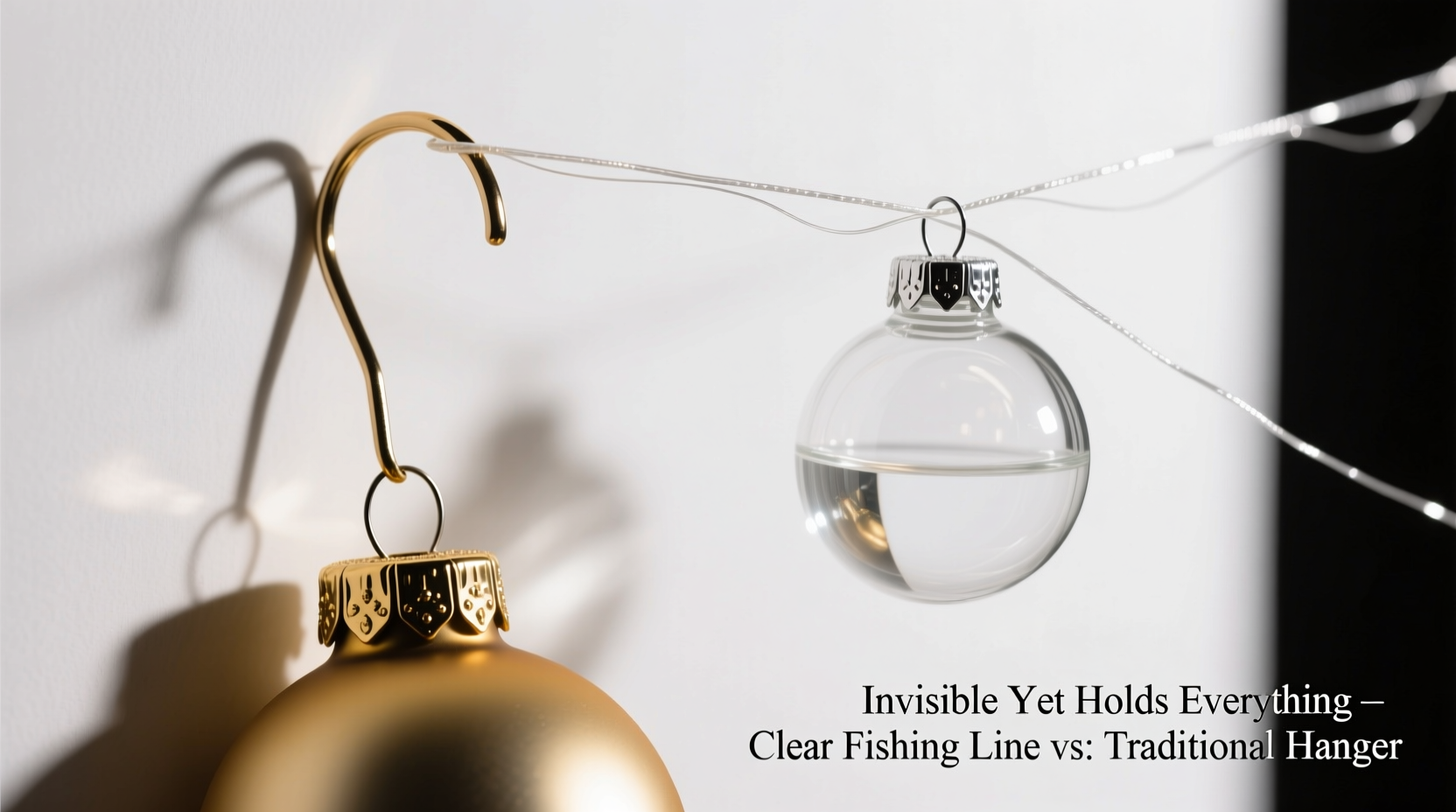
Invisible suspension in photography isn’t about physical absence—it’s about optical neutrality. A support thread must avoid scattering, refracting, or reflecting light in ways that draw attention. Studio lighting setups typically use multiple high-intensity sources (softboxes, strobes, ring lights) to eliminate shadows and enhance color fidelity. Unfortunately, these conditions also amplify the visibility of transparent materials through subtle refractions and hotspots.
Materials like acrylic, nylon, and monofilament can appear “invisible” to the naked eye at a distance but become glaringly obvious in high-resolution images. The issue lies not just in transparency, but in how the material interacts with light wavelength, angle of incidence, and camera aperture.
“Under controlled lighting, even the most transparent thread can turn into a bright filament if it catches the light at the wrong angle.” — Daniel Ruiz, Commercial Product Photographer
This phenomenon explains why some photographers swear by fishing line while others insist on specialty hangers—each has strengths and flaws depending on setup variables.
How Christmas Ornament Hangers Work—and Where They Fail
Traditional ornament hangers are typically made from bent wire, plastic hooks, or molded nylon clips. They attach to the ornament’s cap and rest over a branch or rod. While convenient for tree display, they pose challenges in photography:
- Reflections from metallic components: Even small metal loops reflect direct light, creating distracting highlights.
- Bulkiness: Many hangers extend beyond the ornament, requiring wider framing or post-production cleanup.
- Fixed positioning: Limited adjustability makes precise composition difficult.
- Opacity: Plastic parts may be translucent but rarely fully invisible under bright lights.
Some modern hangers use matte-finish plastics or black-coated wires to reduce reflectivity. However, these only mitigate—not eliminate—the problem. Matte surfaces diffuse light rather than reflect it sharply, which helps, but they still cast micro-shadows when backlit.
Clear Fishing Line: The Go-To for Floating Effects
Fishing line—specifically monofilament used in angling—has long been a staple in product photography for suspending objects. Its advantages include:
- Extremely thin diameter (as low as 0.1mm)
- High tensile strength relative to size
- Optical clarity in still air
- Low cost and wide availability
Monofilament works best when tensioned tightly between two anchor points above and below the ornament, creating a near-vertical suspension. When lit carefully, it can vanish completely from view. However, several factors influence its invisibility:
- Diameter: Thinner lines (2–4 lb test) are less likely to reflect light.
- Color: Clear or smoke-tinted lines perform better than green or blue variants.
- Cleanliness: Dust, oils, or kinks increase surface scatter.
- Background contrast: High-contrast backdrops make faint refractions more visible.
Fishing line’s biggest weakness is its refractive index—close to that of glass—which causes light to bend slightly as it passes through. Under macro lenses or tight zoom, this distortion can reveal the line’s path even when no reflection occurs.
Real-World Test: Studio Shoot Comparison
A commercial photography studio recently tested both methods side-by-side using identical equipment:
- Camera: Canon EOS R5, 100mm macro lens
- Lighting: Two Profoto softboxes at 45° angles, one backlight
- Ornament: 3-inch glass ball with mirrored finish
- Background: Seamless white paper
The results were telling:
| Method | Visibility in Photo | Setup Time | Post-Processing Needed |
|---|---|---|---|
| Plastic Ornament Hanger | Visible hook and base shadow | 1 minute | Moderate (cloning out hardware) |
| Clear Fishing Line (4 lb test) | Nearly invisible when lit properly | 5 minutes (anchoring & tensioning) | Minimal (dust specks only) |
| Fishing Line + Backlight | Line visible due to refraction halo | 5 minutes | Significant (masking required) |
The fishing line succeeded only when backlight was disabled or diffused. With front lighting alone, it disappeared entirely in most shots.
Advanced Techniques for True Invisibility
For photographers aiming for flawless, floating ornament effects, relying solely on hardware choice isn’t enough. Success depends on technique, environment, and post-processing strategy.
Step-by-Step Suspension Setup Using Fishing Line
- Select the right line: Use 2–4 lb test clear monofilament. Avoid fluorocarbon, which has higher refractive index.
- Clean the line: Wipe with isopropyl alcohol to remove oils and residues.
- Create a secure knot: Tie a micro-loop around the ornament’s hook using tweezers. Keep knots small and tucked behind reflective surfaces.
- Anchor above and below: Run the line vertically through ceiling rigging and floor anchor to prevent sway.
- Tension evenly: Use a spring or weight system to maintain tautness—slack increases visibility.
- Light strategically: Use broad, diffused front lighting. Avoid backlighting or ring lights unless heavily diffused.
- Shoot at narrow aperture: f/11–f/16 increases depth of field but may accentuate line blur—test before final shoot.
Material Comparison: Refractive Index and Light Behavior
The key scientific factor determining visibility is the refractive index (RI)—a measure of how much a material bends light. The closer an object’s RI is to air (~1.0), the less visible it becomes.
“The ideal invisible thread would have a refractive index matching air and zero dispersion. No such material exists commercially—but we can get close.” — Dr. Lena Park, Optical Physicist, MIT Media Lab
Here's how common materials compare:
| Material | Refractive Index | Visibility Risk | Notes |
|---|---|---|---|
| Air | 1.00 | None | Reference baseline |
| Clear Monofilament (Nylon) | 1.53 | Medium | Visible under backlight; bends light noticeably |
| Fluorocarbon Fishing Line | 1.42 | Low-Medium | Better underwater; still reflects in air |
| Glass | 1.52 | High | Matches monofilament—can cause confusion in composites |
| Acrylic Hanger | 1.49 | Medium-High | Semi-transparent but scatters light |
| Teflon Thread (experimental) | 1.35 | Low | Rare, expensive, not widely available |
Despite fluorocarbon’s lower RI, it performs inconsistently in air due to surface texture and density variations. Standard nylon monofilament remains the most reliable balance of availability, strength, and optical performance.
When to Use Each Method: Practical Decision Guide
Choosing between ornament hangers and fishing line depends on context. Here’s a checklist to help decide:
✅ Use Fishing Line When:
- You’re shooting for e-commerce or editorial use
- Lighting is primarily frontal and diffused
- You need precise control over ornament placement
- The background is uniform (white, gray, soft color)
- You have time for careful rigging
✅ Use Ornament Hangers When:
- Shooting lifestyle scenes (e.g., on a decorated tree)
- Speed is essential (e.g., catalog shoots with hundreds of items)
- Ornaments will be viewed in motion (video, 360° spin)
- You lack rigging infrastructure (ceiling mounts, stands)
- Post-production resources are limited
Mini Case Study: Holiday Catalog Shoot for Luxury Brand
A premium home goods brand preparing its 2024 holiday catalog needed pristine images of hand-blown glass ornaments. Their initial test used standard red plastic hangers. Despite careful lighting, each photo required 12–15 minutes of retouching to erase the hooks and shadows.
The team switched to 3 lb test clear monofilament suspended from a grid system above the set. Anchors were hidden beneath the backdrop, and lines were tensioned using micro weights. Lighting was adjusted to eliminate backlighting, relying instead on large octaboxes positioned at ±30° from the camera axis.
Result: 92% of images required no retouching for support removal. Average editing time dropped to under 3 minutes per image. The production lead noted, “The switch saved us 40 hours in post-production across 300 products. It paid for the rigging setup in one week.”
Frequently Asked Questions
Can I use dental floss instead of fishing line?
No. Dental floss, even clear varieties, is usually textured or waxed, causing significant light scatter. It also lacks tensile strength and stretches easily, leading to sagging during shoots.
Does the color of the fishing line matter?
Yes. Clear or “smoke” (light gray) lines perform best. Avoid green, blue, or yellow-tinted lines—they introduce chromatic aberration and stand out against neutral backgrounds.
Is there a truly invisible thread available?
Not yet for consumer use. Experimental materials like aerogel fibers or metamaterial threads show promise in labs, but none are commercially viable. For now, proper technique with standard fishing line offers the closest approximation.
Expert Tips for Flawless Results
“Don’t underestimate airflow. Even a slight draft can make a suspended ornament rotate or wobble. Seal the room and let the air settle before shooting.” — Maya Tran, Studio Director at Lumina Visuals
- Use anti-static spray on nearby surfaces to prevent dust from clinging to the line.
- Test visibility by viewing through the camera’s live feed at 10x zoom before capturing.
- Consider double-strand suspension for heavier ornaments—but keep strands parallel to avoid triangulation shadows.
- Always carry backup line: humidity and handling weaken monofilament over time.
Conclusion: The Verdict on Invisibility
Between Christmas ornament hangers and clear fishing line, the latter wins decisively for studio photography where invisibility is paramount. While neither method is perfectly undetectable, fishing line—when selected and used correctly—can achieve near-invisibility under optimal lighting. Ornament hangers remain useful for speed and simplicity but require extensive post-processing to match the clean look of suspended subjects.
The key takeaway is that hardware choice is only part of the solution. Mastery comes from understanding light behavior, material properties, and meticulous setup. Whether you're shooting a single hero image or a full holiday collection, investing time in perfecting your suspension technique pays exponential dividends in image quality and efficiency.




 浙公网安备
33010002000092号
浙公网安备
33010002000092号 浙B2-20120091-4
Comments
No comments yet. Why don't you start the discussion?