
When it comes to decorating for the holidays, lighting sets the mood. Two popular options dominate seasonal displays: traditional string lights and modern Christmas projection lights. While both create festive atmospheres, their installation processes differ significantly. For homeowners, renters, and holiday enthusiasts alike, ease of installation is often a top priority—especially when balancing time, safety, and visual impact. This article compares these two lighting types across multiple practical dimensions to help you decide which option suits your needs best.
Understanding the Basics: How Each System Works
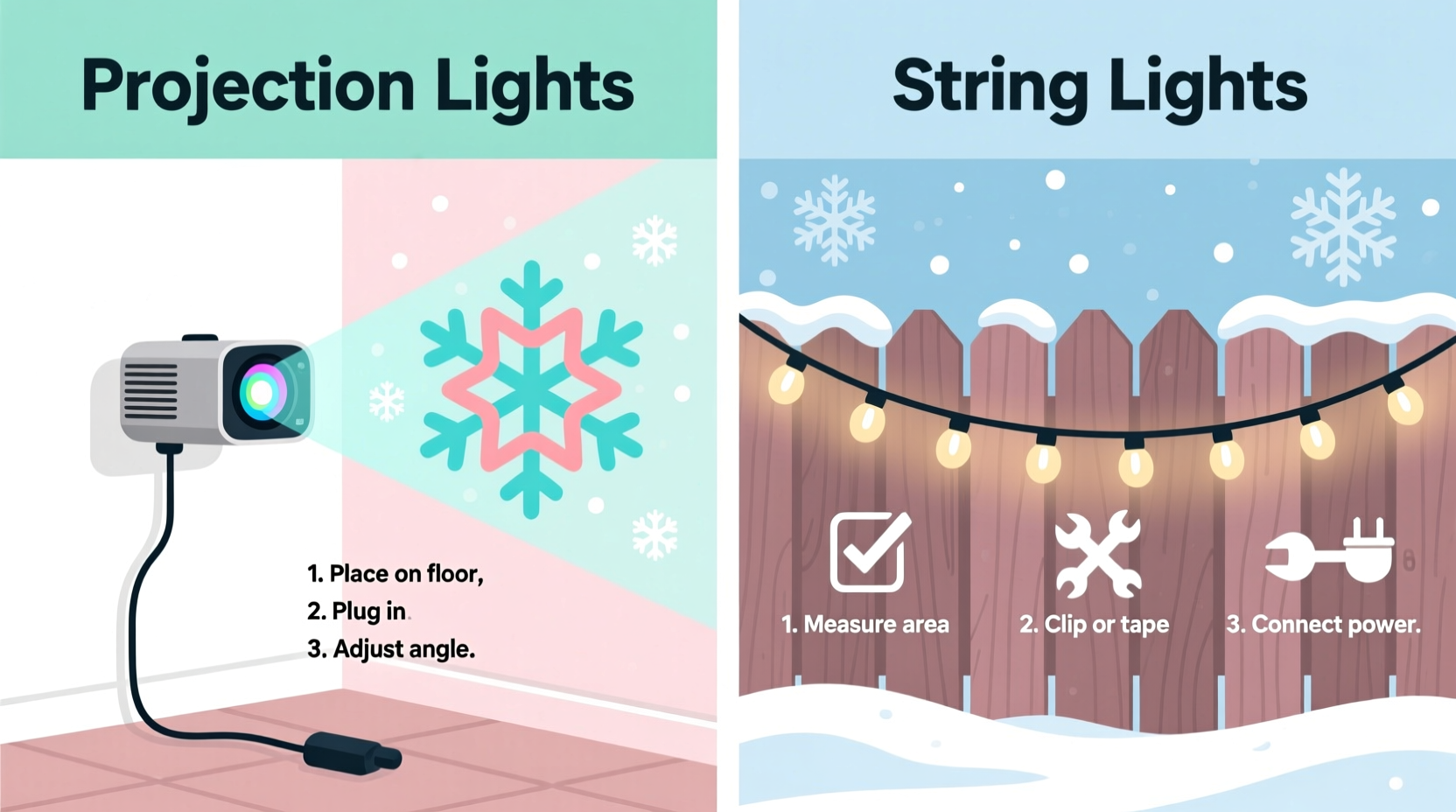
Before diving into installation logistics, it’s essential to understand how each lighting system functions.
String lights consist of a series of small bulbs connected by a wire strand. They’re typically plugged into an outlet and draped along rooflines, trees, railings, or windows. Available in incandescent and LED varieties, they offer flexibility in arrangement but require physical placement across surfaces.
Projection lights, on the other hand, use high-lumen projectors to cast light patterns—such as snowflakes, stars, or twinkling effects—onto walls, lawns, or facades. One unit can cover hundreds of square feet with minimal hardware. These plug into standard outlets and require only proper positioning and aiming.
The fundamental difference lies in distribution: string lights demand coverage through physical extension, while projection lights achieve wide-area illumination from a single point.
Installation Complexity: Step-by-Step Comparison
To assess ease of installation, consider the full process from unboxing to activation.
Installing String Lights: A Multi-Step Process
Setting up string lights involves several stages:
- Planning the layout: Determine where lights will go—roofline, porch, tree trunks—and measure distances.
- Gathering materials: You’ll need clips, hooks, zip ties, extension cords, possibly a ladder, and surge protectors.
- Mounting safely: Attach clips or hooks to surfaces, ensuring not to damage siding or shingles.
- Stringing the lights: Carefully weave the strands through mounts, avoiding tangles and excessive tension.
- Connecting and testing: Plug into outdoor-rated outlets, test functionality, and troubleshoot any dark sections.
This process can take several hours—even days—for larger homes. It also introduces risks associated with working at height, especially in winter conditions.
Setting Up Projection Lights: Simpler and Faster
Projection lights streamline the setup:
- Choose a location: Find a flat surface (ground or deck) within 20–30 feet of the target wall or facade.
- Position the projector: Place it securely, ideally on a tripod or stable base.
- Aim and focus: Adjust the angle and zoom to fill the desired area without cutting off patterns.
- Plug in and power on: Connect to an outdoor outlet and switch on. Most units have automatic timers and remote controls.
Many users report having projection lights operational in under 15 minutes. There’s no climbing, drilling, or weaving required—just strategic placement and electrical access.
Comparison Table: Installation Factors at a Glance
| Factor | String Lights | Projection Lights |
|---|---|---|
| Setup Time | 1–6+ hours depending on home size | 5–20 minutes |
| Tools Required | Ladder, clips, extension cords, zip ties | None (optional tripod) |
| Physical Effort | High (climbing, reaching, securing) | Low (placing and aiming) |
| Safety Risk | Moderate to high (falls, electrical hazards) | Low (ground-level operation) |
| Storage & Reuse | Bulky; prone to tangling | Compact; easy to store |
| Coverage per Unit | Limited (typically 25–50 ft per strand) | Up to 300 sq ft per projector |
Real-World Example: The Johnson Family’s Holiday Setup
The Johnsons live in a two-story suburban home with a front-facing gable roof and large porch columns. For years, they used string lights, spending nearly eight hours over two weekends installing and adjusting them. Mr. Johnson, who has mild vertigo, found ladder work increasingly stressful, and last year, a dropped tool cracked a floor tile.
This season, they switched to three projection units—one for the roof peak, one for the garage door, and one aimed at the front lawn. Total setup time: 40 minutes. They positioned each projector on weighted bases, adjusted the angles using the included remote, and programmed a timer. Neighbors commented that the display looked more dynamic than previous years, and the family avoided all climbing and manual strain.
“We got the same festive impact,” Mrs. Johnson said, “but without the backache or fear of falling. I wish we’d done this sooner.”
Expert Insight: What Industry Professionals Say
Lighting designers and electricians consistently highlight safety and efficiency when recommending holiday lighting solutions.
“Projection lights represent a major leap in user-friendly holiday decor. They eliminate the most dangerous aspects of installation—working at height and managing dozens of connection points—while delivering dramatic visual results.” — Carlos Mendez, Residential Lighting Consultant, BrightPath Designs
Mendez notes that emergency calls related to holiday lighting often involve falls from ladders or overloaded circuits due to daisy-chained string lights. Projection systems reduce both risks by minimizing physical setup and drawing less total wattage across fewer units.
Checklist: Choosing the Right Option for Your Home
Use this checklist to determine which lighting type aligns with your priorities:
- ✅ Do you have easy access to exterior outlets near ground level? → Favors projections
- ✅ Are you uncomfortable or unable to climb ladders? → Favors projections
- ✅ Do you want to decorate trees, railings, or intricate architectural details? → Favors string lights
- ✅ Is storage space limited? → Favors projections (compact design)
- ✅ Do you prefer a soft, ambient glow over bold patterns? → Favors string lights
- ✅ Are you short on time before the holidays? → Strongly favors projections
- ✅ Do you rent and cannot drill or attach fixtures? → Favors projections
For maximum flexibility, some homeowners combine both: using projection lights for large wall displays and string lights for porches or entryways where close-up detail matters.
Common Challenges and How to Overcome Them
Both systems have potential drawbacks, but many can be mitigated with planning.
String Light Issues
- Tangled wires: Store on cardboard reels or specialized spools after removal.
- Bulb burnouts: Use commercial-grade LED strings with shatterproof bulbs and warranty support.
- Weather exposure: Choose UL-listed outdoor models and cover plugs with waterproof enclosures.
Projection Light Limitations
- Surface dependency: Projections require light-colored, relatively flat surfaces. Dark brick or busy textures may distort images.
- Beam obstruction: Clear the path between projector and wall—avoid bushes, signs, or furniture.
- Power distance: Ensure an outdoor outlet is within reach, or use a heavy-duty extension cord rated for outdoor use.
Frequently Asked Questions
Can projection lights work on brick or textured walls?
Yes, but effectiveness depends on texture severity and color. Smooth or lightly textured light-colored walls yield the clearest images. Deeply grooved or dark surfaces absorb light, reducing brightness and pattern definition. For best results, aim at stucco, vinyl siding, or painted wood surfaces.
Are string lights safer than projection lights?
Safety depends on usage. String lights introduce fall risks during installation and potential fire hazards if damaged or overloaded. Projection lights operate at ground level and use cooler LED technology, reducing both risks. However, any electrical device used outdoors must be GFCI-protected and weather-rated.
Can I use both types together?
Absolutely. Many decorators use projection lights for broad coverage (e.g., snowflakes on the house) and string lights for accent areas like fences, trees, or window frames. Just ensure circuits aren’t overloaded—spread loads across multiple outlets.
Final Considerations: Long-Term Value and Usability
While initial cost may favor string lights, long-term value shifts toward projection systems. A quality projector lasts 5–7 seasons with minimal maintenance, whereas string lights degrade faster due to weather exposure, physical stress, and storage wear.
Renters benefit especially from projection lights—they deliver high-impact visuals without violating lease agreements about drilling or permanent fixtures. Seniors and those with mobility challenges also find projections far more accessible.
That said, traditionalists who enjoy the hands-on ritual of decorating or desire fine-grained control over light placement may still prefer string lights. The warmth of manually wrapping a pine tree or outlining a doorway holds sentimental value that projections can’t replicate.
Conclusion: Make Your Holidays Brighter and Simpler
When comparing Christmas projection lights and string lights for ease of installation, projection lights clearly win on speed, safety, and simplicity. They require less equipment, less time, and less physical effort while covering more area. For busy families, older adults, or anyone seeking a low-stress decorating experience, they’re an ideal choice.
String lights remain valuable for detailed, immersive displays and remain a staple of classic holiday charm. But for sheer practicality—especially when time and safety are concerns—projection lights offer a compelling modern alternative.
Whether you choose one or both, the goal is the same: to celebrate the season with beauty and joy, not frustration or risk. Evaluate your home, your needs, and your comfort level. Then make a choice that lets you spend less time setting up—and more time enjoying the glow.




 浙公网安备
33010002000092号
浙公网安备
33010002000092号 浙B2-20120091-4
Comments
No comments yet. Why don't you start the discussion?