
Choosing a holiday centerpiece isn’t just about visual appeal—it’s about anchoring your season in meaning, memory, and shared attention. For decades, two traditions have vied for that central role on mantels, dining tables, and living room floors: the animated rhythm of a Christmas train set and the intricate, snow-dusted charm of a village display. Both evoke nostalgia, invite interaction, and serve as generational touchstones—but they fulfill distinct emotional and practical roles in modern holiday spaces. This isn’t a question of “which is prettier,” but rather “which aligns more authentically with your home’s rhythm, your family’s rituals, and your long-term vision for the season?” We’ll examine them not as competitors, but as complementary expressions—each excelling where the other faces inherent constraints.
Core Differences: Movement, Scale, and Narrative Intent
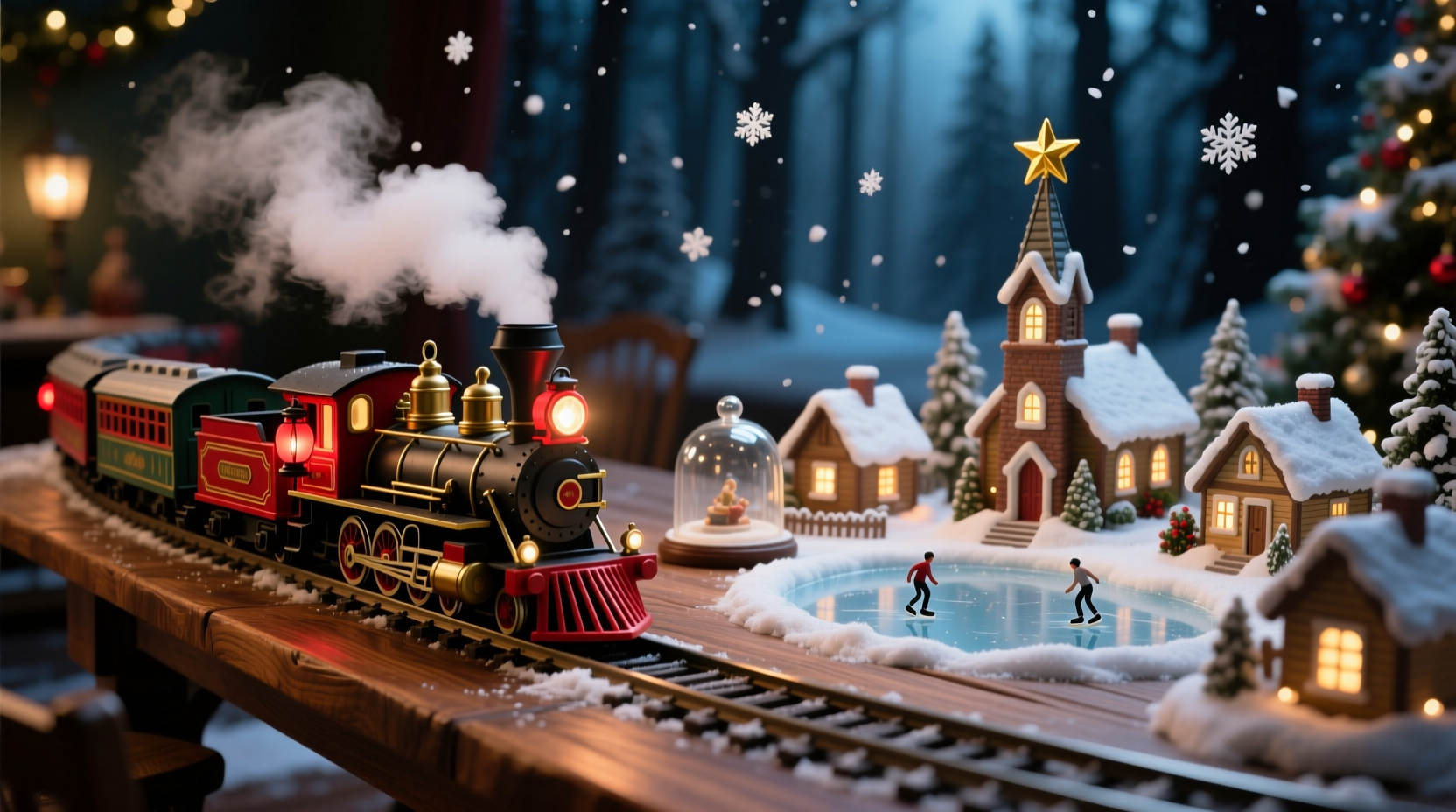
A Christmas train set centers on kinetic storytelling: locomotives chugging through miniature landscapes, bridges arching over faux rivers, and seasonal stations bustling with tiny figures. Its power lies in motion, sound, and repetition—the gentle hum of a transformer, the rhythmic clack-clack of wheels, the anticipation of each loop. It invites observation over time and rewards patience. A village display, by contrast, prioritizes still-life immersion: hand-painted cottages with glowing windows, winding cobblestone paths, frozen fountains, and delicately sculpted snowdrifts. Its strength is in detail, texture, and layered discovery—the quiet joy of spotting a hidden reindeer, a chimney puffing smoke (from a subtle LED), or a tiny bakery sign reading “Open for Cocoa.” Where trains tell a story of journey and return, villages narrate stasis and sanctuary—home as haven.
This fundamental divergence shapes every downstream decision: spatial requirements, assembly complexity, interactivity level, and even how guests engage with the display. A train needs clearance for track radius, electrical access for transformers, and buffer zones to prevent accidental derailments. A village demands flat, stable surface area, careful layering to avoid toppling, and lighting that highlights depth without glare. Neither is inherently “better”—but one will almost always be more harmonious with your physical space and daily life.
Space & Setup Realities: Measuring Your Home, Not Just the Box
Before selecting either option, measure—not the product dimensions listed online, but your actual display zone. Include ceiling height (for overhead clearance), nearby foot traffic patterns, and proximity to heat sources (radiators, fireplaces) or moisture (kitchens, bathrooms). Trains require unobstructed 360° access for track layout flexibility; villages benefit from front-and-center sightlines but tolerate tighter side margins.
Consider real-world constraints: A compact urban apartment with limited floor space may find a 5-foot oval train layout overwhelming, while a sprawling farmhouse might render a modest 2x3-foot village visually lost. Conversely, a high-traffic hallway favors a static village (no risk of tripping over track), whereas a dedicated den or sunroom offers ideal train territory. Power access matters too: most quality train sets require a dedicated outlet for consistent voltage; villages often run on battery packs or low-voltage USB adapters, offering greater placement freedom.
Emotional Resonance & Generational Engagement
Trains tap into a primal fascination with motion and mechanics. Children are drawn to the cause-and-effect simplicity: press a button, hear the whistle, watch the engine go. Adults appreciate the engineering nuance—the difference between a DC analog controller and DCC digital command systems, the realism of weathered freight cars, or the satisfaction of troubleshooting a stalled tender. This creates multi-layered engagement: kids chase the train’s path; teens adjust speed settings; grandparents recall childhood Lionel sets. The experience is dynamic and participatory.
Villages foster contemplative connection. Their stillness invites close inspection and personal projection. A child might assign names and stories to each cottage (“That’s where Santa’s cousin lives!”); an adult might spend minutes tracing hand-painted shingles or arranging miniature evergreen sprigs. Villages also integrate seamlessly with broader decor: they anchor garlands, complement tree ornaments, and harmonize with candlelight. Their emotional signature is warmth, safety, and continuity—less about action, more about belonging.
“The most enduring holiday displays aren’t the largest or most expensive—they’re the ones that hold space for quiet presence. A village doesn’t demand attention; it earns it through patient observation.” — Lena Torres, Curator of Holiday Folk Art, American Museum of Folk Culture
Practical Comparison: Cost, Maintenance & Longevity
Initial investment varies widely, but patterns emerge across tiers. Entry-level train sets ($120–$300) often include basic track, one engine, and a few cars—sufficient for simple loops but lacking realism. Mid-tier ($400–$1,200) adds detailed rolling stock, realistic scenery, and reliable electronics. Premium sets ($1,500+) feature hand-crafted brass engines, prototypical paint schemes, and advanced control systems. Village displays follow a similar arc: starter kits ($80–$250) offer 3–5 generic buildings; mid-range ($350–$900) includes artisan-crafted structures with interior lighting and textured roofs; premium ($1,100+) features museum-quality detailing, custom signage, and integrated snow effects.
| Factor | Christmas Train Set | Village Display |
|---|---|---|
| Setup Time (First Year) | 4–12 hours (track planning, leveling, wiring, testing) | 2–8 hours (layout design, base preparation, building placement, lighting setup) |
| Annual Maintenance | Track cleaning (every 2–3 weeks), wheel polishing, motor lubrication, transformer check | Dusting (monthly), bulb/LED replacement (every 2–3 years), structural stability check (pre-display) |
| Child Safety | Moving parts, small couplers, electrical components—requires supervision & elevated placement | Few moving parts; risk mainly from tipping (if poorly weighted) or fragile details |
| Expandability | High—add tunnels, signals, switches, scenery kits, new engines/cars | Moderate—add buildings, trees, figures, terrain; limited by base size and visual cohesion |
| Lifespan (With Care) | 20–40+ years (metal components endure; electronics may need upgrading) | 30–50+ years (ceramic/resin buildings resist fading; LEDs last 25,000+ hours) |
Real-World Decision Framework: A Step-by-Step Guide
Follow this sequence to determine which centerpiece fits your home—not your neighbor’s, not Pinterest’s, but yours:
- Assess Your Primary Display Zone: Measure length, width, height, and note power outlets, foot traffic, and ambient light. Is it a shelf? A table? A cleared floor area?
- Define Your Core Goal: Do you want to animate the space (draw eyes with motion/sound) or anchor it (create a serene focal point for reflection)?
- Evaluate Household Dynamics: Are young children present? Do adults enjoy tinkering? Is there someone who loves curating tiny worlds? Prioritize what energizes your people.
- Calculate Realistic Time Investment: Be honest: Will you dedicate 2 hours annually to track cleaning? Or prefer a 30-minute annual dusting routine?
- Test the Emotional Fit: Visit a local hobby shop. Sit with both displays for 10 minutes. Which one makes you pause, smile, or lean in? That instinct is data.
Mini Case Study: The Thompson Family’s Shift from Train to Village
The Thompsons displayed a vintage Lionel train set for 17 years—first in their parents’ basement, then on their own dining table. It was beloved, but increasingly impractical. Their daughter developed a severe peanut allergy at age 5, requiring rigorous floor cleaning; loose track pieces became hazardous. Their son, now 12, preferred building Minecraft worlds to operating controllers. And the couple found themselves dreading the 8-hour setup weekend each November. Last year, they sold the train and invested in a mid-tier Department 56 village. They built it on a custom walnut base with integrated dimmable lighting, placed it on a sturdy sideboard away from high-traffic zones, and added personalized elements: a tiny library named after their daughter’s favorite book, a bakery with her initials on the awning. “It’s quieter,” says Sarah Thompson, “but somehow more alive. Guests linger longer. We don’t ‘operate’ it—we inhabit it.” Their centerpiece no longer performs; it welcomes.
Do’s and Don’ts: Avoiding Common Pitfalls
- DO start small—a single train engine with a 2-foot oval track or a 3-building village core—and expand only when the joy remains uncomplicated.
- DO prioritize build quality over quantity: One meticulously detailed cottage outshines five flimsy ones; one smooth-running engine beats three noisy, unreliable ones.
- DON’T place either near HVAC vents, direct sunlight, or humid areas—heat fades paint, UV yellows plastics, and moisture corrodes metal contacts and warps wood bases.
- DON’T ignore scale consistency. Mixing HO-scale trains (1:87) with O-scale villages (1:48) creates jarring visual dissonance. Stick to one standard: HO for trains + villages, or O-scale if space allows.
- DO document your setup: Take photos of track layouts or village arrangements before packing away. Label boxes clearly (“Station House – Front Left Corner”). Future-you will weep with gratitude.
FAQ
Can I combine a train set and village display?
Yes—but thoughtfully. Use the train as a *peripheral* element: run it on a raised platform behind or beside the village, or create a “railway station” as one village building with a short spur track. Avoid placing tracks directly through the village center—this fractures the immersive stillness. The goal is harmony, not collision.
Which is easier to store off-season?
Villages generally win. Most buildings nest efficiently in shallow boxes with foam inserts. Trains require careful separation of engines, cars, track sections, and electronics—plus protection against wheel deformation if stored under weight. However, modular track systems (like LEGO-compatible rail sets) simplify train storage significantly.
Are vintage pieces worth the investment?
Vintage trains (Lionel, Marx, American Flyer pre-1960) often hold value and craftsmanship unmatched by modern mass production—but require expertise to restore and maintain safely. Vintage villages (early Department 56, Lemax) are collectible but may have brittle plastic or outdated wiring. For most families, modern reproductions with warranties and safety certifications deliver better long-term enjoyment.
Conclusion
Your holiday centerpiece shouldn’t be a source of seasonal stress or a trophy gathering dust. It should resonate with the quiet truths of your home: the pace you keep, the memories you honor, and the feelings you wish to cultivate. A Christmas train set pulses with the energy of arrival and adventure—ideal for homes that thrive on rhythm and interaction. A village display breathes with the stillness of belonging—perfect for spaces that cherish intimacy, detail, and unhurried presence. Neither choice is a compromise; both are valid, profound expressions of celebration. What matters isn’t which one wins the comparison, but which one feels like coming home.




 浙公网安备
33010002000092号
浙公网安备
33010002000092号 浙B2-20120091-4
Comments
No comments yet. Why don't you start the discussion?