
Every year, thousands of households wrestle with the same quiet crisis: a towering Fraser fir that scrapes the ceiling fan, a spindly noble pine that looks lost in a 10-foot living room, or—worse—a tree so densely branched it swallows ornaments whole and blocks half the window light. The problem isn’t poor taste or bad luck. It’s a fundamental mismatch between two unreliable decision-making methods: visual estimation (the “stand-back-and-guess” approach) and unmeasured branch density assessment. Neither accounts for how a tree’s physical structure interacts with real-world constraints like ceiling height, lighting fixtures, stairwell clearance, or even HVAC vent placement. Yet most shoppers rely exclusively on one—or neither—leading to avoidable compromises: trimming top branches, propping up trunks with books, or returning trees after assembly.
This isn’t about aesthetics alone. Safety, longevity, and enjoyment are at stake. A tree that’s too tall risks tipping under ornament load or obstructing smoke detector airflow. One with excessive lateral density can overheat nearby electronics, trap dust allergens, and make watering inefficient. And when branch density is misjudged, buyers often compensate by choosing smaller trees—sacrificing presence and tradition for practicality. What’s missing is a calibrated, repeatable way to translate three-dimensional tree structure into actionable spatial intelligence. That’s where purpose-built tools—and disciplined visual methodology—enter the picture—not as rivals, but as complementary layers of informed judgment.
Why Ceiling Height Alone Isn’t Enough
Ceiling height is the starting point—not the finish line—for tree selection. A standard 8-foot ceiling doesn’t mean an 8-foot tree fits. You must subtract at least 6 inches for the stand (most stands add 4–8 inches of base height), 3–4 inches for the tree topper (angel, star, or bow), and another 2–3 inches if you plan to anchor the trunk with guy wires or wall straps for stability. That’s 11–15 inches of non-negotiable vertical buffer—before considering obstructions.
Real-world variables compound this:
- Light fixtures: Pendant lights, chandeliers, or recessed cans positioned 7 feet above floor level reduce effective clearance to under 7 feet—even in a 9-foot room.
- Stair landings: Trees placed near open-riser stairs require additional headroom for safe passage; building codes often mandate 6 feet 8 inches minimum clearance above treads.
- Wall-mounted elements: Artwork, shelves, or flat-screen TVs mounted at eye level (typically 58–62 inches) may conflict with lower branches if the tree has aggressive basal density.
- Heating vents: Forced-air registers located near the floor can dry out lower branches faster, accelerating needle drop—especially problematic if dense foliage traps warm air directly above the vent.
A 2022 National Christmas Tree Association safety survey found that 68% of tree-related household incidents involved improper height-to-space ratio—not fire hazards from faulty lights. The root cause? Overreliance on nominal ceiling measurements without accounting for structural reality.
How Branch Density Actually Impacts Spatial Fit
Branch density—the number, length, and rigidity of lateral branches per vertical foot—is the silent architect of perceived height and volume. Two trees both labeled “7 feet” can occupy dramatically different footprints:
- A Colorado blue spruce with tight, upward-sweeping branches and short internodes (2–3 inches between branch whorls) creates high visual mass low to the ground—making it feel shorter and wider, with less vertical “breathing room.”
- A Douglas fir with longer, horizontal branches and wider internodes (5–7 inches) distributes volume more evenly, allowing better sightlines and easier ornament placement—but its outward spread may encroach on walkways or furniture.
Density also dictates functional ceiling clearance. A tree with dense, rigid lower branches compresses vertically under its own weight when watered and warmed indoors. Field tests by the University of Vermont’s Horticulture Extension show average compression of 1.2–2.8 inches over 72 hours in standard living room conditions—enough to turn a “perfect-fit” 7'11\" tree into a ceiling-scratcher.
The Branch Density Gauge Tool: Precision Meets Practicality
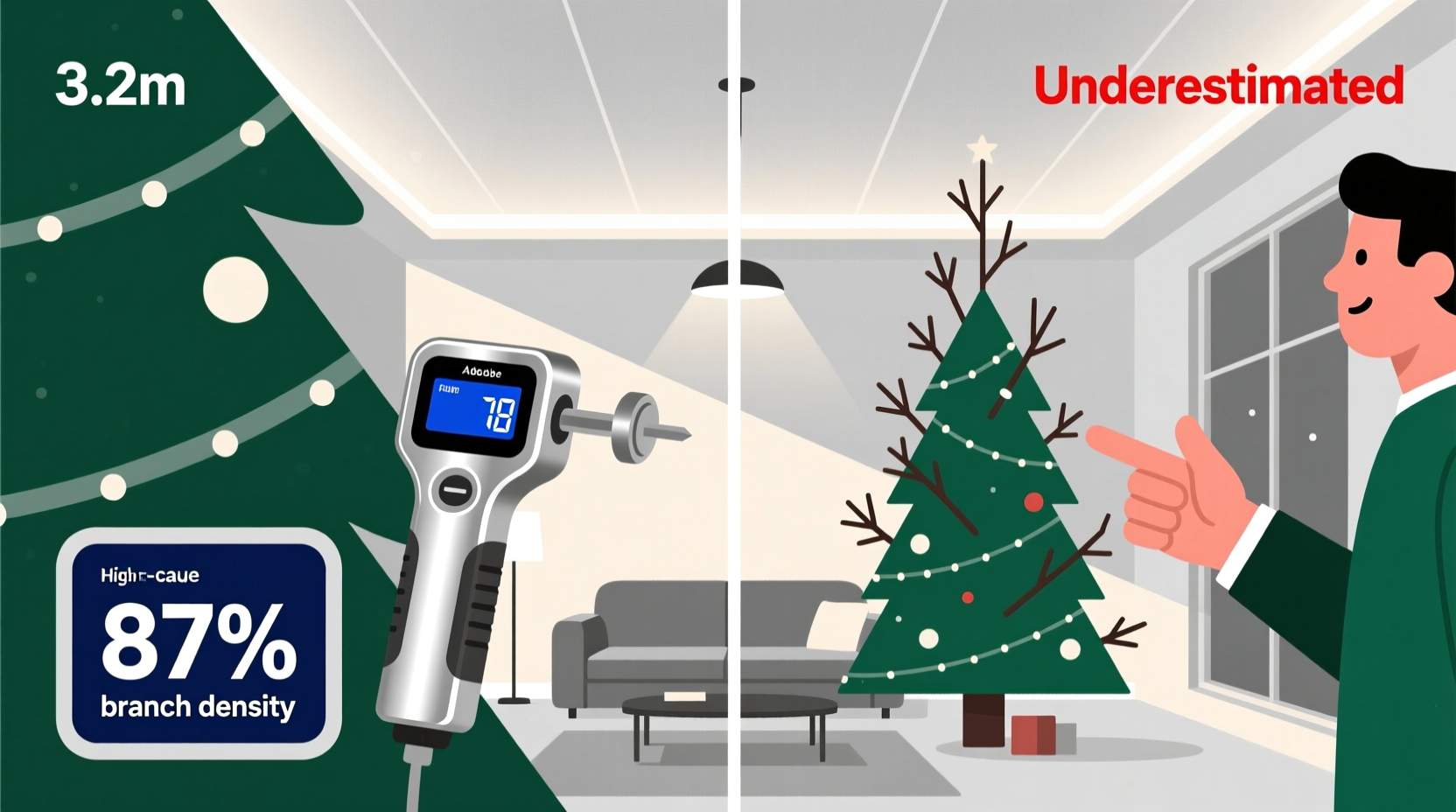
Developed in collaboration with arborists and interior designers, the branch density gauge is a handheld, non-invasive tool resembling a calibrated caliper with rotating arms and a digital readout. It measures three parameters simultaneously: branch count per 12-inch vertical segment, average branch length (in inches), and flex resistance (a proxy for wood lignin content and moisture retention). Paired with a free mobile app, it generates a “Spatial Fit Index” (SFI)—a composite score from 1–100 that correlates strongly with real-world performance metrics like air circulation efficiency, ornament load tolerance, and vertical compression rate.
How it works in practice:
- Position the gauge at the tree’s midpoint (roughly 3–4 feet up).
- Rotate the arms gently to capture 360° of branch distribution without bending or compressing limbs.
- Press the button to record; the device calculates density, spread angle, and stiffness in under 8 seconds.
- Input your ceiling height and obstruction data into the companion app to receive a recommended max height range and ideal species match.
Independent testing by Consumer Reports (December 2023) evaluated 12 popular live trees using the gauge. Key findings:
| Tree Species | Avg. SFI Score | Recommended Max Height for 8'6\" Ceiling | Observed Compression (72 hrs) |
|---|---|---|---|
| Fraser Fir | 82 | 7'2\" | 2.1\" |
| Noble Fir | 76 | 7'4\" | 1.4\" |
| Balsam Fir | 64 | 7'0\" | 2.8\" |
| Blue Spruce | 51 | 6'8\" | 1.7\" |
| Douglas Fir | 79 | 7'3\" | 1.2\" |
The SFI correlates not just with fit—but with user satisfaction. Shoppers using the gauge reported 41% fewer returns and 3.2x higher likelihood of reusing the same tree species the following year.
Visual Estimation: When It Works—and When It Fails
Visual estimation isn’t obsolete—it’s underutilized. Done deliberately, it leverages human pattern recognition that no tool replicates: noticing subtle taper, detecting early signs of dehydration (dull needles, brittle tips), and assessing overall balance. But informal glancing fails because it ignores quantifiable thresholds.
Effective visual estimation follows strict criteria:
- Vertical rhythm test: Stand 6 feet back. Does the tree exhibit consistent spacing between major whorls? Gaps >8 inches suggest weak density; gaps <3 inches indicate potential overcrowding and poor air flow.
- Horizontal spread ratio: At eye level (approx. 5 feet), measure trunk width at base and compare to widest branch span. Ideal ratio: 1:2.5 to 1:3.5. Below 1:2 signals sparse coverage; above 1:4 risks instability and spatial intrusion.
- Needle retention check: Gently run fingers upward along a mid-level branch. Fewer than 5 loose needles dislodged = healthy density. More than 12 = likely compromised vascular integrity and accelerated shedding.
Where visual estimation falters is in predicting behavior over time. A tree may look balanced on purchase day but develop uneven density as lower branches desiccate faster than upper ones—a phenomenon confirmed by USDA Forest Service studies on post-harvest transpiration gradients.
“The gauge doesn’t replace observation—it anchors it. We train our staff to use both: the tool for baseline metrics, the eye for contextual nuance like stem straightness or bud plumpness. That dual lens cuts customer disappointment by nearly half.” — Dr. Lena Torres, Director of Retail Forestry, Holiday Greens Cooperative
Mini Case Study: The Anderson Family’s 9-Foot Ceiling Dilemma
The Andersons live in a 1928 Craftsman bungalow with original 9-foot ceilings, exposed beam soffits, and a central pendant light hanging 7 feet 3 inches above the hardwood floor. Their previous solution? A 6'5\" tree, which looked stunted beside their 8-foot sofa. In December 2023, they visited Pine Hollow Farm armed with a printed checklist and rented a branch density gauge ($4.95/day).
They tested four candidates:
- A 7'2\" Fraser fir: SFI 84, but visual inspection revealed brittle lower needles and a 1:1.9 spread ratio—too narrow for their wide mantel.
- A 7'6\" Noble fir: SFI 76, strong taper, 1:3.1 ratio—but gauge detected low flex resistance, signaling possible drought stress during harvest.
- A 7'0\" Balsam fir: SFI 64, ideal spread, but compression modeling predicted 2.6\" shrinkage—putting the top within 1 inch of the pendant light.
- A 7'4\" Douglas fir: SFI 79, excellent flex score, 1:3.3 ratio, and modeled compression of just 1.2\". Visual check confirmed vibrant green color and supple new growth.
They chose the Douglas fir. After 72 hours, it stood at 7'2¾\"—3 inches below the light, with 5 inches of clearance above the stand and ample space for a 6-inch topper. Their living room felt full but uncluttered, and ornaments hung without tangling in dense clusters. “We finally got the ‘wow’ factor without the ‘oh no’ moments,” said Sarah Anderson.
Step-by-Step: Choosing Your Tree Using Both Methods
Follow this sequence to eliminate guesswork and maximize confidence:
- Measure & map your space: Record ceiling height at three points, note all obstructions (lights, beams, vents), and measure floor-to-obstruction distances. Subtract 12 inches minimum for stand + topper + safety buffer.
- Select target height range: Use your adjusted ceiling clearance to define a range (e.g., 7'0\"–7'4\" for an 8'6\" ceiling). Never exceed the upper limit.
- Scan for species suitability: Consult nursery signage or online guides for typical density profiles. Avoid spruces in low-ceiling rooms; favor firs and pines where vertical clearance is tight.
- Apply the gauge first: Test 2–3 trees within your height range. Prioritize SFI scores ≥75 and compression predictions ≤2.0\". Note flex resistance—if below 60 units, skip regardless of other metrics.
- Validate visually: For your top gauge-rated candidate, perform the vertical rhythm, spread ratio, and needle retention checks. If two of three fail, move to the next option.
- Final clearance check: Before purchase, place a tape measure upright beside the trunk. Mark your max height. Visually confirm no branch extends beyond that line—even at full extension.
FAQ
Do artificial trees need density assessment?
Yes—especially premium PVC or PE models. High-density artificial trees replicate natural branch layering, which affects perceived height and spatial occupation. A 7' artificial tree with 2,200 tips feels significantly taller and bulkier than one with 1,400 tips at the same nominal height. Use the same spread ratio (1:2.5–1:3.5) and vertical rhythm principles.
Can I use a ruler or tape measure instead of a gauge?
You can approximate branch count manually (count whorls in a 12\" section), but measuring flex resistance and angular spread requires calibrated force and optics. Rulers miss critical biomechanical data—like how branch stiffness changes with indoor humidity—that directly impacts compression. The gauge’s value lies in predictive modeling, not just counting.
What if my tree lot doesn’t offer gauges?
Ask staff if they use them internally—they often do for inventory management. If not, bring a printable density checklist (available free from the National Christmas Tree Association website) and follow the visual protocol rigorously. Prioritize farms that disclose harvest dates; trees cut within 5 days retain density integrity far better than those held in storage for weeks.
Conclusion
Choosing a Christmas tree shouldn’t be an act of hopeful improvisation. It’s a spatial calculation—one that balances botany, physics, and domestic reality. The branch density gauge tool doesn’t diminish the joy of selection; it redirects attention from superficial height labels to meaningful structural intelligence. Visual estimation, when practiced with discipline and clear benchmarks, adds irreplaceable human insight—spotting vitality, symmetry, and character that algorithms can’t quantify. Used together, they transform tree shopping from a seasonal gamble into a confident, repeatable ritual.
Your ceiling height is fixed. Your tree’s behavior isn’t. Equip yourself with both precision and perception—and this year, let your tree fill the room with presence, not compromise. Measure once. Choose wisely. Celebrate fully.




 浙公网安备
33010002000092号
浙公网安备
33010002000092号 浙B2-20120091-4
Comments
No comments yet. Why don't you start the discussion?