
Selecting the right Christmas tree is one of the most anticipated parts of holiday decorating. But nothing ruins the moment faster than realizing your majestic 8-foot spruce won’t fit under the ceiling—especially after it’s already been dragged through the house, needle-covered stand in tow. The stakes are real: too tall, and you risk damaging the tree or your ceiling fixture; too short, and the room feels underwhelming. So how do you get it right? Two popular methods dominate the conversation: using a dedicated Christmas tree height calculator app or relying on time-tested tape measure hacks. One promises precision with digital convenience; the other leans on hands-on accuracy. Which actually prevents ceiling collisions—and which might leave you trimming branches at midnight?
The Problem With Guesswork
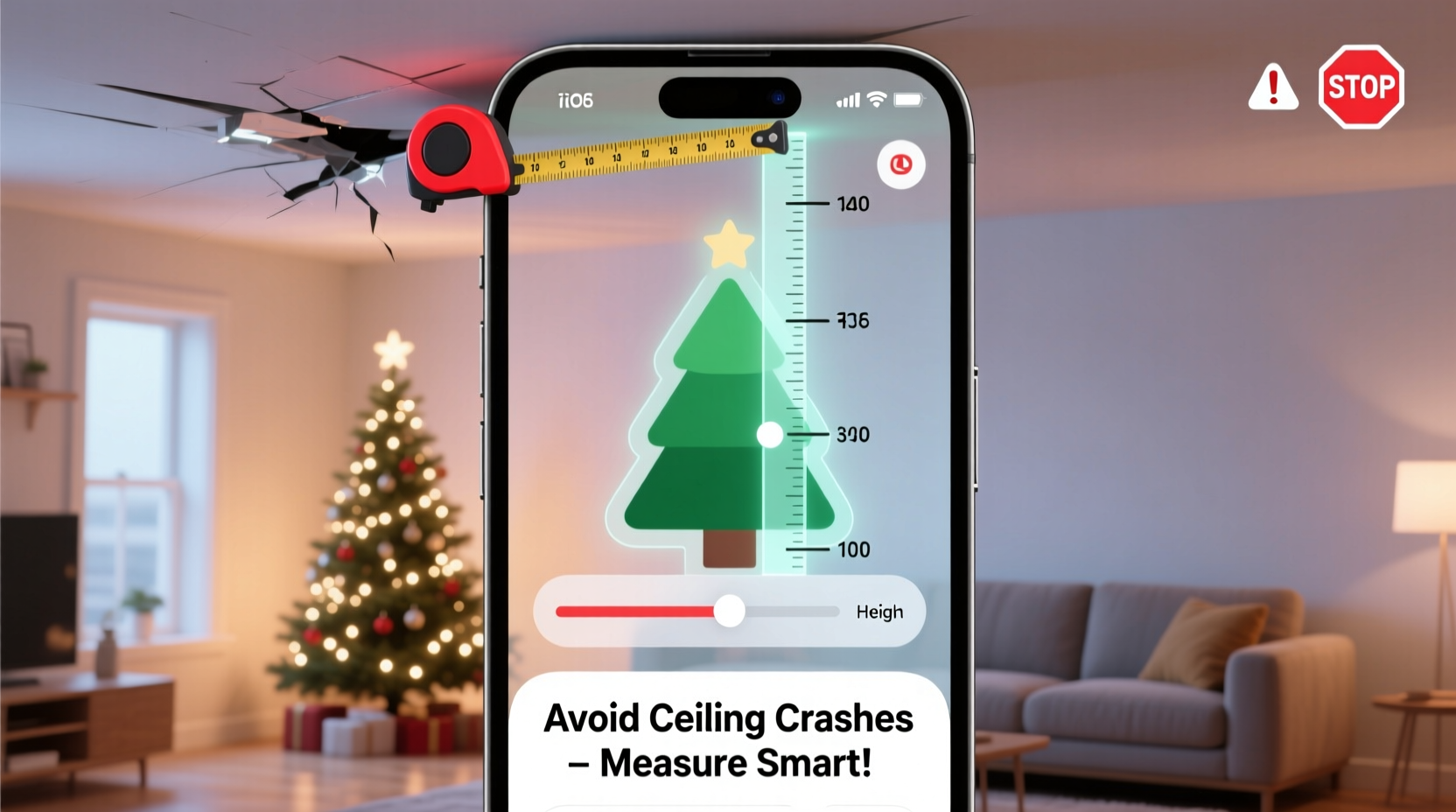
Every year, thousands of households repeat the same ritual: standing a tree upright, stepping back, tilting their heads, and declaring, “Looks about right.” Then comes the dreaded crunch—the top of the tree brushes the ceiling or snags a chandelier. At that point, options narrow quickly: cut the trunk, compress the stand, or start over. None are ideal.
This isn’t just an inconvenience—it’s a waste of money and effort. A full-sized Fraser fir can cost $150 or more. Damaging it during setup defeats the purpose of investing in quality. Beyond aesthetics, safety matters. Overstressed ceiling fans, cracked drywall, or electrical fixtures pulled loose by a leaning tree pose real hazards.
The root of the problem? Misjudging space. Room height alone isn’t enough. You must account for the tree stand (typically 6–10 inches), any topper (star, angel, bow—add another 6–12 inches), and flooring variables like carpet thickness or uneven surfaces. Ignoring these factors turns even a careful estimate into a gamble.
How Tree Height Calculator Apps Work
In recent years, smartphone apps have entered the holiday space with promises of foolproof tree selection. These tools typically guide users through a step-by-step process: enter your ceiling height, select your preferred topper size, specify stand height, and optionally upload a photo of your living space. The app then calculates the maximum safe tree height and may even suggest local retailers selling trees within that range.
Some advanced versions use augmented reality (AR). By pointing your phone’s camera at the corner where the tree will go, the app overlays a virtual tree scaled to your input dimensions. This allows you to “see” how different heights would look before making a purchase.
These apps appeal to tech-savvy decorators and last-minute shoppers. They’re fast, portable, and eliminate the need to carry a tape measure to the tree lot. However, their reliability depends on user input accuracy. If you misenter your ceiling height by two inches—or forget to include the topper—the recommendation becomes misleading.
Additionally, not all apps account for real-world variables like baseboard heaters, nearby furniture, or vaulted ceilings with peak obstructions. Some rely on generic assumptions rather than precise spatial data. In homes with architectural quirks, this can lead to errors no algorithm can fix.
“Technology helps, but it doesn’t replace spatial awareness. I’ve seen people trust an app result only to realize their cathedral ceiling dips near the window.” — Laura Mendez, Interior Designer & Holiday Stylist
Tape Measure Hacks: Low-Tech but Reliable
Long before apps existed, families used simple, physical methods to avoid ceiling collisions. The most effective involve nothing more than a tape measure, a yardstick, or even a broom handle.
One common hack: Cut a length of PVC pipe or wooden dowel to match your desired tree height minus the stand and topper. Label it clearly—e.g., “7' MAX”—and bring it to the lot. Hold it next to candidate trees to visualize fit. It’s crude but effective.
Another approach uses string. Tie one end to the ceiling at the installation spot, drop it to the floor, and mark where the stand base would sit. Unravel the string and measure it. That’s your usable height. Subtract 6 inches for clearance and you have your target.
For those who prefer precision, a laser distance measurer (available at hardware stores for under $50) offers exact readings without stretching a tape across the room. Point, click, read—done.
These methods win on control. You’re not relying on software logic or GPS-like approximations. You’re measuring the actual space, accounting for baseboards, crown molding, and light fixtures in real time. There’s no learning curve, no login, and no battery drain.
| Method | Accuracy | Speed | Cost | Best For |
|---|---|---|---|---|
| Tree Height Calculator App | Medium-High (user-dependent) | Fast | Free – $5 | Urban apartments, tech users, quick decisions |
| Tape Measure + Manual Math | Very High | Moderate | $5–$20 | Older homes, irregular ceilings, detail-oriented planners |
| Laser Distance Tool | Extremely High | Very Fast | $30–$60 | Precision seekers, multi-room setups |
| Broom Handle Hack | Low-Medium | Slow | Free | Emergency fixes, visual estimation |
A Real-World Comparison: Sarah’s Living Room Dilemma
Sarah, a homeowner in Portland, Oregon, faced a classic holiday challenge. Her living room has 8-foot ceilings, but a ceiling fan hangs 7 feet above the floor in the corner where she planned to place the tree. She wanted a full-bodied Douglas fir but didn’t want to risk hitting the blades.
She tried both methods. First, she downloaded a popular tree height calculator app. After entering her ceiling height and selecting a 9-inch star topper, the app recommended a 7'6\" tree. Confident, she ordered one for pickup.
When the tree arrived, she set it up—and the top brushed the fan. Puzzled, she grabbed a tape measure. Only then did she realize the app hadn’t accounted for the fan’s downward extension. Her usable clearance was actually 6'4\", not 7'6\". The app assumed open ceiling space.
She adjusted her plan, cutting the trunk down by 14 inches. The tree fit, but the proportions looked squat. Next year, she vowed to measure manually first.
Sarah’s story isn’t unique. It illustrates a critical gap: apps often assume ideal conditions. Real homes have obstacles. The tape measure, though analog, captures reality in a way code cannot.
Step-by-Step: The Foolproof Tree Height Planning Process
To avoid Sarah’s mistake, follow this proven sequence—whether you plan to use an app or not.
- Measure Floor to Ceiling: Use a metal tape measure from the floor to the ceiling at the exact spot the tree will stand. Do this in at least three spots if the ceiling slopes.
- Subtract Obstructions: Note any hanging lights, fans, or artwork. Record the lowest clearance point.
- Add Your Components: Estimate total added height from stand (6–10\") and topper (6–12\"). Add them together.
- Calculate Usable Tree Height: Subtract component total from your lowest clearance. Example: 96\" ceiling – 18\" (stand + star) = 78\" max tree.
- Deduct Clearance Buffer: Subtract 2–3 inches for safety. Trees aren’t perfectly straight; stands compress. Final target: 75\" in this case.
- Verify at the Lot: Bring your target number—and a measuring tape. Don’t rely on tags alone; tree heights vary by grower.
- Recheck at Home: Before final setup, dry-fit the tree with the stand and topper in place. Step back and assess.
Which Method Prevents More Ceiling Collisions?
The answer isn’t binary. Both tools have value—but only when used correctly.
Apps excel when speed and convenience matter. For apartment dwellers with standard 9-foot ceilings and minimal obstructions, they provide quick guidance. Many integrate with delivery services, letting you order a perfectly sized tree online. In controlled environments, they reduce guesswork.
However, tape measures and manual measurement prevent more collisions overall. Why? They force engagement with the actual space. You see what’s overhead. You notice the chandelier chain, the smoke detector, the slant in the ceiling. You make fewer assumptions.
Moreover, the act of measuring builds mental clarity. When you physically mark a 7-foot line on a wall, you internalize the limit. Apps display numbers; tape measures create spatial memory.
For maximum reliability, combine both: use the app as a starting point, but verify every input with a tape measure. Let technology assist—not replace—your judgment.
FAQ
Can I trust the height labels on pre-cut trees at big-box stores?
Not always. Labels like “7–8 feet” are estimates. Trees vary in growth pattern and trimming. Always measure from base to tip with a tape before purchasing, even if tagged.
What if my ceiling is vaulted or sloped?
Focus on the lowest point where the tree will be placed. Even if the peak is 14 feet high, if the corner dips to 7 feet due to rafters, that’s your limiting factor. Use a laser measurer or long tape to confirm.
Do tree height apps work outdoors, like for front yard displays?
Some do, especially AR-based ones. But outdoor lighting, wind, and glare can interfere with accuracy. For large displays, manual measurement remains the gold standard.
Final Verdict: Precision Over Convenience
While Christmas tree height calculator apps offer modern convenience, they can't replicate the tactile certainty of a tape measure. Apps depend on accurate inputs and idealized models. Tape measures reveal truth—uneven floors, sagging ceilings, forgotten vents. They don’t crash, freeze, or require Wi-Fi.
The goal isn’t just to avoid ceiling collisions. It’s to achieve balance: a tree that fills the space without dominating it, that honors tradition without risking damage. That kind of harmony comes from attention to detail, not algorithmic shortcuts.
If you're buying a tree this season, download an app if it helps organize your thoughts. But keep a tape measure in your coat pocket. Let data inform your choice—but let reality decide it.




 浙公网安备
33010002000092号
浙公网安备
33010002000092号 浙B2-20120091-4
Comments
No comments yet. Why don't you start the discussion?