
Transforming a Christmas tree into a mesmerizing centerpiece goes beyond stringing lights—it's about choreography. The way lights illuminate over time can evoke emotion, capture attention, and elevate the festive atmosphere. Whether you're decorating a home tree, managing a public display, or programming smart LEDs, choosing the right lighting sequence is crucial. Three popular approaches dominate: sequential, random, and spiral. Each creates a distinct visual rhythm, and understanding their strengths allows you to design displays with purpose and flair.
The difference between a flat, static glow and a living, breathing cascade of light lies in intentional sequencing. Modern LED controllers and smart lighting systems make it easier than ever to experiment with timing, direction, and pattern variation. But without thoughtful planning, even advanced technology can fall flat. This guide breaks down each major sequence type, compares their visual impact, and provides actionable advice to help you craft a lighting display that captivates.
Understanding Lighting Sequences: Why Timing Matters
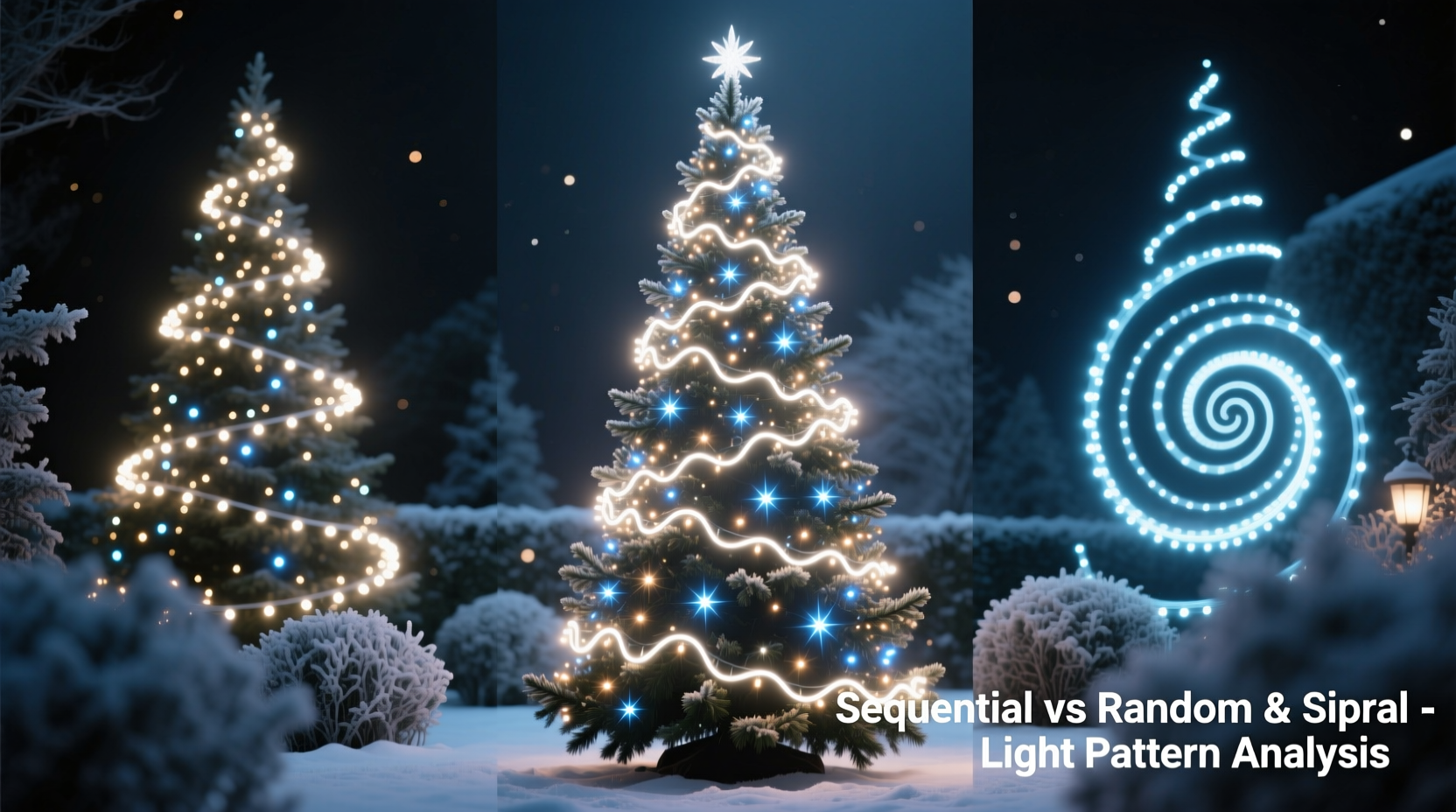
A Christmas tree isn’t just lit—it’s revealed. The human eye naturally follows movement and change, making timed sequences far more engaging than a uniform on/off switch. A well-planned sequence guides the viewer’s gaze, builds anticipation, and turns illumination into storytelling.
Lighting sequences are typically controlled through programmable timers, microcontrollers like Arduino, or smart home platforms such as Philips Hue, LIFX, or dedicated Christmas lighting software like xLights or Light-O-Rama. These tools allow precise control over which lights turn on or off, when, and how they transition—whether fading, twinkling, chasing, or sweeping.
The three most effective base patterns—sequential, random, and spiral—serve different aesthetic goals:
- Sequential: Lights activate row by row, creating a clean, predictable wave.
- Random: Bulbs illuminate unpredictably, mimicking natural flicker or starlight.
- Spiral: Lights follow a helical path around the tree, producing a smooth upward or downward motion.
Selecting the right one depends on your desired mood, tree shape, bulb density, and audience.
Sequential Lighting: Precision and Predictability
Sequential lighting involves activating strands in a fixed order—usually from top to bottom, bottom to top, or outward from the trunk. This method produces a clean, engineered effect ideal for formal settings or displays emphasizing symmetry.
Best suited for trees with evenly spaced horizontal rows of lights, the sequential approach works particularly well when lights are wrapped in a tiered fashion. It’s commonly used in commercial installations where clarity and repetition reinforce brand messaging or seasonal themes.
The strength of sequential lighting lies in its reliability. Viewers quickly recognize the pattern, which fosters a sense of comfort and nostalgia. However, overuse can lead to predictability. To maintain visual interest:
- Vary the speed: Try slow sweeps for elegance, rapid chases for excitement.
- Add pauses: Insert brief blackouts between cycles to reset attention.
- Combine directions: Alternate between upward and downward flows.
“Sequential patterns work best when paired with color gradients. Watching warm white shift to cool blue in a wave adds depth.” — Daniel Reyes, Holiday Lighting Designer, NYC Public Displays
When to Use Sequential Sequencing
- You want a polished, professional look.
- Your tree has structured, tiered branches.
- You’re using monochromatic or dual-color schemes.
- The display is viewed from a distance (e.g., storefronts).
Random Lighting: Embracing Chaos and Sparkle
Random sequencing introduces spontaneity by illuminating individual bulbs or small clusters at unpredictable intervals. This mimics the irregular twinkle of stars or fireflies, creating a lively, organic feel.
Unlike true randomness, most “random” sequences in lighting software use pseudo-random algorithms to avoid clustering or long silences. This ensures constant activity while preserving the illusion of chance. Random effects are especially effective with multi-colored mini-lights or fairy lights densely wrapped around the tree.
This style excels in intimate settings—a living room tree viewed up close benefits from the playful energy of scattered twinkles. It also helps mask imperfections in light distribution, as the eye is drawn to movement rather than gaps.
Enhancing the Random Effect
- Layer multiple random channels: Run two independent random sequences at different speeds.
- Incorporate dimming: Have some bulbs fade in/out while others snap on/off.
- Use color variety: Assign random hues to enhance unpredictability.
Spiral Lighting: The Illusion of Motion
Spiral sequencing follows a helical path around the tree, simulating an upward or downward swirl. When executed correctly, it creates a hypnotic, fluid motion that appears almost three-dimensional.
This technique requires careful physical placement of lights. For optimal effect, wrap the strand in a continuous spiral from base to tip (or vice versa), ensuring even spacing. Then program the controller to activate bulbs along that same path in sequence. The result is a smooth ribbon of light traveling up the tree like a glowing vine.
Spiral sequences are among the most visually compelling because they exploit depth perception. As the light moves diagonally across the conical form, the brain interprets it as dynamic volume, not just surface decoration.
Pro Tips for Spiral Success
- Mark your starting point and maintain consistent turns per foot (e.g., 3–5 wraps per vertical foot).
- Use addressable LEDs (like WS2812B) so each bulb can be individually controlled.
- Adjust timing to match tree height—taller trees need slower speeds to avoid blurring.
- Reverse direction every few cycles to prevent visual fatigue.
“The spiral sequence is my go-to for community trees. People stop, tilt their heads, and say, ‘How does it do that?’ That’s the magic we’re after.” — Miriam Lopez, Lead Technician, Denver Holiday Lights Festival
Comparison: Choosing Your Strategy
| Sequence Type | Visual Effect | Best For | Setup Difficulty | Dynamism Score (1–5) |
|---|---|---|---|---|
| Sequential | Wave-like, orderly progression | Formal displays, symmetrical trees | Medium | 3 |
| Random | Chaotic sparkle, natural flicker | Indoor trees, cozy ambiance | Low to Medium | 4 |
| Spiral | Smooth upward/downward swirl | Tall, well-proportioned trees | High | 5 |
While each method has merit, combining them often yields the richest results. For example, run a slow spiral as the primary motion, overlay a faint random twinkle in the background, and punctuate with a full sequential sweep every 30 seconds. Layering sequences creates complexity without clutter.
Step-by-Step Guide to Planning Your Sequence
Creating a dynamic lighting plan doesn’t require professional equipment—but it does benefit from structure. Follow this timeline to build a compelling display:
- Assess your tree (Day 1): Measure height, note branch density, and determine access to power and controls.
- Choose bulb type (Day 2): Opt for addressable RGB LEDs if sequencing complexity is a goal; standard LEDs work for basic patterns.
- Wrap lights strategically (Day 3): For spiral effects, wrap in a continuous helix. For random, ensure even coverage. For sequential, group by horizontal tiers.
- Test connectivity (Day 4): Connect to controller and verify all bulbs respond. Label channels if using multiple strands.
- Program base sequences (Day 5): Upload one pattern at a time—start with spiral, then add random, then sequential.
- Refine timing (Day 6): Adjust delays, durations, and transitions. Slow down fast sequences; add variation to repetitive ones.
- Preview at night (Day 7): Observe from multiple angles and distances. Invite feedback from family or neighbors.
- Finalize and automate (Day 8): Set schedule (e.g., 5 PM to 11 PM), enable weatherproofing, and secure connections.
Mini Case Study: Transforming a Front Yard Display
The Thompson family in Portland, Oregon, had used the same steady-on red-and-green lights for 12 years. In 2023, they upgraded to a smart LED system with sequencing capabilities. Their goal: create a display that drew compliments without overwhelming their quiet street.
They began by wrapping their 8-foot Fraser fir in a tight spiral using 500 RGB LEDs. Using a $40 Wi-Fi controller, they programmed a 12-second upward spiral cycle in gold-white, followed by a 20-second random twinkle in soft rainbow tones. Every five minutes, a bold sequential wave in patriotic red, white, and blue swept from top to bottom.
The result? Neighbors reported slowing down to watch, children pointed excitedly, and local news featured their home in a “Best Lights” segment. Most importantly, the Thompsons found joy in tweaking the show weekly—adding snowflake chases before Christmas Eve and switching to icy blue spirals for New Year’s.
Their success came not from spending the most, but from planning with intention. They prioritized motion over quantity, using fewer bulbs with smarter sequencing.
Expert Checklist: Lighting Sequence Readiness
Before finalizing your display, ensure you’ve covered these critical points:
- ✅ Lights are evenly distributed and securely fastened
- ✅ Controller is waterproof (if outdoors) and within reach of power
- ✅ All bulbs respond during test mode
- ✅ Sequence runs smoothly without skips or glitches
- ✅ Speed matches tree size—no blur on tall trees, no lag on short ones
- ✅ Transitions between patterns are smooth, not jarring
- ✅ Display is visible and enjoyable from primary viewing angles
- ✅ Backup sequence is loaded in case of software failure
Frequently Asked Questions
Can I mix sequence types on one tree?
Absolutely. In fact, layering sequences often produces the most engaging results. For example, run a slow spiral as the main animation while a subtle random twinkle plays in the background. Just ensure your controller supports multiple channels or zones.
Do I need expensive equipment for spiral sequences?
Not necessarily. While addressable LEDs offer the most precision, you can simulate a spiral effect with standard lights by grouping bulbs into segments and wiring them in helical order. However, true smooth motion requires individually controllable pixels.
How long should each sequence cycle last?
Aim for 10–30 seconds per major animation. Shorter cycles (under 10 seconds) may feel frantic; longer ones (over 60 seconds) risk losing attention. Include brief pauses or fades between cycles to reset visual focus.
Conclusion: Illuminate with Intention
A Christmas tree’s glow should do more than light a room—it should spark wonder. By moving beyond static illumination and embracing thoughtful sequencing, you turn tradition into theater. Whether you choose the elegant predictability of sequential waves, the joyful chaos of random twinkles, or the mesmerizing flow of a spiral climb, the key is deliberate design.
Start simple, test often, and don’t be afraid to iterate. Some of the most beloved displays began as experiments in a driveway or living room. With today’s accessible technology, anyone can become a lighting choreographer.




 浙公网安备
33010002000092号
浙公网安备
33010002000092号 浙B2-20120091-4
Comments
No comments yet. Why don't you start the discussion?