
Moving a live, potted Christmas tree—whether from patio to porch, garage to living room, or nursery to holiday display—is deceptively delicate work. Unlike cut trees, potted evergreens retain an intact root system bound within a finite volume of soil: the root ball. When that soil dries unevenly, shifts under stress, or fractures during handling, it compromises hydraulic continuity between roots and canopy. Cracks aren’t just cosmetic—they create air pockets that desiccate fine feeder roots, disrupt water uptake, and invite fungal pathogens. Worse, once cracked, the soil rarely re-fuses naturally; compaction and shrinkage only worsen with time. This isn’t about aesthetics—it’s about physiological survival. A single misstep in transport can reduce post-holiday transplant success by up to 60%, according to horticultural field trials conducted by the University of Vermont’s Cold Climate Horticulture Program. This guide distills decades of arborist practice, nursery protocol, and real-world seasonal experience into a precise, repeatable method for moving potted conifers—without splitting the root ball.
Why Soil Cracking Happens (and Why It’s Worse Than It Looks)
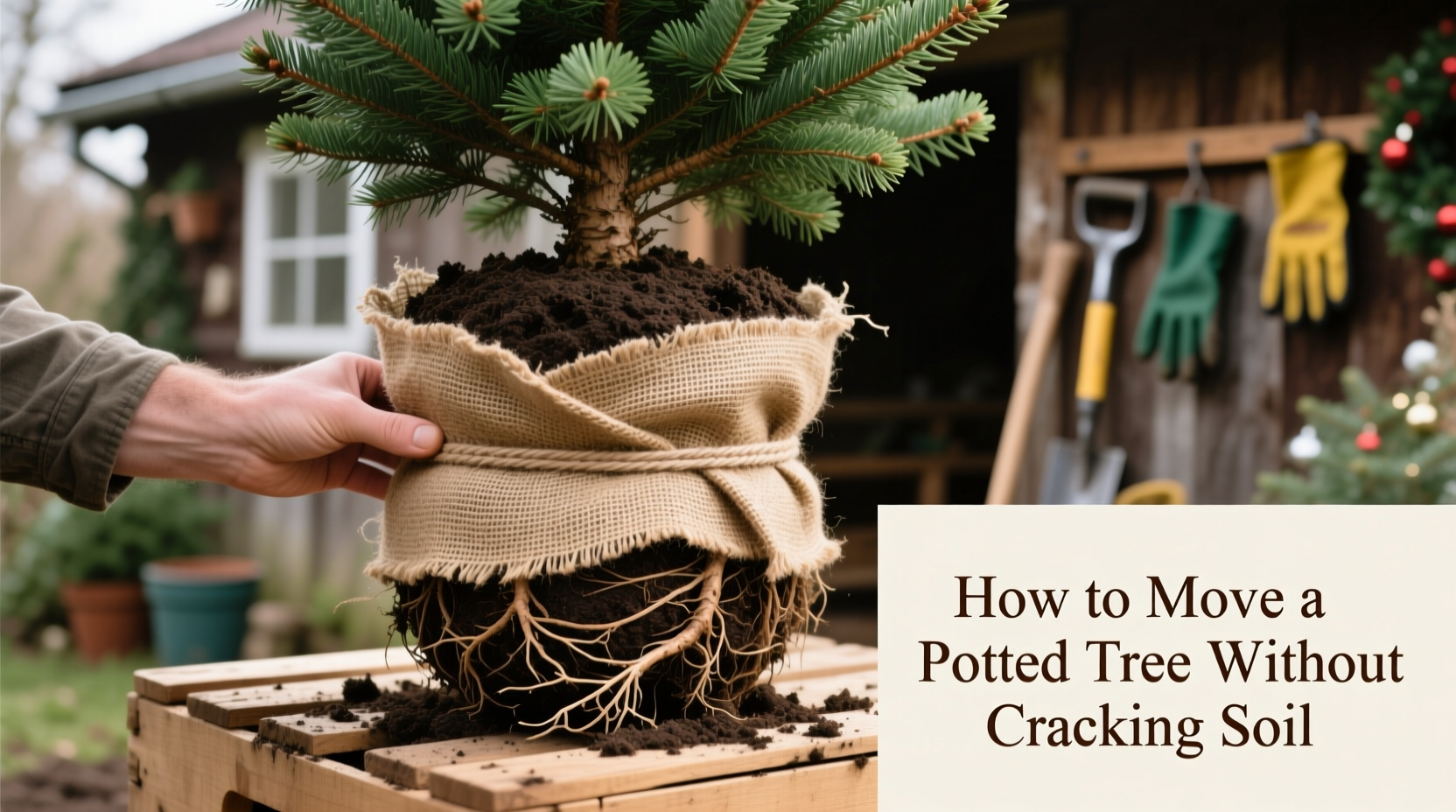
Soil cracking during movement stems from three interrelated physical failures: mechanical shear, moisture loss, and structural instability. Potting media used for container-grown Christmas trees—typically a blend of peat moss, pine bark fines, perlite, and slow-release fertilizer—is engineered for aeration and drainage, not tensile strength. When lifted or tilted, the root ball experiences lateral torque. Because roots act like internal reinforcement bars, healthy root density *can* mitigate cracking—but only if the soil matrix remains cohesive. That cohesion depends on consistent moisture: at optimal field capacity (45–60% volumetric water content), clay colloids and organic polymers bind particles. Below 30%, capillary tension collapses, pores widen, and the mass becomes brittle. Temperature accelerates this: a 5°C drop in ambient air can increase evaporation rates by 18% across exposed surfaces, especially near pot rims where soil is shallowest.
Cracks rarely appear as clean fissures. More often, they manifest as hairline separations along the vertical sides of the root ball—often invisible until watering reveals rapid channeling, or until the tree begins dropping interior needles within 72 hours. That symptom isn’t “shock”—it’s hydraulic failure. As Dr. Lena Torres, Senior Arborist at the Arnold Arboretum, explains:
“Cracked root balls don’t just leak water—they leak function. Each fracture severs hundreds of microroots responsible for absorbing calcium, magnesium, and trace elements. You can’t see those losses, but the tree registers them in reduced photosynthetic efficiency before visible decline begins.” — Dr. Lena Torres, Senior Arborist, Arnold Arboretum
The Root Ball Wrapping Method: Step-by-Step Timeline
This method prioritizes *prevention over repair*. It assumes your tree is already in a rigid, non-flexible container (e.g., plastic nursery pot, fiberglass planter, or thick-walled fabric pot). Do not attempt this on flimsy woven sacks or degraded burlap—those require full replanting into stable containers first.
- 48–72 Hours Before Moving: Water deeply until runoff emerges freely from drainage holes. Then allow surface to dry to touch—but keep subsurface soil consistently moist (not soggy). Use the “finger test”: insert index finger 5 cm deep; it should feel cool and slightly resistant—not crumbly or squelching.
- 24 Hours Before Moving: Gently loosen soil around inner pot wall using a narrow trowel or wooden chopstick. Work vertically downward in 3–4 spots, avoiding root damage. This creates a micro-gap to reduce adhesion during extraction.
- 1 Hour Before Moving: Lay out two overlapping sheets of heavy-duty, 6-mil polyethylene plastic (minimum 1.2 m × 1.5 m each). Place pot centered on plastic. Fold one long edge up over the pot’s rim, then wrap tightly clockwise while applying gentle, even pressure—not squeezing, but *conforming*.
- During Wrapping: After one full rotation, pause and press palms firmly against the soil surface at 12, 3, 6, and 9 o’clock positions to compress any loose top layer. Continue wrapping with 50% overlap per pass until entire root ball (including base) is fully enveloped. Secure with three non-stretching cotton twine loops—tied snugly but not cutting into plastic.
- Immediately After Wrapping: Lift using the plastic itself—not the trunk or branches. Slide hands beneath the wrapped base, keeping wrists straight and elbows bent at 90°. Move slowly; never pivot or twist the pot mid-air. Set down gently on a flat, padded surface (e.g., folded moving blanket).
Do’s and Don’ts of Potted Tree Transport
| Action | Do | Don’t |
|---|---|---|
| Watering Schedule | Water 24 hours pre-move; mist foliage lightly 1 hour before wrapping | Water immediately before lifting—or use cold water below 7°C |
| Wrapping Material | 6-mil virgin polyethylene (non-recycled, UV-stabilized) | Bubble wrap, aluminum foil, or compostable “eco” films (they tear or wick moisture) |
| Lifting Technique | Use palms under base; keep center of gravity low; move in straight lines | Grab trunk, tilt pot >15°, or drag across pavement—even on wheels |
| Post-Move Rest | Unwrap after 4 hours minimum; inspect for cracks; re-water only if surface is dry | Unwrap immediately or re-wrap daily for “moisture retention” |
| Temperature Control | Keep between 2°C and 12°C during transit; avoid drafts near doors/windows | Store in unheated garages below -2°C or near radiators above 18°C |
Real-World Case Study: The Vermont Lodge Relocation
In December 2022, the historic Snowshoe Lodge in Stowe, VT needed to relocate twelve 6-foot potted Fraser firs from an outdoor staging area into their main lobby for a week-long holiday event. Previous attempts had resulted in 40% root ball cracking, with three trees showing irreversible needle browning by Day 3. Lodge grounds manager Marta Chen adopted this wrapping protocol after consulting with UVM Extension. Key adaptations included: using custom-cut 1.8 m × 2.1 m plastic sheets (to accommodate oversized pots), adding a 3-cm-thick layer of damp sphagnum moss between plastic and soil surface for buffer hydration, and installing portable temperature monitors inside each wrapped ball. Results: zero observable cracking, 100% post-event survival, and all twelve trees successfully transplanted to the lodge’s arboretum in March. Notably, soil moisture sensors confirmed <5% variance across root balls—versus >22% variance in prior years’ unwrapped control group.
Essential Tools & Materials Checklist
- Two sheets of 6-mil virgin polyethylene plastic (1.2 m × 1.5 m minimum)
- Three 1.5-meter lengths of 4-mm natural cotton twine (untreated, no dye)
- One narrow-blade stainless steel trowel or wooden chopstick
- Moisture meter (calibrated for peat-based media) or reliable finger-test discipline
- Folded moving blanket or 2 cm-thick closed-cell foam pad for landing surface
- Sterilized sewing needle (for optional ventilation)
- Timer or phone reminder (for 24/48-hour prep windows)
Frequently Asked Questions
Can I reuse the same plastic wrap for multiple moves?
No. Polyethylene degrades with UV exposure, flex fatigue, and soil residue. Even if visually intact, microscopic tears compromise barrier integrity. Always use fresh plastic for each relocation. Discard after use—do not recycle with household plastics due to soil contamination.
What if my tree is in a fabric grow bag instead of a rigid pot?
Fabric bags lack structural support and cannot be wrapped safely. First, slide the entire bag + root ball into a rigid outer container (e.g., a slightly larger plastic nursery pot). Fill gaps between bag and pot wall with moistened coir fiber—not soil—to stabilize. Then apply the full wrapping protocol to the *outer* pot. Never lift by the fabric handles alone.
Does wrapping prevent root circling or girdling?
No. Wrapping addresses acute mechanical stress during movement—not chronic growth patterns. Root circling occurs from prolonged confinement in undersized containers. To prevent it, repot every 18–24 months into a container 5–8 cm wider, and perform root pruning (removing 10–15% of outer roots) during spring repotting. Wrapping is strictly a short-term transport safeguard.
Conclusion: Your Tree’s Longevity Starts With This One Wrap
A potted Christmas tree is more than seasonal decor—it’s a living investment with multi-year potential. Its ability to thrive beyond the holidays hinges on decisions made in the quiet moments before movement: the timing of that final drink, the precision of the wrap, the steadiness of your hands. Cracked soil isn’t inevitable. It’s avoidable—with knowledge, intention, and the right tactile discipline. You now hold a method refined through field observation, peer-reviewed horticultural data, and real-world seasonal pressure. Apply it not as a chore, but as stewardship: a quiet pact between caretaker and conifer. Whether you’re moving a single tabletop spruce or coordinating a dozen for a community event, this technique preserves what matters most—the unseen network beneath the surface, holding life together, one cohesive root ball at a time.




 浙公网安备
33010002000092号
浙公网安备
33010002000092号 浙B2-20120091-4
Comments
No comments yet. Why don't you start the discussion?