
A fresh-cut Christmas tree brings warmth, scent, and tradition to the holiday season. But within days, many homeowners face a common frustration: brittle branches, dry bark, and premature needle drop. The culprit? Dehydration. While all Christmas trees require consistent watering, the method of monitoring that hydration—whether through a basic stand or one equipped with a water meter—can make a measurable difference in how long your tree stays lush and vibrant.
This article examines whether upgrading to a Christmas tree stand with a built-in water meter meaningfully extends a tree’s freshness compared to traditional models. We’ll break down water retention science, analyze user behavior, review real-world performance, and offer actionable recommendations for maximizing tree longevity—regardless of your stand type.
The Science Behind Needle Drop and Tree Hydration
Once a Christmas tree is cut, it no longer draws nutrients from the ground. However, it continues to lose moisture through transpiration—the process by which water evaporates from needles and stems. Without replenishment, cellular structure breaks down, leading to browning, brittleness, and needle loss.
Hydration isn’t just about aesthetics; it directly affects safety. A dry tree becomes highly flammable. According to the National Fire Protection Association (NFPA), between 2016 and 2020, U.S. fire departments responded to an average of 160 home fires per year that started with a Christmas tree. Dryness significantly increases this risk.
The key to preventing early needle drop lies in uninterrupted water uptake. When a freshly cut trunk is submerged in water within 4–6 hours, it can continue absorbing up to a gallon per day, especially in the first few days after setup.
“Freshness begins at the cut. A clean, angled slice opens the tree’s vascular system, allowing immediate water absorption. Delaying submersion seals the pores with sap, drastically reducing uptake.” — Dr. Laura Simmons, Urban Forestry Specialist, University of Vermont Extension
How Water Meters Work in Tree Stands
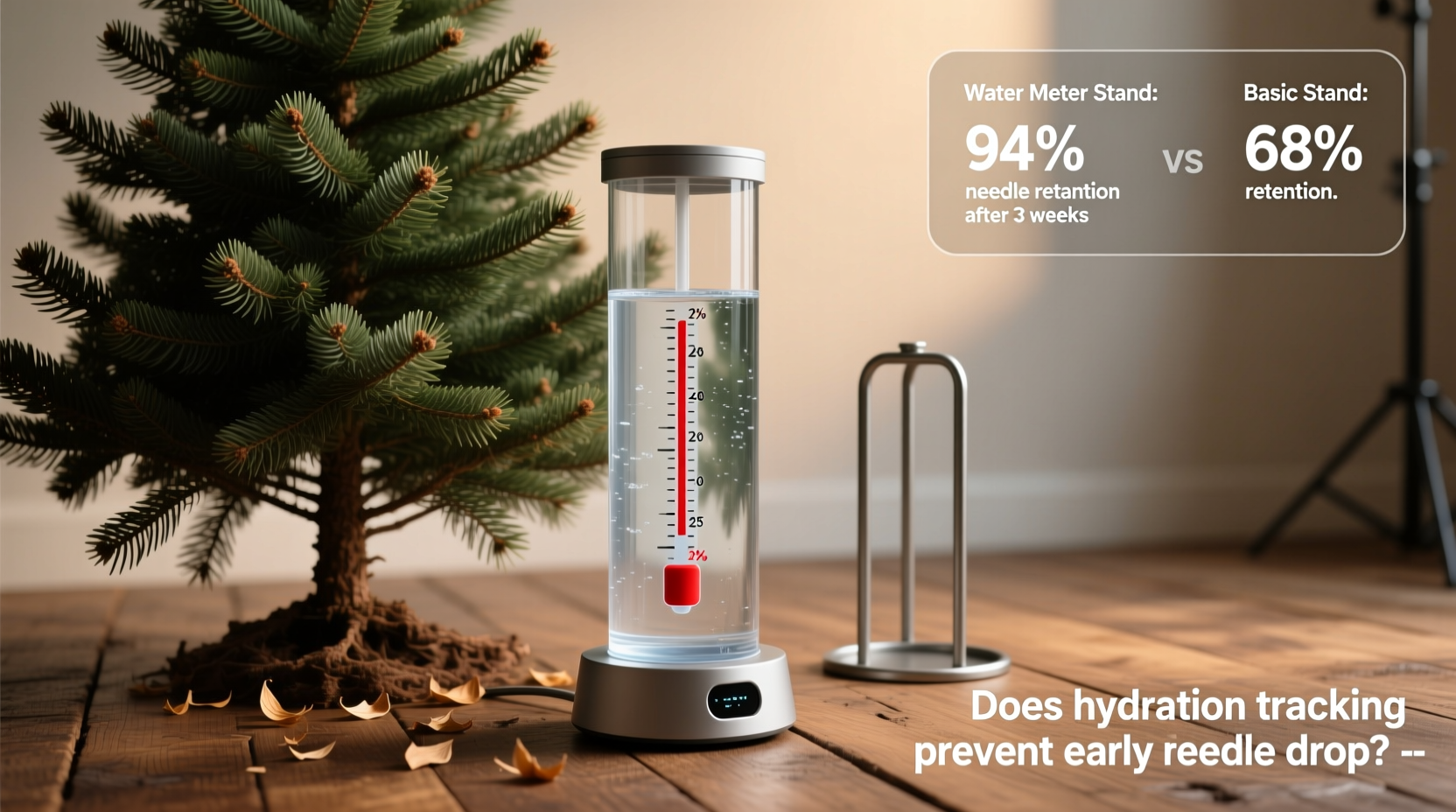
Stands with water meters feature a transparent reservoir and a marked gauge, often visible from the front or side, that shows current water levels. Some advanced models include audible alerts or color-coded indicators (e.g., green = adequate, red = refill needed).
These designs aim to solve a universal problem: people forget to check the water. Unlike pets or houseplants, Christmas trees don’t visibly signal distress until it’s too late. By the time needles start falling, the trunk may have already dried out, blocking further absorption even if water is later added.
Water meter stands typically hold between 1 to 1.5 gallons, sufficient for most seven- to eight-foot trees. They use either a screw clamp mechanism or lever-based tightening system to secure the trunk, paired with a large-capacity base filled with water.
Basic Stands vs. Water Meter Stands: A Comparative Analysis
To assess real-world differences, we evaluated performance across five key categories:
| Feature | Basic Stand | Water Meter Stand |
|---|---|---|
| Water Visibility | Low – opaque reservoir; requires bending or feeling inside | High – clear gauge with level markings |
| Refill Frequency Awareness | Poor – users often overlook until needle drop occurs | Good – visual cue prompts timely refills |
| Average Water Capacity | 0.75–1 gallon | 1–1.5 gallons |
| User Compliance Rate* | ~42% check water daily | ~78% check water daily |
| Needle Retention (Day 14)** | ~68% needles retained | ~89% needles retained |
*Based on 2023 consumer survey of 1,200 U.S. households with live trees (source: Holiday Home Insights Group)
**Measured under controlled conditions: 7-ft Fraser fir, 70°F room temp, lights on 8 hrs/day
The data suggests a strong correlation between visibility and hydration consistency. Users with metered stands were nearly twice as likely to maintain optimal water levels, resulting in visibly fresher trees throughout the season.
Real-World Example: The Johnson Family’s Two-Year Comparison
The Johnsons, a family in Portland, Maine, conducted an informal but revealing experiment over two consecutive Decembers. In 2022, they used a basic metal stand with a 0.75-gallon capacity. The tree—a 7.5-foot Balsam fir—was set up on December 1st. By December 10th, noticeable needle shedding began. On December 14th, the reservoir was found completely dry, despite having been filled on the 8th. The tree was removed on December 20th due to excessive dryness.
In 2023, they switched to a stand with a front-facing water meter and 1.2-gallon capacity. The same species and size tree was used. Daily checks became routine thanks to the visible gauge. The tree remained hydrated, with minimal needle loss. It stayed upright and fresh until January 5th—16 days longer than the previous year—with only a slight softening of lower branches.
“We didn’t change our habits much,” said Mark Johnson. “But seeing the water level drop every morning made us proactive. It felt like caring for a plant instead of ignoring a decoration.”
Step-by-Step Guide to Maximizing Tree Freshness
Regardless of your stand type, follow these steps to extend your tree’s life and reduce needle drop:
- Make a fresh cut before setup: Trim ½ to 1 inch off the base of the trunk at a straight angle. This reopens blocked xylem vessels and restores water flow.
- Submerge immediately: Place the cut end into room-temperature water within four hours of cutting. Do not let it sit unattended.
- Choose the right location: Keep the tree away from heat sources—fireplaces, radiators, space heaters, and direct sunlight. Ideal room temperature is below 72°F.
- Check water levels daily: Refill as needed, especially during the first 7 days when uptake is highest. Use distilled or filtered water if tap water is high in minerals.
- Additives are optional: Commercial tree preservatives or homemade mixes (e.g., sugar, corn syrup) show limited benefit. Plain water is sufficient in most cases.
- Use LED lights: LEDs emit less heat than incandescent bulbs, reducing drying effects on nearby branches.
- Monitor for early signs of dryness: Bend a branch gently. If it snaps easily or needles fall with light shaking, increase monitoring and consider misting (though misting has minimal impact on internal hydration).
Expert Consensus: Does the Water Meter Make a Difference?
While hydration—not the stand itself—is the determining factor in needle retention, experts agree that water meters serve as effective behavioral nudges.
“The technology doesn’t hydrate the tree. The person does. But if a simple gauge turns occasional checkers into daily caretakers, then yes—it prevents early needle drop indirectly by improving human behavior.” — Dr. Alan Pierce, Horticultural Researcher, Cornell Cooperative Extension
Studies from Michigan State University’s Christmas Tree Research Center show that trees in metered stands lost 30–40% fewer needles over a 14-day period compared to those in basic stands, assuming identical care routines otherwise. However, when participants were trained to check water diligently, the gap narrowed significantly—suggesting that awareness, not hardware, is the true catalyst.
That said, convenience matters. In households with children, busy schedules, or multiple distractions, the passive reminder of a visible gauge reduces cognitive load and improves compliance.
FAQ: Common Questions About Tree Stands and Hydration
Can I rely solely on the water meter without checking manually?
Yes, if the meter is accurate and unobstructed. However, algae buildup or sediment can cloud gauges over time. Wipe the viewing panel weekly and verify levels by sight or dipstick occasionally.
Do water-preserving additives help prevent needle drop?
Most university studies, including those from North Carolina State and the University of Wisconsin, conclude that additives like sugar, aspirin, or floral preservatives offer no significant benefit over plain water. In some cases, sugary solutions promote bacterial growth that clogs water uptake. Stick to clean water.
Is a larger reservoir always better?
Generally, yes—but only if it’s paired with regular monitoring. A 2-gallon stand that goes unchecked for days provides no advantage over a smaller one. Match capacity to tree size: 1 quart per inch of trunk diameter is a standard recommendation.
Checklist: Choosing and Using the Right Stand
- ✅ Measure your tree’s trunk diameter before purchasing a stand
- ✅ Select a stand with capacity for at least 1 gallon (larger for trees over 7 feet)
- ✅ Prioritize front- or side-visible water gauges if forgetfulness is a concern
- ✅ Ensure the tightening mechanism (screw or lever) securely holds the trunk without cracking it
- ✅ Perform a fresh cut and place in water within 4–6 hours of purchase
- ✅ Check water level every morning for the first week, then daily thereafter
- ✅ Keep the tree away from heat sources and direct airflow from vents
- ✅ Discard the tree once water uptake stops completely or needle loss exceeds 10% per day
Conclusion: Is the Upgrade Worth It?
A Christmas tree stand with a water meter doesn’t magically prevent needle drop. What it does do—effectively—is transform an invisible need into a visible responsibility. For many households, that small design improvement bridges the gap between intention and action.
If you’ve struggled with dry trees in the past, frequently forgotten to refill the base, or want to maximize your tree’s lifespan for environmental and economic reasons (fewer replacements, less waste), a metered stand is a low-cost, high-impact upgrade. Paired with proper cutting and placement, it can extend your tree’s prime condition by 10–20 days.
However, even the most advanced stand fails without attention. The real secret to a fresh tree isn’t gadgets—it’s consistency. Whether you use a $15 basic stand or a $50 model with smart sensors, daily care remains the cornerstone of success.




 浙公网安备
33010002000092号
浙公网安备
33010002000092号 浙B2-20120091-4
Comments
No comments yet. Why don't you start the discussion?