
Modern minimalist decor thrives on intentionality—not absence. It values clean lines, restrained ornamentation, thoughtful materiality, and emotional resonance over visual noise. When it comes to the Christmas tree—the centerpiece of seasonal warmth and tradition—the topper is not a decorative afterthought. It’s the final punctuation mark: the quiet apex that either harmonizes with or disrupts the entire composition. For those who curate spaces with precision—where a single ceramic vase holds weight and negative space breathes—choosing a tree topper demands more than nostalgia or convention. It requires alignment: with aesthetic language, spatial proportion, personal meaning, and the quiet confidence of less.
The Minimalist Imperative: Why the Topper Matters More Than You Think
In minimalist interiors, every object earns its place. A tree isn’t “just festive”—it’s integrated architecture. Its height, silhouette, and finish interact with ceiling lines, adjacent furniture, and ambient light. The topper sits at the highest point of visual gravity. A cluttered, overly ornate, or tonally dissonant topper fractures cohesion. Conversely, a well-chosen topper reinforces rhythm, scale, and serenity. Designers like Ilse Crawford emphasize that “minimalism is not about subtraction—it’s about distillation to essence.” That principle applies directly to holiday styling: what remains must carry meaning without shouting.
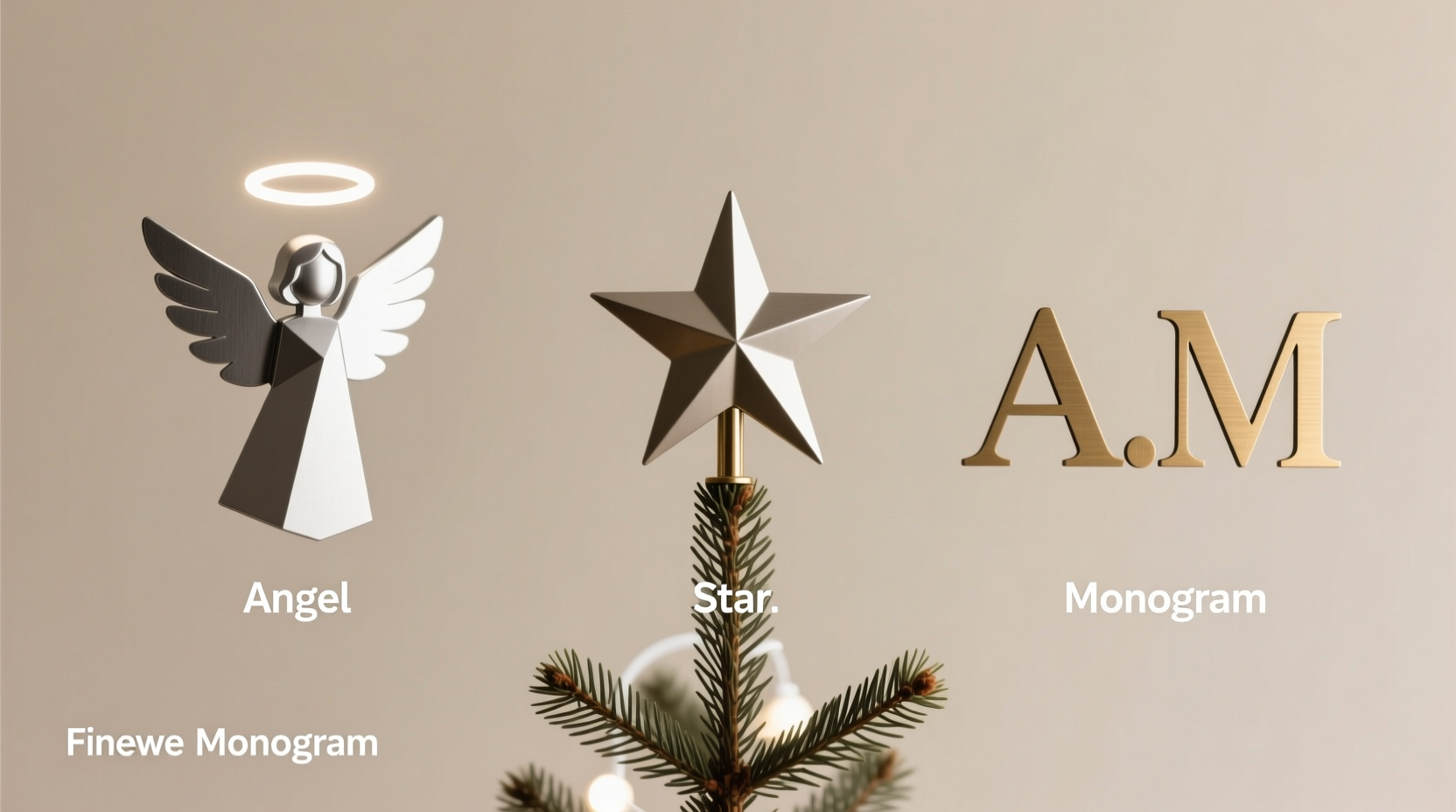
Minimalist trees often feature monochromatic palettes (ivory, charcoal, sage, warm taupe), natural materials (dried eucalyptus, bleached wood beads, unbleached linen ribbons), and sparse, intentional ornamentation. In this context, the topper becomes the sole focal point—a distilled symbol rather than an accumulation of detail. Its form, texture, and presence must hold space without competing. That’s why the classic triad—angel, star, and custom monogram—deserves fresh scrutiny beyond tradition.
Angel Topper: Graceful Symbolism—With Caveats
Angels evoke reverence, protection, and quiet hope. Their historical role as heralds of divine peace resonates deeply in minimalist contexts where calm and sanctuary are central values. A well-designed minimalist angel avoids Victorian frills: think smooth matte ceramic, hand-carved ash wood with soft contours, or brushed brass with simplified wing geometry—no glitter, no porcelain lace, no exaggerated facial features.
However, angels present three practical challenges in minimalist settings:
- Spatial dominance: Even streamlined angels retain vertical volume—often 8–12 inches tall with extended wings. On slender, floor-to-ceiling trees common in open-plan lofts or studio apartments, they can appear top-heavy or visually “busy” against clean walls.
- Interpretive ambiguity: While spiritually meaningful for some, angels may feel overtly religious or culturally specific in secular, pluralistic homes—clashing with the inclusive neutrality many minimalist spaces cultivate.
- Material mismatch: Traditional angel toppers frequently use glossy finishes, metallic paint, or delicate glass—materials that reflect light unpredictably and risk looking dated beside matte concrete, raw oak, or wool textiles.
Star Topper: Timeless Geometry—Refined for Restraint
The star carries universal resonance: guidance, aspiration, celestial wonder. Its inherent geometry—radial symmetry, sharp points, clear center—aligns naturally with minimalist design logic. Unlike figurative forms, a star speaks through shape alone. That makes it highly adaptable: a five-point star cut from blackened steel reads as architectural; a delicate brass star with fine, tapered arms echoes mid-century modernism; a matte white ceramic star integrates seamlessly with Scandinavian palettes.
A star’s strength lies in scalability and material honesty. It can be reduced to its essential lines without losing identity. Its flat profile minimizes visual weight, and its centered structure anchors the tree’s apex without pulling attention sideways. Design historian Sarah Archer notes, “The star endures because it’s both ancient and abstract—its meaning is held in form, not ornament. That’s why it transitions so gracefully into contemporary interiors.”
Yet stars aren’t universally ideal. Oversized vintage stars with pronged plastic points or garish gold foil can undermine restraint. And while symbolic, the star lacks the personal intimacy of a monogram—it’s collective, not individual.
Custom Monogram Topper: Quiet Identity, Elevated Craft
A custom monogram topper—typically a single letter, initials, or subtle typographic motif rendered in high-quality material—is the most conceptually aligned choice for rigorous minimalism. It replaces inherited symbolism with self-authored meaning. It says: *This celebration is anchored in our presence, not prescribed tradition.*
Unlike mass-produced toppers, a custom monogram is inherently site-specific and human-scaled. A 6-inch brushed brass “E” for Emma, a 4-inch walnut “J+M” joined by a thin copper bar, or a floating acrylic “O” suspended by near-invisible monofilament—all communicate intention, craftsmanship, and quiet confidence.
Its advantages are structural and philosophical:
- Scale control: Dimensions can be precisely calibrated to match tree height and room volume—no guessing if it will overwhelm.
- Material continuity: Can echo existing interior metals (brass hardware), woods (oak shelving), or stone (marble countertops), creating subtle harmony.
- Emotional precision: Represents the people who inhabit the space—not myth, not doctrine, but lived reality.
- Longevity: Lacks seasonal cliché; feels equally appropriate displayed year-round on a shelf or mantel.
“The most minimalist choices are often the most personal. When a monogram replaces a star or angel, you’re not removing meaning—you’re relocating it, from the celestial to the domestic, from the general to the particular.” — Lena Voss, Interior Designer & Author of Quiet Spaces: Designing for Intentional Living
Decision Framework: A Step-by-Step Selection Process
Choosing isn’t about preference—it’s about alignment. Follow this sequence to arrive at your definitive topper:
- Assess your tree’s physical context: Measure height, trunk thickness, and branch density. Note ceiling height, nearby lighting (especially recessed spots that may glare off reflective surfaces), and wall color/texture. A 7-foot tree in a 9-foot ceiling room with white plaster walls favors subtlety; a 5-foot tabletop tree in a sun-drenched kitchen with black steel cabinetry can support bolder material contrast.
- Define your core aesthetic non-negotiables: List three words that describe your everyday interior (e.g., “warm,” “textural,” “uncluttered”). Discard any topper option that contradicts two or more. Example: If “matte,” “organic,” and “grounded” are your words, a glossy brass star fails on two counts.
- Evaluate symbolic weight: Ask honestly: Does spiritual heritage matter deeply to your household’s holiday experience? If yes, an angel or star may carry necessary resonance. If your tradition centers on gathering, memory, or simple joy—not doctrine—a monogram honors that priority.
- Test material fidelity: Hold a swatch of your primary interior material (e.g., a walnut cutting board, a linen pillowcase, a brushed nickel drawer pull) next to mock-up images of each topper type. Which feels like a natural extension—not a guest?
- Consider lifecycle integration: Will this topper live only on the tree? Or could it hang on a hook by the entryway in January? Sit on a bookshelf in April? A monogram excels here; a star can transition to a wall-mounted art piece; an angel rarely does without feeling displaced.
Comparative Decision Table: Angel vs Star vs Custom Monogram
| Criteria | Angel | Star | Custom Monogram |
|---|---|---|---|
| Visual Weight | Medium–High (inherent volume & gesture) | Low–Medium (flat profile, scalable) | Low (precisely controllable) |
| Material Flexibility | Limited (figurative form constrains material expression) | High (works in metal, ceramic, wood, acrylic) | Very High (any material, finish, scale) |
| Symbolic Alignment | Religious, protective, traditional | Universal, aspirational, guiding | Personal, grounded, identity-centered |
| Interior Integration | Challenging (requires careful tonal/material matching) | Strong (geometric, neutral, adaptable) | Exceptional (designed to echo existing elements) |
| Lifespan Beyond Holidays | Low (rarely repurposed) | Medium (can become wall art or shelf object) | High (designed for year-round relevance) |
Real-World Case Study: The Brooklyn Loft Transformation
Maya and David renovated their 1920s industrial loft with exposed brick, poured concrete floors, and custom oak cabinetry. Their aesthetic: “warm minimalism”—textural, human-scaled, quietly refined. For years, they used a vintage brass star that felt increasingly jarring against their muted palette. “It was shiny, loud, and didn’t speak to us,” Maya explained. “It looked like it belonged in someone else’s home.”
They commissioned a custom monogram: their shared initial “M+D” in matte blackened steel, 5 inches tall, with clean sans-serif lettering and a subtle bevel. The steel was heat-treated to match the patina of their kitchen range hood. Installed atop their 6.5-foot Nordmann fir (decorated with ivory velvet bows and dried pampas grass), the monogram created a focal point that felt inevitable—not imposed. Neighbors remarked how “calm” and “cohesive” the tree looked. Crucially, in February, they mounted it beside their entryway mirror using a discreet brass bracket. It now serves as a quiet anchor to their domestic identity year-round.
Frequently Asked Questions
Can I mix topper types—for example, a small star *with* a monogram?
No—minimalism relies on singular focus. Layering symbols dilutes clarity and introduces visual competition. Choose one anchor element. If you desire layered meaning, integrate it elsewhere: a monogrammed ornament lower on the tree, or a star-shaped ceramic dish holding pinecones on the coffee table.
What if my family expects a traditional topper? How do I honor that without compromising my aesthetic?
Reframe tradition as continuity of feeling—not replication of form. Explain that your monogram or refined star honors the same values: light, hope, unity—but expressed through your home’s authentic language. Offer participation: let relatives choose the material (e.g., “Would you prefer walnut or brass?”) or help select the font. Shared authorship builds investment in the new form.
Are there minimalist-friendly alternatives beyond these three?
Yes—but proceed with caution. A single oversized dried citrus slice, a smooth river stone wrapped in linen twine, or a tiny ceramic orb can work—if rigorously edited. However, these lack the symbolic weight and structural presence of the core three. They risk reading as “unfinished” rather than intentional. Reserve them for secondary trees (bedroom, office) unless you have deep confidence in your compositional eye.
Conclusion: Your Tree, Your Terms
Choosing a Christmas tree topper isn’t about selecting decoration—it’s about declaring your relationship to tradition, space, and self. In a minimalist home, that declaration must be precise, honest, and materially resolved. An angel carries centuries of reverence but asks you to reconcile its figurative presence with your commitment to abstraction. A star offers timeless geometry and universal resonance but remains a borrowed symbol. A custom monogram is the quietest, most confident choice: it roots celebration in the people who live there, honors craft over cliché, and respects the integrity of your carefully curated environment.
There is no “correct” answer—only alignment. When your topper feels like the inevitable culmination of your design choices, your values, and your daily life, you’ve succeeded. That moment—when the tree is lit, the room is still, and the topper holds its space without strain—that’s when minimalism fulfills its deepest promise: not emptiness, but fullness, distilled.




 浙公网安备
33010002000092号
浙公网安备
33010002000092号 浙B2-20120091-4
Comments
No comments yet. Why don't you start the discussion?