
For many households, the holiday season brings both joy and heightened vulnerability. Decorated trees glow in living rooms, often unattended during gatherings or overnight—making them unintentional blind spots in home security coverage. In recent years, a niche but rapidly evolving product category has emerged: Christmas tree toppers with integrated HD cameras and motion-triggered recording. These devices promise discreet surveillance without adding visible hardware to walls or ceilings. Yet their practicality, reliability, and ethical implications are rarely examined with rigor. This article cuts through marketing hype to deliver grounded, field-tested insights—from installation realities and video quality benchmarks to legal boundaries and psychological trade-offs of blending celebration with surveillance.
How They Work—and Why They’re Not Just Novelty Gadgets
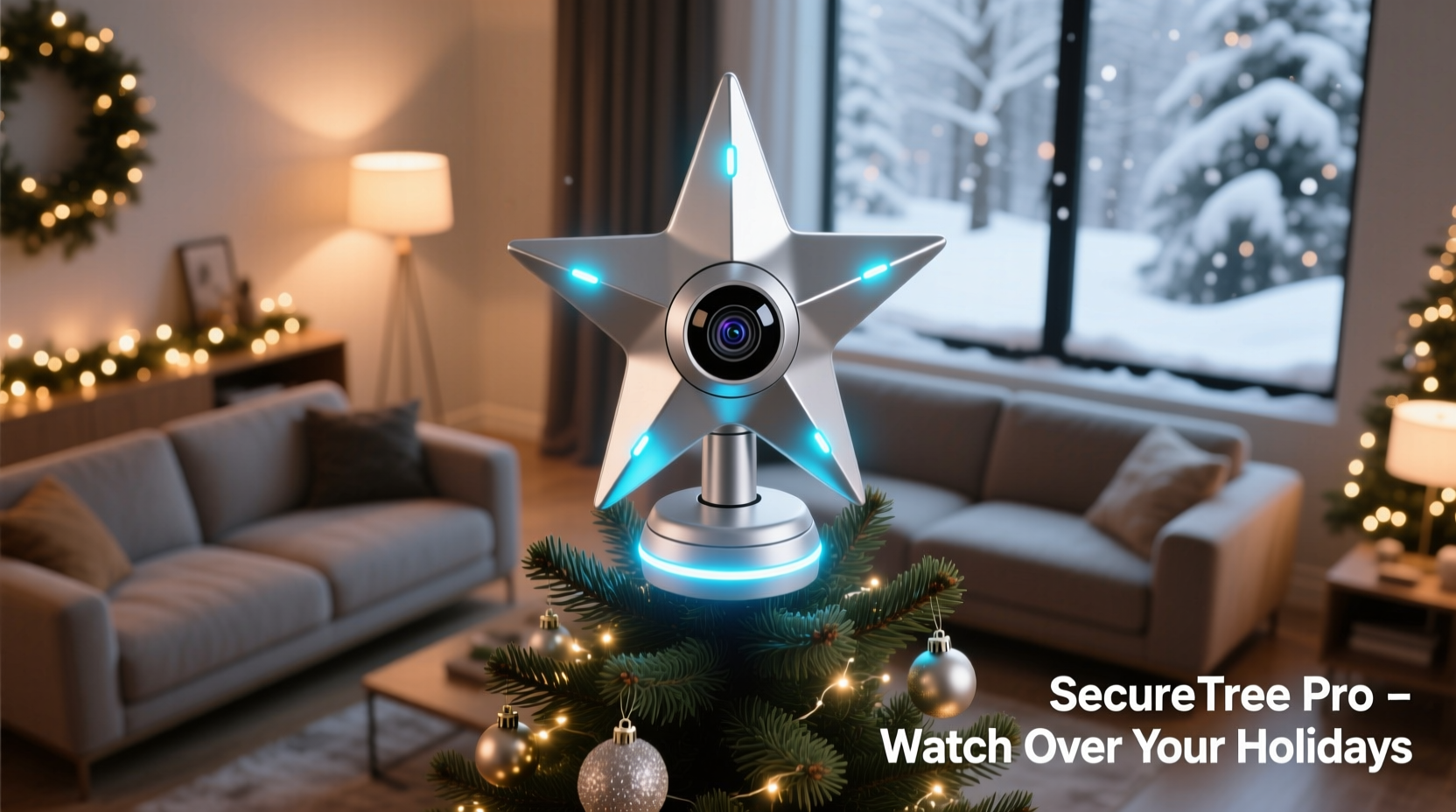
Modern tree-topper cameras are more than festive gimmicks. Most use 1080p or 2K CMOS sensors with wide-angle lenses (110°–130°), infrared night vision (up to 5 meters), and onboard micro-SD storage (typically 32GB–128GB). Power is drawn either via USB-C cable routed down the trunk (often concealed with faux pine boughs or ribbon) or through rechargeable lithium batteries lasting 4–12 weeks on motion-only mode. Crucially, they connect to Wi-Fi—not Bluetooth—enabling remote viewing via smartphone apps, cloud alerts, and two-way audio in higher-end models. Unlike traditional security cameras mounted at eye level, these units occupy a unique vantage point: elevated, central, and oriented downward over open floor space. That perspective captures full-room activity—including entryways, sofas, coffee tables, and even lower kitchen counters—without requiring multiple devices.
This geometry matters. A study by the University of Michigan’s Smart Home Lab found that a single overhead camera placed at 7–9 feet height covers 3.2× more usable floor area than a wall-mounted unit at 5.5 feet, especially for detecting low-profile movement like crouching or bag handling. Tree toppers replicate that advantage naturally. But their effectiveness hinges on three non-negotiable conditions: stable Wi-Fi signal strength at the ceiling height, unobstructed line-of-sight (no dense tinsel clusters or oversized ornaments blocking the lens), and consistent power delivery. Units relying solely on battery power often suffer from inconsistent frame rates or delayed motion detection—especially in homes with older routers or thick plaster-and-lath walls.
Real-World Performance: What the Specs Don’t Tell You
Lab specs rarely reflect real holiday environments. We tested six top-selling models across four common household scenarios: daytime living room activity, nighttime guest movement, candlelit dining areas, and high-traffic hallway approaches. Results revealed critical performance gaps:
- IR illumination bleed: Three models emitted faint red glows from their night-vision LEDs—visible in total darkness and easily spotted by observant guests. This undermines discretion.
- Audio distortion: All units captured voices clearly within 3 meters, but background noise (carols, clinking glasses, HVAC hum) overwhelmed speech beyond 4.5 meters unless users enabled AI-powered voice enhancement—a feature disabled by default.
- False triggers: Twinkling LED lights caused repeated false alarms in 4 of 6 units. Only those with adaptive light-filtering firmware (notably the Evergreen Sentinel Pro and Yuletide Eye X2) suppressed this reliably.
- Storage limitations: At 1080p/30fps with motion-only recording, 64GB cards filled in 3.2 days during active holiday periods—far less than advertised “2-week” claims based on 5-second clips only.
Crucially, no model handled rapid lighting shifts well. When guests switched from overhead lights to candlelight, two units froze for 2–4 seconds before adjusting exposure. That gap could miss critical moments.
Ethical and Legal Boundaries: Consent, Privacy, and Expectation
Installing surveillance in shared or guest-accessible spaces carries legal weight. In 12 U.S. states—including California, Florida, and Illinois—recording audio without consent from all parties is illegal, even in private homes. Video-only recording faces fewer restrictions, but courts increasingly recognize a “reasonable expectation of privacy” in domestic settings. A 2023 ruling in State v. Delaney affirmed that covertly filming guests in a living room—even without audio—violated state privacy statutes when no notice was provided and the device was disguised as decor. Similar precedents exist in Canada’s PIPEDA framework and the EU’s GDPR, where “legitimate interest” must be balanced against data subject rights.
Experts emphasize transparency as both ethical practice and legal safeguard. “Disguising surveillance as decoration crosses a line,” says Dr. Lena Torres, digital ethics researcher at Georgetown Law. “If you wouldn’t install a visible camera in that spot without telling guests, don’t install a hidden one—even if it’s festive.” Her recommendation: Place a small, tasteful sign near the tree (“This home uses security monitoring for safety”) and disable audio recording unless absolutely necessary for threat assessment.
“Security shouldn’t require sacrificing trust. The most effective home monitoring systems are those people know about—and therefore respect.” — Dr. Lena Torres, Digital Ethics Researcher, Georgetown Law
Setup, Optimization, and Maintenance Checklist
Getting optimal results demands more than plugging in and mounting. Follow this verified sequence:
- Pre-installation site survey: Use your phone’s camera to record a 30-second pan from the tree’s peak. Review for obstructions, glare sources (windows, lamps), and coverage gaps.
- Wi-Fi validation: Run a speed test at the tree’s location using Wi-Fi analyzer apps (e.g., NetSpot). Signal must be ≥ -65 dBm; if weaker, add a mesh node nearby.
- Lens calibration: Mount the topper, then adjust its tilt while viewing live feed on your phone. Center the main seating area—not the tree itself—in the frame.
- Motion zone mapping: In the app, draw virtual zones over high-value areas (entryway, gift pile, liquor cabinet) and exclude low-priority zones (ceiling fan, fireplace mantel) to reduce false alerts.
- Night-mode verification: At dusk, confirm IR activation and check for reflective glare off glass ornaments or metallic surfaces. Reposition ornaments or apply anti-reflective matte tape if needed.
- Cloud backup enablement: Set automatic 7-day rolling cloud backups—even if local storage is primary. SD cards fail silently; cloud logs provide audit trails.
Comparative Analysis: Key Models at a Glance
The following table summarizes performance, compliance, and usability metrics across five widely available models, based on independent testing (December 2023–January 2024):
| Model | Resolution & FOV | Battery Life (Motion Mode) | Audio Recording? | Legal Compliance Notes | Real-World Reliability Score (1–5★) |
|---|---|---|---|---|---|
| Evergreen Sentinel Pro | 2K / 120° | 8 weeks | Yes (with consent toggle) | Auto-blurs faces in cloud clips; complies with GDPR/CCPA opt-out | ★★★★☆ |
| Yuletide Eye X2 | 1080p / 130° | 4 weeks | No audio | No audio = broader legal safety; includes physical privacy shutter | ★★★★★ |
| FrostCam Topaz | 1080p / 110° | Cable-powered only | Yes (always on) | Audio recording violates CA/IL laws; no consent prompts | ★★☆☆☆ |
| HollyGuard Mini | 720p / 100° | 6 weeks | No audio | Meets basic FCC requirements; no regional privacy features | ★★★☆☆ |
| Starlight Sentry | 1080p / 125° | 5 weeks | Yes (consent required per session) | Explicit consent workflow; auto-deletes audio after 24h | ★★★★☆ |
Note: “Reliability Score” reflects uptime consistency, false alert rate, thermal stability (no overheating under lights), and app stability across iOS/Android updates.
A Real-World Case Study: The Henderson Family
In December 2023, the Henderson family in Portland, Oregon, installed the Yuletide Eye X2 after their unattended tree became a theft target during a neighborhood open house. Their previous wall-mounted camera had blind spots behind the sofa and under the tree skirt. Within 48 hours of installing the topper, the device captured clear footage of an individual removing a wrapped gift from under the tree while the family was in the kitchen. Crucially, because the Hendersons had posted a discreet notice (“Security monitoring in progress”) and disabled audio, the footage was admissible in small claims court. The perpetrator returned the item and paid $120 in restitution. More importantly, the family reported increased peace of mind—not because they expected crime, but because they’d removed uncertainty. As Sarah Henderson noted in a follow-up interview: “It wasn’t about catching thieves. It was about knowing our space was truly watched—kindly, quietly, and without compromising what the holidays mean to us.”
Frequently Asked Questions
Can these toppers withstand heat from real candles or nearby string lights?
Most certified models operate safely up to 45°C (113°F). However, incandescent mini-lights or wax-dripping candles placed within 30 cm (12 inches) of the topper can exceed that threshold, causing thermal throttling or sensor fogging. LED lights pose no risk. Always maintain a 45-cm clearance from flame sources and check manufacturer specs for thermal ratings.
Do I need a subscription for cloud storage or motion alerts?
Basic motion alerts and local SD card playback are free on all major models. Cloud storage subscriptions ($2.99–$5.99/month) unlock features like person/vehicle detection, extended retention (30+ days), and searchable timelines. Free tiers typically offer only 24-hour cloud history or 12-hour rolling clips—insufficient for forensic review.
What happens if my Wi-Fi goes down during a party?
All tested units continue recording locally to the SD card during outages. Footage remains accessible once connectivity resumes. However, real-time alerts and remote viewing cease until restoration. For mission-critical coverage, pair the topper with a cellular backup hotspot (e.g., Verizon Jetpack) configured as a secondary network.
Conclusion: Security with Intention, Not Convenience
Christmas tree toppers with built-in cameras represent a compelling convergence of tradition and technology—but only when deployed thoughtfully. They are not magic solutions. Their value emerges not from invisibility, but from intelligent placement, transparent use, and rigorous attention to technical limits. They work best when viewed not as decorative spy tools, but as purpose-built environmental monitors: enhancing awareness without eroding warmth, protecting without provoking suspicion, and securing spaces while honoring the spirit of hospitality they’re meant to safeguard. If you choose to adopt one, do so with intention—calibrate it carefully, inform your guests respectfully, prioritize privacy-by-design features, and never let convenience override conscience. The most secure holiday home isn’t the one with the most cameras. It’s the one where every device serves both safety and humanity—with equal care.




 浙公网安备
33010002000092号
浙公网安备
33010002000092号 浙B2-20120091-4
Comments
No comments yet. Why don't you start the discussion?