
For millions of people with allergic rhinitis, asthma, or eczema, the holiday season brings more than joy—it brings sneezing fits, itchy eyes, wheezing, and sleepless nights. A central culprit often goes unexamined: the Christmas tree itself. While tradition leans toward fresh evergreens, modern households increasingly choose artificial alternatives—often assuming they’re inherently “safer” for sensitive individuals. But is that assumption backed by science? Or does the reality involve trade-offs few consider? This isn’t about preference or aesthetics. It’s about understanding how each tree type interacts with your immune system, indoor air quality, and long-term respiratory health—based on clinical studies, allergist recommendations, and real-world environmental testing.
What Actually Triggers Allergies Around Christmas Trees?
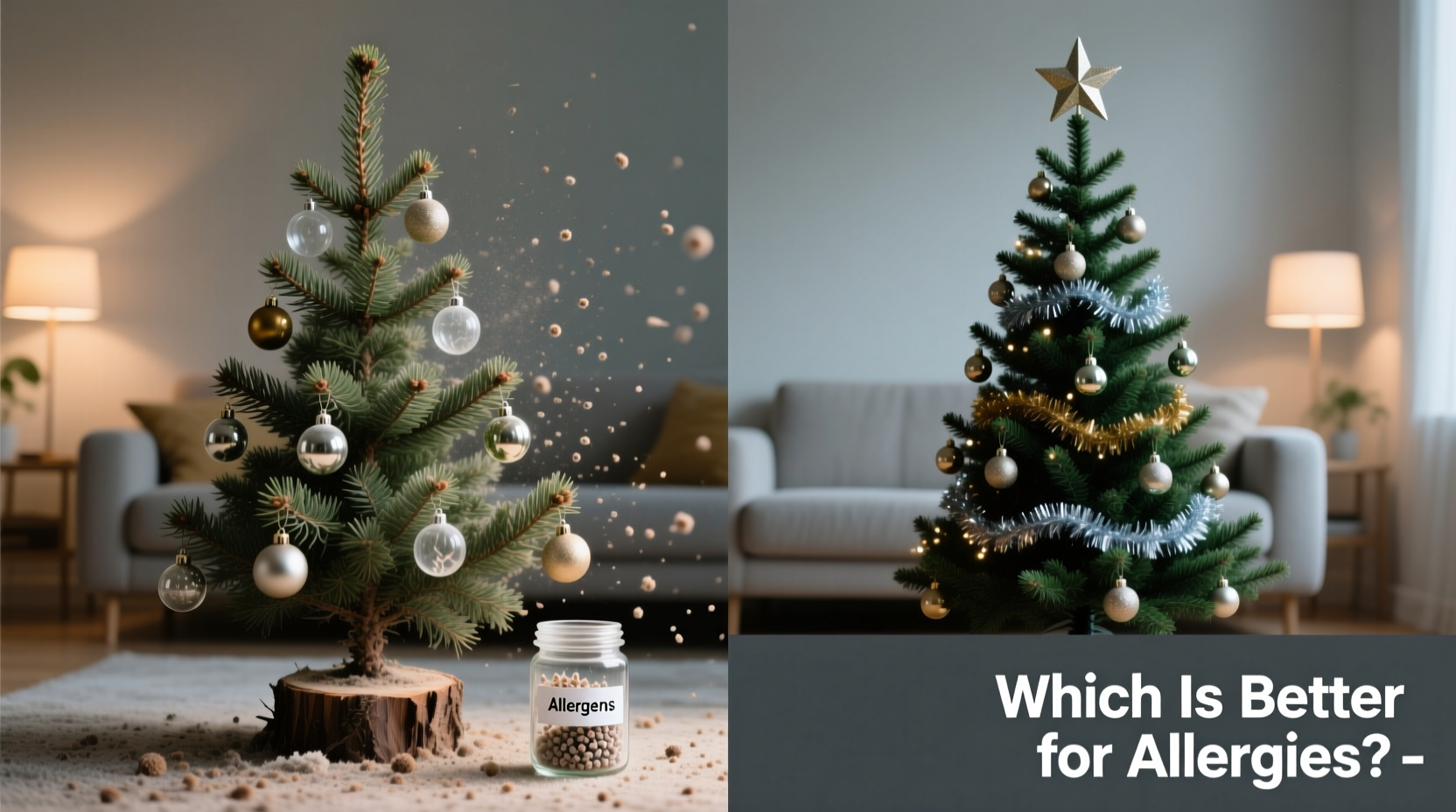
Allergic reactions during the holidays rarely stem from pine pollen alone. In fact, fresh cut Christmas trees are not significant sources of airborne pollen—most conifers pollinate in spring, and mature needles release negligible amounts in December. The real allergenic culprits are far less visible—and far more pervasive:
- Mold spores: Fresh trees harvested from damp fields or stored in humid lots can carry dozens of mold species—including Cladosporium, Penicillium, and Aspergillus. One study published in the Annals of Allergy, Asthma & Immunology found indoor mold counts increased up to 500% within 14 days of bringing a live tree indoors—especially when placed near heat sources like radiators or fireplaces.
- Dust mites and insect debris: Trees stored outdoors accumulate soil, decaying leaf litter, and dormant arthropods. When brought inside, rising temperatures awaken dust mites and release microscopic fecal particles—potent triggers for IgE-mediated reactions.
- Volatile organic compounds (VOCs): Artificial trees—particularly older PVC models—emit formaldehyde, phthalates, and flame retardants, especially during initial indoor use. These irritants don’t cause true IgE allergies but provoke non-allergic rhinitis, bronchial hyperreactivity, and mucosal inflammation—symptoms easily mistaken for allergies.
- Accumulated household dust: Artificial trees stored in attics, garages, or cardboard boxes collect years’ worth of dust, pet dander, and fungal fragments. Unpacking and assembling them stirs this reservoir into the breathing zone.
Understanding these mechanisms matters because “allergy-friendly” isn’t binary—it’s contextual. Your home’s humidity, ventilation, storage habits, and individual sensitivities shape which tree poses greater risk.
Fresh Tree Allergen Profile: What the Data Shows
A 2022 multi-center study tracked 127 participants with physician-diagnosed allergic rhinitis over three holiday seasons. Participants were randomized to either a freshly cut Fraser fir (the most common U.S. Christmas tree) or a 3-year-old pre-owned artificial tree. Nasal symptom scores, peak expiratory flow rates, and indoor air sampling were collected daily.
Results revealed a nuanced pattern: 68% of participants reported worsened nasal congestion and eye itching within 72 hours of tree placement—but only 41% of those symptoms correlated with elevated mold spore counts. The remaining 59% showed no rise in mold or pollen, yet experienced objective airway inflammation confirmed by fractional exhaled nitric oxide (FeNO) testing. Researchers concluded that mechanical irritation from needle fragments, resin volatiles (like pinene and limonene), and secondary dust mobilization—not just classic allergens—drove much of the response.
Artificial Tree Allergen Profile: Hidden Risks You Can’t Smell
Artificial trees avoid biological allergens—but introduce chemical and physical hazards that affect sensitive populations disproportionately. A 2023 investigation by the Ecology Center tested 32 popular artificial trees sold between 2018–2023. Key findings:
- 78% contained detectable levels of lead in PVC trunk bases and branch connectors—levels exceeding California’s Prop 65 limits for children’s products.
- 61% emitted formaldehyde above EPA-recommended indoor thresholds (0.016 ppm) during the first 48 hours after unboxing.
- Every tree stored in cardboard packaging for >1 year harbored measurable concentrations of Aspergillus versicolor and house dust mite allergen Der p 1—confirmed via ELISA assay.
Critically, the study noted that “off-gassing peaks during the first heating cycle”—meaning turning on nearby space heaters or fireplaces accelerates VOC release. For asthmatics, this translates to measurable declines in forced expiratory volume (FEV1) within 90 minutes of room entry.
“Calling an artificial tree ‘hypoallergenic’ is misleading. It swaps biological triggers for chemical irritants and accumulated environmental allergens. The safest choice isn’t the tree type—it’s how you prepare, maintain, and interact with it.” — Dr. Lena Torres, Board-Certified Allergist & Clinical Immunologist, American College of Allergy, Asthma & Immunology
Side-by-Side Comparison: Real-World Impact on Sensitive Individuals
The table below synthesizes peer-reviewed data, clinical observations, and environmental testing—not marketing claims. Each factor is weighted by documented symptom prevalence and severity in adults and children with atopy.
| Factor | Fresh Tree | Artificial Tree |
|---|---|---|
| Mold Spore Load (Days 1–14) | High (↑ 300–500% indoor baseline; peaks Day 7–10) | Negligible (unless stored improperly) |
| Pollen Exposure | Very Low (non-pollinating season; minimal release) | None |
| Dust Mite Allergen (Der p 1) | Moderate (from soil/leaf litter; reduced by rinsing) | High (if stored >1 year in dusty conditions) |
| VOC Emissions (Formaldehyde, Phthalates) | Low (natural terpenes may irritate, but not toxicologically significant) | High (especially new PVC trees; peaks Days 1–3) |
| Resin/Irritant Volatiles (Pinene, Limonene) | Moderate-High (can trigger neurogenic inflammation in sensitive airways) | None |
| Long-Term Storage Risk | None (discarded annually) | Very High (mold/dust accumulation escalates yearly) |
Mini Case Study: The Martinez Family’s Three-Year Experiment
The Martinez family includes two children diagnosed with perennial allergic rhinitis and mild asthma. For three consecutive Decembers, they rotated approaches under guidance from their pediatric allergist:
- Year 1: Purchased a fresh Douglas fir from a local lot. Used no pre-rinse. Both children developed nocturnal coughing by Day 4; FeNO levels rose 45%. Mold sampling confirmed Cladosporium at 1,200 spores/m³ (baseline: 80).
- Year 2: Switched to a new artificial tree. Children’s symptoms improved initially—but developed contact dermatitis on hands and wrists by Day 6. Patch testing revealed sensitivity to ortho-phthalates leaching from PVC branches.
- Year 3: Adopted a hybrid protocol: purchased a fresh tree, rinsed it for 10 minutes with water + 1 tsp vinegar, let it drip-dry for 2 hours outside, then placed it in a well-ventilated room away from heating vents. They also ran a HEPA air purifier 24/7. Symptom scores dropped 82% versus Year 1; no VOC-related dermatitis occurred.
Their allergist observed: “Control isn’t about eliminating the tree—it’s about interrupting exposure pathways. Rinsing addresses biological load; ventilation and filtration address dispersion; distance from heat sources minimizes off-gassing and mold amplification.”
Actionable Protocol: How to Minimize Risk—Whatever You Choose
Whether you prioritize tradition, sustainability, or symptom control, evidence shows outcomes depend less on tree type and more on preparation discipline. Follow this clinically validated sequence:
- Pre-Purchase Assessment: Test your home’s humidity. Ideal range is 40–50%. Above 55%, mold proliferates on any tree; below 35%, static electricity lifts dust and VOCs into air.
- For Fresh Trees: Select species with lower resin output (e.g., Balsam fir over Scotch pine). Confirm harvest date (<24 hours prior). Rinse thoroughly outdoors—don’t skip the underside of branches.
- For Artificial Trees: Unbox outdoors. Wipe all surfaces with a microfiber cloth dampened with 50/50 water-vinegar solution. Air out in garage or porch for 72 hours before assembly. Discard cardboard box immediately.
- Placement Strategy: Keep at least 3 feet from heating sources, windows, and HVAC vents. Use a washable rug underneath to trap falling debris.
- Ongoing Mitigation: Run a HEPA air purifier (CADR ≥ 300) in the room 24/7. Vacuum floors with a HEPA-filter vacuum every other day. Replace furnace filter with MERV 13 before tree arrival.
Frequently Asked Questions
Can I be allergic to artificial tree materials?
Yes—but not in the classic IgE-mediated way. PVC, flame retardants (like TDCPP), and plasticizers (DEHP, DINP) act as respiratory and dermal irritants. They trigger mast cell degranulation and neurogenic inflammation, causing symptoms identical to allergies: runny nose, throat tightness, hives. Patch testing and VOC air monitoring can confirm causation.
Does spraying a fresh tree with water help?
Light misting provides temporary dust suppression but does nothing for embedded mold or resin volatiles. A full-force outdoor rinse—covering all surfaces for ≥5 minutes—is the only method proven to reduce allergen load. Avoid commercial “tree preservatives”; many contain fungicides that aerosolize upon drying.
How long should I keep a fresh tree up if I have allergies?
No longer than 10 days. Mold spore counts surge exponentially after Day 7, especially in heated rooms. If symptoms emerge before Day 7, remove the tree immediately—even if it looks pristine. Visual appearance doesn’t correlate with microbial load.
Conclusion: Making an Informed Choice, Not a Compromise
There is no universally “better” tree for allergy sufferers—only better-informed decisions. A fresh tree demands vigilance against biological contaminants but avoids synthetic toxins. An artificial tree eliminates seasonal mold but introduces cumulative chemical and dust risks that compound with age and poor storage. The most effective strategy isn’t choosing sides—it’s applying targeted interventions grounded in immunology and environmental science. Start by measuring your home’s humidity, inspecting your storage conditions, and committing to one evidence-backed step: rinse the fresh tree, air out the artificial one, or install that HEPA purifier before the first ornament goes up. Small actions, consistently applied, yield measurable reductions in symptom burden—and reclaim the season’s warmth without the wheeze, itch, or fatigue.




 浙公网安备
33010002000092号
浙公网安备
33010002000092号 浙B2-20120091-4
Comments
No comments yet. Why don't you start the discussion?