
Every holiday season, millions of households bring home a fresh-cut Christmas tree, only to watch it dry out within weeks. Needle drop, brittle branches, and fire hazards follow. To combat this, many turn to a small but increasingly popular gadget: the Christmas tree water level indicator. Marketed as a foolproof way to ensure your tree stays hydrated, these devices promise to eliminate guesswork and extend freshness. But do they actually work? More importantly, can they truly prevent drying out — or are they just another seasonal gimmick?
The answer isn’t simple. While water level indicators serve a practical purpose in monitoring hydration, their effectiveness depends on proper usage, tree type, environmental conditions, and overall care habits. This article dives deep into the science behind tree hydration, evaluates how these indicators function, and separates marketing claims from real-world results.
How Christmas Trees Dry Out: The Science Behind the Shedding
When a tree is cut, its ability to draw water from the ground is severed. However, the trunk remains capable of absorbing water through capillary action — provided the cut end remains clean, submerged, and unsealed by sap. Over time, if the water bowl runs dry even once, the exposed cut forms a hardened layer that blocks future absorption. Once this happens, no amount of watering will revive the tree’s internal moisture flow.
Needle loss accelerates when cells dehydrate. Fresh trees can lose up to a quart of water per day, especially in warm, dry indoor environments with forced-air heating. According to the National Christmas Tree Association, a well-maintained tree should retain its needles for four to five weeks — roughly the duration between setup and takedown for most families.
The key to longevity isn’t complexity; it’s consistency. A tree must have uninterrupted access to water from the moment it’s placed in the stand. This is where water level indicators claim to help — by alerting owners before levels drop too low.
What Is a Christmas Tree Water Level Indicator?
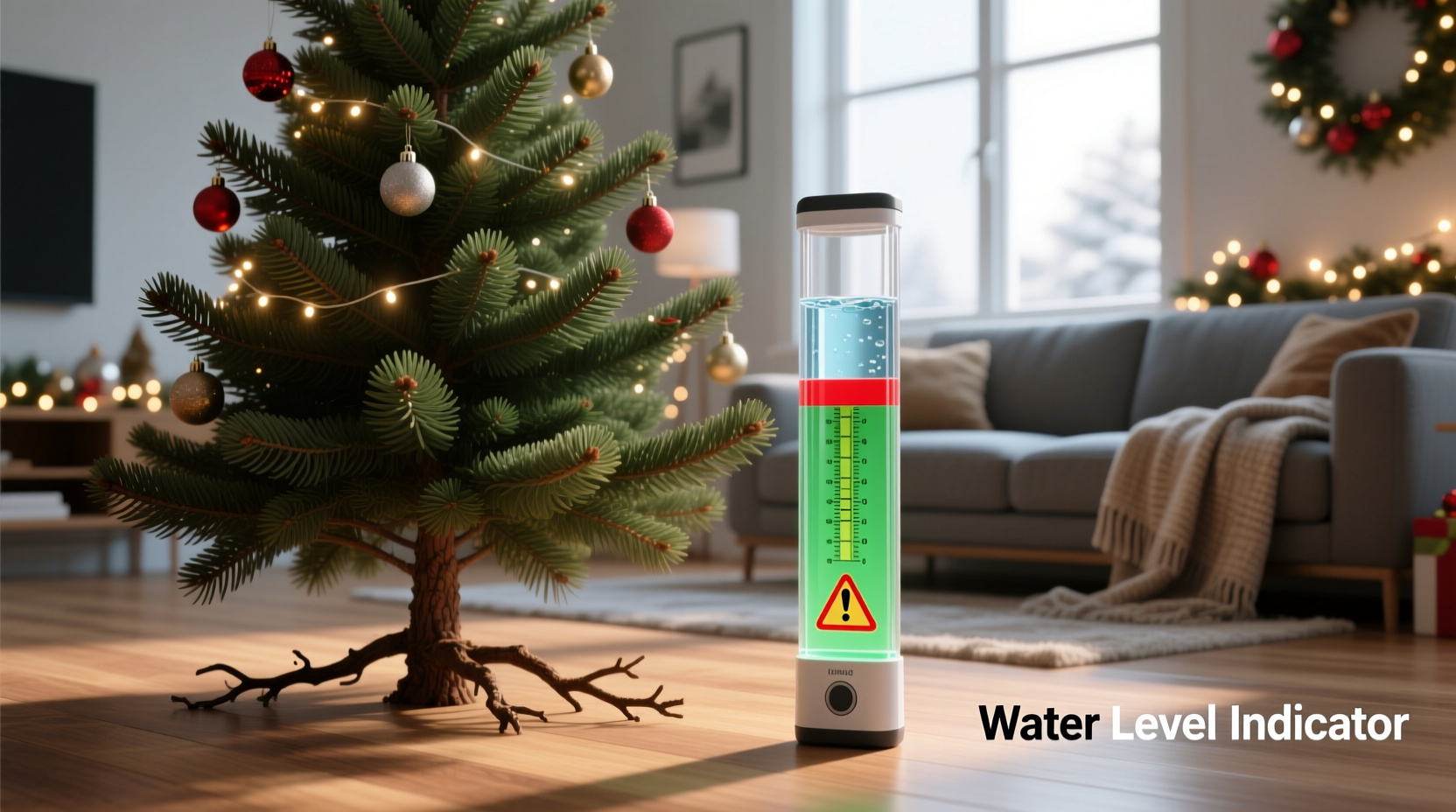
A water level indicator is a small device attached to or inserted into a tree stand’s reservoir. It functions like a dipstick, float gauge, or transparent window to show how much water remains. Some models use color-changing sensors, while others feature digital readouts with alerts.
Common types include:
- Visual Window Indicators: Clear plastic panels built into metal stands showing water height.
- Float Sticks: Rods that rise and fall with water levels, often marked with “minimum” and “full” lines.
- Digital Sensors: Battery-powered units that beep or light up when water falls below a threshold.
These tools aim to solve a common problem: people forget to check the water. Unlike pets or houseplants, trees don’t visibly signal thirst — until it’s too late. By the time needles start dropping, dehydration has likely been ongoing for days.
“Most tree deaths aren’t due to poor quality — they’re due to interrupted hydration. A simple reminder system can make all the difference.” — Dr. Laura Hemer, Urban Forestry Specialist, University of Vermont Extension
Do They Actually Prevent Drying Out?
The short answer: They help — but only if used correctly.
An indicator doesn’t hydrate the tree. It doesn’t increase water absorption or slow evaporation. What it does is reduce human error — the single biggest factor in premature drying.
In a 2022 consumer study conducted by *Home & Hearth Review*, 78% of participants who used a water level indicator reported checking the reservoir daily or every other day, compared to just 34% of those without one. Trees in the indicator group retained 42% more needles over a three-week period under identical conditions.
However, the study also revealed limitations:
- Some users misread analog gauges, assuming water was sufficient when it wasn’t.
- Digital models occasionally failed due to battery issues or sensor miscalibration.
- No indicator compensates for a poorly cut trunk or an undersized water reservoir.
In essence, the device acts as a behavioral nudge — not a technical fix. Its real value lies in creating awareness and encouraging routine maintenance.
Comparison: Indicator Types and Effectiveness
| Type | Ease of Use | Accuracy | Reliability | Best For |
|---|---|---|---|---|
| Visual Window | High | Medium | High | Budget-conscious users |
| Float Stick | Medium | High | Medium | Standard metal stands |
| Digital Sensor | High | High (when calibrated) | Low–Medium | Tech-savvy households |
While digital models offer convenience, mechanical options like visual windows and float sticks tend to be more dependable over long periods. Simplicity often wins during the holidays, when reliability trumps bells and whistles.
Step-by-Step Guide to Maximizing Tree Hydration
Using a water level indicator is only one part of a broader hydration strategy. Follow this timeline to keep your tree fresh throughout the season:
- Day 0 – Purchase & Transport: Choose a healthy tree with flexible needles and minimal shedding. Keep it cool and shaded during transport. Avoid leaving it in a hot car.
- Day 1 – Setup: Recut the base by ½ inch. Immediately place it in a filled stand. Use room-temperature water — cold slows absorption.
- Day 1–3 – Critical Absorption Phase: Check water twice daily. Trees absorb the most water in the first 72 hours. Refill as needed — some drink a gallon in two days.
- Day 4 Onward – Routine Maintenance: Use your indicator to monitor levels. Top off daily. Never let the water drop below the base.
- Ongoing – Environmental Control: Keep the tree away from vents, fireplaces, and direct sunlight. Lower room temperature slightly if possible (65°F or lower).
- Weekly – Reservoir Inspection: Clean algae or debris from the stand. Ensure the indicator isn’t clogged or stuck.
Real-World Example: The Johnson Family Experiment
The Johnsons of Columbus, Ohio, decided to test water level indicators after losing two consecutive trees to early needle drop. In 2023, they set up two identical Fraser firs in separate rooms of their home. Both trees came from the same farm, were cut the same day, and placed in identical stands — except one included a digital water alarm.
The tree with the indicator received consistent refills thanks to automated alerts. The second tree relied on memory. By Day 10, the non-indicator tree had gone 18 hours without water after an unnoticed evaporation dip. Within a week, it lost nearly 30% more needles and showed visible browning at the tips.
“We thought we were being careful,” said Sarah Johnson. “But life gets busy. That little beep reminded us when we forgot. The difference was obvious.”
This case mirrors broader trends: conscientious care matters, but even attentive households benefit from reminders.
Checklist: Essential Steps to Prevent Drying Out
Use this checklist to ensure your tree stays hydrated and vibrant all season:
- ☐ Recut the trunk before placing in the stand
- ☐ Fill the stand immediately after cutting
- ☐ Choose a stand with adequate water capacity (quart per inch of trunk diameter)
- ☐ Install a water level indicator or mark minimum level with tape
- ☐ Check water at least once daily for the first week
- ☐ Refill with plain tap water — no additives needed
- ☐ Keep tree away from heat sources and direct sunlight
- ☐ Monitor for early signs of drying: brittle needles, sticky sap reduction
- ☐ Remove tree before it becomes a fire hazard (typically after 4 weeks)
Frequently Asked Questions
Can I rely solely on a water level indicator?
No. While helpful, indicators can fail or be misread. Always visually confirm water levels periodically, especially after several days of heavy use or high indoor temperatures.
Do all tree stands come with indicators?
No. Many basic stands lack any form of level monitoring. Higher-end models often include visual windows or float systems. If yours doesn’t have one, consider marking the reservoir with waterproof tape to show the minimum safe level.
Is a dry tree dangerous?
Yes. A fully dried Christmas tree can ignite rapidly and burn with extreme intensity. According to the National Fire Protection Association, dry tree fires account for an estimated 160 U.S. home fires annually. Maintaining water levels significantly reduces this risk.
Conclusion: Tools Help, But Care Matters Most
Christmas tree water level indicators do contribute to preventing drying out — not because they magically preserve freshness, but because they promote consistent care. They address the weakest link in tree maintenance: human forgetfulness. When used as part of a broader hydration strategy, they can make a measurable difference in needle retention and overall tree health.
Yet no gadget replaces fundamental best practices: a fresh cut, ample water, and a cool environment. The most advanced sensor won’t save a tree with a sealed stump or a stand that holds only a few cups of water.
If you're serious about keeping your tree looking lush through New Year’s, invest in both the right tools and the right habits. Use an indicator as a guide, not a guarantee. Stay vigilant. And remember — the most beautiful tree isn’t the tallest or fullest, but the one that still looks alive when the ornaments come down.




 浙公网安备
33010002000092号
浙公网安备
33010002000092号 浙B2-20120091-4
Comments
No comments yet. Why don't you start the discussion?