
A wristwatch is more than a timekeeping device—it's a statement of style, precision, and sometimes, technical sophistication. Among the most popular mechanical upgrades beyond basic time display is the chronograph. But with that added functionality comes a higher price tag. So, is the extra cost justified? More importantly, what are those extra dials actually used for in daily life? This guide breaks down the practical value of chronographs, compares them to standard watches, and helps you decide whether the investment makes sense for your lifestyle.
Understanding the Chronograph: More Than Just Extra Dials
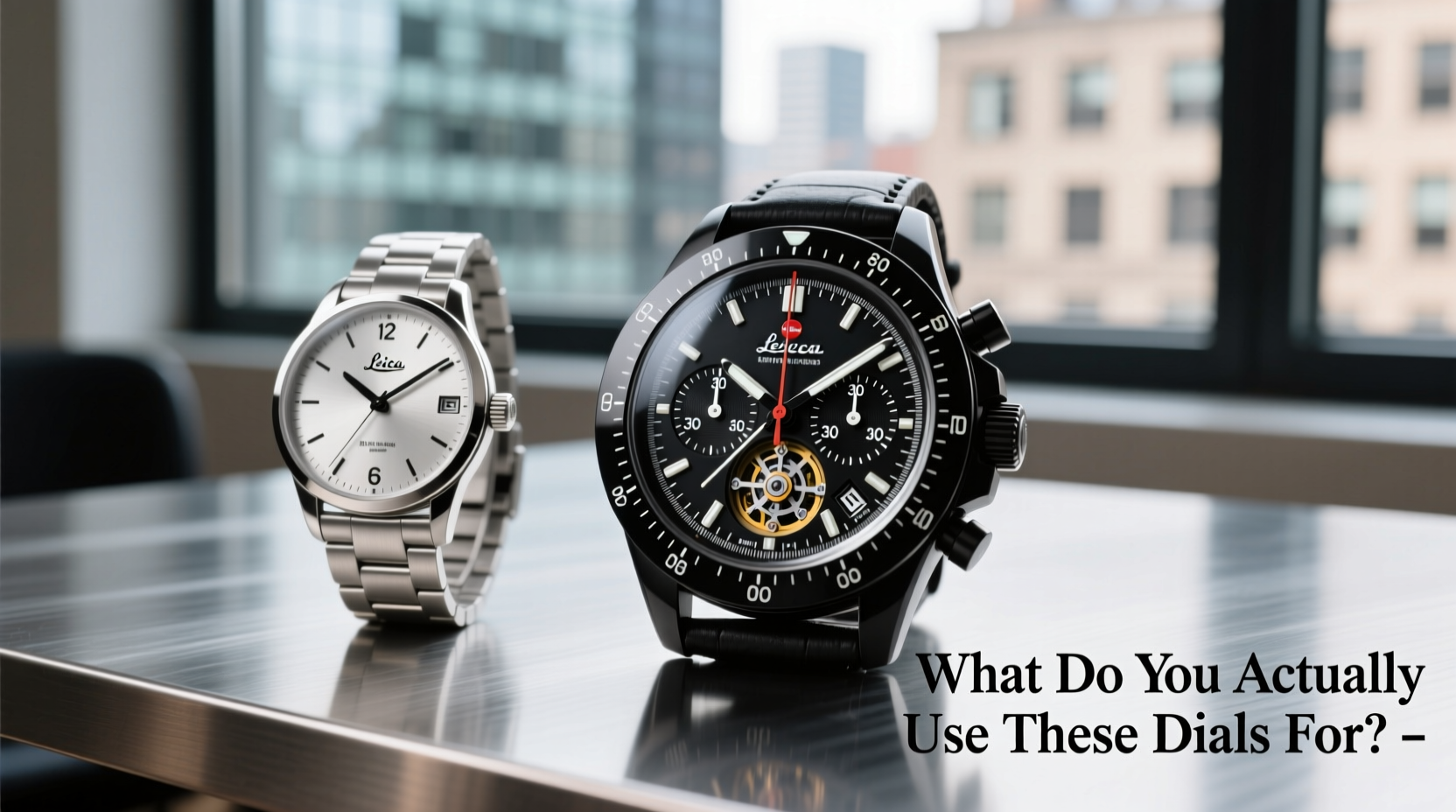
The term “chronograph” comes from the Greek words *chronos* (time) and *graph* (writer), literally meaning “time writer.” In horological terms, it refers to a watch with a built-in stopwatch function. Unlike a standard analog watch that only displays hours, minutes, and seconds, a chronograph includes subdials and pushers on the side of the case to measure elapsed time.
The typical chronograph features three hands: the central seconds hand for the stopwatch, and two or three subdials that track elapsed minutes, hours, and sometimes continuous seconds. Pressing the top pusher starts and stops the timer; pressing the bottom resets it. These functions are mechanically or electronically integrated into the movement, depending on whether the watch is quartz or mechanical.
“Chronographs represent the marriage of utility and engineering elegance. They’re not just about telling time—they’re about measuring moments.” — Antoine Morel, Watchmaker & Horology Instructor at Geneva Institute of Time
What Do the Subdials Actually Do?
Many people admire the look of a chronograph but never use its stopwatch feature. To understand their purpose, it helps to decode what each dial typically measures:
| Subdial Position | Function | Real-World Use Case |
|---|---|---|
| Top-left (3 o'clock) | Elapsed minutes (30 or 60) | Timing a workout, meeting, or cooking process |
| Bottom-left (6 o'clock) | Continuous seconds (regular timekeeping) | Ensures main time accuracy while stopwatch is inactive |
| Top-right (9 o'clock) | Elapsed hours (12-hour max) | Tracking long-duration events like races or drives |
For example, if you start a chronograph, the central seconds hand begins moving immediately. After one minute, the top-left subdial advances by one unit. After 30 minutes, it shows half full. The top-right subdial tracks each hour passed—so after two hours, it reads \"2.\" This allows precise measurement of intervals without needing a separate digital timer.
Chronograph vs Standard Watch: A Practical Breakdown
The decision between a chronograph and a standard watch isn’t just about aesthetics. It involves trade-offs in price, durability, readability, and maintenance. Here’s a detailed comparison:
- Price: Chronographs typically cost 30%–100% more than comparable standard watches due to complex movements and additional components.
- Thickness & Weight: Chronographs are often thicker because of the extra gears and pusher mechanisms. This can affect comfort under a shirt cuff.
- Readability: While elegant, multiple subdials can clutter the face, making it harder to read the time at a glance—especially in low light.
- Maintenance: More moving parts mean higher servicing costs and greater susceptibility to wear or misalignment over time.
- Battery Life (Quartz): In quartz chronographs, frequent use of the stopwatch drains the battery faster than a standard time-only model.
That said, some users value the functionality enough to accept these drawbacks. Pilots, athletes, engineers, and medical professionals often rely on precise timing in their work. For them, a chronograph isn’t a luxury—it’s a tool.
When a Chronograph Adds Real Value
Consider this scenario: Maria, a triathlon coach, uses her chronograph daily. She times swim laps, cycling intervals, and transition drills with split-second accuracy. Her watch allows her to record lap times using the flyback function (on higher-end models), which resets and restarts instantly without stopping. This level of control would be cumbersome with a smartphone or app, especially in wet conditions.
In contrast, David, an office manager, bought a chronograph because he liked the sporty look. He’s never used the stopwatch. After two years, he noticed the subdials were slightly misaligned after a routine battery change—a common issue when technicians lack chronograph-specific training. He now regrets not choosing a simpler, slimmer watch.
Do You Actually Need One? A Decision Checklist
Before investing in a chronograph, ask yourself the following questions. Answer “yes” to two or more, and the upgrade may be worthwhile:
- Do you regularly need to time events (meetings, workouts, cooking, etc.) without relying on your phone?
- Do you work in a field where precise interval tracking matters (aviation, medicine, motorsports)?
- Do you appreciate mechanical complexity and enjoy using all your watch’s functions?
- Are you willing to pay more upfront and potentially higher servicing fees down the line?
- Does the design of a chronograph better suit your wardrobe or personal aesthetic?
If most answers are “no,” a standard watch might serve you better. Simplicity often wins in both reliability and elegance.
How to Use a Chronograph Effectively: Step-by-Step Guide
If you own or are considering a chronograph, knowing how to use it properly enhances its value. Follow these steps:
- Identify the pushers: The top crown-adjacent button starts/stops the chronograph; the bottom one resets it.
- Press once to start: The central seconds hand will begin moving; subdials activate as time accumulates.
- Press again to stop: The hand freezes, showing elapsed time across the relevant subdials.
- Record or note the time: Read minutes from the top-left dial, hours from the top-right.
- Reset: Press the bottom pusher to return all hands to zero. Only do this after stopping.
Note: Never reset a running chronograph—this can damage the internal mechanism. Always stop first.
Frequently Asked Questions
Can I use a chronograph every day as a regular watch?
Yes. When the chronograph is not activated, it functions like any other analog watch. However, the constant seconds subdial (usually at 6 o’clock) continues moving, which some find reassuring as a sign of life in mechanical watches.
Are chronographs less accurate than standard watches?
Not inherently. Accuracy depends on the movement quality (quartz vs. mechanical, COSC-certified, etc.), not the presence of a chronograph. However, poorly maintained chronographs may develop timing inconsistencies due to gear stress.
Is a chronograph a good investment?
It depends. High-end chronographs from brands like Omega, Rolex, or TAG Heuer often retain or increase value, especially limited editions. Entry-level models may depreciate faster than simple watches due to higher perceived obsolescence and repair costs.
Final Thoughts: Function Over Fashion?
The appeal of a chronograph is undeniable. Its intricate dials and sporty symmetry convey precision and capability. But beneath the surface, it’s a tool—one that demands engagement to justify its existence. If you're drawn to it purely for looks, consider whether the added bulk, cost, and complexity align with your needs.
On the other hand, if you time events regularly, appreciate mechanical craftsmanship, or simply love having multifunctional tools on your wrist, a chronograph can be deeply satisfying. The key is intentionality: buy it for what it does, not just how it looks.




 浙公网安备
33010002000092号
浙公网安备
33010002000092号 浙B2-20120091-4
Comments
No comments yet. Why don't you start the discussion?