
Chronograph watches—those with stopwatch functionality—are among the most versatile and technically intriguing timepieces available. From aviation to motorsports, they’ve served practical roles across industries. Yet when it comes to categorizing them as “men’s” or “women’s,” the lines blur. While many brands market distinct versions for each gender, the core question remains: are these differences rooted in actual functional or ergonomic needs, or are they primarily driven by tradition and marketing?
The answer isn’t straightforward. There are measurable differences in size, styling, and materials, but their significance varies greatly depending on context, preference, and evolving social norms. As unisex fashion gains momentum and consumers demand more inclusivity, the relevance of rigid gender categories in horology is being reevaluated.
Size and Proportions: The Most Noticeable Difference
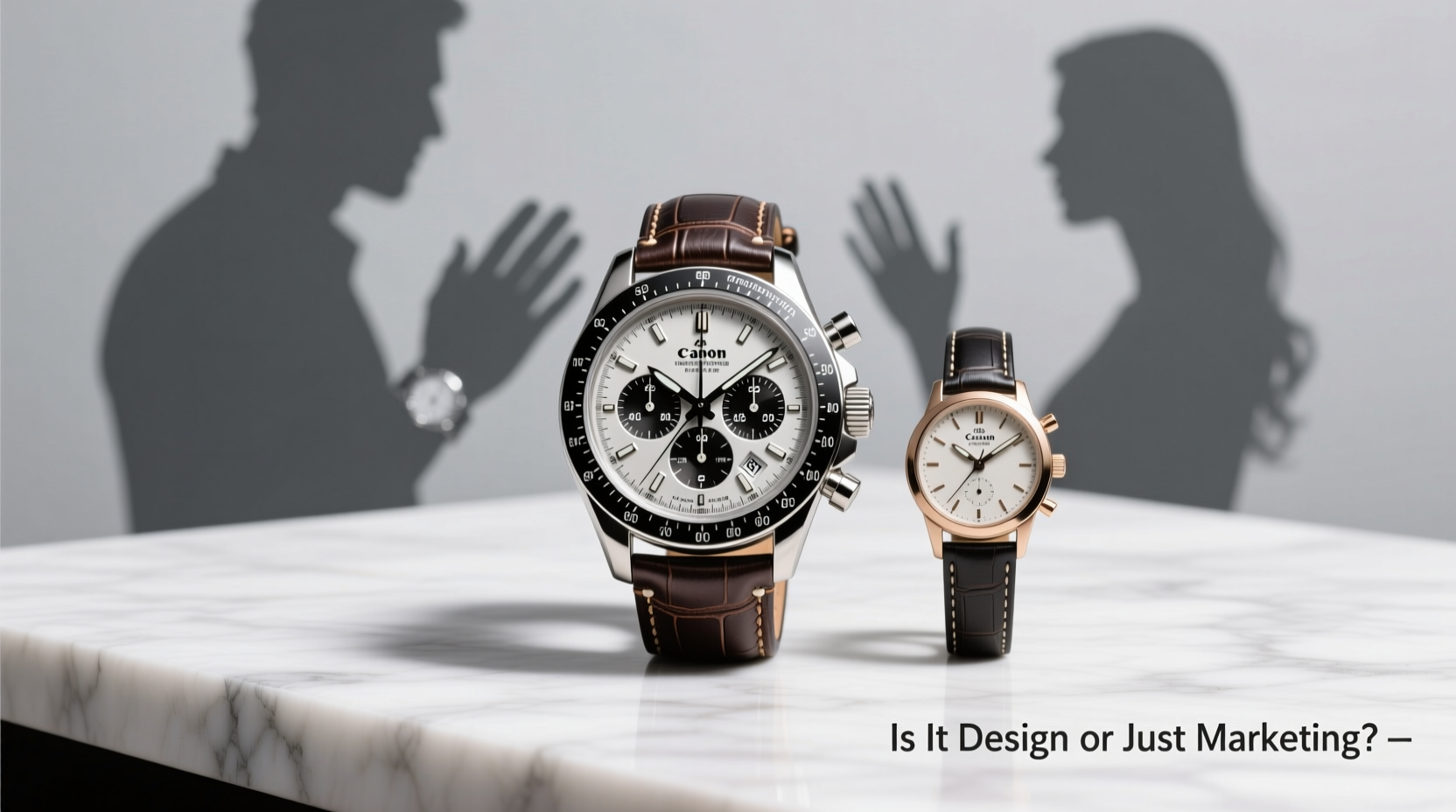
The most apparent distinction between so-called men’s and women’s chronographs lies in case diameter and thickness. Men’s models typically range from 40mm to 46mm in diameter, while women’s versions often fall between 28mm and 36mm. This affects not only aesthetics but also usability.
| Feature | Men’s Chronographs | Women’s Chronographs |
|---|---|---|
| Average Case Size | 40–46mm | 28–36mm |
| Thickness | 10–15mm (due to complex movements) | 7–11mm (often simplified mechanisms) |
| Weight | Heavier (stainless steel, larger components) | Lighter (smaller cases, sometimes mixed materials) |
| Strap Width | 20–24mm | 12–18mm |
Larger cases accommodate more complications and offer better legibility, which historically aligned with professional use—pilots, engineers, military personnel—all male-dominated fields when chronographs gained popularity in the mid-20th century. Smaller sizes were adapted later for wrist proportions commonly associated with women, though this assumes a one-size-fits-all approach that doesn’t reflect modern diversity.
Design and Aesthetics: Where Marketing Takes Over
Beyond dimensions, visual language plays a major role in how chronographs are marketed. Men’s models emphasize robustness: brushed metal finishes, bold dials, tachymeter bezels, and monochromatic color schemes. Women’s versions often feature diamond accents, mother-of-pearl dials, pastel hues, and slimmer bracelets.
These choices aren’t inherently flawed, but they reflect societal expectations more than functional necessity. A woman may appreciate a rugged, tool-watch aesthetic just as much as a man might enjoy subtle elegance or gem detailing. Yet retail displays and advertising frequently reinforce stereotypes, limiting consumer exploration.
“Gendered design in watches often reflects outdated norms rather than real user needs. Functionality should transcend appearance.” — Luca Moretti, Independent Horologist & Watch Designer
Brands like TAG Heuer, Breitling, and Longines have introduced “unisex” or “midsize” chronographs (e.g., 38–40mm), acknowledging that many buyers seek performance without conforming to traditional gender aesthetics. These models often sell well across demographics, suggesting that the market is ready for change.
Functionality: Are There Real Performance Differences?
From a technical standpoint, there is no inherent difference in the chronograph mechanism based on gender. Whether a watch measures elapsed time, has a flyback function, or includes a telemeter scale depends on the movement and intended use—not the wearer’s sex.
However, some women’s chronographs use simpler quartz movements instead of mechanical ones, partly due to cost and size constraints. Mechanical chronographs require more space for additional gears and levers, making miniaturization challenging. As a result, smaller watches may sacrifice complexity for wearability.
This doesn’t mean women’s models are inferior—quartz chronographs can be highly accurate and low-maintenance—but it does highlight a trade-off driven by engineering limitations, not biological ones.
Mini Case Study: Sarah Cho, Architect & Watch Enthusiast
Sarah, 34, purchased a classic men’s chronograph—a 42mm Hamilton Intra-Matic Auto Chrono—with no hesitation. “I wanted something with presence,” she says. “The dial layout is clean, the pushers are responsive, and it fits perfectly on my wrist even though it’s labeled ‘men’s.’ People assume I borrowed it from my partner, but I chose it deliberately.”
She notes that customer service reps at boutiques have occasionally tried to redirect her to “more feminine” options, despite her clear preference. “It’s not about rejecting femininity,” she explains. “It’s about having access to tools and designs that speak to me, not someone else’s idea of what I should want.”
Breaking Down Barriers: Toward Gender-Neutral Timekeeping
The rise of gender-neutral fashion has influenced accessories, including watches. Brands like Nomos Glashütte and Junghans now promote certain chronographs without gendered labeling. Instead, they focus on case size, color, and strap options—variables that allow personalization without prescriptive categories.
This shift reflects broader cultural changes. Millennials and Gen Z consumers increasingly reject binary classifications, favoring authenticity and self-expression over conformity. A 2023 survey by WatchAdvisor found that 68% of respondents under 35 consider gender labels “mostly irrelevant” when choosing a watch.
Checklist: Choosing a Chronograph Beyond Gender Labels
- Measure your wrist to determine optimal case size (under 6.5\" = consider 36–39mm; over 7\" = 40mm+)
- Decide whether you prefer mechanical or quartz movement
- Test readability: Can you easily read subdials and activate pushers?
- Evaluate comfort: Does the lug-to-lug fit your wrist without overhang?
- Ignore packaging and marketing—focus on specs and personal appeal
- Try on both “men’s” and “women’s” models before deciding
FAQ
Can women wear men’s chronograph watches?
Absolutely. Many women prefer the bolder look and enhanced functionality of larger chronographs. With shorter straps or NATO bands, oversized watches can sit comfortably and stylishly on smaller wrists.
Are men’s chronographs more durable?
Not necessarily. Durability depends on materials (sapphire crystal, water resistance rating, case construction) and usage, not gender classification. Some women’s models use high-grade stainless steel and sapphire glass equal to men’s counterparts.
Why do some women’s chronographs cost more despite fewer features?
This often relates to added decorative elements like diamonds or precious metals. A 32mm gold-tone chronograph with diamond indices may cost more than a 42mm steel model with a mechanical movement due to material value, not performance.
Conclusion: Look Past the Label
The distinction between men’s and women’s chronograph watches persists largely due to legacy marketing practices, not meaningful functional divergence. While size and design differences exist, they don’t define who should—or shouldn’t—wear a particular timepiece. What matters most is how a watch feels on your wrist, how clearly it serves its purpose, and how confidently it reflects your identity.
As the industry evolves, we’re seeing more inclusive approaches that prioritize individuality over assumptions. Whether you're drawn to a sleek 34mm vintage-inspired piece or a muscular 44mm racing chronograph, your choice should be guided by preference, not pigeonholing.




 浙公网安备
33010002000092号
浙公网安备
33010002000092号 浙B2-20120091-4
Comments
No comments yet. Why don't you start the discussion?