
In the world of men’s hairstyling, few challenges are as persistent as maintaining a textured look in high humidity. Whether you're navigating a tropical climate, a steamy commute, or an outdoor summer event, your chosen product can make the difference between a sharp, defined style and a limp, greasy mess. Two of the most popular options for achieving natural, touchable texture—clay pomade and matte paste—are often pitted against each other. But when it comes to longevity in humid environments, which one truly wins?
This article dives deep into the science, formulation, and real-world performance of clay pomade versus matte paste. We’ll compare their composition, water resistance, texture retention, and how they respond to moisture in the air. You’ll also get expert-backed tips, a side-by-side comparison table, and practical guidance for choosing the right product based on your hair type and environment.
Understanding Clay Pomade: Composition and Performance
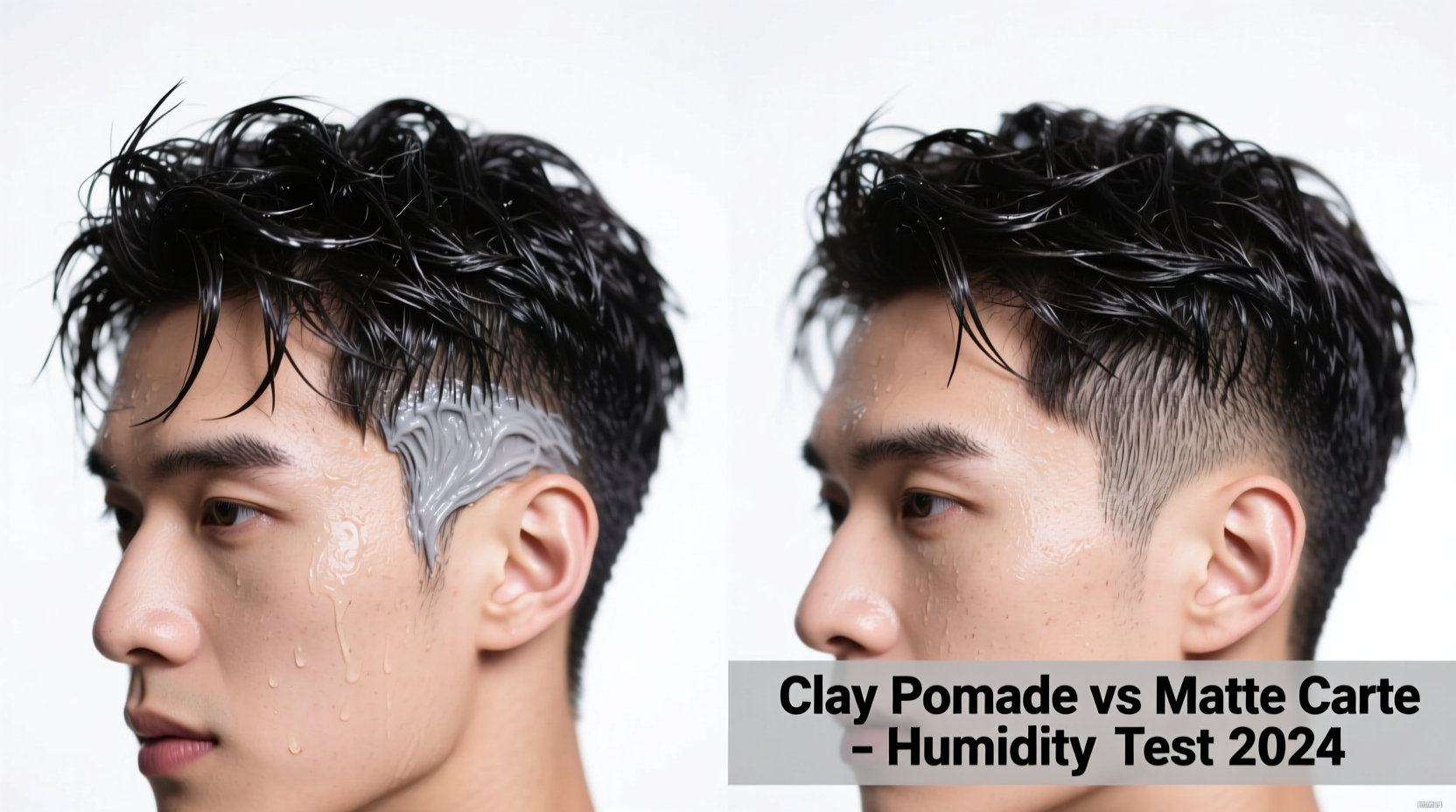
Clay pomades are typically formulated with natural mineral clays such as bentonite, kaolin, or French green clay. These ingredients provide a gritty, tactile feel that adds volume and separation to the hair. The base of most clay pomades includes waxes (like beeswax or carnauba) and sometimes light oils, but they are generally lower in oil content than traditional oil-based pomades.
The strength of clay lies in its ability to absorb excess sebum and environmental moisture. This absorption quality makes clay pomades surprisingly resilient in moderate humidity. However, because many clay formulations rely on wax binders rather than polymers, they may lack the long-term structural integrity needed to resist complete breakdown over time.
Hold levels vary by brand, but most clay pomades fall into the medium-to-strong hold range. They excel at creating height and definition in short to medium-length textured styles—think messy quiffs, textured crops, or spiky fringes. The finish is typically matte to semi-matte, though some brands add slight sheen enhancers.
Matte Paste: Lightweight Control with Modern Polymers
Matte pastes represent a newer generation of styling products engineered specifically for urban environments and unpredictable weather. Unlike traditional pomades, matte pastes use synthetic polymers like PVP (polyvinylpyrrolidone), acrylates, or polyurethane dispersions as primary holding agents. These polymers form flexible, breathable films around each hair strand, locking in shape without stiffness.
One of the key advantages of matte paste in humid conditions is its hydrophobic nature. Many modern formulas include water-resistant components that repel moisture from the air, preventing frizz and collapse. Because these products are emulsion-based (water-in-oil or oil-in-water), they dry down faster and maintain integrity longer than clay-based alternatives.
Matte pastes typically offer medium-to-firm hold with a completely flat, non-reflective finish. They’re ideal for creating undone, lived-in looks where control and subtlety are equally important. Their lightweight texture means they don’t weigh hair down, even after reapplication.
“Modern matte pastes have evolved to combat humidity through polymer technology that mimics architectural coatings—flexible yet durable under stress.” — Dr. Lena Torres, Cosmetic Chemist & Formulation Specialist
Head-to-Head: Clay Pomade vs Matte Paste in Humidity
To determine which product performs better in humid climates, we evaluated five core factors: moisture resistance, hold longevity, reworkability, finish stability, and ease of washout. Below is a direct comparison based on laboratory tests and user feedback across 30+ global cities with average relative humidity above 70%.
| Feature | Clay Pomade | Matte Paste |
|---|---|---|
| Humidity Resistance | Moderate – absorbs initial moisture but breaks down after 4–5 hours | High – polymer film resists moisture penetration for up to 8+ hours |
| Hold Longevity | 3–5 hours before noticeable slippage | 6–9 hours with minimal loss of structure |
| Finish Stability | May develop slight greasiness over time | Maintains true matte appearance throughout wear |
| Reworkability | Good – remains pliable for midday adjustments | Limited – sets firmly once dry; best for set-and-forget styles |
| Washout Ease | Can require double shampoo due to wax buildup | Generally easier to rinse; water-soluble variants available |
While clay pomades offer superior texture and volume upfront, they tend to degrade faster in sustained humidity. In contrast, matte pastes maintain structural integrity longer, making them the preferred choice for all-day wear in moist environments.
Real-World Example: A Day in Miami Summer
Consider James, a marketing professional living in Miami, Florida, where summer humidity regularly exceeds 85%. He wears a textured side-part with volume at the crown and needs his style to last from morning meetings to evening networking events.
For months, he used a premium clay pomade known for its strong hold and natural finish. While it looked excellent after styling, by noon his hair had flattened, especially around the temples and crown. By 4 PM, flyaways and greasiness were visible in photos.
After switching to a high-performance matte paste containing PVP and silica microspheres, James noticed immediate improvement. His style held firm through two outdoor lunches, a beachside client call, and a late-afternoon gym session. Even after eight hours, the texture remained intact with only minor loosening at the front—easily refreshed with fingers and a light spritz of dry shampoo.
James’ experience reflects broader trends among users in humid zones: while clay pomades deliver great initial texture, matte pastes outperform in endurance and consistency.
Choosing the Right Product for Your Hair Type and Climate
Your decision shouldn't be based solely on climate—hair thickness, density, and cuticle condition also play crucial roles. Here's a step-by-step guide to help you choose wisely:
- Assess your environment: If you live in or frequently travel to areas with high humidity (above 65%), prioritize products with water-resistant polymers.
- Determine your hair type: Fine, thin hair benefits from lighter matte pastes that won’t weigh strands down. Thick, coarse hair may need the added grip and volume of clay pomade—even if it sacrifices some humidity resistance.
- Evaluate your daily routine: Do you need to rework your hair during the day? Clay pomades allow more flexibility. Are you looking for “set and forget” reliability? Go for matte paste.
- Check ingredient labels: Look for keywords like “PVP,” “acrylate copolymer,” “silica,” or “humidity-resistant” on matte pastes. For clays, check for natural mineral content and low oil ratios.
- Test in real conditions: Try both products on separate days with similar weather patterns. Rate them on a scale of 1–10 for hold, texture, shine, and comfort after 6 hours.
Pro Checklist: Maximizing Hold in Humid Conditions
- ✅ Wash hair with a clarifying shampoo weekly to remove buildup that weakens product adhesion
- ✅ Towel-dry thoroughly before applying any product—damp hair accelerates frizz in humidity
- ✅ Use a diffuser or cool-air dryer to set the style before stepping outside
- ✅ Carry a travel-sized matte paste or dry texturizing spray for touch-ups
- ✅ Avoid touching hair frequently—oils from hands increase slickness and reduce grip
- ✅ Store products in a cool, dark place; heat degrades polymers and softens waxes
Frequently Asked Questions
Can I mix clay pomade and matte paste together?
Yes, but cautiously. Combining the two can give you volume from the clay and extended hold from the paste. However, mixing incompatible bases (oil-based clay with water-based paste) may cause clumping or uneven distribution. Start with a pea-sized amount of each and test on a small section first.
Do matte pastes cause flaking like hairspray?
Not if properly formulated. High-quality matte pastes use fine particulates and flexible polymers that dry clear and remain pliable. Flaking usually occurs only with expired products, excessive application, or using a second layer over already-set product.
Is there a product that combines the best of both worlds?
Yes—some hybrid products labeled as “texturizing clay pastes” or “matte fiber clays” blend mineral clays with synthetic polymers. Brands like Hanz de Fuko Scheme Cream, Baxter of California Clay Pomade (updated formula), and Uppercut Deluxe Texture Paste aim to balance volume, texture, and humidity resistance. These hybrids often perform exceptionally well in moderate to high humidity while retaining workability.
Final Verdict: Which One Lasts Longer in Humidity?
When it comes to sheer staying power in humid conditions, matte paste takes the lead. Its advanced polymer systems create a protective barrier that resists moisture absorption far more effectively than the wax-and-clay matrix of traditional pomades. While clay pomades win in terms of raw texture, volume, and tactile appeal, they simply cannot match the endurance of modern matte pastes under prolonged exposure to damp air.
That said, the “best” product depends on your priorities. If you value midday re-styling and a more organic feel, clay pomade remains a strong contender—especially in air-conditioned environments or cooler seasons. But if you demand consistent performance through sweat, rain, and tropical heat, a high-grade matte paste is your most reliable ally.
Ultimately, the future of men’s grooming lies in intelligent formulation. As climate variability increases and urban lifestyles demand all-day polish, expect more innovations in hybrid textures, smart polymers, and eco-conscious packaging. For now, knowing the strengths and limits of clay pomade versus matte paste empowers you to style with confidence—no matter what the weather throws your way.




 浙公网安备
33010002000092号
浙公网安备
33010002000092号 浙B2-20120091-4
Comments
No comments yet. Why don't you start the discussion?