
Training a stubborn dog can feel like pushing against a brick wall. You say “sit,” they look at you like you’re speaking Martian. You offer a treat, they sniff it once and walk away. Frustration builds—for both of you. But the solution isn’t more yelling or stricter rules. It’s choosing the right training method. Two popular approaches dominate modern dog training: clicker training and treat-based reinforcement. While both rely on positive reinforcement, their mechanisms differ—and so do their results, especially with resistant or hard-headed breeds.
Understanding which method accelerates learning in difficult dogs isn’t just about speed—it’s about building trust, clarity, and consistency. This article breaks down the science, compares practical outcomes, and delivers a verdict based on behavioral research and real-world case studies.
The Science Behind Positive Reinforcement
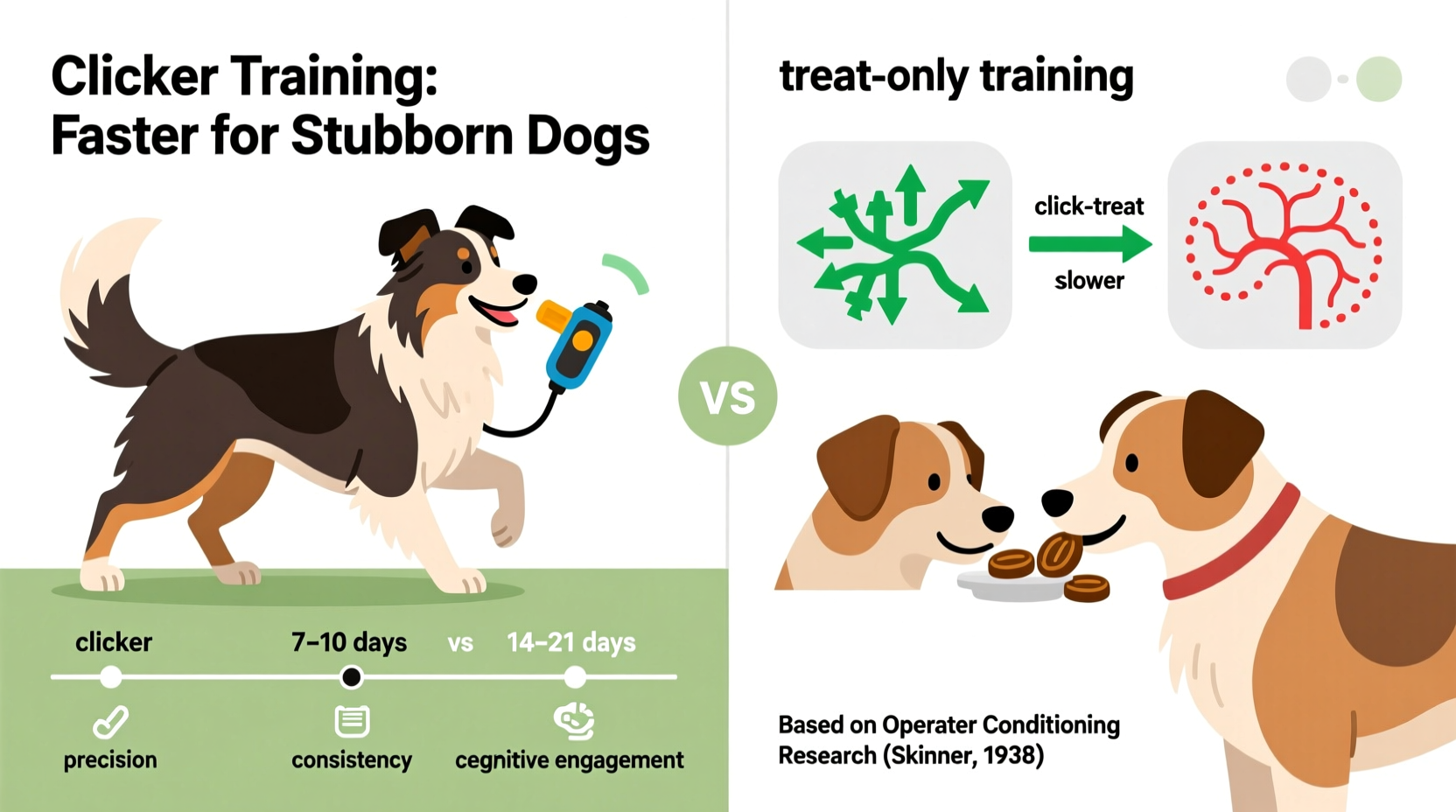
Dogs learn through association. When a behavior leads to a desirable outcome, they’re more likely to repeat it. This principle—called operant conditioning—forms the foundation of both clicker and treat training. However, the timing and precision of feedback significantly influence how quickly a dog grasps what’s expected.
In traditional treat training, the reward follows the desired behavior. The delay between action and reward can be critical. Even a two-second gap confuses the dog about which action earned the treat. Clicker training addresses this flaw by using a distinct, consistent sound—the “click”—to mark the exact moment the correct behavior occurs. The treat follows immediately after, reinforcing the connection.
“The click is like a camera snapping a photo of the right behavior. It freezes the moment so the dog knows precisely what earned the reward.” — Dr. Karen Overall, Veterinary Behaviorist
This immediacy gives clicker training an edge in accuracy, particularly when shaping complex behaviors or working with dogs that are easily distracted or slow to respond.
How Clicker Training Works: Precision Over Pressure
Clicker training uses a small handheld device that makes a sharp, consistent clicking noise. The process begins with “charging” the clicker—pairing the sound with a treat until the dog understands that “click” means “a reward is coming.” Once this association is solid, the trainer uses the click to mark the exact instant the dog performs the desired action, such as sitting, staying, or making eye contact.
For stubborn dogs, this precision matters. Consider a dog who sits only halfway. With treat-only training, you might give the treat while the dog is still lowering itself, accidentally reinforcing an incomplete sit. With a clicker, you wait until the full sit is achieved, then click. The dog learns faster because there’s no ambiguity.
Clicker training excels in shaping behaviors step-by-step. For example, teaching a dog to go to their mat involves multiple stages: looking at the mat, stepping on it, lying down, staying. Each micro-behavior can be clicked and reinforced individually. This gradual progression is ideal for dogs who resist direct commands or become overwhelmed by expectations.
Treat Training: Simplicity with Limitations
Treat training is straightforward: perform the behavior, get a treat. No extra tools, no charging period. Many owners start here because it feels intuitive. Lure a dog into a sit with a treat over their nose, reward when they comply. Repeat.
But simplicity comes at a cost. Without a precise marker, dogs often guess what earned the reward. Did they get the treat for looking at you? For moving toward you? For finally sitting? This uncertainty slows learning, especially in dogs already prone to ignoring commands.
Moreover, treat dependency becomes a problem. Some dogs stop performing unless they see the treat first. Others lose interest if the food isn’t high-value enough. Stubborn dogs may simply refuse to engage, turning their heads or walking away when they realize a treat is involved.
Treat training also struggles with timing. If you’re holding the treat in your hand and waiting to deliver it after the behavior, the delay dilutes the lesson. Even experienced trainers can’t match the millisecond accuracy of a click.
Head-to-Head Comparison: Effectiveness for Stubborn Dogs
| Factor | Clicker Training | Treat Training |
|---|---|---|
| Learning Speed | Faster due to precise marking of behavior | Slower; delayed rewards reduce clarity |
| Consistency | High—sound is uniform every time | Variable—depends on handler’s timing and tone |
| Behavior Shaping | Excellent for breaking tasks into steps | Limited; better for simple, lured actions |
| Dog Engagement | High—mental stimulation increases focus | Can decrease if treats aren’t motivating |
| Weaning Off Tools | Easier—click fades as cue takes over | Harder—dog may expect treat every time |
| Suitability for Stubborn Dogs | High—clarity reduces frustration | Moderate—often fails with unresponsive dogs |
The data shows a clear trend: clicker training outperforms treat-only methods in speed and reliability, especially when dealing with dogs that have a history of non-compliance, fear, or distraction.
Real-World Example: Turning Around a Resistant Rescue
Max, a three-year-old Border Collie mix, was adopted from a shelter after being labeled “untrainable.” He ignored basic cues, pulled on leash, and refused to make eye contact. His new owner tried treat luring for weeks with minimal progress. Max would sometimes sit—but only when he felt like it.
A certified dog trainer introduced clicker training. Instead of demanding a sit, they began by clicking and treating any glance toward the owner’s face. Within two days, Max was offering sustained eye contact. Next, they shaped a sit by clicking the moment his hips lowered, even slightly. By day six, Max was sitting on cue—without a lure.
The breakthrough wasn’t just obedience. Max became more attentive, less anxious, and eager to participate. The clicker gave him a way to understand what was expected, reducing confusion and resistance. Treats were still used, but as a follow-up to the click—not the primary signal.
This case illustrates a key advantage: clicker training turns training into a communication system, not a transaction. The dog isn’t just working for food; they’re solving puzzles and earning feedback.
Step-by-Step Guide to Starting Clicker Training with a Stubborn Dog
If you’re ready to try clicker training, follow this sequence to build success from day one:
- Charge the clicker: In a quiet space, click once, then immediately give a small, high-value treat. Repeat 10–15 times. The dog should begin looking for the treat after each click.
- Test understanding: Click and pause. If the dog looks expectantly at your hand or mouth, the association is formed.
- Mark a simple behavior: Wait for your dog to sit naturally. The moment their butt hits the floor, click, then treat. Do this 5–10 times.
- Add the verbal cue: As your dog is sitting, say “sit” just before the behavior completes. Then click and treat. After several repetitions, say “sit” before they act. Click only if they comply.
- Phase out the clicker: Once the dog responds reliably to the cue, start clicking only occasionally. Replace the click with praise or a pat, but still reward intermittently.
- Generalize the behavior: Practice in different locations with increasing distractions. Use the clicker again briefly if performance drops.
This method works because it respects the dog’s cognitive process. You’re not forcing compliance—you’re guiding understanding.
Combining Methods for Maximum Results
Purists may argue for one method over the other, but the most effective trainers blend tools. Clicker training provides precision; treats provide motivation. Together, they create a powerful feedback loop.
For stubborn dogs, start with the clicker to establish clarity, then use treats to maintain enthusiasm. Once the behavior is solid, fade both the clicker and continuous treats, moving to a variable reward schedule—where the dog gets a treat only sometimes, but still performs reliably.
You can also incorporate life rewards: click and treat for sitting before going through a door, then let the dog walk through as additional reinforcement. This teaches that good behavior leads to real-world benefits.
Frequently Asked Questions
Can I use clicker training with an older or previously untrained dog?
Absolutely. Age doesn’t prevent learning. Older dogs may take longer to form associations, but the clicker’s clarity often accelerates their progress. Start with simple behaviors and keep sessions short (3–5 minutes).
What if my dog is scared of the clicker sound?
Some dogs react negatively to the sharp noise. In that case, muffle the clicker by wrapping it in a cloth or use a verbal marker like “yes” or a tongue click. The key is consistency—not the sound itself.
Do I need to carry a clicker forever?
No. The clicker is a teaching tool, not a crutch. Once your dog reliably performs a behavior on cue, you can phase it out. The learned behavior remains, supported by intermittent rewards and praise.
Final Verdict: Which Method Works Faster?
For stubborn dogs, clicker training consistently produces faster, more reliable results than treat-only methods. Its strength lies in precision, timing, and the ability to shape behavior without pressure. While treats alone can work for simple commands or highly food-motivated dogs, they fall short when clarity and consistency are needed.
The clicker acts as a bridge between human intention and canine understanding. It removes guesswork, reduces frustration, and transforms training into a collaborative game. Stubborn dogs aren’t defiant—they’re confused. Clicker training gives them the roadmap they need.
That said, treats remain essential as the reward mechanism. The best approach combines the immediacy of the click with the motivation of food, then gradually transitions to real-life rewards and verbal praise.
“Dogs don’t fail training. Training fails dogs. The right method meets them where they are.” — Jean Donaldson, Author of *The Culture Clash*
Take Action Today
If you’ve been struggling with a stubborn dog, reconsider your approach. Grab a clicker, charge it properly, and start marking tiny wins. Celebrate attention, a glance, a single paw movement toward sitting. Progress compounds. What feels impossible today can become routine in a week.
Training isn’t about dominance or repetition. It’s about communication. And the clicker is one of the clearest languages your dog will ever learn.




 浙公网安备
33010002000092号
浙公网安备
33010002000092号 浙B2-20120091-4
Comments
No comments yet. Why don't you start the discussion?