
The way we play video games is undergoing a fundamental shift. As internet speeds increase and cloud infrastructure matures, cloud gaming has emerged as a credible alternative to traditional console gaming. By 2025, the choice between streaming your favorite titles over the internet or investing in dedicated hardware like the PlayStation 5 or Xbox Series X is no longer just about preference—it’s about value. This article breaks down both models across key dimensions: upfront cost, game library, performance, ownership, and future scalability.
Understanding the Core Differences
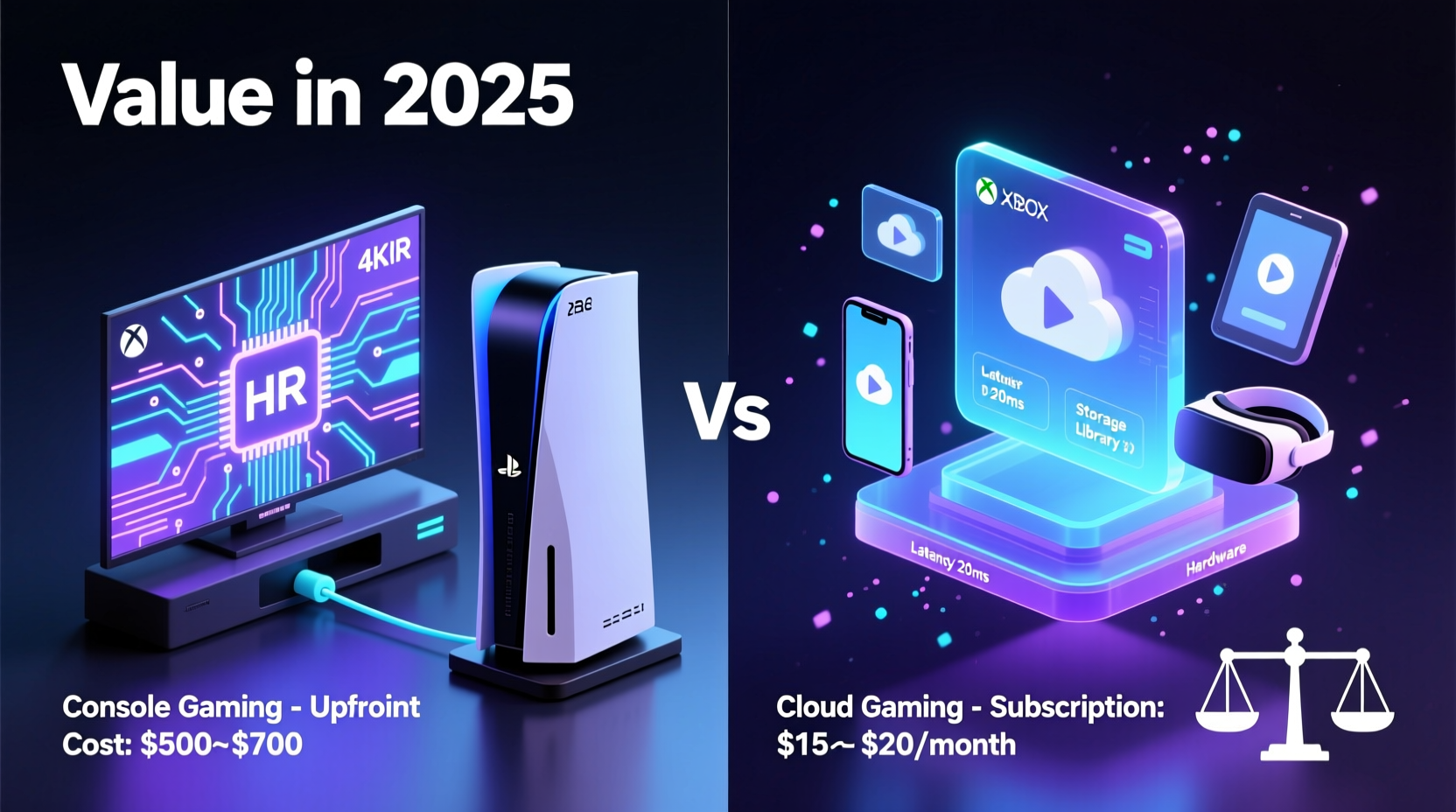
At its core, console gaming relies on local hardware. You purchase a physical device—such as a PlayStation, Xbox, or Nintendo Switch—that processes and renders games directly. All data runs through the machine in your living room, and you store games either on internal storage or physical discs.
Cloud gaming, by contrast, operates on remote servers. Games are rendered in high-end data centers and streamed to your device—be it a smart TV, laptop, phone, or even a low-end PC—in real time. Your inputs are sent back to the server, creating a feedback loop that mimics local gameplay, provided latency is low enough.
The distinction isn't just technical—it shapes how much you pay, what games you can access, and how much control you have over your experience.
Cost Comparison: Upfront Investment vs Ongoing Subscriptions
One of the most immediate differences lies in cost structure. Console gaming requires a significant upfront investment. In 2025, a new-generation console typically costs between $400 and $600. Add to that accessories, external storage, and individual game purchases—often $70 per AAA title—and the total expense adds up quickly.
Cloud gaming flips this model. Most services operate on a subscription basis. For example:
| Service | Monthly Fee (2025) | Game Library Size | Offline Play? | Resolution/FPS |
|---|---|---|---|---|
| Xbox Cloud Gaming (Game Pass Ultimate) | $17 | 100+ (incl. first-party day-one releases) | No | 1080p @ 60fps |
| NVIDIA GeForce NOW | $20 (Ultimate Tier) | Access to owned Steam/Epic games | No | 4K @ 120fps (RTX enabled) |
| PlayStation Plus Premium | $18 | 800+ (classics + select PS5 titles) | Limited | 1080p @ 60fps |
| Amazon Luna | $15 (varies by channel) | 200+ (channel-dependent) | No | 1080p @ 60fps |
While there’s no initial hardware cost beyond a compatible screen and controller, cloud gaming demands a reliable internet connection—ideally fiber or high-speed cable with at least 25 Mbps download speed. Poor connectivity leads to input lag, stuttering, or disconnections, undermining the experience.
Performance and Experience: Latency vs Hardware Power
Latency remains the Achilles’ heel of cloud gaming. Even with fast connections, the round-trip delay between your controller input and the server response can range from 30ms to over 100ms—noticeable in fast-paced genres like competitive shooters or fighting games.
In contrast, console gaming delivers consistent, low-latency performance because everything happens locally. The trade-off? You’re limited by the console’s fixed hardware. While consoles receive software optimizations over time, they cannot improve beyond their original specs. By year five of a console cycle, newer games may run at lower frame rates or reduced resolutions.
Cloud platforms, however, can upgrade server-side hardware without requiring user intervention. Google Stadia was ahead of its time in this regard; future platforms could dynamically allocate more powerful GPUs for demanding titles, offering a scalable path forward.
“Cloud gaming won’t replace consoles overnight, but by 2025, it’s becoming a viable second screen or entry point for casual and mid-core players.” — Sarah Kim, Senior Analyst at GameTech Insights
Ownership and Long-Term Access
A critical yet often overlooked factor is ownership. When you buy a game on disc or digitally for a console, you retain access as long as the platform supports it. Digital storefronts may shut down, but physical media remains playable indefinitely.
With cloud gaming, you don’t own anything. Cancel your subscription, and your entire library disappears. Services like Xbox Game Pass rotate titles in and out. Even if a game is available today, it might be delisted tomorrow due to licensing agreements.
This creates a fragile ecosystem for preservation and nostalgia. Gamers who value building a personal collection or revisiting classics years later may find cloud options limiting.
Real Example: Maria’s Hybrid Approach
Maria, a 32-year-old teacher and part-time streamer, wanted to stay current with gaming without overspending. She already had a 4K smart TV and a stable gigabit internet connection. Instead of buying a PS5 during shortages, she signed up for Xbox Game Pass Ultimate at $17/month.
For six months, she played major releases like *Starfield* and *Forza Motorsport* via her phone and tablet while commuting. At home, she used a Bluetooth controller and cloud streaming on her TV. When she discovered she loved *Hi-Fi Rush*, she purchased it on sale for her older Xbox One to keep permanently.
Her strategy saved over $500 in hardware costs and gave her flexibility. However, when Microsoft removed several Bethesda titles from Game Pass, she realized she couldn’t replay some narrative-driven games she’d enjoyed. This prompted her to adopt a hybrid model: using cloud for discovery, owning favorites locally.
Future-Proofing: Where Is Gaming Headed in 2025?
The lines between cloud and console are blurring. Sony now offers cloud streaming for PS5 games via Remote Play and PlayStation Plus. Microsoft integrates cloud saves, cross-play, and streaming into the Xbox ecosystem. Even Nintendo has experimented with cloud-based versions of demanding titles like *Bayonetta 2* on Switch.
By 2025, the most valuable setup may not be one or the other—but a combination. Consider this step-by-step approach to maximizing value:
- Assess your internet quality: Run a speed test and check latency to regional servers. If ping exceeds 40ms or bandwidth fluctuates, cloud gaming may disappoint.
- Start with a cloud trial: Most services offer 7–14 day free trials. Test gameplay in your actual environment.
- Use cloud for variety, console for permanence: Subscribe to access new releases and niche genres without buying full copies.
- Invest in a mid-tier console only if needed: If you play competitively or want offline access, a last-gen or budget console (like Xbox Series S) may suffice alongside cloud use.
- Monitor service changes: Track game removals, price hikes, and new features. Be ready to pivot if value declines.
This hybrid mindset allows gamers to enjoy the breadth of subscription libraries while retaining ownership of meaningful titles.
Checklist: Choosing What’s Right for You in 2025
- ✅ Do I have stable, high-speed internet (25+ Mbps, low latency)?
- ✅ Am I comfortable with renting games instead of owning them?
- ✅ Do I frequently play fast-paced, competitive games where lag matters?
- ✅ How important is offline access (e.g., during travel or outages)?
- ✅ Can I afford a $400–$600 upfront cost, or would monthly payments suit my budget better?
- ✅ Do I care about preserving my game library long-term?
- ✅ Am I willing to switch between platforms depending on the title?
FAQ
Can I use my existing controllers with cloud gaming?
Yes, most cloud services support popular controllers. Xbox Wireless Controllers, DualSense, and even many third-party pads work seamlessly with Android devices, PCs, and smart TVs. Some platforms also allow keyboard-and-mouse input for compatible games.
What happens if my internet goes down during gameplay?
Your session will disconnect. With cloud gaming, there’s no local processing—so no connection means no game. Some platforms save progress automatically, but you’ll lose any unsaved progress since the last checkpoint. Offline-capable consoles avoid this issue entirely.
Are graphics better on cloud or console?
It depends. High-tier cloud services like GeForce NOW RTX 4080 can deliver 4K HDR at 120fps—surpassing standard consoles. But this requires elite internet and premium subscriptions. Most users stream at 1080p, comparable to base PS5 or Xbox performance. Local rendering still offers more consistency and visual fidelity under real-world conditions.
Conclusion: Value Depends on Lifestyle, Not Just Price
In 2025, “better value” isn’t determined solely by dollars spent. It’s shaped by how you live, work, and play. Cloud gaming excels for mobile users, budget-conscious players, and those seeking instant access to diverse libraries without cluttering shelves or hard drives. It’s ideal for sampling games, casual play, and households with multiple users sharing one subscription.
Console gaming remains superior for enthusiasts who prioritize performance consistency, ownership, and deep immersion. It’s the choice for competitive players, collectors, and anyone who values digital autonomy. The upfront cost is higher, but so is long-term control.
The smartest path forward may be integration. Use cloud gaming to explore, then own what truly resonates. Let subscriptions reduce waste from impulse buys, while preserving emotional and cultural connections to the games that matter most.




 浙公网安备
33010002000092号
浙公网安备
33010002000092号 浙B2-20120091-4
Comments
No comments yet. Why don't you start the discussion?