
The landscape of video gaming has shifted dramatically over the past decade. What was once dominated by physical consoles and local hardware is now being challenged by cloud-based streaming platforms that promise high-end gameplay without the need for expensive gear. Services like Xbox Cloud Gaming, NVIDIA GeForce NOW, and PlayStation Plus Premium allow users to play AAA titles on low-powered devices—provided they have a strong internet connection. But as cloud gaming gains traction, a critical question emerges: Has internet speed become the new bottleneck in the evolution of home entertainment?
This shift isn't just technological—it's economic, social, and deeply personal. Gamers must now weigh upfront hardware costs against ongoing data usage, latency concerns, and regional infrastructure disparities. The debate between cloud gaming and traditional console ownership is no longer about which offers better graphics or exclusives; it’s about accessibility, reliability, and whether your router can keep up with your reflexes.
The Rise of Cloud Gaming: Convenience at a Cost
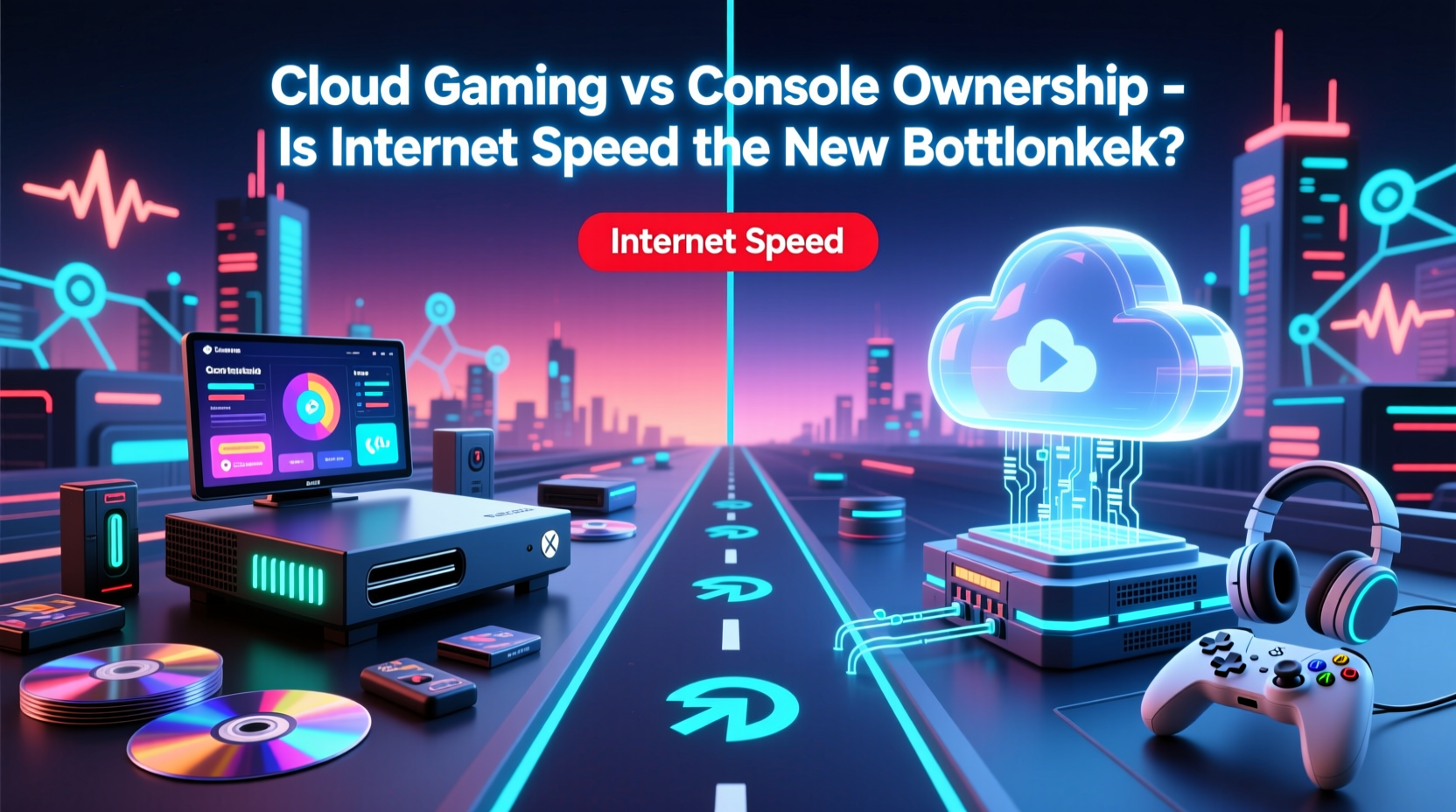
Cloud gaming operates on a simple premise: Instead of running games on local hardware, processing happens on remote servers. These servers render the game in real time and stream the video output to your device, while your inputs are sent back over the internet. This model eliminates the need for powerful GPUs and CPUs, opening doors for gamers using smartphones, tablets, or older laptops.
Platforms like Google Stadia (before its shutdown), Amazon Luna, and Microsoft’s xCloud have demonstrated that high-fidelity gaming can be delivered over IP networks. However, this convenience comes with significant trade-offs. Streaming 1080p or even 4K video at 60 frames per second requires consistent bandwidth, low latency, and minimal packet loss—all of which depend heavily on network quality.
Unlike downloading a game file once, cloud gaming consumes data continuously. A single hour of gameplay at 1080p/60fps can use up to 3–5 GB of data. For households with data caps or shared bandwidth, this quickly becomes unsustainable. Moreover, peak-hour congestion can degrade performance, turning an immersive experience into a slideshow with input lag.
Console Ownership: Predictable Performance, Upfront Investment
Traditional console ownership—exemplified by systems like the PlayStation 5, Xbox Series X, and Nintendo Switch—remains popular due to its reliability and offline capabilities. Once purchased, these devices run games locally, meaning performance depends on internal hardware rather than external network conditions.
While the initial cost ranges from $300 to $500 (or more with accessories), there are no recurring fees tied to bandwidth consumption. Gamers can play in 4K HDR at stable frame rates without worrying about Wi-Fi dropouts or ISP throttling. Updates still require downloads, but patches and installations happen once, not every time you press “Start.”
Ownership also grants long-term access. Even if online services shut down, physical discs or digital libraries remain playable (barring authentication requirements). In contrast, cloud platforms operate on subscription models—stop paying, lose access. When Google discontinued Stadia, users lost their purchased games despite promises of permanence.
“Hardware ownership gives players control. With cloud gaming, you're renting an experience that could vanish overnight.” — David Liu, Senior Analyst at GameTech Insights
Internet Speed: The Hidden Gatekeeper of Cloud Gaming
Despite advancements in compression and edge computing, internet infrastructure remains the weakest link in cloud gaming’s promise. Latency—the delay between input and response—is the most critical factor. Even with fast download speeds, high ping times make competitive gaming nearly impossible.
Consider this: In a first-person shooter, a 50ms delay might mean the difference between landing a headshot and getting eliminated. While fiber-optic networks in cities like Seoul or Tokyo support sub-10ms latency, rural areas in the U.S., Canada, and parts of Europe often struggle to maintain 50 Mbps connections, let alone low jitter and packet consistency.
Mobile networks add another layer of complexity. 5G theoretically supports ultra-low latency and high throughput, but real-world coverage is spotty. Many \"5G\" zones still rely on LTE backhaul, resulting in inconsistent performance. Playing Assassin’s Creed Valhalla on a phone via cloud may look impressive in demos—but try doing it during a commute through a tunnel.
Key Network Metrics for Optimal Cloud Gaming
| Metric | Minimum Requirement | Ideal Target | Impact on Gameplay |
|---|---|---|---|
| Download Speed | 15 Mbps | 25+ Mbps | Affects resolution and frame rate stability |
| Latency (Ping) | 40 ms | 10–20 ms | Determines responsiveness; critical for fast-paced games |
| Jitter | 30 ms | Under 10 ms | Causes stuttering and unpredictable input delay |
| Packet Loss | 1% | 0% | Results in visual artifacts and disconnections |
| Data Usage | N/A | 3–5 GB/hour (HD) | Limits playtime under capped plans |
These thresholds aren’t arbitrary—they reflect real engineering limits. Video codecs like H.265 help reduce bandwidth needs, but they can’t eliminate physics. Light travels fast, but not instantaneously. Data routed from a server hundreds of miles away will always incur propagation delay. Edge computing helps by placing servers closer to users, but deployment is expensive and uneven.
Real-World Example: Maria’s Weekend Gaming Dilemma
Maria lives in a mid-sized town in Indiana with her two kids. She works remotely and relies on her home internet for Zoom calls, streaming, and her children’s online schooling. Her current plan offers 50 Mbps download and 5 Mbps upload over cable, with occasional slowdowns during evenings.
She considered switching to Xbox Cloud Gaming to save money instead of buying a $499 console. At first, it worked well—she played Forza Horizon 5 on her tablet while her kids used laptops nearby. But by Saturday night, when everyone was online, the experience degraded. The画面 froze mid-race, controls lagged, and audio desynchronized. A firmware update later revealed she’d used 180 GB of data that month—nearly half her cap.
Frustrated, Maria returned to her old PS4. It wasn’t as powerful, but it didn’t care about network traffic. She downloaded games during off-peak hours and enjoyed uninterrupted sessions. For her household, console ownership proved more reliable despite the higher upfront cost.
Maria’s story isn’t unique. Millions face similar trade-offs where infrastructure hasn’t kept pace with digital ambitions.
Checklist: Choosing Between Cloud Gaming and Console Ownership
- Evaluate your internet stability: Run multiple speed tests at different times of day.
- Check data caps: Contact your ISP to confirm monthly limits and overage fees.
- Test latency-sensitive games: Try cloud demos of fast-paced titles like shooters or racing games.
- Compare total cost of ownership: Factor in console price, subscriptions, and potential upgrade cycles.
- Assess household usage: Determine how many devices share the network simultaneously.
- Verify service availability: Not all cloud platforms support every region or game library.
- Plan for offline access: Consider how often you play without internet (travel, outages).
Expert Insight: The Infrastructure Divide
The gap between urban and rural connectivity isn’t just inconvenient—it’s creating a digital divide in entertainment. According to the FCC, over 14 million Americans lack access to broadband (25 Mbps/3 Mbps). Globally, the situation is worse. In India, Southeast Asia, and large parts of Africa, average speeds hover below 15 Mbps, making cloud gaming impractical for most.
“We’re building a future where only those with premium internet can participate in next-gen gaming. That’s exclusionary, not innovative.” — Dr. Lena Patel, Digital Equity Researcher at MIT Connectivity Lab
Meanwhile, console manufacturers continue innovating within physical constraints. The PS5’s custom SSD reduces load times dramatically. Xbox Velocity Architecture enables dynamic asset streaming—all without relying on external networks. These advances benefit all users equally, regardless of zip code.
FAQ
Can I use Wi-Fi for cloud gaming, or do I need Ethernet?
You can use Wi-Fi, but Ethernet is strongly recommended. Modern dual-band routers help, but wireless interference from other devices, walls, and distance can cause micro-stutters and latency spikes. A wired connection provides the most stable path for real-time gaming.
Are cloud gaming subscriptions cheaper than buying a console?
Short-term, yes. A $15/month subscription seems cheaper than a $500 console. But over three years, that’s $540—more than the cost of a new system. Add in potential internet upgrades or overage charges, and savings disappear. Only consider cloud if you already have excellent internet and don’t mind losing access when subscriptions end.
Will 5G make cloud gaming viable everywhere?
Potentially, but not yet. True mmWave 5G offers gigabit speeds and ultra-low latency, but coverage is limited to small urban zones. Most “5G” today is enhanced LTE with modest improvements. Widespread, reliable mobile cloud gaming is likely five to seven years away, depending on infrastructure investment.
Conclusion: The Future Isn’t Either/Or—It’s Adaptive
The choice between cloud gaming and console ownership isn’t binary. The future likely lies in hybrid models. Microsoft, for instance, allows cross-play between local Xbox consoles and cloud streams. Sony integrates Remote Play with its ecosystem. Developers are beginning to design games with both environments in mind.
But until global internet infrastructure reaches parity with hardware innovation, network speed will remain the defining constraint. For now, owning a console guarantees performance. Cloud gaming offers flexibility—if your connection cooperates.
Rather than declaring a winner, savvy gamers should assess their individual circumstances: location, budget, internet quality, and playstyle. Technology should serve people, not the other way around. As networks improve, cloud gaming will expand. Until then, don’t underestimate the value of a machine you control, right in your living room.




 浙公网安备
33010002000092号
浙公网安备
33010002000092号 浙B2-20120091-4
Comments
No comments yet. Why don't you start the discussion?