
Choosing Christmas tree bulbs isn’t just about aesthetics—it’s a functional decision with lasting implications for ambiance, maintenance, budget, and seasonal flexibility. As LED technology has matured, two dominant categories have emerged: dynamic color-changing bulbs (often RGB or RGBW) and traditional fixed-hue LEDs (warm white, cool white, multicolor, etc.). Yet many shoppers conflate “more features” with “more value,” overlooking how usage patterns, household needs, and long-term ownership costs shape true customization value. This article cuts through marketing hype to assess what each bulb type actually delivers—not in specs, but in lived experience.
What “Customization Value” Really Means
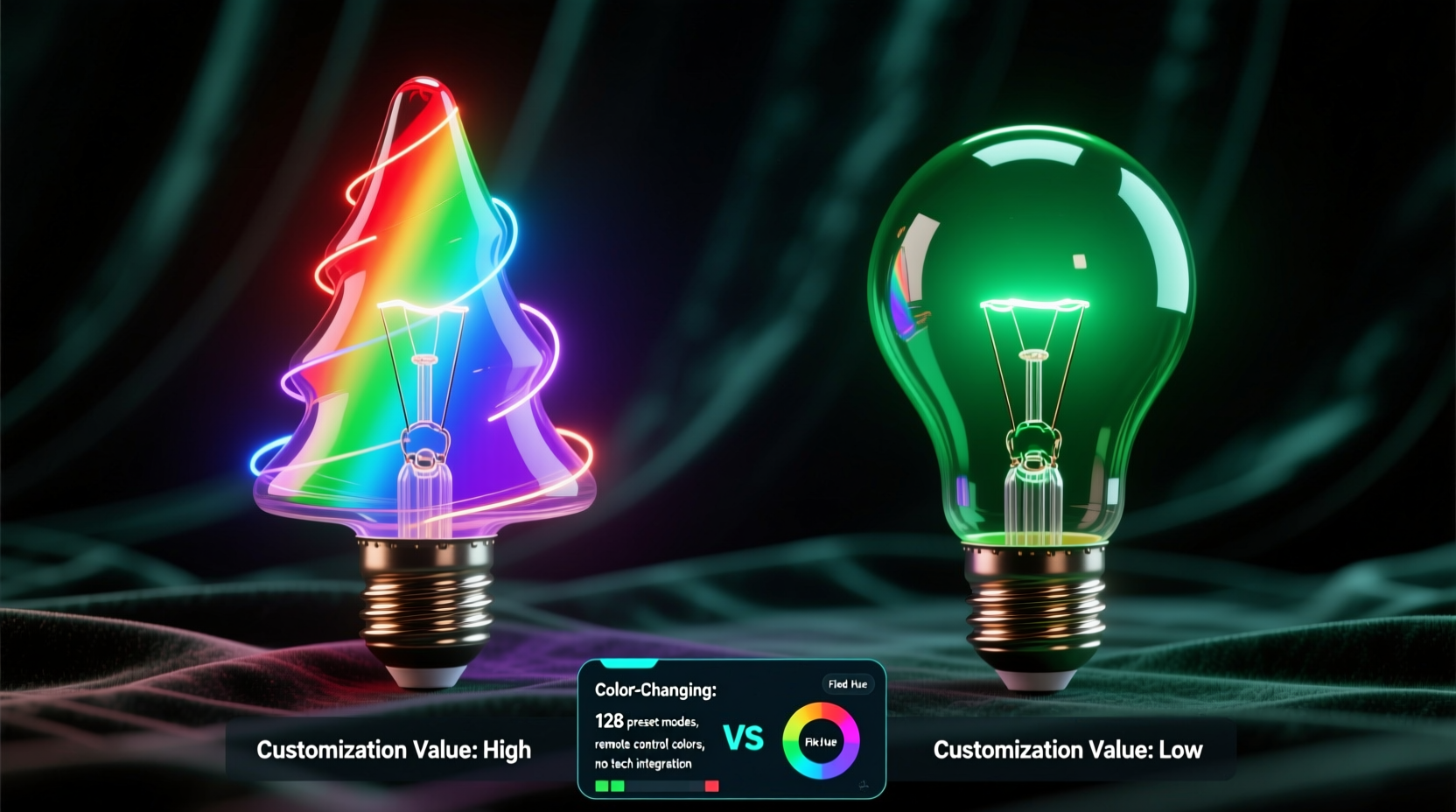
Customization value isn’t measured solely by the number of colors or modes available. It’s the ratio of meaningful control to effort, expense, and compromise. High value emerges when a feature solves a recurring need—like adapting lighting for different occasions (a quiet family dinner vs. a lively holiday party), accommodating sensitivities (e.g., migraine triggers from rapid flashing), or extending usable life across evolving decor schemes. Low value appears when complexity undermines reliability, when features go unused after the first week, or when upfront savings erode due to premature failure or energy inefficiency.
Fixed-hue bulbs excel in consistency and simplicity. Color-changing bulbs promise versatility—but only if that versatility aligns with how you actually live, decorate, and celebrate. Understanding this distinction is essential before investing in 100 bulbs—or upgrading your entire light string ecosystem.
Performance & Practicality Comparison
| Feature | Fixed-Hue Bulbs | Color-Changing Bulbs |
|---|---|---|
| Light Quality | Consistent color temperature; no perceptible flicker; high CRI options widely available (90+) | Variable CRI (often 75–85); some models exhibit subtle banding or uneven saturation, especially at low brightness |
| Control Method | None (plug-and-play) or basic on/off timer | Remote, app, voice (via smart hub), or built-in mode buttons; requires pairing, firmware updates, battery replacement |
| Lifespan (Rated Hours) | 25,000–50,000 hours (most exceed 30,000) | 15,000–30,000 hours (RGB drivers add thermal stress; early failure common in budget models) |
| Energy Use (per 100-bulb string) | 4–6 watts (warm white); 6–8 watts (multicolor fixed) | 8–14 watts (dynamic modes increase draw; chase effects consume ~2× static white) |
| Repairability | Individual bulbs easily swapped; universal E12/E17 bases; no proprietary parts | Often non-replaceable modules; sealed units; remote or controller failure renders entire string unusable |
The table reveals a foundational trade-off: fixed-hue bulbs prioritize durability, efficiency, and plug-and-play reliability. Color-changing bulbs prioritize expressive flexibility—but introduce points of failure, higher operational costs, and dependency on external systems. For households with young children, pets, or limited tech comfort, that dependency isn’t theoretical—it’s a December evening spent resetting Bluetooth connections while guests wait.
Real-World Usage Patterns: A Mini Case Study
In Portland, Oregon, the Chen family upgraded their 7-foot Nordmann fir with a premium 200-bulb RGBW string in 2022. They used the app daily for the first 12 days—cycling through “Candy Cane,” “Twilight,” and “Frost.” By December 18, they’d defaulted to “Warm White Static” and haven’t changed it since. Why? The remote batteries died twice; the app occasionally failed to detect the string; and their 8-year-old accidentally triggered “Disco Pulse” during a video call with grandparents, causing visible discomfort for her grandmother, who experiences photosensitive migraines.
In contrast, their neighbor, retired teacher Miriam Ruiz, uses three separate strings of fixed-hue bulbs: warm white for the tree, amber micro-lights for mantel garlands, and deep red mini-lights for wreaths. She rotates them yearly based on her evolving color palette—last year’s “navy and gold” scheme used the same warm white string, paired with new velvet ribbons and brass ornaments. Her bulbs, purchased in 2019, still function flawlessly. “I don’t need my lights to dance,” she says. “I need them to glow, last, and let *my* choices—not an algorithm’s—set the mood.”
This isn’t resistance to innovation—it’s evidence that customization value is deeply contextual. For the Chens, the color-changing string delivered novelty, not utility. For Miriam, fixed hues delivered enduring, adaptable elegance.
Expert Insight: Beyond the Glow
“Most consumers buy color-changing lights thinking they’re buying flexibility. In reality, they’re buying complexity—and complexity has a maintenance tax. A well-designed fixed-hue string can outlive three generations of smart bulbs. True customization lies in how thoughtfully you layer light with texture, ornament scale, and natural elements—not in how many pixels you can cycle per second.” — Dr. Lena Torres, Lighting Psychologist and Author of Illuminated Spaces: Human-Centered Light Design
Torres’ point underscores a critical oversight: lighting doesn’t exist in isolation. Its emotional impact emerges from interaction—with wood grain, wool throws, candlelight, and even ambient daylight. Fixed-hue bulbs integrate more seamlessly into layered, tactile decor because their output is stable and predictable. Color-changing bulbs, by design, compete for attention—sometimes undermining the very serenity people seek during the holidays.
Actionable Tips for Maximizing Customization Value
- Match control to your household’s rhythm: If no one checks smartphones hourly, skip app-dependent bulbs. Opt for remotes with physical buttons and clear LED feedback—or choose fixed hues and rotate strings seasonally.
- Test CRI before committing: Visit a showroom or order a single strand to observe bulbs under real indoor lighting. Low-CRI RGB often renders skin tones sallow and greenery dull—especially problematic in photos or video calls.
- Calculate total cost of ownership: Factor in replacement remotes ($12–$25), battery packs (2–4 AA/year), potential Wi-Fi extender needs, and estimated electricity cost over 5 years. Fixed-hue strings typically cost 30–50% less to operate annually.
- Consider hybrid solutions: Use fixed-hue warm white as your base layer (80% of tree coverage), then add a small accent string of color-changing bulbs—only where dynamic light enhances rather than dominates (e.g., top tier or inner branches).
- Verify dimming compatibility: Many color-changing strings dim poorly—or not at all—on standard wall dimmers. Fixed-hue LEDs almost universally support ELV/MLV dimmers. If you use dimmers, confirm compatibility before purchase.
Step-by-Step: Building a High-Value Lighting Strategy
- Assess your core aesthetic anchor: Is your decor consistently warm-toned (wood, cream, rust)? Cool-toned (gray, silver, icy blue)? Or intentionally eclectic? Fixed-hue warm white or cool white will harmonize more reliably than shifting RGB.
- Map your usage intensity: Do you host large gatherings (where dynamic light adds energy) or prefer intimate, quiet evenings (where static, gentle light supports calm)? High-intensity use favors robust fixed-hue strings; occasional-event use may justify color-changing investment.
- Evaluate your tech environment: Do you already use a compatible smart home platform (e.g., Matter-enabled hub)? Is your Wi-Fi strong near the tree? No? Choose remotes with replaceable batteries and simple pairing—not app-only models.
- Calculate bulb density and placement: For trees 6–7.5 ft tall, 300–500 total bulbs is ideal. Reserve 15–20% for accents. If using color-changing, limit them to visible zones (front-facing branches, top third)—not hidden inner layers where shifts go unnoticed.
- Order samples and test for 72 hours: Run both types simultaneously in your actual space. Observe glare, reflection on ornaments, effect on wall colors, and whether animations feel festive—or fatiguing—after repeated exposure.
FAQ
Do color-changing bulbs really save money long-term?
No—they rarely do. While LED efficiency is high across both categories, color-changing bulbs draw more power in active modes, require more frequent controller replacements, and have shorter average lifespans. A $35 fixed-hue string used for 10 seasons costs ~$3.50/year. A $45 color-changing string lasting 4 seasons averages $11.25/year—plus $20+ in remote/controller replacements and higher electricity costs.
Can I mix fixed-hue and color-changing bulbs on the same tree?
Yes—and it’s often the highest-value approach. Use fixed-hue warm white as your foundation for even, restful illumination. Then add a short section (e.g., 20–30 bulbs) of color-changing lights at the apex or wrapped around a central branch. This delivers visual interest without overwhelming cohesion or increasing system-wide failure risk.
Are there color-changing bulbs designed for accessibility?
Some newer models include “sensitivity modes” (reduced motion, slower transitions, no strobes) and physical remotes with large, tactile buttons. However, these remain niche. Fixed-hue bulbs inherently meet accessibility needs: zero motion, zero latency, zero cognitive load. For households with sensory processing differences, fixed hues are not a compromise—they’re the optimal choice.
Conclusion
Customization isn’t defined by how many colors a bulb can produce—it’s defined by how meaningfully those colors serve your life. A fixed-hue warm white string that glows softly beside your favorite armchair, unchanged for seven Decembers, holds profound value. So does a color-changing string that transforms your living room into a winter wonderland for your child’s first holiday party—provided its controls work reliably, its light feels joyful rather than jarring, and its lifespan matches your expectations. The most valuable choice isn’t the flashiest or the simplest. It’s the one that aligns with your rhythms, respects your space, and endures beyond the season’s rush.
Don’t default to novelty. Audit your habits. Test before you commit. Prioritize light quality over pixel count. And remember: the most memorable holiday moments aren’t lit by algorithms—they’re illuminated by intention.




 浙公网安备
33010002000092号
浙公网安备
33010002000092号 浙B2-20120091-4
Comments
No comments yet. Why don't you start the discussion?