
Lighting plays a pivotal role in shaping the mood, functionality, and aesthetic of any space. As technology evolves, consumers are no longer limited to simple on/off switches or static hues. Today’s market offers two dominant decorative lighting options: color-changing smart bulbs and fixed-color LED string lights. While both enhance ambiance, their flexibility, control, and adaptability vary significantly. Understanding these differences helps homeowners, renters, and event planners choose the right solution for their needs.
The core distinction lies in customization. Color-changing smart bulbs offer dynamic control over hue, brightness, timing, and even synchronization with music or routines. Fixed-color string lights, while reliable and often more affordable, deliver a consistent tone—ideal for permanent installations or seasonal decor. But when it comes to true flexibility, one clearly outshines the other.
Understanding Flexibility in Lighting
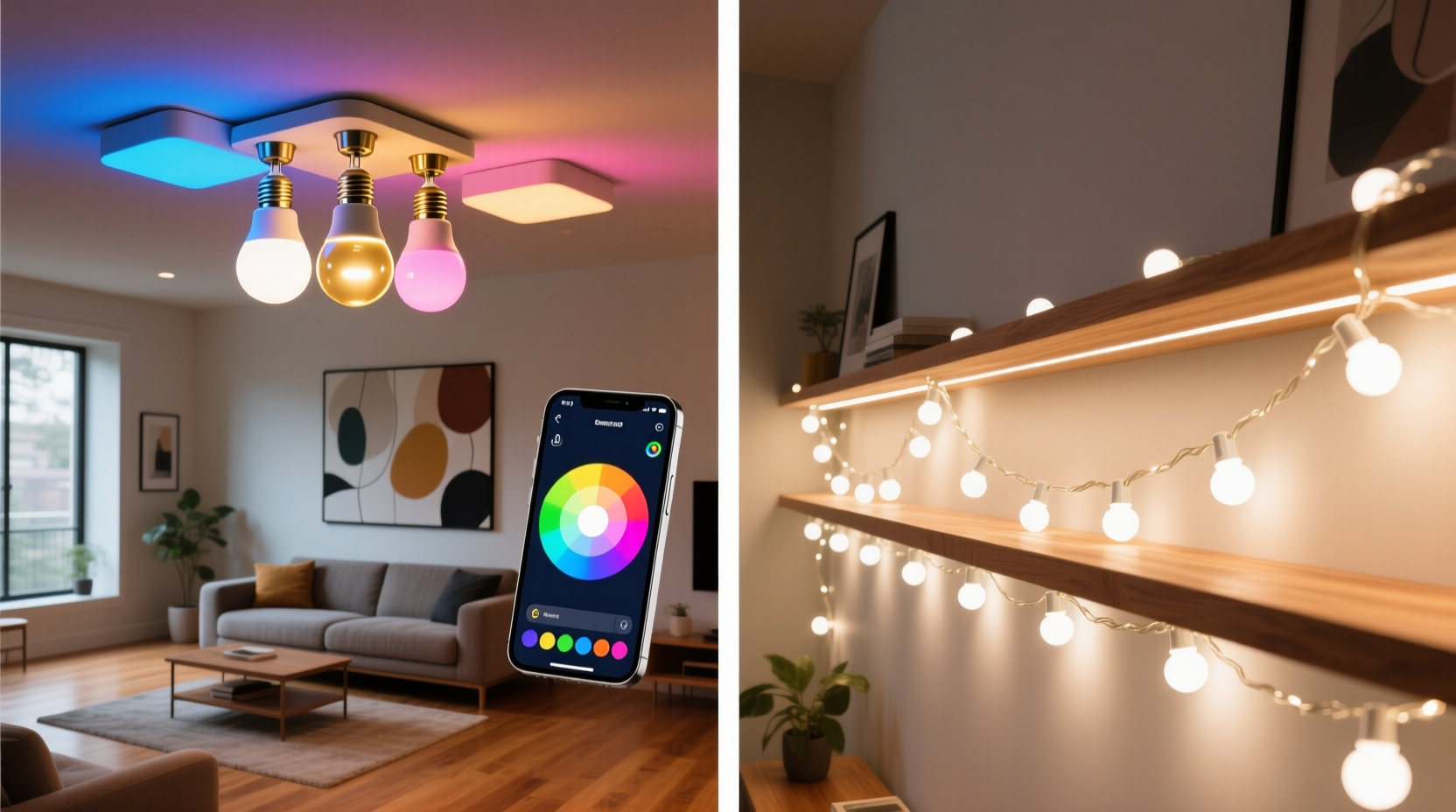
Flexibility in lighting refers to the ability to adapt illumination to different times, moods, activities, and environments. A flexible lighting system allows users to:
- Adjust color temperature (warm white to cool daylight)
- Switch between thousands of RGB colors
- Control brightness levels remotely
- Schedule changes based on time or events
- Integrate with smart home ecosystems
- Create scenes for entertainment, relaxation, or productivity
Fixed-color string lights fulfill only a fraction of this potential. They provide charm and consistency but lack responsiveness. In contrast, smart bulbs transform lighting into an interactive experience. Their programmability enables shifts from energizing morning blues to calming evening ambers—all without replacing a single bulb.
Feature Comparison: Smart Bulbs vs Fixed-Color Strings
To evaluate flexibility objectively, consider key performance categories. The table below outlines how each option performs across essential metrics.
| Feature | Color-Changing Smart Bulbs | Fixed-Color String Lights |
|---|---|---|
| Color Range | 16 million colors + white spectrum | Single color (e.g., warm white, blue, multicolor) |
| Brightness Control | Dimmable via app, voice, or automation | Often non-dimmable; some have basic dimmers |
| Remote Access | Yes – smartphone, tablet, or web interface | No – manual switch or plug timer only |
| Scheduling & Automation | Full support (sunrise/sunset, routines, geofencing) | Limited to mechanical timers |
| Voice Assistant Integration | Compatible with Alexa, Google Assistant, Siri | Not applicable |
| Installation Complexity | Requires Wi-Fi setup and app configuration | Plug-and-play; minimal setup |
| Cost per Unit | Higher initial investment ($15–$30 per bulb) | Lower cost ($5–$15 per strand) |
| Lifespan | 15,000–25,000 hours | 20,000–50,000 hours (LED dependent) |
| Use Case Adaptability | High – suitable for daily living, parties, therapy, workspaces | Low – best for themed decor or accent lighting |
This comparison underscores a fundamental truth: smart bulbs are built for evolution. They respond to user behavior, environmental cues, and emotional needs. Fixed-color strings serve a singular purpose—they look good doing one thing well. But they cannot pivot when needs shift.
Real-World Applications and Scenarios
Flexibility becomes most apparent in everyday situations where lighting demands change rapidly. Consider the following mini case study.
Mini Case Study: The Urban Apartment Host
Jamal lives in a downtown studio apartment he uses as both a home office and social space. On weekdays, he works remotely and prefers bright, cool-white lighting to stay alert. By Friday evening, the same room transforms into a lounge for friends. He wants soft purple ambient lighting synced to music during gatherings.
With fixed-color string lights—say, warm white—he’d need multiple sets to accommodate different moods. Switching would mean unplugging one strand and plugging in another, disrupting flow and cluttering outlets.
Instead, Jamal installs four color-changing smart bulbs in pendant fixtures around the room. Using his phone, he creates three presets:
- Focus Mode: 5000K daylight white at 80% brightness
- Relax Mode: 2700K warm amber at 30%
- Party Mode: RGB pulse effect in deep violet and indigo, synced to beat detection
He schedules Focus Mode to activate at 8 AM on weekdays and Relax Mode to fade in at 7 PM. Voice commands let him switch scenes instantly. No rewiring. No extra hardware. Just seamless adaptation.
In this scenario, smart bulbs aren’t just convenient—they enable a multifunctional lifestyle within constrained physical space. Fixed-color strings could never match that level of responsiveness.
Expert Insight: Why Dynamic Lighting Matters
The benefits of flexible lighting extend beyond convenience. Experts in wellness and environmental design emphasize its psychological impact.
“Dynamic lighting influences circadian rhythms, mood regulation, and cognitive performance. Being able to shift from stimulating to soothing light throughout the day supports mental health and productivity.” — Dr. Lena Torres, Environmental Psychologist and Lighting Research Fellow, MIT Media Lab
Dr. Torres’ research highlights how exposure to cooler, blue-enriched light in the morning suppresses melatonin and increases alertness—similar to natural daylight. As evening approaches, warmer tones signal the body to prepare for rest. This kind of rhythm is impossible to achieve with fixed-color lights unless manually replaced multiple times a day.
Smart bulbs automate this biological alignment. Some models even sync with local sunrise and sunset data, gradually adjusting color temperature without user input. This passive intelligence makes them not just flexible, but intuitively adaptive.
Step-by-Step Guide to Choosing the Right Option
Selecting between smart bulbs and fixed-color strings depends on your priorities. Follow this decision timeline to determine the best fit.
- Assess Your Primary Use Case
Are you decorating for a holiday, wedding, or permanent fixture? Temporary or thematic displays favor fixed-color strings. Daily-use rooms (living room, bedroom, office) benefit from smart bulbs. - Evaluate Control Needs
Do you want to adjust lighting from your couch or while away from home? If yes, smart bulbs are essential. If a wall switch or timer suffices, fixed strings may be adequate. - Check Compatibility
Ensure your router supports 2.4 GHz Wi-Fi (required by most smart bulbs). Confirm integration with existing smart assistants (Alexa, Google Home, Apple HomeKit). - Budget for Long-Term Value
While smart bulbs cost more upfront, their versatility reduces the need for multiple lighting products. Calculate long-term savings in replacement costs and energy efficiency. - Test a Single Fixture First
Install one smart bulb before committing to a full rollout. Use it for a week to gauge satisfaction with app performance, responsiveness, and light quality.
When Fixed-Color Strings Still Make Sense
Despite their limitations, fixed-color string lights retain value in specific contexts. They excel when:
- Cost is a major constraint: Renters or students may not afford smart systems.
- Decor is seasonal: Christmas, Diwali, or Halloween displays rarely require mid-event adjustments.
- Simplicity is preferred: Elderly users or tech-averse individuals benefit from plug-and-forget operation.
- Outdoor durability matters: Many fixed strands are fully weatherproof and don’t rely on wireless signals vulnerable to interference.
For example, a porch draped in classic warm-white fairy lights creates timeless curb appeal. There's no need to change the color weekly—consistency enhances charm. In such cases, fixed strings are not inferior; they're appropriately matched to the goal.
Frequently Asked Questions
Can I mix smart bulbs with fixed-color strings?
Yes, many people combine both. Use smart bulbs for primary lighting and fixed strings for accent decor. Just ensure circuits and outlets can handle combined wattage. Control each system separately unless using a smart plug for the string lights.
Do smart bulbs work during power outages?
No—like all connected devices, they require electricity. However, if paired with a UPS (uninterruptible power supply), they can remain operational briefly during short outages. Fixed strings behave the same way unless powered by batteries.
Are color-changing bulbs harder to install?
Physically, installation is identical to standard bulbs—screw in and power on. The added step is connecting to Wi-Fi via an app. Most manufacturers provide clear tutorials, and setup typically takes under 10 minutes per bulb.
Final Checklist Before You Buy
Use this checklist to ensure you select the most flexible and suitable lighting for your needs:
- ✅ Define the room’s primary function (work, relax, entertain)
- ✅ Determine whether color variability adds value
- ✅ Verify Wi-Fi strength in the installation area
- ✅ Check bulb base type (E26, E12, GU10, etc.)
- ✅ Confirm compatibility with dimmer switches (if used)
- ✅ Decide between standalone control or full smart home integration
- ✅ Read reviews for app reliability and customer support
Conclusion: Flexibility Wins for Modern Living
While fixed-color string lights have nostalgic appeal and practical simplicity, color-changing smart bulbs offer unmatched flexibility. They adapt to lifestyles, support well-being, integrate with technology, and eliminate the need for multiple lighting products. For anyone seeking a responsive, intelligent environment—whether in a studio apartment, family home, or creative workspace—smart bulbs are the superior choice.
The future of lighting isn’t just about brightness; it’s about intentionality. It’s about creating spaces that breathe with your rhythm. With smart bulbs, every evening can feel different without changing a wire. That’s not just convenience—it’s transformation.




 浙公网安备
33010002000092号
浙公网安备
33010002000092号 浙B2-20120091-4
Comments
No comments yet. Why don't you start the discussion?