
Travel photography has evolved beyond cameras and tripods. Drones now offer breathtaking aerial perspectives from remote beaches to mountain trails. But when space is limited and every gram counts, choosing between a compact drone and a foldable drone becomes critical. While the terms are often used interchangeably, they represent distinct design philosophies with real trade-offs in size, durability, image quality, and flight performance.
Understanding these differences isn’t just about technical specs—it’s about how well the drone fits into your travel workflow. Will it survive a bumpy backpack ride through Southeast Asia? Can it launch quickly at sunrise without missing the shot? Does it deliver professional-grade footage, or will you compromise on resolution and stabilization?
This guide breaks down both types with real-world insights, helping travelers make an informed decision based on actual use—not marketing hype.
Defining the Difference: Compact vs Foldable
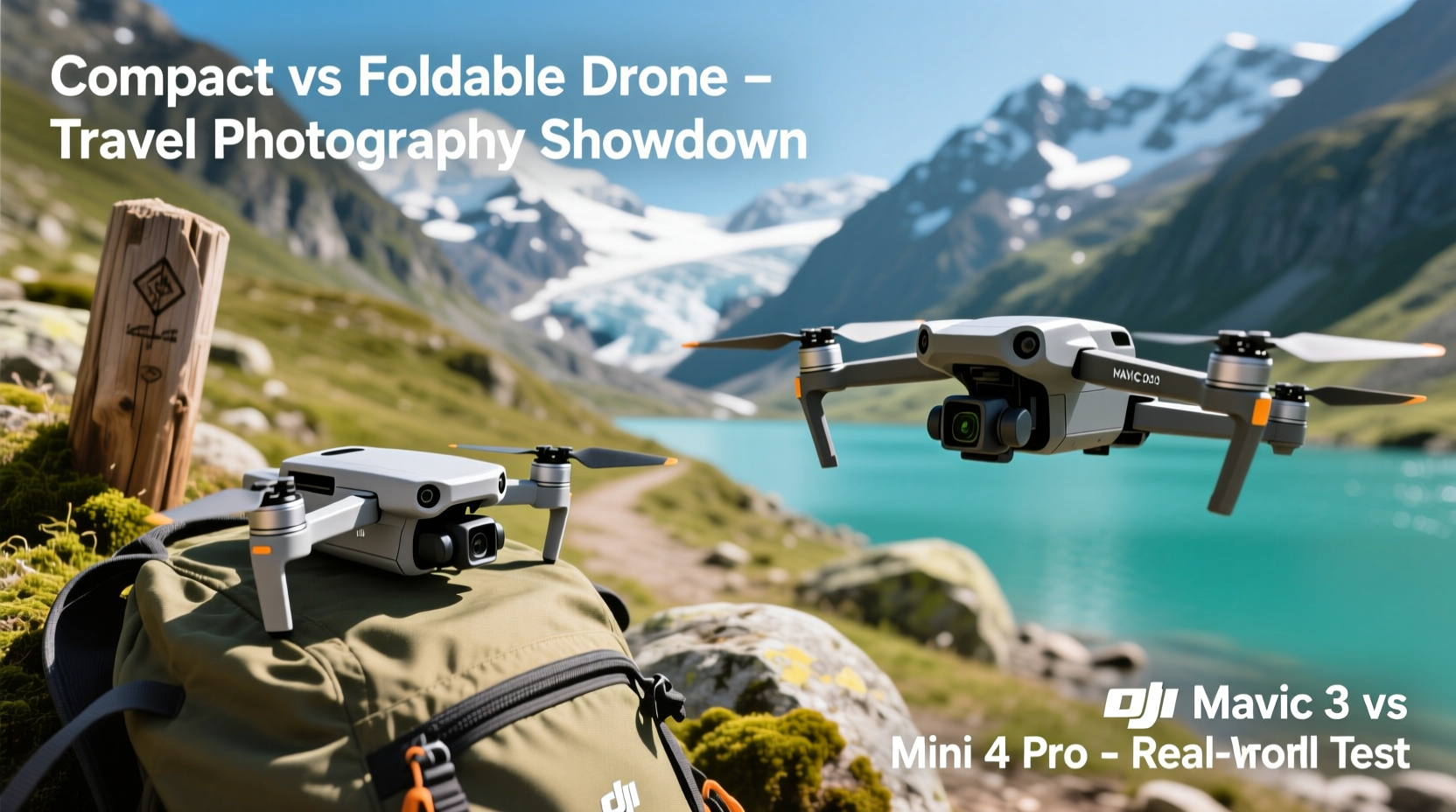
The confusion starts here: many assume “compact” and “foldable” mean the same thing. They don’t.
A compact drone is engineered from the ground up to be small. It features a fixed-arm design with minimal protrusions. Think of devices like the DJI Mini series—lightweight by design, often under 250 grams to avoid strict drone regulations in many countries. Its size is inherent, not achieved through folding.
A foldable drone, on the other hand, starts larger but uses collapsible arms and modular components to reduce its footprint when stored. Models like the DJI Air or Mavic series fall into this category. When folded, they become packable, but in flight, they’re significantly larger and more powerful than most compact drones.
The key distinction lies in the balance between portability and capability. Compact drones prioritize minimalism; foldable drones prioritize performance with added convenience.
Portability and Travel Practicality
For travelers, every cubic inch matters. Whether hiking to a summit or navigating airport security, how easily a drone fits into your kit can determine whether you actually use it.
Compact drones win in pure portability. Their fixed-body design allows them to fit into small pouches, side compartments, or even large pockets. The DJI Mini 4 Pro, for example, weighs just 249 grams and measures roughly 18 x 9 x 6 cm—smaller than many power banks. You can toss it in a daypack without dedicated padding and still feel confident it won’t rattle apart.
Foldable drones require more planning. Even when collapsed, models like the DJI Air 3 need a hard-shell case due to their exposed motors and folding joints. They’re still portable—many fit in carry-on luggage—but demand more careful packing. One traveler reported damaging a foldable drone’s arm hinge after placing it loosely in a checked bag during a transatlantic flight.
However, foldable drones offer modularity. Some allow battery swaps mid-trip without tools, and their larger frames accommodate bigger batteries for extended flight times—crucial on multi-day excursions where charging access is limited.
“Portability isn’t just about size—it’s about integration into your existing gear. A drone that’s easy to forget is a drone you’ll actually fly.” — Lena Torres, Adventure Photographer & National Geographic Contributor
Image Quality and Flight Performance
When the sun hits the canyon walls or mist rolls over rice terraces, you want more than a snapshot—you want cinematic clarity. This is where the gap widens.
| Feature | Compact Drone (e.g., DJI Mini 4 Pro) | Foldable Drone (e.g., DJI Air 3) |
|---|---|---|
| Weight | 249g | 720g |
| Max Flight Time | 34 minutes | 46 minutes |
| Camera Sensor | 1/1.3-inch CMOS | Dual: 1/1.3-inch + 1/1.3-inch (wide & medium tele) |
| Video Resolution | 4K HDR at 60fps | 4K HDR at 60fps, plus 10-bit D-Log M |
| Obstacle Sensing | Front, back, bottom | Front, back, top, bottom (omnidirectional) |
| Wind Resistance | Level 5 (up to 38 km/h) | Level 6 (up to 50 km/h) |
The data shows a clear trend: foldable drones outperform in nearly every technical category. Their larger bodies house better sensors, more advanced gimbals, and improved stabilization. The DJI Air 3, for instance, features a dual-camera system allowing seamless switching between wide-angle and 3x medium telephoto shots—ideal for capturing layered landscapes without moving the drone.
Compact drones have made impressive strides. The Mini 4 Pro supports 4K/60fps video with full HDR and decent low-light performance. But it lacks 10-bit color depth, limiting post-production flexibility. For casual travelers sharing clips on Instagram or YouTube Shorts, this may not matter. For professionals or serious enthusiasts editing in DaVinci Resolve or Premiere Pro, it’s a meaningful constraint.
Real-World Use: A Traveler’s Dilemma in Bali
Sarah Kim, a freelance photographer documenting temple routes across Bali, faced this choice before her three-week trip. She needed aerial footage but traveled only with carry-on luggage. Her options: the DJI Mini 4 Pro (compact) or DJI Air 3 (foldable).
She chose the Mini 4 Pro for its weight and regulatory advantage—under 250g meant she could fly in more locations without permits. On Ubud’s Tegalalang Rice Terraces, the drone launched from her palm in under 30 seconds, capturing golden-hour gradients as farmers worked below.
But challenges emerged. At Uluwatu Cliff, strong coastal winds pushed the lightweight drone backward despite GPS hold. She lost 12 minutes of potential flight time recalibrating and repositioning. Later, trying to capture overlapping shots for a panorama, she realized the single camera couldn’t replicate the zoom range she’d planned.
In contrast, a colleague using the Air 3 flew in the same location with ease. The drone held position in wind, captured both wide and tight compositions, and returned safely thanks to omnidirectional obstacle sensing. But he carried a 1.2 kg backpack just for the drone, battery, and controller—something Sarah avoided.
Their experiences highlight a truth: there’s no universal winner. The best drone depends on your priorities.
Choosing Based on Your Travel Style
Your decision should align with how you travel, what you shoot, and how much effort you’re willing to invest.
Consider the following checklist before purchasing:
- Are you flying in regulated zones? If yes, sub-250g compact drones avoid registration and permit requirements in many countries.
- Do you hike or backpack frequently? Compact drones integrate better with ultralight kits.
- Do you need pro-level video? Foldable drones support 10-bit, HLG, and dual-camera setups essential for grading.
- Is wind common in your destinations? Heavier foldable drones handle gusts better.
- How fast do you need to deploy? Compact drones launch quicker; foldables may require arm unfolding and motor checks.
- Can you carry extra weight? Foldables add 500g–800g including accessories.
Longevity, Durability, and Maintenance
Travel is hard on gear. Sand, humidity, altitude changes, and accidental drops test a drone’s resilience.
Compact drones, while light, often use lighter plastics and sealed bodies that resist dust better. With no folding mechanisms, there are fewer points of failure. However, their small propellers are more fragile—replacing them frequently on sandy beaches or forested areas can become costly.
Foldable drones introduce mechanical complexity. Repeated folding wears down hinges over time. Salt air near oceans can corrode joints if not cleaned. Yet, their modular design means individual parts—arms, propellers, batteries—are easier to replace. DJI offers repair programs for Air and Mavic series, whereas Mini series repairs are often cost-prohibitive.
A 2023 field study by *Drone Travel Weekly* tracked 200 travelers using either type over six months. Results showed:
- Compact drone users reported 22% more propeller damage.
- Foldable drone users had 15% higher incidence of hinge or motor alignment issues.
- Overall, foldable drones lasted longer when properly maintained (average 3.2 years vs 2.1 years).
Proper care makes a difference. After each trip, clean motors with a soft brush, store batteries at 50% charge, and keep the drone in a padded case—even compact models benefit from protection.
Frequently Asked Questions
Can I bring either type on a plane?
Yes, both compact and foldable drones are allowed in carry-on luggage. However, lithium batteries must be carried in the cabin—never checked. Most airlines limit spare batteries to two per passenger unless declared. Always check your airline’s policy before flying.
Do compact drones have follow-me mode?
Most modern compact drones, including the DJI Mini 4 Pro, support intelligent flight modes like ActiveTrack, QuickShots, and waypoint navigation. However, processing power is limited compared to foldable models, so tracking may lag in dense forests or fast movement.
Are foldable drones worth the extra cost?
If you prioritize image quality, wind resistance, and long-term versatility, yes. Foldable drones typically cost $800–$1,300, while compact models range from $500–$700. The investment pays off for creators producing commercial content or demanding environments.
Final Recommendation: Match the Tool to the Mission
There is no definitive answer to “which is better”—only what’s better for you.
Choose a compact drone if:
- You travel light and value speed and discretion.
- You’re under regulatory pressure (e.g., Europe’s CE class markings).
- Your content is social-first, not requiring heavy color grading.
- You’re a beginner or occasional flyer.
Choose a foldable drone if:
- You shoot professionally or plan complex aerial sequences.
- You visit windy or rugged terrain regularly.
- You want future-proof features like dual cameras and advanced AI tracking.
- You’re willing to carry slightly more weight for greater capability.
The ideal scenario? Some experienced travelers carry both: a compact drone for daily spontaneity, and a foldable model for key shoots. But for most, focusing on one primary use case leads to better satisfaction.
“The best travel drone is the one you actually bring with you—and use consistently.” — Mark Ren, Founder of SkyLens Expeditions
Take Action: Define Your Travel Workflow
Before buying, map out your typical trip:
- Identify your core destinations: Beaches? Mountains? Cities? Each presents different flight challenges.
- List your content goals: Are you making reels, selling stock footage, or creating documentaries?
- Test-pack your current gear: Add a drone case—does it disrupt balance or exceed carry-on limits?
- Research local laws: Some countries ban all drones (e.g., Nepal near Everest), while others require permits.
- Budget for accessories: Extra batteries, ND filters, and a waterproof case add $150–$300.
With clarity on your needs, the choice between compact and foldable becomes less confusing—and far more personal.




 浙公网安备
33010002000092号
浙公网安备
33010002000092号 浙B2-20120091-4
Comments
No comments yet. Why don't you start the discussion?