
Travel photography demands a balance between performance and portability. Whether capturing golden-hour landscapes in Morocco or street scenes in Tokyo, your camera must deliver sharp, vibrant images without weighing you down. For years, DSLRs dominated this space with their optical viewfinders and robust build. But the rise of mirrorless technology has shifted the landscape. Today’s compact mirrorless cameras offer impressive image quality in smaller bodies, challenging the long-standing reign of DSLRs. Choosing between them isn’t just about specs—it’s about how each fits into the rhythm of travel.
Size, Weight, and Portability
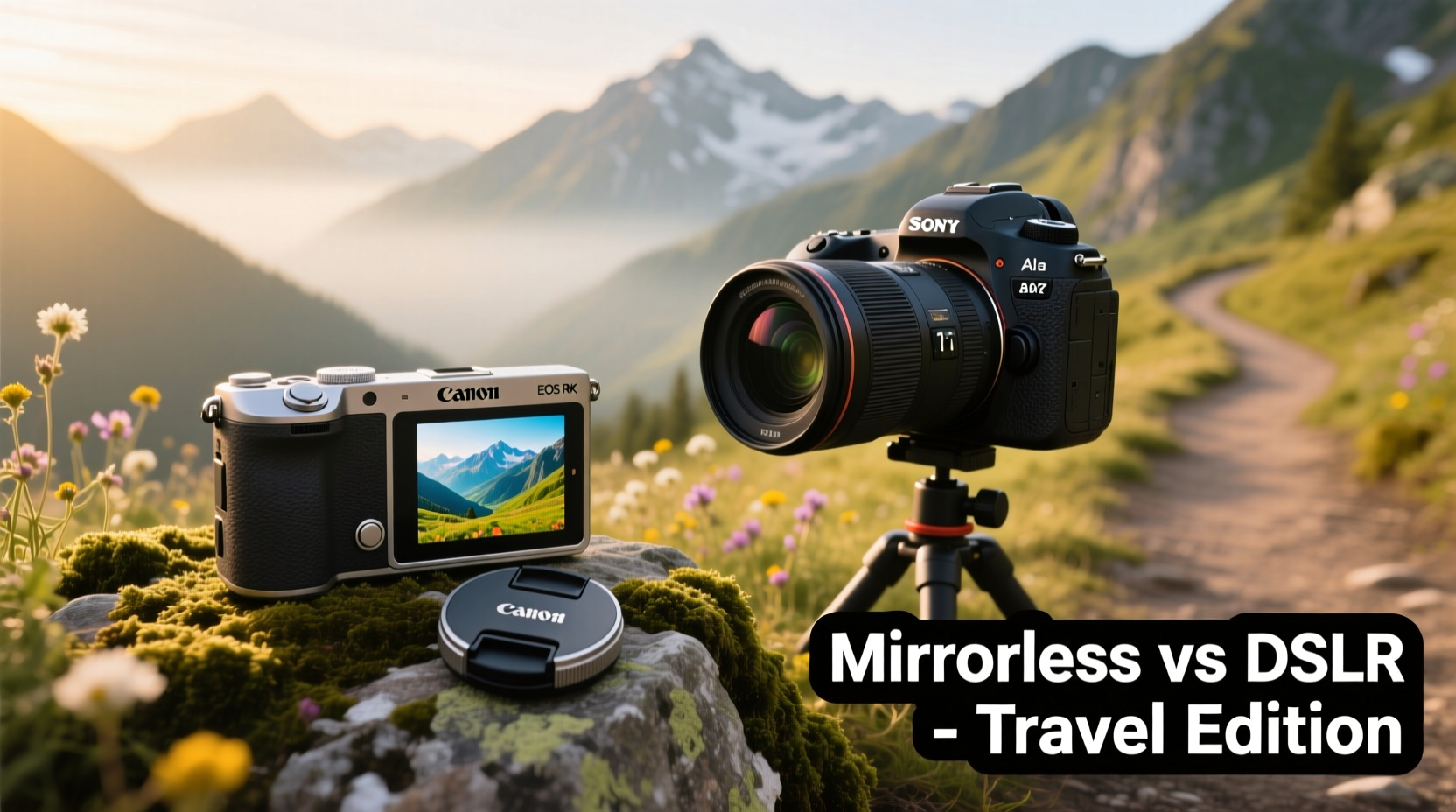
When you’re navigating cobblestone alleys, hiking mountain trails, or squeezing through crowded markets, every ounce counts. Mirrorless cameras have redefined what’s possible in terms of compactness. Without the mirror box and optical viewfinder mechanism, mirrorless systems are inherently smaller and lighter. A typical entry-level mirrorless body like the Sony ZV-E10 or Fujifilm X-T30 II weighs under 400 grams—nearly half the weight of a Canon EOS 90D or Nikon D7500 DSLR.
Lenses also play a crucial role. Mirrorless manufacturers now produce pancake lenses and compact zooms that maintain high optical quality while minimizing bulk. The Fujinon XF 27mm f/2.8, for example, is barely larger than a lens cap and delivers excellent sharpness for street photography.
DSLRs, on the other hand, remain bulkier due to their internal mechanics. While they offer ergonomic grips and durable magnesium alloy bodies—beneficial for extended shooting—they demand more space in your backpack and add fatigue over long days.
Image Quality and Sensor Performance
Both mirrorless and DSLR cameras now commonly feature APS-C or full-frame sensors, meaning there’s little difference in image quality at the same sensor size. A full-frame mirrorless camera like the Sony A7C produces files indistinguishable from a full-frame DSLR like the Canon EOS 6D Mark II under identical lighting and lens conditions.
Where differences emerge is in low-light performance and dynamic range. Modern mirrorless models often include advanced image processors and backside-illuminated sensors that capture more light, giving them an edge in dim environments—common during early mornings or indoor temple visits. The Sony A7 IV, for instance, offers clean ISO 6400 shots, making handheld night photography viable.
DSLRs still perform admirably, especially mid-tier models with large pixels and mature noise reduction algorithms. However, their phase-detection autofocus systems are limited to the dedicated AF sensor, which can struggle in near-darkness compared to mirrorless contrast-detection systems that cover nearly the entire frame.
“Mirrorless cameras have closed the gap in durability and surpassed DSLRs in low-light responsiveness—critical for spontaneous travel moments.” — Lena Torres, Travel Photographer & National Geographic Contributor
Autofocus and Real-Time Tracking
One of the most transformative advantages of mirrorless systems is their autofocus capability. With on-sensor phase detection and AI-driven subject recognition, mirrorless cameras can track eyes, faces, animals, and even birds mid-flight. The Panasonic Lumix S5 II uses Deep Learning AF to lock onto a moving cyclist in a festival parade and maintain focus across frames—a task that would require constant manual adjustment on most DSLRs.
DSLRs rely on a separate autofocus module beneath the mirror, limiting coverage to a central cluster of points. While high-end models like the Canon EOS-1D X III offer wide-area AF, entry and mid-level DSLRs often force recomposition after focusing, slowing response time during fast-paced scenes.
For travel photographers capturing candid moments—children laughing, street performers, wildlife—the speed and accuracy of mirrorless autofocus reduce missed shots significantly.
Autofocus Comparison: Mirrorless vs DSLR
| Feature | Mirrorless | DSLR |
|---|---|---|
| AF Coverage | Up to 90% of frame | 30–60%, center-biased |
| Eye/Face Detection | Standard in most models | Limited or absent |
| Low-Light AF | Down to -6 EV | Typically -3 to -1 EV |
| Tracking Accuracy | High (AI-based) | Moderate (predictive) |
Battery Life and Power Management
This is where DSLRs still hold a clear advantage. Their optical viewfinders consume no power, allowing some models to shoot over 1,000 frames per charge. The Nikon D850, for example, manages around 1,840 shots with a single EN-EL15b battery.
Mirrorless cameras, by contrast, rely on electronic viewfinders (EVFs) and rear LCDs, both of which drain batteries quickly. The Sony A7C offers roughly 540 shots per charge—less than a third of the D850. Frequent EVF use in bright sunlight further reduces this.
Travelers must adapt. Carrying spare batteries is essential with mirrorless systems. Some newer models support USB-C charging, allowing you to top up using portable power banks—an increasingly common solution on long trips.
Lens Ecosystem and Flexibility
A camera is only as capable as its lenses. DSLRs benefit from decades of lens development. Canon EF and Nikon F mounts offer hundreds of affordable, third-party options—from ultra-wide fisheyes to super-telephoto primes. If you already own DSLR glass, transitioning to mirrorless may require adapters or new investments.
Mirrorless systems are catching up fast. Sony’s E-mount, Fujifilm’s X-mount, and Canon’s RF lineup now include compact, high-performance lenses tailored for travel. The RF 24-105mm f/4L IS USM is a favorite among globe-trotters for its versatility and weather sealing.
However, some mirrorless telephoto lenses remain expensive and bulky. The Sony FE 70-200mm f/2.8 GM II is optically superb but costs over $2,000 and requires a tripod collar—hardly ideal for minimalist travelers.
Real-World Example: Iceland Expedition
Sophie Nguyen, a landscape photographer documenting Iceland’s highlands, tested both systems over a two-week trek. She carried a Nikon D7500 with a 16-80mm lens and later switched to a Fujifilm X-S10 with a 16-55mm f/2.8.
“The DSLR felt sturdy in freezing rain, and I got incredible battery life,” she said. “But the Fujifilm was half the weight, and its IBIS (in-body stabilization) let me shoot handheld waterfalls at 1/4 second. I didn’t miss the optical viewfinder once.”
In the end, she chose the mirrorless setup for future trips, citing reduced fatigue and faster setup times as decisive factors—even though she had to carry two extra batteries.
Step-by-Step: Choosing Your Travel Camera
Follow this decision-making process to determine the best system for your needs:
- Assess your travel style: Do you hike long distances or stay in cities? Backpackers benefit more from lightweight gear.
- Evaluate your current gear: If you already own DSLR lenses, consider whether adapting them to mirrorless makes financial sense.
- Determine priority features: Is battery life non-negotiable, or do you value autofocus speed and video capabilities?
- Test handling: Visit a store to feel the ergonomics. A small camera may be hard to grip with cold gloves; a large DSLR might deter street photography.
- Plan for expansion: Choose a system with a growing lens catalog so you can upgrade without switching platforms.
Checklist: Mirrorless vs DSLR Decision Guide
- ✅ Need maximum portability? → Mirrorless
- ✅ Shooting in low light frequently? → Mirrorless (better EVF, superior AF)
- ✅ Want longest battery life? → DSLR
- ✅ Already invested in DSLR lenses? → Consider staying with DSLR or using adapters
- ✅ Prioritize video quality? → Mirrorless (most offer 4K, advanced stabilization)
- ✅ Prefer optical viewfinder clarity? → DSLR
- ✅ Traveling for weeks without charging access? → DSLR
FAQ
Can I use my old DSLR lenses on a mirrorless camera?
Yes, with the right adapter. Brands like Canon (EF to RF), Nikon (F to Z), and Sony (A-mount to E-mount) offer official adapters that maintain autofocus and aperture control. Third-party options exist but may lack reliability.
Do mirrorless cameras overheat during travel?
Some models, especially when recording 4K video in hot climates, can overheat. Cameras like the Fujifilm X-T5 include heat-dissipating structures, while others like older Sony Alphas have been known to shut down after 30 minutes of continuous recording. Check user reviews for thermal performance before buying.
Is a smartphone enough for travel photography?
Modern smartphones excel in convenience and computational photography, but they lack manual controls, interchangeable lenses, and dynamic range. For serious travel work—especially in variable lighting or when printing large—dedicated cameras still outperform phones.
Conclusion
The choice between a compact mirrorless camera and a DSLR for travel photography ultimately hinges on trade-offs: size versus battery, innovation versus familiarity, agility versus endurance. Mirrorless systems win in portability, autofocus intelligence, and video capability—ideal for most modern travelers who value spontaneity and ease of movement. DSLRs remain relevant for those who prioritize optical viewfinders, longer battery life, and legacy lens compatibility.
There’s no universal winner. But as mirrorless technology matures and ecosystems expand, the momentum is clearly shifting. For new buyers, mirrorless offers a future-proof path. For DSLR loyalists, upgrading doesn’t mean abandoning quality—it means gaining freedom.




 浙公网安备
33010002000092号
浙公网安备
33010002000092号 浙B2-20120091-4
Comments
No comments yet. Why don't you start the discussion?