
In dimly lit restaurants, evening cityscapes, or indoor events without flash, capturing a sharp, noise-free photo is a challenge. As smartphone cameras grow more advanced, many assume they’ve surpassed dedicated compact mirrorless cameras in low light. But does computational photography truly outperform optical advantages? The answer isn’t binary—it depends on how you define “sharper” and what kind of lighting conditions you typically shoot in.
While smartphones use AI-driven stacking, noise reduction, and multi-frame blending to simulate clarity, mirrorless cameras rely on larger sensors, faster lenses, and superior dynamic range. This article breaks down the technical and practical differences between compact mirrorless cameras and modern smartphones when it comes to low-light photography, helping you understand which device actually captures sharper images under challenging lighting.
Sensor Size and Light Gathering: The Core Advantage
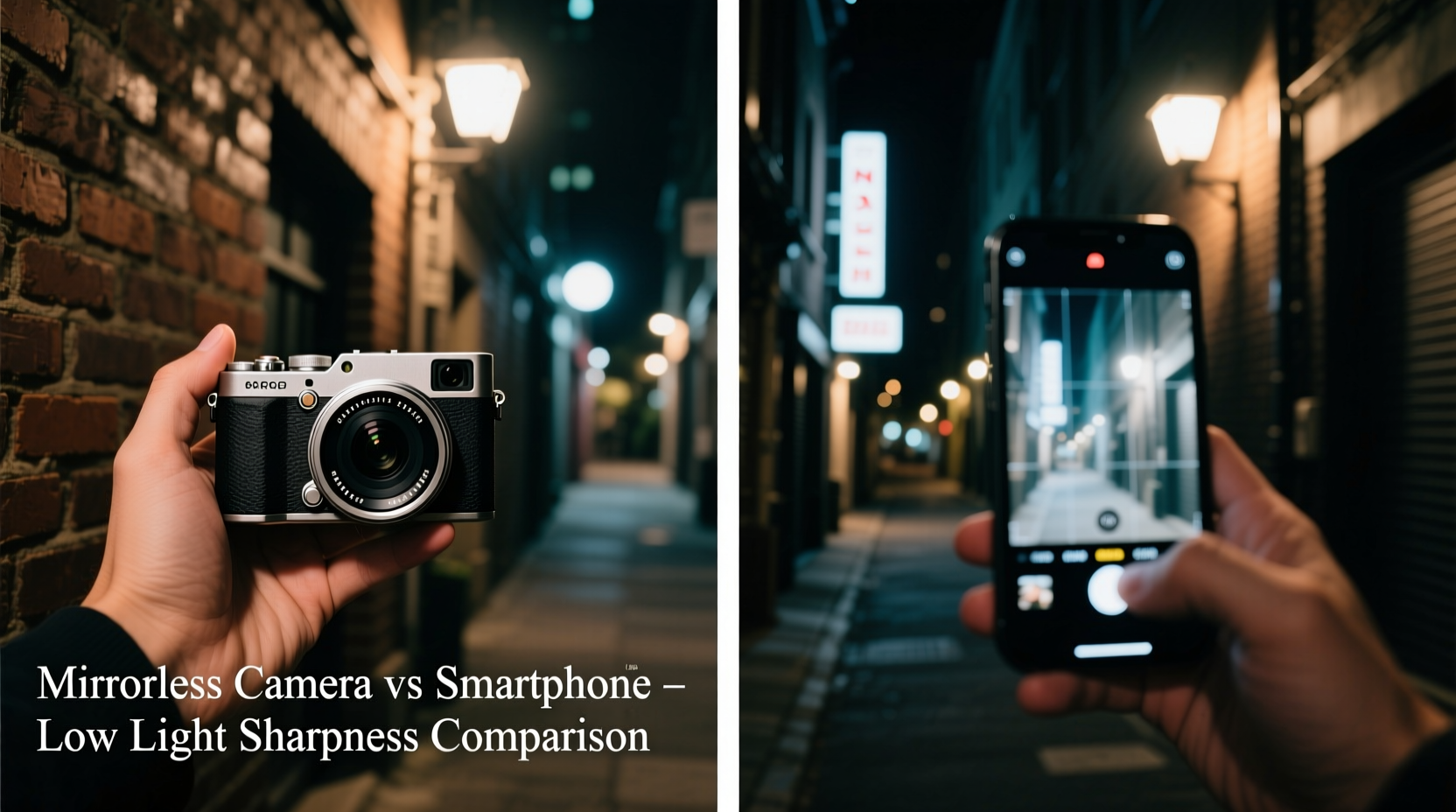
The fundamental reason mirrorless cameras often outperform smartphones in low light lies in their sensor size. Even the smallest APS-C sensor found in compact mirrorless models like the Fujifilm X-S10 or Sony a6100 is significantly larger than any smartphone sensor. For example:
- A typical smartphone sensor measures around 1/1.3 inches (approx. 9.7mm diagonal).
- An APS-C mirrorless sensor measures about 28.4mm diagonally—nearly three times larger.
Larger sensors collect more photons, which translates directly into better signal-to-noise ratio. This means less digital noise, finer detail retention, and cleaner shadows—all critical for image sharpness in dark environments.
Smartphones attempt to compensate with pixel binning—combining data from multiple small pixels into one “super pixel.” While this helps reduce noise, it doesn’t replicate the physical advantage of a larger photodiode area. As a result, even flagship phones like the iPhone 15 Pro Max or Samsung Galaxy S24 Ultra still fall short in preserving fine textures and avoiding smudging in very dark scenes.
Aperture and Lens Speed: Why f/1.8 Matters
Another key factor in low-light performance is lens aperture. Most high-end smartphones feature wide apertures—typically f/1.8 to f/2.2—but these are fixed and limited by tiny physical dimensions. In contrast, compact mirrorless systems support interchangeable lenses with apertures as wide as f/1.4 or even f/1.2.
For instance, pairing a Sony a6400 with a Sigma 30mm f/1.4 lens allows four to five times more light intake compared to an average smartphone. This enables faster shutter speeds, reducing motion blur and improving perceived sharpness—even without stabilization.
| Device Type | Average Max Aperture | Effective Light Capture (Relative) | Adjustable Aperture? |
|---|---|---|---|
| Flagship Smartphone | f/1.8 – f/2.2 | 1x | No |
| Compact Mirrorless (APS-C) | f/1.4 – f/2.8 (lens-dependent) | 4–6x | Yes |
| Full-Frame Mirrorless | f/1.2 – f/2.0 | 8–10x | Yes |
Moreover, mirrorless cameras allow manual control over depth of field. While smartphones simulate bokeh through software, mirrorless systems achieve it optically—preserving edge definition and subject separation that contribute to visual sharpness.
Image Processing: The Smartphone’s Secret Weapon
Where smartphones shine is post-capture processing. Modern devices use multi-frame exposure fusion, where dozens of frames are captured in rapid succession and merged using AI algorithms. This technique brightens shadows, suppresses noise, and enhances contrast—often producing images that *look* sharper immediately after capture.
However, this comes at a cost. Aggressive noise reduction can erase fine details like fabric textures, hair strands, or architectural patterns. Edge enhancement may create halos around objects, giving a false impression of clarity. And because the final image is heavily interpreted by software, it lacks the authenticity and dynamic latitude of a raw file from a mirrorless camera.
“Smartphones are great for shareable snapshots, but if you want true detail preservation in darkness, nothing beats a large sensor and fast glass.” — Lena Park, Professional Travel Photographer
In side-by-side tests conducted in candlelit interiors, mirrorless cameras consistently retain more natural tonality and micro-contrast. Smartphones, while brighter and more vivid out of the box, often appear oversmoothed or artificially sharpened—especially when viewed at 100% zoom.
Real-World Example: Concert Photography Test
To illustrate the difference, consider a real scenario: photographing a live band in a dimly lit bar. Ambient lighting is minimal, stage lights flicker unpredictably, and performers move constantly.
A photographer uses two devices:
- iPhone 15 Pro Max (main camera, Night mode enabled)
- Fujifilm X-T30 II with XF 23mm f/1.4 lens
The iPhone produces a well-exposed image with balanced colors and decent facial recognition. However, upon closer inspection, the guitarist’s fingers on the fretboard lack definition, and the texture of the drum kit cymbals is blurred into uniform silver patches. Background audience members are smeared due to motion averaging across frames.
The Fujifilm, shooting in RAW at ISO 3200 with a 1/125s shutter speed, captures distinct string vibrations, individual wood grains on the guitar body, and crisp eyelashes on the singer. There is visible grain, but it’s organic and non-destructive—preserving spatial information that can be refined in post-processing.
In this case, the mirrorless camera delivers objectively sharper results despite a noisier appearance at first glance. The smartphone prioritizes instant appeal over fidelity.
When the Smartphone Wins: Controlled Low Light
It’s important to acknowledge scenarios where smartphones outperform compact mirrorless systems. In moderately dim environments—such as a well-lit living room or twilight outdoors—modern computational photography excels.
Features like Google Pixel’s Super Res Zoom, Apple’s Deep Fusion, or Samsung’s Adaptive Pixel technology combine sharpness optimization with intelligent tone mapping. These systems adapt exposure locally, preserving highlight and shadow detail better than many entry-level mirrorless cameras set to auto mode.
Additionally, smartphones offer seamless integration with editing apps, cloud backup, and instant sharing—making them ideal for casual users who value convenience over precision.
Step-by-Step Guide: Choosing the Right Tool for Low-Light Clarity
Follow this decision framework to determine which device will give you sharper results based on your shooting context:
- Evaluate lighting level: Is the scene extremely dark (e.g., concert, candlelight) or just dim (e.g., sunset, indoor lamp)? Extreme darkness favors mirrorless.
- Assess subject movement: Are people or objects moving quickly? Fast motion benefits from higher shutter speeds enabled by mirrorless sensors and fast lenses.
- Determine output needs: Will you print the photo or view it only on social media? High-resolution prints demand unprocessed detail only mirrorless can provide.
- Consider stability: Do you have steady hands or access to a tripod? Smartphones require longer exposure times in Night Mode and suffer from shake.
- Decide on workflow: Do you plan to edit photos later? Mirrorless RAW files offer far greater flexibility than compressed smartphone JPEGs.
If three or more answers point toward controlled conditions and quick sharing, the smartphone is sufficient. For maximum sharpness, detail retention, and creative control, choose the mirrorless system.
Checklist: Maximizing Sharpness in Low Light
Use this checklist whether you’re using a smartphone or mirrorless camera:
- ✅ Clean the lens before shooting (grease smudges ruin clarity)
- ✅ Disable digital zoom (use optical only or crop later)
- ✅ Enable highest-quality format (RAW on mirrorless, HEIF/JPEG High on phone)
- ✅ Use a stable surface or enable stabilization (OIS/IBIS)
- ✅ Avoid excessive ISO boost (prioritize aperture/shutter speed)
- ✅ Focus manually or tap-to-focus precisely on subject
- ✅ Shoot multiple exposures to increase success rate
FAQ
Can a smartphone ever match a mirrorless camera in low-light sharpness?
Currently, no. While smartphones produce visually pleasing results through AI enhancement, they cannot replicate the optical resolution and dynamic range of a larger sensor and fast lens. True sharpness—defined as accurate reproduction of fine detail—is still dominated by mirrorless systems.
Do all mirrorless cameras outperform smartphones in low light?
Not necessarily. Entry-level models with slow kit lenses (e.g., f/3.5–5.6) may perform worse than a flagship phone in some situations. Performance depends on both the camera body and lens combination. Pairing a compact mirrorless with a prime lens (f/1.8 or faster) is essential for optimal low-light results.
Is handheld mirrorless shooting feasible in near-darkness?
Yes, especially with in-body image stabilization (IBIS) and fast lenses. Many modern mirrorless cameras allow shutter speeds as slow as 1 second handheld without blur. Combined with high ISO performance, this makes them viable even without tripods—unlike smartphones that require complete stillness during long Night Mode exposures.
Final Verdict: Optical Physics vs. Computational Magic
The debate between compact mirrorless cameras and smartphones in low light ultimately hinges on priorities. If you value immediate shareability, vibrant colors, and ease of use, today’s smartphones deliver impressive results. Their AI-powered enhancements make dark photos look clean and eye-catching—perfect for Instagram or messaging apps.
But if your goal is genuine sharpness—retaining texture, minimizing noise, and preserving authentic tonal transitions—then the mirrorless camera remains unmatched. Its larger sensor, superior optics, and minimal reliance on artificial sharpening produce images with structural integrity that withstand scrutiny at full resolution.
Technology continues to close the gap. Future smartphones may integrate hybrid sensors or variable apertures. Yet, as long as physics governs light collection, dedicated cameras will hold an edge in extreme conditions.




 浙公网安备
33010002000092号
浙公网安备
33010002000092号 浙B2-20120091-4
Comments
No comments yet. Why don't you start the discussion?