
Organization isn’t just about tidiness—it’s about efficiency, accessibility, and mental clarity. Whether you're managing office supplies, craft materials, tools, or household items, choosing the right storage solution can make a dramatic difference in how easily you find what you need and maintain order over time. Two of the most common options are compartmented storage boxes and single-chamber containers. While both serve the purpose of containment, their impact on organization varies significantly based on use case, item type, and personal habits.
Understanding the strengths and limitations of each helps avoid clutter buildup, wasted space, and frustration during retrieval. The decision isn’t about which is universally better—it’s about matching the container to your specific organizational needs.
Key Differences Between Compartment and Single Storage Boxes
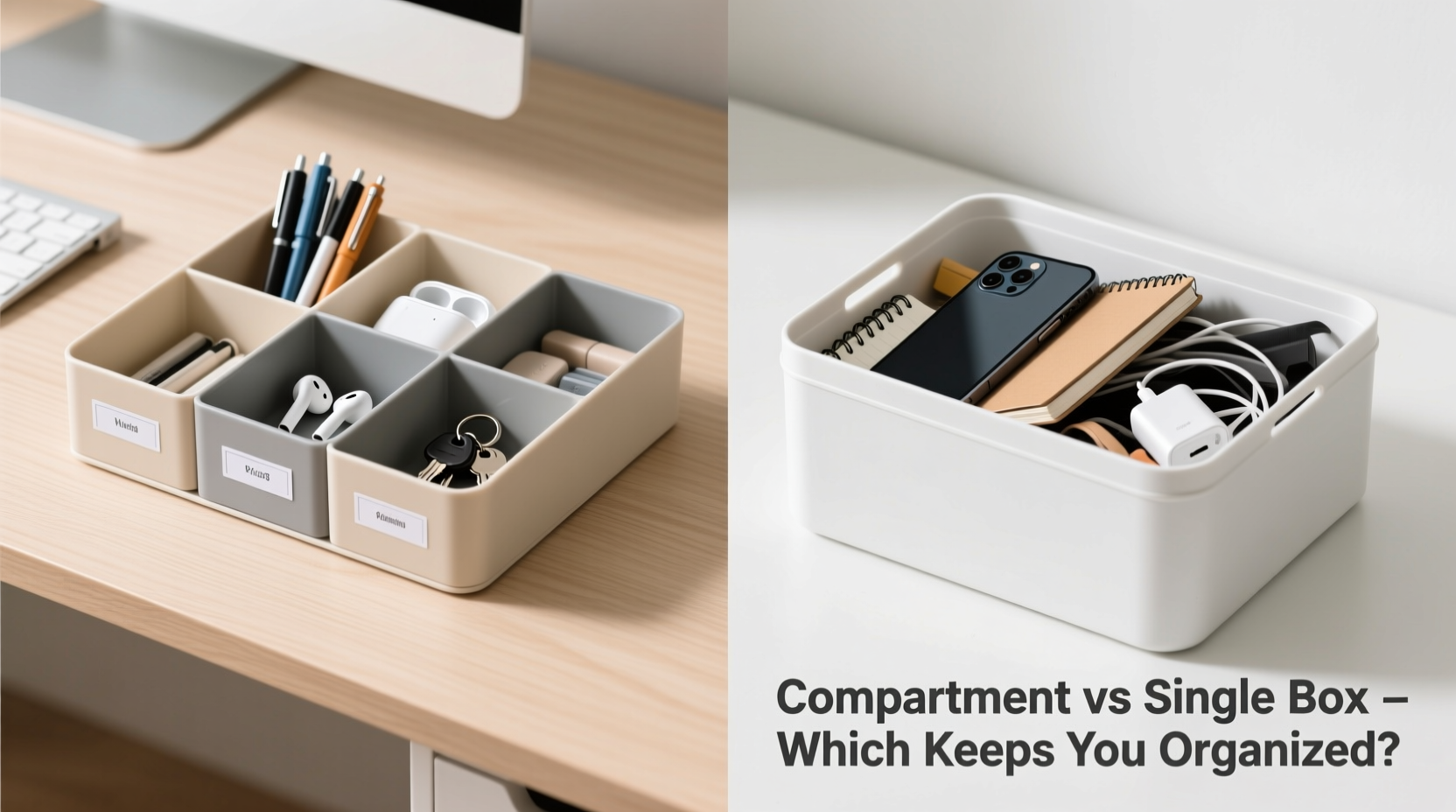
The fundamental distinction lies in internal structure. A **compartment storage box** divides its interior into multiple sections—often fixed or adjustable—designed to separate different types of items. In contrast, a **single storage box** offers one open cavity where everything coexists unless manually sorted.
This structural difference affects usability across several dimensions:
- Item segregation: Compartments prevent mixing; single boxes require additional sorting effort.
- Space utilization: Dividers may reduce total volume slightly but improve access.
- Mobility: Single boxes are often easier to stack and move due to simpler shapes.
- Customization: Modular compartment systems allow reconfiguration; single boxes rely on inserts or labels for order.
For example, storing screws, nails, and washers together in a single box leads to chaotic digging every time you need a specific size. A compartment box with labeled sections eliminates that hassle entirely.
When a Compartment Box Wins: Precision Organization
Compartment boxes excel when dealing with heterogeneous collections. They’re especially effective for:
- Workshop tools (drill bits, sockets, fasteners)
- Craft supplies (beads, threads, buttons)
- Medication organizers (daily doses separated by time)
- Kitchen spice racks with individual slots
- Makeup or grooming kits with distinct product types
These environments benefit from visual and physical separation. Each item has a designated “home,” reducing search time and preventing cross-contamination—like keeping sandpaper grits from mixing or pills from spilling together.
“People who use compartmentalized systems report up to 40% faster retrieval times for small components.” — Dr. Lena Torres, Human Factors Researcher at MIT AgeLab
Additionally, compartment boxes support habit formation. When every space is assigned, disorganization becomes immediately visible—making it easier to maintain discipline. Returning items to their correct slot becomes intuitive rather than optional.
Real Example: The Electronics Technician’s Toolkit
Consider Mark, an electronics repair technician working from home. He once used a single plastic bin for resistors, capacitors, IC chips, and connectors. Finding the right component could take minutes, especially under deadline pressure. After switching to a 36-slot compartment box with labeled dividers, his average part retrieval time dropped from 90 seconds to under 15. His workspace became cleaner, errors decreased, and client turnaround improved noticeably.
When a Single Storage Box Is More Practical
Single storage boxes aren’t outdated—they’re optimized for different scenarios. Their strength lies in simplicity, capacity, and flexibility.
They work best when:
- Items are large or irregularly shaped (e.g., cables, power adapters, toys)
- All contents belong to the same category (e.g., winter accessories, photo albums)
- Frequent access isn’t required (e.g., seasonal decorations)
- Portability is key (e.g., moving supplies between locations)
A single box allows unrestricted placement and accommodates bulkier items without constraint. It also reduces cost and complexity—fewer parts mean less chance of breakage or loss.
However, this freedom comes at an organizational cost. Without external labeling or internal structure, these boxes risk becoming \"black holes\" where things go in but don’t come out easily.
Comparison Table: Features at a Glance
| Feature | Compartment Box | Single Storage Box |
|---|---|---|
| Best For | Small, varied items needing separation | Large, uniform, or infrequently accessed items |
| Organization Level | High (built-in structure) | Low to moderate (requires user discipline) |
| Retrieval Speed | Fast (dedicated slots) | Slower (searching required) |
| Customization | Adjustable dividers in many models | Limited (unless using inserts) |
| Durability | May have fragile partitions | Generally more robust |
| Cost | Higher due to complexity | Lower, widely available |
| Ideal Environment | Desks, workshops, kitchens, bathrooms | Garages, attics, basements, moving |
Step-by-Step Guide to Choosing the Right Option
Selecting between compartment and single storage shouldn’t be arbitrary. Follow this process to ensure optimal results:
- Inventory Your Items: List everything you plan to store. Note sizes, quantities, and categories.
- Assess Frequency of Use: How often do you access these items? Daily use favors compartments.
- Evaluate Size and Shape: Are items uniform or mixed? Small and similar-sized items suit compartments.
- Define Access Needs: Do you need to see or grab specific pieces quickly? If yes, choose compartmentalization.
- Test Space Constraints: Measure available shelf or drawer space. Some compartment boxes have non-standard dimensions.
- Try a Hybrid Approach: Use compartment boxes inside larger single bins—for instance, a tool organizer within a rolling garage chest.
This methodical approach prevents overbuying and ensures functionality aligns with actual behavior.
Common Mistakes to Avoid
- Overloading compartments: Forces items to spill over and defeats the purpose of separation.
- Using unlabeled single boxes: Leads to uncertainty—\"Is this the holiday lights or the camping gear?\"
- Ignoring future growth: Choose expandable or modular systems if your collection will grow.
- Prioritizing aesthetics over function: Clear boxes look neat but expose clutter—opaque ones with labels often perform better long-term.
FAQ
Can I convert a single storage box into a compartmentalized one?
Yes. You can add DIY dividers using cardboard, foam board, or 3D-printed inserts. Commercial foam organizers also fit standard bins. Just ensure materials won’t degrade or shift over time.
Are compartment boxes worth the extra cost?
For high-use, detail-oriented tasks, yes. The time saved and reduced stress justify the investment. For occasional storage, a well-labeled single box may suffice.
What’s the best way to label either type of box?
Use waterproof labels or permanent markers. For frequent changes, consider erasable dry-erase tags or digital QR codes linked to inventory lists.
Final Recommendation: Match the Tool to the Task
There’s no universal winner between compartment and single storage boxes. The key is alignment with your workflow and environment. Compartment boxes offer superior control for complex, active collections. Single boxes provide simplicity and scalability for bulkier, consolidated storage.
In practice, most organized spaces benefit from both. Think of them as tools in a kit: use the right one for the job. A sewing room might use a compartment box for needles and thread spools, while storing fabric bolts in a single large bin. An office desk uses divided trays for pens and clips, while archiving old files in uniform single containers.




 浙公网安备
33010002000092号
浙公网安备
33010002000092号 浙B2-20120091-4
Comments
No comments yet. Why don't you start the discussion?