
In the high-stakes world of first-person shooters (FPS), every millisecond and pixel matters. The debate between using a controller versus mouse and keyboard has raged for over a decade, but at the heart of it lies a contentious question: Is aim assist—commonly used with controllers—really cheating? For casual players, this might seem like a minor detail. But in competitive circles, it’s a line drawn in digital sand that influences balance, fairness, and even game design.
This divide isn’t just about preference. It reflects fundamental differences in input mechanics, player accessibility, and how developers approach cross-platform gameplay. As more games go cross-play—allowing PS5, Xbox, and PC users to compete together—the tension between these two control schemes intensifies. Understanding the real impact of aim assist, the physics of precision, and the ethics of competitive advantage is essential for both players and designers alike.
The Mechanics of Control: How Inputs Shape Performance
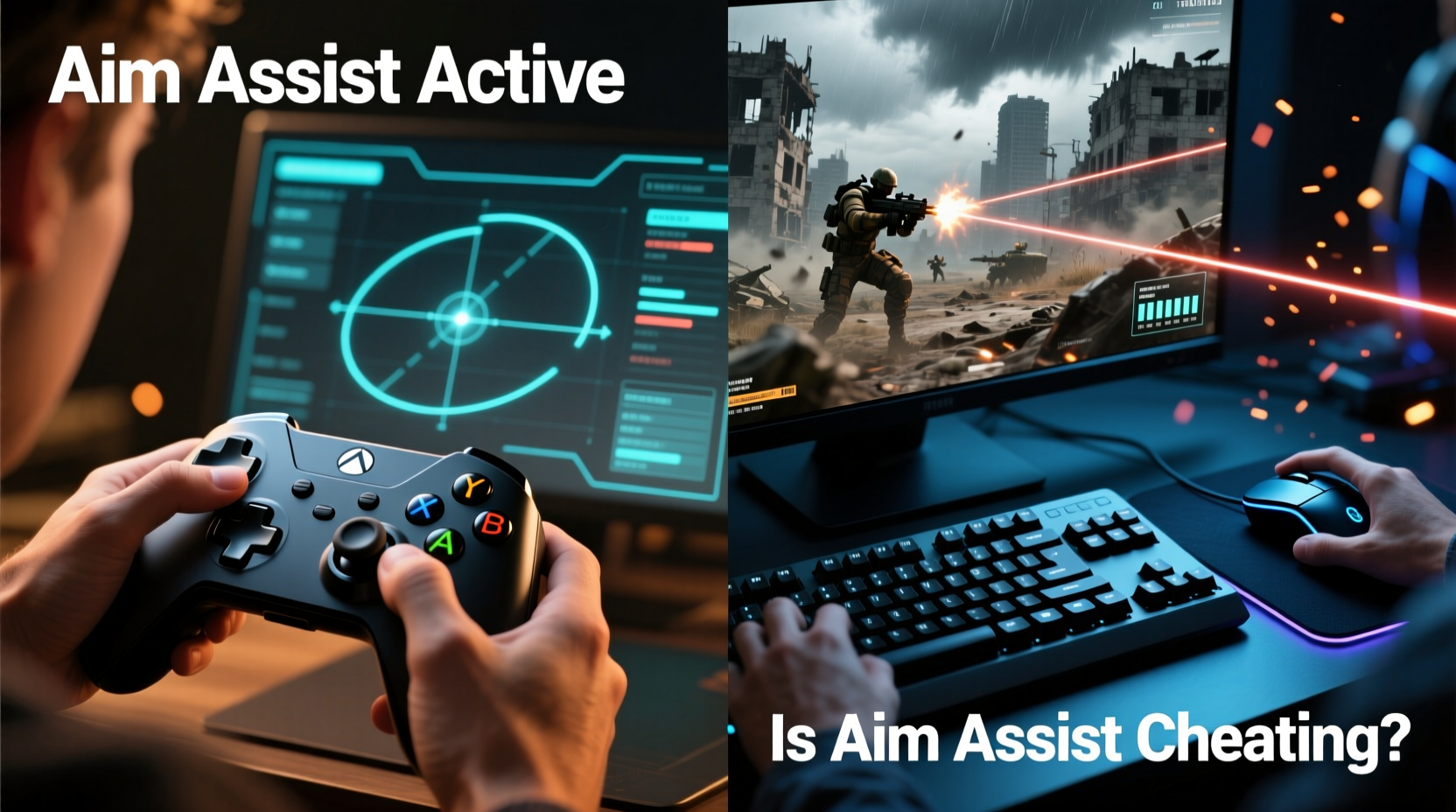
At its core, the controller vs. mouse and keyboard debate is rooted in hardware limitations and capabilities. A mouse offers near-infinite precision through direct 1:1 movement mapping. When you move your hand six inches across a desk, the cursor moves proportionally on-screen. This allows for micro-adjustments critical in tracking fast-moving targets at long range.
Controllers, by contrast, rely on analog sticks. These use electrical resistance to detect direction and intensity, but they are inherently limited in resolution. Even high-end sticks max out at around 8-bit input resolution, which means they can only register a finite number of positions. This results in “dead zones,” stick drift, and less granular control—especially when making small corrections during intense gunfights.
To compensate, developers implement aim assist—a system that subtly pulls the reticle toward an enemy when the player is close to acquiring a target. This doesn’t auto-lock; rather, it enhances accuracy within a calculated radius, reducing the mechanical disadvantage of analog sticks.
What Exactly Is Aim Assist? And How Does It Work?
Aim assist is not a single feature but a suite of dynamic adjustments made in real time. Its behavior varies significantly between games. In Call of Duty: Warzone, for example, aim assist strengthens as your reticle nears an enemy, applying magnetic pull based on distance, weapon type, and movement state. In Fortnite, it’s tuned differently for building-heavy combat, where flick shots are common.
Most systems work in layers:
- Target Snapping: The reticle slightly gravitates toward enemies within a set radius.
- Reduced Recoil: Some games reduce visual or mechanical recoil when aiming near a target.
- Acceleration Dampening: Fast flicks are smoothed to prevent overshooting.
- Dead Zone Compensation: Software adjusts for natural stick drift or imprecision.
Crucially, aim assist does not guarantee hits. Skilled players still need to lead targets, manage spray patterns, and position themselves effectively. However, it narrows the gap between controller and mouse precision—particularly in close-range engagements where rapid target acquisition is key.
“On console, aim assist isn’t a crutch—it’s a necessity to make the experience viable. Without it, most players would struggle to compete at all.” — Marcus Reed, Senior Designer at Respawn Entertainment
Controller vs Mouse and Keyboard: A Fair Comparison?
To assess whether aim assist is “cheating,” we must compare raw performance metrics. Studies and community testing have consistently shown that mouse and keyboard setups offer superior accuracy, especially at longer ranges and during sustained firefights.
Consider sensitivity: a professional CS2 player might use a DPI setting of 400–800 with in-game sensitivity under 1.0, allowing pixel-perfect control. On console, even with high-sensitivity controller settings, the same level of fine motor adjustment is physically unattainable due to analog stick limitations.
Yet, controllers excel in certain areas. Thumbstick muscle memory allows for quick 180-degree turns, and integrated thumb placement supports faster grenade throws or weapon swaps. Additionally, many players report better comfort during extended sessions, reducing fatigue-related errors.
The real imbalance arises in cross-platform multiplayer. When a PC player with no aim assist faces a console player with full assist—even if both are equally skilled—the PC player may perceive the match as unfair. This perception is amplified when console players dominate in close-range scenarios.
| Factor | Mouse & Keyboard | Controller (with Aim Assist) |
|---|---|---|
| Precision Tracking | High (1:1 movement) | Moderate (assisted correction) |
| Close-Range Reflexes | Good | Excellent (optimized flicks) |
| Long-Range Accuracy | Superior | Limited (assist weakens at distance) |
| Input Latency | Low (direct signal) | Slight delay (processing assist) |
| Learning Curve | Steeper (coordination required) | Gentler (natural stick motion) |
Is Aim Assist Cheating? The Ethical Debate
Cheating implies gaining an unfair advantage through rule-breaking. Aim assist, however, is a sanctioned mechanic—approved by developers and baked into the rules of the game. Calling it “cheating” misunderstands its purpose: it’s a balancing tool, not a hack.
Think of it like handicaps in golf or weight classes in boxing. The goal is equitable competition despite differing physical or technical conditions. Just as a beginner golfer gets stroke allowances, console players receive mechanical aid to offset hardware disadvantages.
That said, problems emerge when transparency is lacking. Some players don’t realize how strong their aim assist is until they switch platforms. Others exploit tuning settings—like stacking sensitivity boosts with high-assist profiles—to gain an edge even within console limits.
The deeper issue is perception. Competitive integrity relies on shared understanding. When one group feels the playing field is tilted, trust erodes. This is why titles like Rainbow Six Siege disable cross-play by default, while Apex Legends uses matchmaking adjustments to separate input types.
Real-World Example: The Cross-Play Backlash in Modern Warfare II
When Call of Duty: Modern Warfare II launched in 2022, its aggressive aim assist model sparked immediate controversy. PC players reported being consistently outmaneuvered in close quarters by console opponents, despite superior positioning and reaction times.
Data emerged showing that console players had up to a 15% higher headshot accuracy in sub-10-meter engagements—attributed directly to aim assist strength. While Infinity Ward argued the numbers were within acceptable balance thresholds, the backlash led to multiple patch updates that reduced assist magnitude and altered target prioritization.
This case illustrates the tightrope developers walk: too little assist, and console players feel crippled; too much, and PC players accuse the system of undermining skill. The solution wasn’t removing aim assist, but refining it based on telemetry and feedback.
How Developers Are Addressing the Divide
Forward-thinking studios are adopting smarter approaches to maintain fairness without sacrificing accessibility:
- Differential Matchmaking: Games like Destiny 2 and Overwatch 2 use input-based matchmaking to pair players with similar control schemes.
- Adjustable Assist Levels: Some titles allow players to tune aim assist strength, promoting self-regulation.
- Hybrid Devices: Products like the SCUF Reflex or Backbone One blur the line, offering controller ergonomics with paddle buttons and remappable inputs.
- Transparency Tools: Displaying input type in lobbies helps players understand who they’re facing.
Additionally, some developers are experimenting with “input normalization”—scaling mouse sensitivity relative to controller performance to create a more level baseline. While still in early stages, this could redefine how we think about fairness in mixed-environment lobbies.
Checklist: Evaluating Fairness in Your FPS Experience
- Know your game’s aim assist behavior—test it in private matches.
- Use input-based matchmaking if available.
- Compare sensitivity settings across platforms for context.
- Report exploitative assist tuning via official feedback channels.
- Respect players across platforms—skill transcends hardware.
Frequently Asked Questions
Does aim assist work the same on all consoles?
No. While PlayStation and Xbox controllers have nearly identical hardware, aim assist behavior is determined by the game developer, not the console manufacturer. Settings can vary widely between titles—even within the same franchise.
Can PC players get aim assist?
Traditionally, no—most PC FPS games disable aim assist entirely. However, some newer titles like Helldivers 2 introduced optional aim assist for mouse users, acknowledging that not all players have the same motor skills. This trend may grow as inclusivity becomes a design priority.
Is it possible to win fairly with a controller against a mouse user?
Absolutely. While mouse and keyboard holds a precision edge, victory in FPS games depends on map knowledge, communication, game sense, and positioning. Many top-ranked players on console outperform PC counterparts through superior tactics and consistency, proving that hardware doesn’t define skill.
Conclusion: Rethinking Fairness in Competitive Gaming
The question isn’t whether aim assist is cheating—it’s whether we’re measuring fairness correctly. True equity doesn’t mean identical tools for everyone. It means giving every player a realistic chance to succeed within their chosen environment.
Aim assist isn’t a loophole. It’s an adaptation—a necessary evolution to preserve competitiveness across diverse hardware. Rather than vilifying console players for using built-in features, the community should push for greater transparency, smarter matchmaking, and inclusive design.
For developers, the path forward lies in data-driven tuning and honest communication. For players, it means recognizing that mastery comes in many forms. Whether you flick with a stick or track with a mouse, skill is proven in execution, not equipment.




 浙公网安备
33010002000092号
浙公网安备
33010002000092号 浙B2-20120091-4
Comments
No comments yet. Why don't you start the discussion?