
Convenience sampling is one of the most commonly used methods in preliminary research, market surveys, and academic studies due to its simplicity and low cost. However, this ease comes at a price: the risk of significant bias. When researchers rely solely on readily available participants—such as students on campus, social media followers, or people in a specific geographic location—they often end up with data that does not accurately reflect the broader population. This phenomenon is known as convenience sampling bias. Left unchecked, it can distort findings, lead to flawed conclusions, and undermine the credibility of entire studies.
What Is Convenience Sampling Bias?
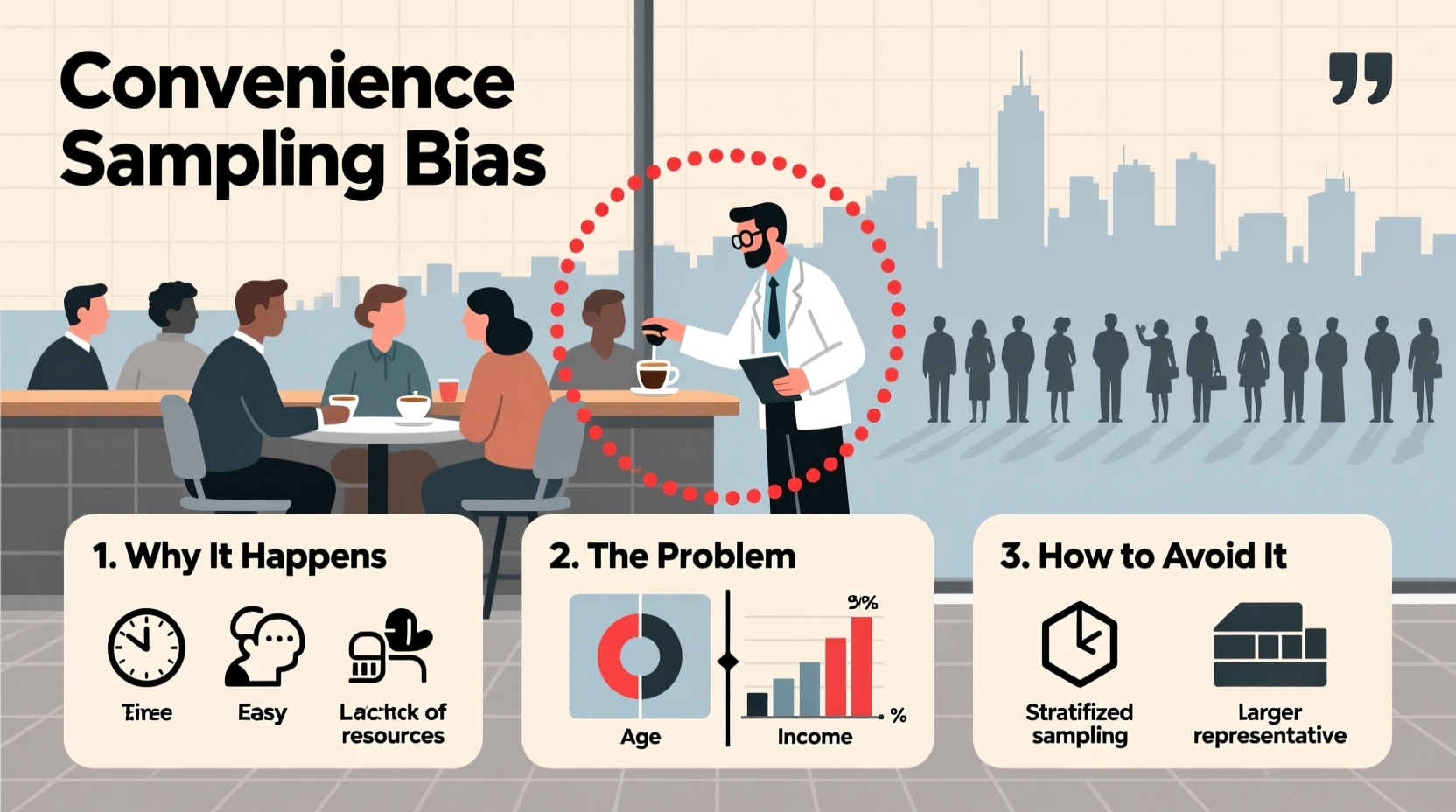
Convenience sampling involves selecting participants who are easiest to reach. Unlike probability sampling methods (like random or stratified sampling), convenience sampling does not ensure every member of the target population has an equal chance of being included. As a result, the sample becomes unrepresentative.
Convenience sampling bias occurs when the characteristics of the selected group systematically differ from those of the general population. For example, conducting a survey about smartphone usage exclusively among university students may overrepresent tech-savvy individuals while underrepresenting older adults or rural populations with limited access to technology.
“Sampling bias, especially from non-probability methods like convenience sampling, can invalidate otherwise well-designed studies.” — Dr. Lena Patel, Biostatistician at Johns Hopkins University
Why Does Convenience Sampling Bias Happen?
The root causes of convenience sampling bias are both logistical and cognitive. Researchers often face constraints such as time, budget, and accessibility, which push them toward easier recruitment methods. But beyond practical limitations, several underlying factors contribute to the emergence of bias:
- Limited access to diverse populations: Many researchers work within institutions (e.g., universities) where their immediate environment skews toward certain demographics.
- Overreliance on digital platforms: Online surveys distributed via social media tend to attract younger, more connected users, excluding offline or less digitally engaged groups.
- Assumption of homogeneity: Some researchers mistakenly assume that insights from one subgroup apply universally, ignoring cultural, socioeconomic, or regional differences.
- Urgency for quick results: In fast-paced environments like marketing or public health emergencies, teams may prioritize speed over representativeness.
Real-World Example: The 2016 U.S. Election Polls
While not exclusively based on convenience sampling, many pre-election polls leading up to the 2016 U.S. presidential election suffered from similar biases. Several major forecasting models predicted a decisive win for Hillary Clinton. However, they relied heavily on online and phone surveys that undersampled rural voters, working-class whites, and individuals without landlines—groups that ultimately played a pivotal role in swing states.
This case illustrates how even sophisticated statistical models can fail when the foundational data is skewed by selection bias. The samples were convenient—reachable via digital tools or listed phone numbers—but not representative of the full electorate.
How to Avoid Convenience Sampling Bias
Avoiding convenience sampling bias doesn’t require abandoning the method entirely. Instead, it calls for awareness, intentionality, and corrective strategies. Below are actionable steps to minimize bias while still benefiting from accessible data collection.
1. Acknowledge the Limitations Upfront
Transparency is critical. If you use convenience sampling, clearly state it in your methodology section. Explain potential sources of bias and how they might affect interpretation. This allows readers, reviewers, or decision-makers to weigh the findings appropriately.
2. Combine with Other Sampling Methods
Use convenience sampling as a starting point, then supplement it with targeted outreach. For instance, after collecting initial responses from college students, actively recruit participants from community centers, senior groups, or remote areas to balance representation.
3. Weight Your Data
Statistical weighting adjusts the influence of different subgroups to better match known population proportions. If your sample includes 70% women but the target population is 50% women, you can down-weight female responses during analysis.
4. Set Inclusion Criteria Early
Define demographic quotas before launching your study. For example, aim for specific percentages of age groups, income levels, or geographic regions. Monitor enrollment in real-time and adjust recruitment efforts accordingly.
5. Use Stratified Sampling Where Possible
If resources allow, divide the population into strata (e.g., by region, occupation, education level) and draw samples from each. This hybrid approach retains some efficiency while improving representativeness.
Checklist: Minimizing Convenience Sampling Bias
- Clearly define your target population before recruiting.
- Document all recruitment channels and participant sources.
- Compare your sample demographics to known population statistics.
- Apply statistical weights if significant imbalances exist.
- Supplement convenience data with purposive or random sampling.
- Report limitations openly in your final analysis.
- Test key findings across subgroups to check for consistency.
Comparison Table: Sampling Methods and Risk of Bias
| Sampling Method | Description | Bias Risk | Best Use Case |
|---|---|---|---|
| Convenience Sampling | Selects participants based on availability | High | Preliminary research, pilot testing |
| Random Sampling | Every individual has equal chance of selection | Low | Generalizable studies, policy evaluation |
| Stratified Sampling | Divides population into groups, samples each | Moderate to Low | Diverse populations, subgroup analysis |
| Quota Sampling | Non-random selection to meet predefined targets | Moderate | Market research, opinion polling |
| Systematic Sampling | Selects every nth individual from a list | Low to Moderate | Large databases, registries |
Frequently Asked Questions
Is convenience sampling ever acceptable?
Yes, particularly in exploratory research, pilot studies, or when resources are limited. The key is recognizing its limitations and avoiding overgeneralization. It’s useful for generating hypotheses, not confirming them.
Can I fix convenience sampling bias after data collection?
You cannot fully eliminate bias post-collection, but you can mitigate its impact through statistical techniques like weighting, sensitivity analysis, or comparing subgroups. Still, prevention during design is far more effective.
How do I know if my sample is biased?
Compare your sample demographics (age, gender, location, income) to reliable population benchmarks (e.g., census data). Large discrepancies suggest bias. Additionally, inconsistent results across subgroups may indicate representativeness issues.
Conclusion: Prioritize Awareness and Integrity
Convenience sampling will likely remain a fixture in research due to its practicality. But convenience should never come at the expense of validity. The goal isn’t perfection—it’s honesty. By understanding why convenience sampling bias occurs and taking deliberate steps to reduce its influence, researchers can produce insights that are not only faster to gather but also more trustworthy.




 浙公网安备
33010002000092号
浙公网安备
33010002000092号 浙B2-20120091-4
Comments
No comments yet. Why don't you start the discussion?