
When a recipe calls for half an onion but all you have is onion powder, knowing the right conversion can mean the difference between balanced flavor and an overpowering aftertaste. This common kitchen dilemma arises frequently—especially during meal prep, pantry cooking, or when avoiding fresh produce waste. Understanding how to accurately substitute fresh onions with their dehydrated counterpart ensures consistency in taste, texture, and aroma across dishes. The key lies not just in volume but in concentration: dried onion powder packs more intense flavor per gram than its raw form due to water removal. For home cooks aiming for precision without compromising authenticity, mastering this conversion is essential. Whether you're making soups, stews, rubs, or sauces, getting the ratio right enhances depth while preventing bitterness or dryness from overuse.
Definition & Overview
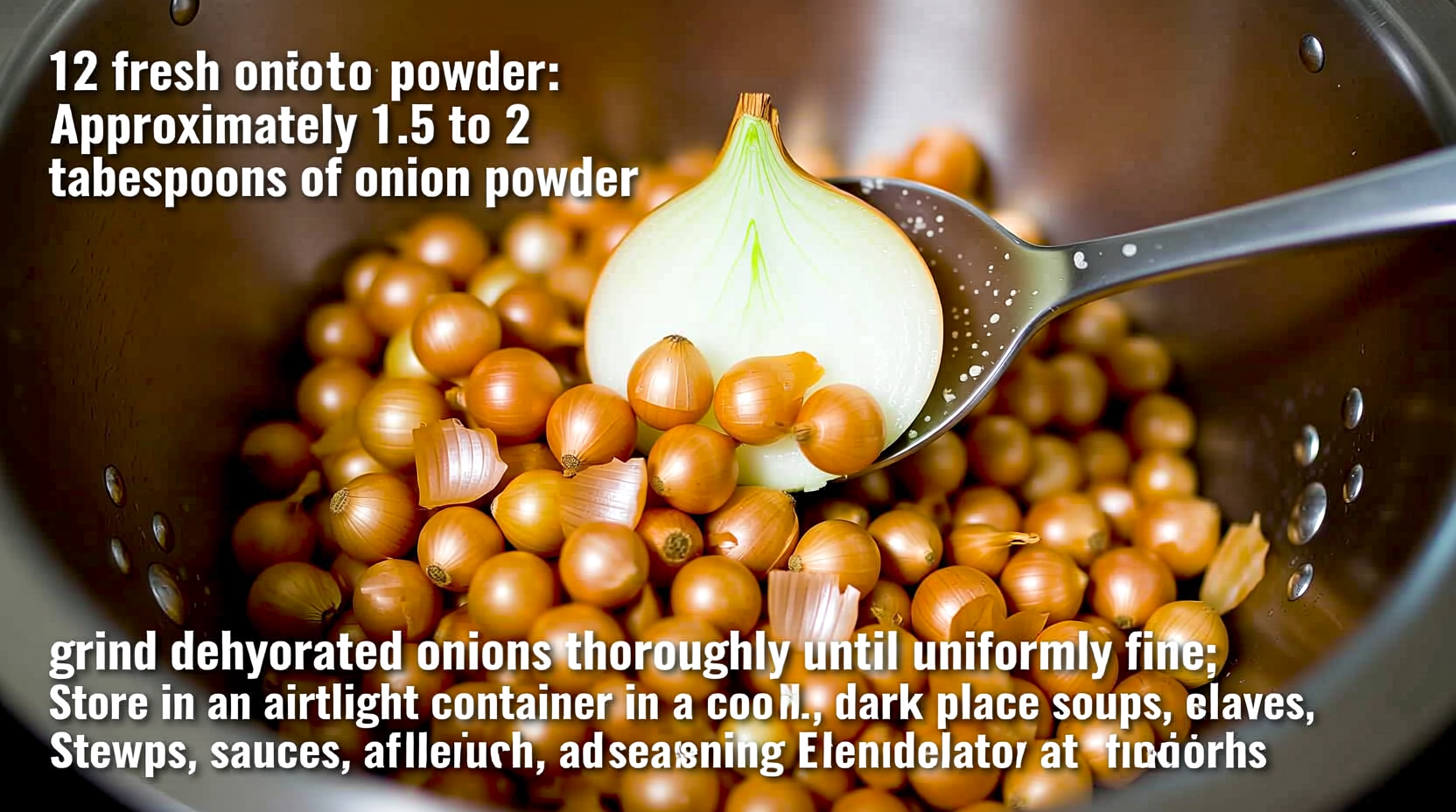
Onion powder is a finely ground seasoning made from dehydrated onions, typically white, yellow, or red varieties. It undergoes a process of slicing, drying (either air-dried, sun-dried, or mechanically dehydrated), and milling into a fine, free-flowing powder. Unlike granulated onion, which has a coarser texture, onion powder dissolves easily in liquids and integrates seamlessly into spice blends, marinades, and dry rubs. Its origins trace back to ancient preservation techniques used by civilizations in Central Asia and the Middle East, where drying vegetables extended shelf life long before refrigeration existed. Today, it's a staple in global cuisines—from American barbecue rubs to Indian curry powders and Mediterranean spice mixes.
The transformation from fresh onion to powder concentrates its natural sugars and sulfur compounds, intensifying the savory-sweet umami character while eliminating moisture that contributes bulk and sharp bite. As a result, onion powder delivers a more robust, earthy flavor profile compared to raw onion, with less pungency and no crunch. It functions primarily as a background enhancer rather than a textural component, ideal for applications where uniform dispersion and subtle depth are desired. Because of its concentrated nature, using too much can lead to off-flavors or chemical-like notes, especially in delicate dishes.
Key Characteristics
| Characteristic | Description |
|---|---|
| Flavor Profile | Savory, sweet, mildly pungent; deeper and more concentrated than fresh onion |
| Aroma | Dry, warm, slightly sulfurous when opened; releases fragrance upon contact with moisture |
| Color/Form | Fine tan-to-light-brown powder; may clump if exposed to humidity |
| Heat Level | Non-spicy; does not contribute heat, only aromatic depth |
| Culinary Function | Flavor base, seasoning agent, thickening aid in dry mixes, binder in coatings |
| Shelf Life | 2–3 years when stored properly in a cool, dark, dry place |
Practical Usage: How to Substitute 1/2 Fresh Onion with Powder
The standard culinary conversion accepted by professional chefs and food scientists is:
1 tablespoon of fresh minced onion ≈ 1 teaspoon of onion powder
Given that half a medium-sized onion yields approximately ½ cup (8 tablespoons) of chopped pieces, the equivalent amount in powder becomes:
- ½ cup chopped onion = 8 teaspoons
- 8 teaspoons ÷ 3 ≈ 2¾ teaspoons of onion powder
For practical purposes, round this to **2½ to 3 teaspoons** depending on desired intensity. In most home-cooking scenarios, using exactly **1 tablespoon (3 teaspoons)** of onion powder per whole onion’s worth provides optimal balance.
Step-by-Step Substitution Guide
- Determine the quantity of fresh onion called for: Identify whether the recipe uses ¼, ½, or 1 full onion.
- Estimate volume in tablespoons: A medium onion equals about 1 cup chopped (16 Tbsp). Half an onion = 8 Tbsp.
- Apply the 3:1 ratio: Divide the number of tablespoons by 3. Example: 8 ÷ 3 = ~2.67 tsp.
- Rounded measurement: Use 2½ to 3 teaspoons of onion powder for ½ onion.
- Add early in cooking: Incorporate powder at the sauté stage with oil or liquid to rehydrate and bloom flavors.
- Taste and adjust: Wait 5–7 minutes after adding, then reassess. Add another ¼ tsp if needed—but avoid exceeding 1 extra teaspoon unless building bold profiles like chili or stew.
Pro Tip: When replacing fresh onion entirely with powder in slow-cooked dishes (e.g., braises, soups), consider adding ½ teaspoon of sugar or tomato paste to mimic the caramelization effect lost without actual browning. Also, include a splash of water or broth when blooming the powder to prevent scorching.
Real-World Application Examples
Beef Stew Recipe Calling for ½ Chopped Onion
Instead of sautéing fresh onion, heat 1 tbsp oil in a Dutch oven, add 2¾ tsp onion powder, stir for 30 seconds, then deglaze with wine or broth. Proceed with other ingredients. Result: deep, even onion essence without textural interference.
Dry Rub for Grilled Chicken (½ Onion Called for in Paste Form)
Replace with 2½ tsp onion powder mixed into the rub. Combine with garlic powder, paprika, salt, and black pepper. Apply generously and rest 30 minutes before grilling. Outcome: consistent adhesion and flavor penetration without moisture dilution.
Homemade Soup Base Using No Fresh Alliums
In a powdered soup mix, replace each ½ onion with 2½ tsp onion powder. Blend with cornstarch, herbs, salt, and chicken bouillon. Dissolve in boiling water. Achieves restaurant-style clarity and body without lumps or raw bite.
Variants & Types of Dried Onion Products
Not all dried onion products are interchangeable. Choosing the correct form affects both performance and outcome. Below are the primary types available:
- Onion Powder – Finely milled, dissolves quickly, best for sauces, dressings, dry rubs, and spice blends.
- Onion Granules – Coarser texture, slower dissolution, adds slight texture in meatloaf, casseroles, or rehydrated dishes.
- Dehydrated Minced Onion – Small flakes, requires soaking or prolonged simmering; closest to fresh in appearance but still concentrated.
- Crispy Fried Onions (Store-Bought) – Not a direct substitute; used as garnish only, often high in fat and sodium.
- Freeze-Dried Onion – Preserves more volatile aromatics; pricier, used in specialty applications or astronaut meals.
| Type | Texture | Dissolution Speed | Best Use Case |
|---|---|---|---|
| Onion Powder | Fine dust | Instant (with liquid) | Spice blends, soups, gravies |
| Onion Granules | Small beads (~1–2mm) | Moderate (needs heat/moisture) | Meat dishes, stuffing, chili |
| Minced Dehydrated | Flaky bits | Slow (requires rehydration) | Casseroles, dips, baked goods |
| Freeze-Dried | Porous, brittle | Fast, retains shape | Gourmet preparations, instant meals |
For converting ½ fresh onion, **onion powder remains the top choice** due to its solubility and uniform integration. Granules or minced versions require adjustment—typically use 1½ times the volume of powder when substituting upward (e.g., 1 Tbsp granules = 2 tsp powder).
Comparison with Similar Ingredients
Several onion-derived products are mistaken for one another, leading to incorrect substitutions and imbalanced dishes. Here’s how they differ:
| Ingredient | Flavor Strength vs. Fresh Onion | Equivalent to ½ Onion | Notes |
|---|---|---|---|
| Onion Powder | Stronger (concentrated) | 2½–3 tsp | Use sparingly; dissolves completely |
| Garlic Powder | Stronger, different compound profile | Not interchangeable | Distinct flavor; never a 1:1 swap |
| Onion Salt | Same onion strength + salt | 2½ tsp MAX, reduce added salt | Contains ~⅔ tsp salt per tsp—adjust seasoning accordingly |
| Shallots (Fresh) | Milder, sweeter | Use same volume as onion | Can replace fresh onion directly, not powder |
| Leeks (White Part) | Much milder, grassy | Use 1:1 volume | Requires thorough cleaning; not suitable for powder conversion |
\"Many home cooks assume all allium powders are equal, but onion and garlic behave differently chemically. Onion powder brings sweetness and body; garlic brings sharpness and volatility. Confusing them alters the dish’s entire architecture.\" — Chef Elena Torres, Culinary Instructor, Institute of Artisan Foods
Practical Tips & FAQs
Q: Can I use onion powder in place of raw onion in salads?
No. Raw onion contributes crisp texture and cooling juiciness absent in powder. Instead, sprinkle a tiny pinch (⅛ tsp) of powder into creamy dressings for background flavor, but always use fresh for chunked components.
Q: Does onion powder go bad?
It doesn’t spoil like fresh produce but loses potency over time. Discard after 3 years or if it smells flat, musty, or lacks aroma. Store in an airtight container away from light and heat to preserve quality.
Q: Is onion powder gluten-free?
Pure onion powder is naturally gluten-free. However, check labels for additives or anti-caking agents derived from wheat, especially in bulk or store-brand versions.
Q: Why does my dish taste bitter when I use onion powder?
Bitterness usually results from overheating. Onion powder scorches easily when added directly to hot oil without liquid. Always bloom it with a small amount of water, broth, or fat-based liquid to prevent burning.
Q: Can I make my own onion powder at home?
Yes. Slice a yellow onion thinly, dehydrate at 135°F (57°C) for 6–8 hours until brittle, then grind in a spice mill or blender. Sift to remove large particles. Store in a glass jar. Homemade versions lack preservatives but offer superior freshness and control over quality.
Q: Are red and white onion powders different?
Minimal difference in flavor once dried. Yellow onions are most commonly used due to higher solids content and balanced sweetness. Red onion powder may impart a slight color tint but is functionally equivalent.
Q: What dishes benefit most from onion powder substitution?
Slow-cooked dishes (stews, chilis), dry spice blends (taco seasoning, jerk rub), baked savory items (cheese bread, crackers), and commercial-style sauces (barbecue, ranch dressing) respond exceptionally well to powdered form.
Storage Checklist:
✔ Keep in opaque, airtight container
✔ Store in cool, dark cupboard (not above stove)
✔ Label with purchase date
✔ Keep away from spices with strong odors (cumin, curry)
✔ Do not refrigerate—condensation causes clumping
Summary & Key Takeaways
Substituting ½ fresh onion with onion powder requires understanding both volume and concentration. The precise conversion is **2½ to 3 teaspoons of onion powder**, based on the standard 3:1 ratio of fresh minced onion to powder. This substitution works best in cooked applications where texture isn't critical and flavor integration is paramount. Onion powder offers convenience, longevity, and uniformity, but demands careful handling to avoid bitterness or over-seasoning.
Remember these core principles:
- Always apply the 3:1 rule: 1 Tbsp fresh minced onion = 1 tsp powder.
- Bloom powder in liquid or fat early in cooking to unlock full flavor.
- Adjust salt downward when using onion salt as a substitute.
- Prefer pure onion powder over granules or flavored salts for accurate measurement.
- Store properly to maintain potency for up to three years.
Mastering this simple yet powerful substitution empowers cooks to adapt recipes confidently, minimize waste, and maintain consistent results—even when fresh ingredients aren’t available. Whether you're scaling a family recipe, batch-prepping meals, or improvising with pantry staples, knowing how much onion powder equals half an onion transforms uncertainty into precision.
Challenge Yourself: Next time you cook a soup or sauce calling for onion, try omitting the fresh version entirely and rely solely on correctly measured onion powder. Note the differences in preparation ease, mouthfeel, and overall flavor cohesion. You might find the powdered alternative delivers cleaner, more integrated results—especially in blended or strained dishes.




 浙公网安备
33010002000092号
浙公网安备
33010002000092号 浙B2-20120091-4
Comments
No comments yet. Why don't you start the discussion?