
When it comes to tackling demanding DIY tasks—drilling through hardwood, driving long lag screws into timber, or installing heavy shelving—choosing between a cordless and a corded drill can make or break your project. Both tools have evolved significantly over the past decade, but they serve different needs. While cordless drills offer unmatched mobility and convenience, corded models still hold an edge in raw power and continuous performance. Understanding their strengths, limitations, and ideal use cases is essential for making the right choice.
Power Output and Performance Under Load
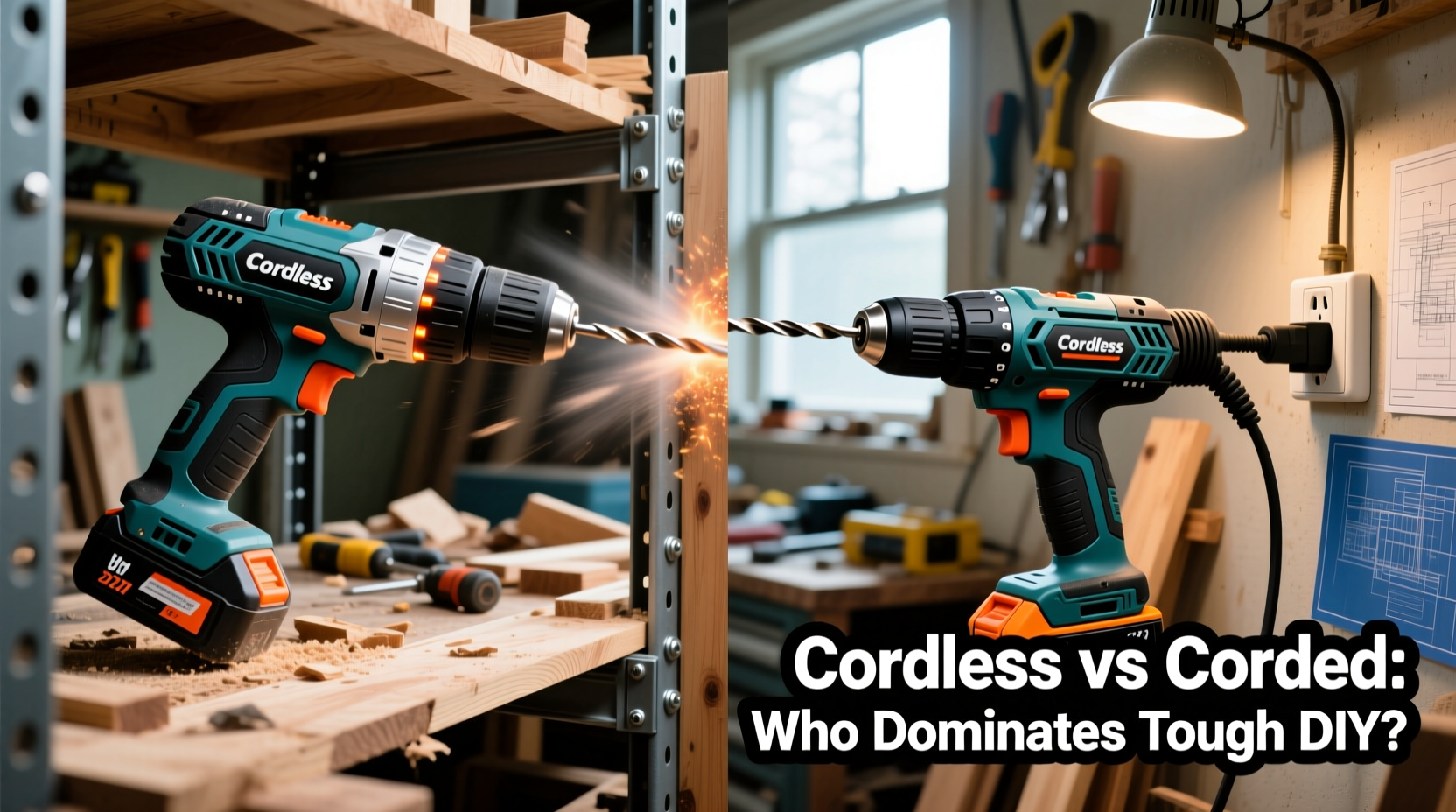
The most critical factor when comparing cordless and corded drills for tough jobs is consistent power delivery. Corded drills run directly off AC power, meaning they don’t suffer from voltage drop or battery depletion during extended use. This makes them inherently more capable of sustaining high torque and RPM under constant load.
A typical 7-amp corded drill delivers around 500–600 in-lbs of torque and maintains that output indefinitely as long as it’s plugged in. In contrast, even high-end cordless drills powered by 20V MAX lithium-ion batteries usually max out at 400–550 in-lbs—and only until the battery charge begins to wane. Once the voltage drops below optimal levels, so does performance.
“On job sites where drilling never stops—like framing or deck building—a corded drill remains the workhorse. It doesn’t quit, doesn’t slow down, and doesn’t need recharging.” — Mark Rios, Professional Carpenter & Tool Instructor
This consistency matters when you're working on large-scale installations. For example, driving dozens of 3-inch structural screws into pressure-treated lumber will drain a cordless battery quickly and cause the motor to heat up, potentially triggering thermal shutdowns. A corded model handles this workload without breaking a sweat.
Mobility and Workspace Flexibility
Cordless drills win decisively in terms of freedom of movement. Without being tethered to an outlet, users can work anywhere—on ladders, inside unfinished walls, or across large yards. Modern brushless motors and improved battery chemistry (such as lithium-ion) have made cordless drills lighter, more efficient, and powerful enough for many mid-tier DIY applications.
For homeowners installing cabinets, assembling furniture, or hanging drywall, a cordless drill offers all the torque needed with none of the hassle of extension cords. Battery life has also improved; dual-battery systems and rapid chargers mean downtime is minimized.
However, mobility comes at a cost. Extension cords may be cumbersome, but they provide infinite runtime. No matter how advanced battery technology becomes, there’s still a limit to how long a cordless drill can operate before needing a recharge—typically 20 to 45 minutes of active use per battery, depending on workload.
Real-World Scenario: Building a Garden Shed
Imagine constructing a wooden garden shed from scratch. You’ll need to drill pilot holes, drive hundreds of screws, and possibly bore large holes for electrical conduit. With a cordless drill, you start strong. But halfway through, your first battery dies. You swap in a second, then wait 30 minutes while the others charge. Meanwhile, sawdust piles up, and your momentum stalls.
Now imagine using a corded drill. Plug it into a weatherproof extension cord, and it runs continuously. No interruptions. No anxiety about low battery warnings. The trade-off? Managing the cord around scaffolding and avoiding trip hazards. But for pure productivity, especially in stationary tasks, corded wins.
Durability and Long-Term Reliability
While both types are built to last, corded drills often have simpler internal designs. Fewer electronic components—no battery management system, no charging circuits—means fewer points of failure. Their motors are designed for prolonged operation and typically include better heat dissipation.
Cordless drills, on the other hand, depend heavily on battery health. Lithium-ion batteries degrade over time, losing capacity after 300–500 charge cycles. After a few years, a once-powerful cordless tool may struggle to complete jobs it handled easily before. Replacing batteries can be costly—sometimes approaching half the price of a new tool.
| Feature | Corded Drill | Cordless Drill |
|---|---|---|
| Continuous Runtime | Unlimited (while plugged in) | Limited by battery (20–45 min avg) |
| Peak Torque | Higher and consistent | High initially, drops with battery |
| Mobility | Restricted by cord length | Full freedom of movement |
| Battery/Energy Cost | None (uses household power) | Batteries degrade; replacements costly |
| Lifespan (Motor) | Longer (fewer electronics) | Shorter due to battery dependency |
| Ideal Use Case | Framing, decking, shop work | Home repairs, light construction, tight spaces |
Choosing the Right Tool: A Step-by-Step Decision Guide
Selecting between cordless and corded isn’t about which is “better” overall—it’s about matching the tool to your specific project demands. Follow this decision framework:
- Assess the scope of work: Are you doing a one-time shelf installation or building a full backyard pergola? Larger projects favor corded tools.
- Evaluate power requirements: Will you be drilling into masonry, thick steel, or dense hardwood? High-resistance materials demand sustained torque.
- Consider workspace access: Is there an outlet nearby? Can you safely run an extension cord? Outdoor or remote areas lean toward cordless.
- Estimate runtime needs: How many screws or holes must be completed in one session? Over 50 fasteners? Corded avoids mid-job delays.
- Weigh portability needs: Will you be moving frequently between floors or ladders? Cordless reduces setup time and physical strain.
- Budget for ownership cost: Factor in not just the tool, but spare batteries, chargers, and eventual replacements.
For most serious DIYers, the answer isn’t either/or—it’s both. A well-equipped workshop includes a high-torque corded drill for heavy-duty tasks and a compact cordless for everyday maintenance and quick fixes.
Expert Verdict: When Each Tool Excels
Industry professionals rarely rely solely on cordless tools for production-level carpentry. On commercial job sites, corded drills remain standard for tasks like subflooring, wall sheathing, and beam connections. The reason is simple: predictability.
As one contractor put it: “I trust my cordless for trim and cabinetry, but when I’m putting up a roof truss system, I grab the corded. It’s not sexy, but it gets the job done without a single pause.”
That said, technological advances have narrowed the gap. Brushless motors in cordless drills reduce energy waste and increase efficiency, allowing them to deliver near-corded levels of performance—for short bursts. However, sustained high-load applications still expose their limitations.
In controlled environments like workshops or garages, where outlets are accessible and dust/moisture risks are managed, corded drills deliver superior value. They’re cheaper upfront, cheaper to maintain, and more reliable over thousands of hours of use.
Cordless drills shine in versatility. From changing a light fixture in the ceiling to assembling children’s playground equipment in the yard, their convenience outweighs their power deficit in most non-industrial settings.
Checklist: Do You Need a Corded Drill?
- ✅ Drilling multiple deep holes in wood, metal, or masonry
- ✅ Driving long or thick fasteners regularly
- ✅ Working in a fixed location with easy power access
- ✅ Prioritizing long-term durability over portability
- ✅ Doing frequent remodeling or structural work
Frequently Asked Questions
Can a cordless drill handle concrete or brick?
Yes—but only if it’s a hammer drill model with sufficient impact energy. Even then, corded rotary hammers are far more effective for masonry work. Cordless versions struggle with large-diameter holes and prolonged use due to overheating and battery drain.
Are cordless drills becoming obsolete?
No. In fact, they dominate the consumer market. But for heavy-duty applications, corded drills remain relevant and often preferred. The two categories coexist because they solve different problems.
Is it safe to use a corded drill outdoors?
Yes, provided you use a GFCI-protected outlet and a weather-rated extension cord. Never operate a corded drill in wet conditions or on damp ground without proper safety precautions. Ground fault protection is essential to prevent electrocution.
Final Recommendation: Build a Balanced Toolkit
For tough DIY projects, neither cordless nor corded drills universally dominate. Each has a role. The corded drill reigns supreme in raw power, endurance, and cost-efficiency for high-volume tasks. It’s the go-to for anyone doing structural builds, outdoor decking, or shop-based fabrication.
The cordless drill, meanwhile, excels in accessibility, ease of use, and adaptability. It’s perfect for homeowners, weekend warriors, and those tackling varied small-to-medium jobs around the house.
The smartest approach? Own both. Start with a quality cordless for general use—something like a 20V MAX brushless model with dual batteries. Then, invest in a 7–10 amp corded drill with a keyed chuck and variable speed trigger for when the job demands relentless performance.
“The best tool collection isn’t about having the flashiest gear—it’s about having the right tool ready when the job calls for it.” — Dana Pruitt, Master Electrician & Home Renovation Blogger
Conclusion: Power Meets Practicality
When push comes to shove on tough DIY projects, the corded drill still holds the crown for sheer power and reliability. But dismissing cordless models would ignore their revolutionary impact on convenience and usability. The modern DIYer doesn’t need to choose sides—they need to understand context.
If you’re building something substantial, permanent, and physically demanding, plug in. If you’re fixing, assembling, or accessing tight spots, go cordless. Recognizing these distinctions transforms your workflow from reactive to strategic.




 浙公网安备
33010002000092号
浙公网安备
33010002000092号 浙B2-20120091-4
Comments
No comments yet. Why don't you start the discussion?