
In the world of everyday carry (EDC), every gram counts. Whether you're a minimalist urban commuter or an outdoor enthusiast, the items you attach to your keyring should earn their place. Two popular contenders have emerged in recent years: the crab keychain — a quirky, durable novelty item made from a single piece of metal shaped like a crab — and the multi tool keychain, a compact device packed with functions like pliers, blades, screwdrivers, and bottle openers. At first glance, one looks fun; the other, functional. But which one is actually more useful in real life?
This isn't just about preference or aesthetics. It's about practical value, reliability, and adaptability across daily scenarios. Let’s dissect both options beyond the hype and determine which EDC gadget delivers consistent utility.
The Rise of the Crab Keychain
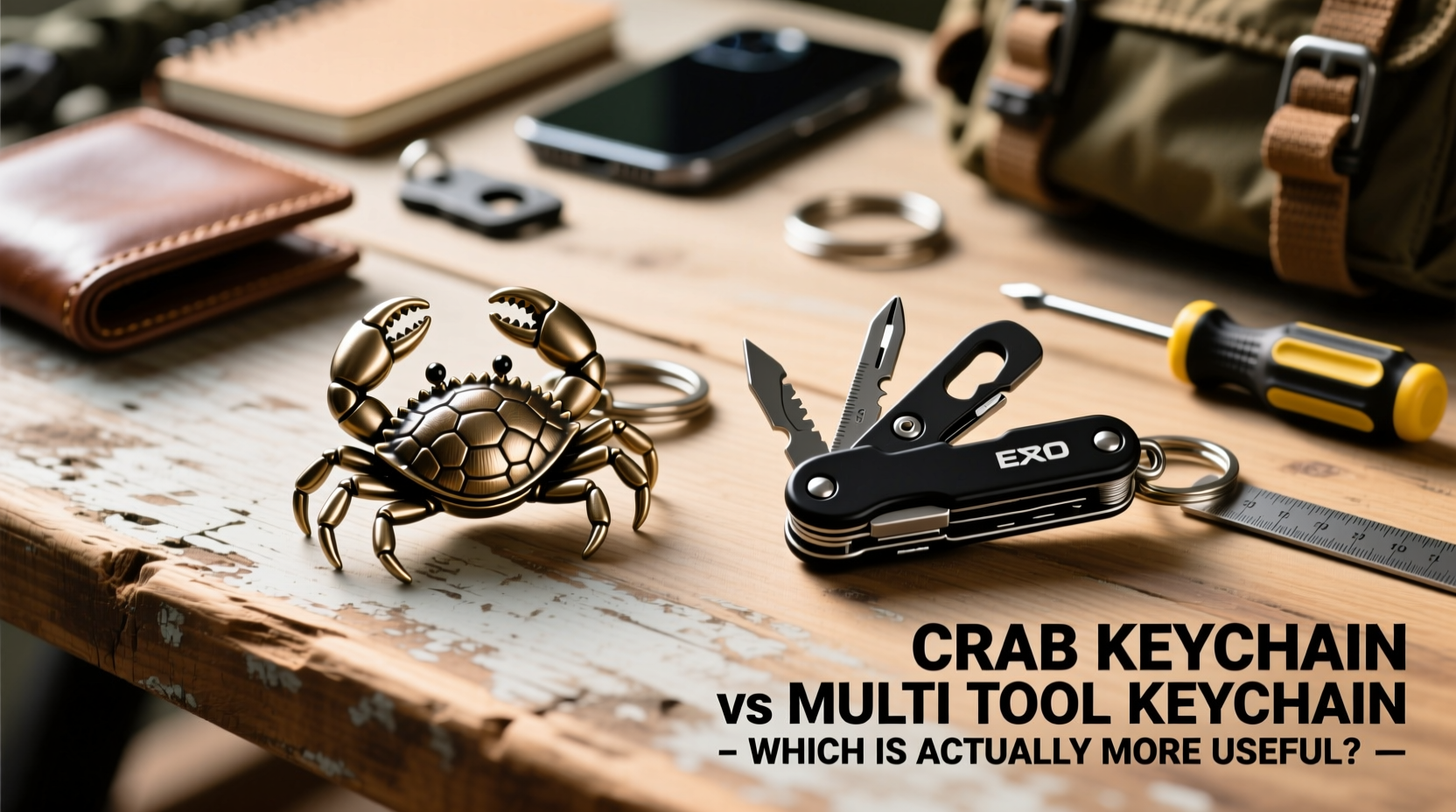
The crab keychain, originally developed by brands like Wazoo and Sherrill Tool, started as a joke — a tiny, indestructible metal crab that could withstand drops, corrosion, and even being run over by a car. Made from a single piece of forged stainless steel, it has no moving parts, requires zero maintenance, and weighs barely 0.7 ounces. Its claws are sharp enough to scratch surfaces, pry small objects, or even serve as a makeshift glass breaker in emergencies.
Despite its whimsical appearance, the crab has earned a cult following among EDC enthusiasts for its rugged simplicity. It doesn’t break. It doesn’t wear out. And because it’s so small, it adds almost no bulk.
Multi Tool Keychains: Functionality Packed into Tiny Frames
On the flip side, multi tool keychains like the Leatherman Style PS, Gerber Dime, or SwissTech UC-1M pack multiple tools into a single compact unit. These typically include combinations of flathead and Phillips screwdrivers, bottle openers, can openers, files, knives, and sometimes even pliers. They’re designed for people who want real functionality without carrying a full-sized multitool.
The appeal is clear: instead of juggling six separate tools, you carry one. For someone who regularly tightens eyeglass screws, opens bottles at picnics, or adjusts electronics, this makes perfect sense. However, size constraints mean compromises — smaller tools are less ergonomic, harder to grip, and often lack the torque needed for tougher jobs.
“Compact multitools are great for light-duty tasks, but don’t expect them to replace a full-sized toolset.” — David Lin, EDC Gear Designer and Former Firefighter
Head-to-Head Comparison: Utility, Durability, and Practicality
| Feature | Crab Keychain | Multi Tool Keychain |
|---|---|---|
| Weight | 0.5–0.8 oz | 1.5–3.5 oz |
| Moving Parts | None | Multiple (hinges, pivots) |
| Durability | Extremely high (no failure points) | Moderate (hinges can loosen or break) |
| Functions | Limited (scratching, prying, emergency use) | 5–10+ tools depending on model |
| Maintenance | None required | Occasional cleaning/lubrication recommended |
| Cost | $10–$25 | $25–$60 |
| Pocket Comfort | Excellent (small, smooth) | Fair to poor (bulky, sharp edges) |
The table reveals a fundamental trade-off: the crab wins in durability and minimalism, while the multitool leads in versatility. But usefulness isn’t just about features — it’s about how often those features solve real problems.
Real-World Scenarios: Who Comes Out Ahead?
Consider three common situations:
- You’re at a picnic and need to open five bottles. The multitool’s bottle opener shines here. The crab can’t help.
- Your glasses screw comes loose during a meeting. A multitool with a precision screwdriver bit fixes it instantly. The crab might scratch the frame trying to tighten it manually.
- You drop your keys down a storm drain. The crab’s claw can be used to hook onto shoelaces or dental floss to fish them out. A multitool might work too, but its bulkier shape makes it harder to maneuver.
Now consider long-term reliability. After two years of daily use, a crab keychain will look nearly identical to when it was new. A multitool, however, may suffer from worn pivot joints, rusted blades, or broken bits — especially if exposed to moisture or dropped frequently.
Mini Case Study: Urban Commuter vs. Weekend Camper
Meet Alex and Jordan. Alex commutes daily via subway, works in an office, and rarely performs manual tasks. Their EDC includes a phone, wallet, and keys. One day, their earbud case breaks open mid-commute. Using the multitool’s flathead screwdriver, they tighten the hinge screw at a coffee shop. Without it, they’d have had to wait days.
Jordan hikes weekly, carries a full backpack, and values redundancy. They own a multitool but switched their keychain to the crab after their last multitool’s pliers snapped during a trail repair. “I lost faith,” Jordan says. “Now I keep a full-sized multitool in my pack and the crab on my keys. It’s survived falls, river crossings, and fire — and still works as a scraper, grip aid, and even a tension tool for cordage.”
In this contrast, neither gadget is universally better. Context determines value.
When the Crab Wins — And When It Doesn’t
The crab excels in environments where simplicity and survival matter more than convenience. It’s ideal for:
- Emergency preparedness kits
- Outdoor adventures where gear failure is dangerous
- Minimalist EDC setups
- Situations requiring a discreet, non-threatening tool
However, it fails when actual mechanical function is needed. You can’t tighten a bike bolt, cut a zip tie, or open a paint can with a crab. It’s a symbol of rugged minimalism — not a replacement for tools.
Choosing the Right Tool: A Practical Checklist
Before deciding, ask yourself the following:
- Do I regularly perform small repairs (e.g., eyewear, electronics)? → Lean toward multitool.
- Do I prioritize durability and hate maintaining gear? → Crab is stronger.
- Is weight or pocket comfort important to me? → Crab wins by a wide margin.
- Do I already carry a full-sized multitool or knife? → The crab avoids redundancy.
- Am I using this primarily as a conversation starter or backup tool? → The crab has charm; the multitool has purpose.
Frequently Asked Questions
Can a crab keychain really be used as a tool?
Yes, but within limits. It can scrape, pry, score, and apply pressure in tight spaces. Some users have reported using it to start fires (with flint), adjust loose screws (by wedging), or even defend themselves in extreme cases. It’s not a precision instrument, but its strength lies in improvisation.
Are multi tool keychains worth the extra weight?
For many, yes — especially if you frequently encounter minor mechanical issues. However, if you already carry a pocket knife or full multitool, adding another redundant tool may not justify the added bulk and noise in your pocket.
Which lasts longer: crab or multitool?
The crab will almost always outlast a multitool due to its solid construction. Multitools have pivot points, springs, and thin blades prone to wear. With regular use, even high-end models show degradation within 2–3 years.
Final Verdict: Usefulness Depends on Your Lifestyle
If your day involves frequent small fixes — tightening screws, opening packages, adjusting equipment — a multi tool keychain offers tangible, repeatable value. It solves known problems efficiently.
But if you value resilience, minimalism, and the ability to improvise under pressure, the crab keychain is surprisingly capable. It won’t do everything, but it will never fail when you need it most.
Ultimately, the most useful EDC isn’t the one with the most features — it’s the one that works when nothing else does. For some, that’s a precision screwdriver. For others, it’s a tiny, unbreakable crab forged from steel.




 浙公网安备
33010002000092号
浙公网安备
33010002000092号 浙B2-20120091-4
Comments
No comments yet. Why don't you start the discussion?